Most interviews fail for a boring reason: they reward confidence, speed, and likeability more than judgment. Strategic interview questions fix that by forcing candidates to show how they think over time, how they prioritize under constraints, and how they connect decisions to outcomes.
This guide is for HR leaders and people managers in 50+ employee companies who want a repeatable way to evaluate strategic thinking without turning interviews into improv theater. Strategic interview questions help identify candidates who are a strong fit for your organization and gain insight into their decision-making abilities and growth potential. You’ll get:
- Clear definitions (so interviewers stop arguing about what “strategic” means)
- A structured question system (behavioral, situational, career-oriented)
- Practical scoring guidance (so answers translate into decisions)
- A path to connect interview data with behavioral assessment insights (including OAD where relevant)
1) What Makes an Interview Question “Strategic” (Not Just Smart-Sounding)
A strategic interview question does one main thing: it reveals how a candidate makes decisions when the right answer is not obvious. Strategic interview questions are designed to assess a candidate’s ability to evaluate complex situations and demonstrate their understanding of key industry or organizational dynamics. Not their vocabulary. Not their confidence. Not whether they can describe a framework they once heard on a podcast.
Define “strategic thinking” in a job context
In hiring, strategic thinking is the ability to:
- Set direction toward a clear outcome (not just “do work”)
- Anticipate future trends and second-order effects (what happens after the first decision)
- Choose trade-offs under constraints (time, budget, headcount, risk)
- Adjust based on signals (data, customer feedback, stakeholder input) without thrashing
- Develop plans that align with organizational goals and consider future trends and risks
Effective strategic thinkers combine critical thinking, long-term vision, business acumen, and adaptability to create and execute strategic plans.
Strategic thinking is not a personality trait like “being visionary.” It is a mix of judgment, pattern recognition, and disciplined decision-making. Some roles need enterprise-wide strategic direction. Others need local strategy, like prioritizing the right initiatives inside a function.
Hiring implication: You must define the “strategy scope” of the role first. Otherwise, you’ll reject strong operators for not sounding like executives, or you’ll hire talkers who can’t execute.
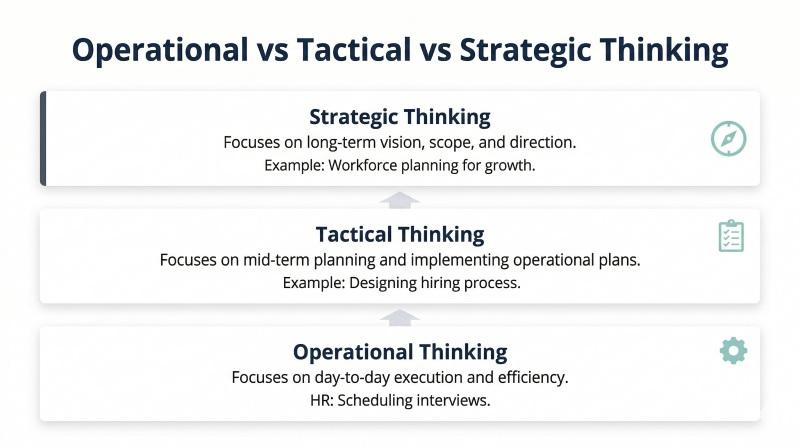
Strategic vs tactical vs operational (and why interviewers confuse them)
These levels overlap, but they are not the same:
- Operational: Executes repeatable processes well. Keeps systems running. Improves reliability.
- Tactical: Solves near-term problems. Optimizes within constraints. Drives quarterly wins.
- Strategic: Decides what to do and what not to do. Connects choices to broader objectives. Manages uncertainty and future trends.
Strategic interview questions can help assess a candidate’s understanding of the differences between strategic, tactical, and operational roles.
A candidate can be excellent at operational efficiency and still weak at strategic decision making. Another can sound strategic and still fail at execution because they don’t translate strategy into operational processes.
Authority layer, used correctly: Decades of selection research consistently shows that unstructured interviews are vulnerable to bias and noise (different interviewers valuing different traits, inconsistent scoring, and over-weighting first impressions). Strategic questions only work if you structure them and score them consistently. Otherwise you just create higher-status small talk.
Behavioral signals that show strategic aptitude
You are looking for signals in how they think, not how polished they sound.
Strong signals (green flags):
- They clarify goals before proposing solutions (“What outcome are we optimizing for?”)
- They identify internal and external factors that matter (market dynamics, capacity, dependencies)
- They can articulate trade-offs and priorities without trying to “win everything”
- They reference measurable impact appropriately (KPIs when relevant, not forced)
- They show a learning process: what changed their view, what feedback or data shifted the plan
- They consider stakeholders without becoming permission-seeking
- They can assess complex situations, evaluating challenging scenarios and developing appropriate responses that demonstrate critical thinking and sound decision-making
Weak signals (yellow/red flags):
- Strategy equals buzzwords (“alignment,” “synergy,” “north star”) with no concrete moves
- They skip constraints and jump to ideal-state plans
- They treat risk management as “be careful” rather than likelihood and impact
- They talk in abstractions and avoid ownership of outcomes
- They claim success but cannot explain decision rationale or what they’d do differently
A quick calibration trick: Ask the candidate to explain their decision like they’re briefing a busy executive in two minutes. Then ask them to explain it again to a new team member who needs to implement it. Strategic thinkers can switch levels without losing coherence.
2) Why Strategic Interview Questions Improve Hiring Outcomes
Most hiring teams think they are evaluating capability. In reality, they’re often evaluating presentation skills under mild pressure. Strategic interview questions shift the interview from “tell me about yourself” to “show me how you make decisions.” These questions help identify candidates who demonstrate the potential to thrive in the company’s unique environment.
Strategic thinking predicts performance where the role has ambiguity
Strategic roles, and many “non-strategic” roles in growing companies, share a few conditions:
- Priorities change fast.
- Resources are limited.
- Stakeholders disagree.
- The business environment is noisy (market trends, competitor moves, shifting customer expectations).
- The work requires trade-offs, not task completion.
In those conditions, someone can be smart and hardworking and still fail if their strategic approach is weak. They may:
- Chase urgent requests instead of strategic objectives.
- Build plans that look good but collapse during implementation.
- Over-invest in one initiative while ignoring key factors and dependencies.
- Freeze when there’s no perfect answer.
Strategic interview questions expose how candidates handle those realities before you hire them.

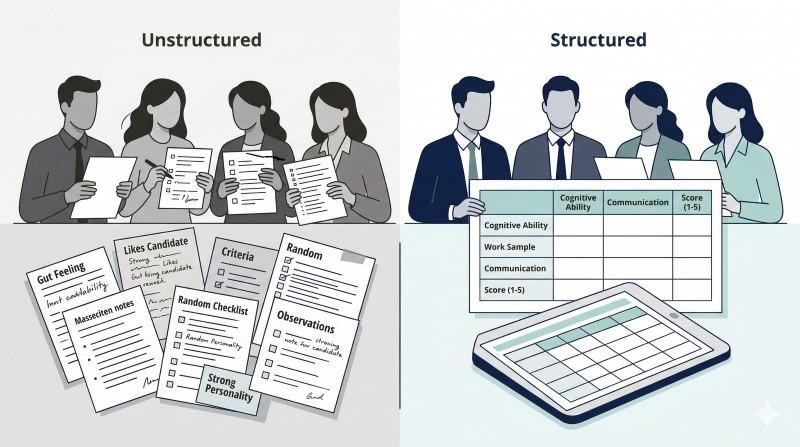
Unstructured interviews create noise, not insight
When interviews are unstructured, every interviewer evaluates a different job.
One interviewer is listening for confidence. Another is listening for culture fit. Another is listening for technical depth. Another is listening for “leadership presence.”
Even if everyone is competent, you end up with:
- Inconsistent criteria
- Different standards per candidate
- Post-interview debates driven by personality and storytelling
Behavioral interview questions help gain insight into candidates’ decision-making, stress tolerance, and how they handle conflicts, with 75% of recruiters reporting these questions help determine a candidate’s performance.
Strategic interview questions only improve outcomes when they come with two controls:
- A defined competency model (what you mean by “strategic thinking skills” in this role)
- A scoring system (what a strong answer looks like versus a weak one)
Without those, you are just adding longer questions to the same flawed process.
They reduce false positives from confident “talkers”
There are candidates who sound strategic because they speak in abstractions:
- “I aligned stakeholders around the north star.”
- “We drove synergy across functions.”
- “I optimized the operating model.”
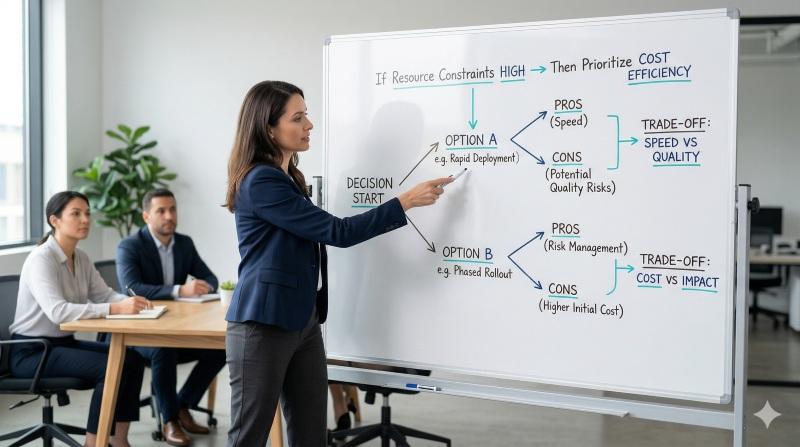
Strategic interview questions force specificity:
- What did you prioritize and why?
- What trade-off did you accept?
- What risk did you take, and how did you mitigate it?
- What changed your plan?
- How did you measure success?
This is where the gap shows up fast: a real strategic thinker can explain the decision-making process and the constraints. A talker can usually only describe the “story arc.”
They surface decision quality, not just results
Results matter, but hiring based on results alone is a trap because outcomes are influenced by:
- market timing
- budget and team quality
- leadership support
- existing brand strength
- external factors outside the candidate’s control
Strategic interview questions let you evaluate how they got there:
- Did they use data analysis or just intuition?
- Did they involve stakeholders early or late?
- Did they test assumptions or commit blindly?
- Did they notice future trends or get surprised repeatedly?
- Did they learn and adjust, or rationalize?
That makes your hiring decisions more stable across job candidates with different backgrounds and different levels of privilege and support.
They create reusable hiring assets (instead of one-off “good interviews”)
A structured bank of strategic interview questions becomes a system:
- The same questions can be reused across teams with minor tailoring.
- Scorecards become comparable across candidates and hiring cycles.
- Interviewers get trained on consistency, not vibes.
- You can track which questions predict on-the-job success.
This is where people analytics becomes useful: not by turning HR into a statistics lab, but by making your hiring process measurable enough to improve, especially when you pair structured interviews with a psychometrically validated OAD Survey.
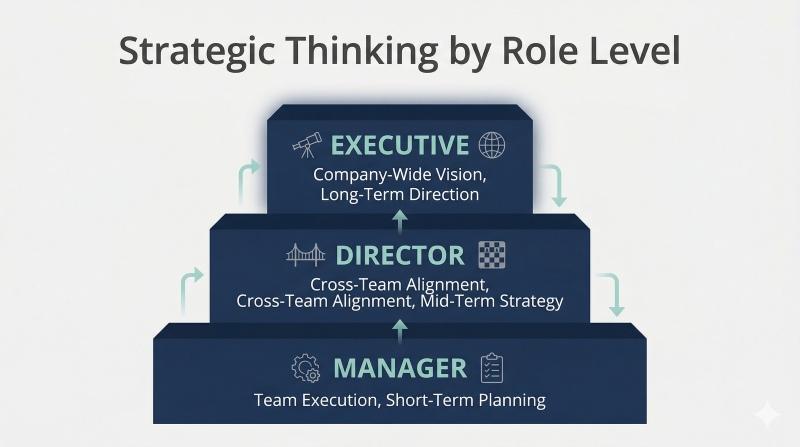
Quick example: how “strategic” differs by role level
A common failure is asking enterprise-level strategy questions for roles that need local strategy.
- Manager (local strategy): prioritizes team initiatives, allocates headcount, manages operational trade-offs, aligns execution to broader objectives.
- Director (cross-functional strategy): sets direction across teams, manages stakeholder perspectives, balances resources across strategic initiatives.
- Executive (enterprise strategy): sets strategic vision, allocates capital, anticipates industry trends, shapes organizational success under uncertainty.
Same competency label, different scope. Your strategic interview questions should match that scope or you will select for the wrong kind of strategic thinker.
3) Start With Outcomes: Map Role Strategy to the Hiring Process
If you skip this step, you get the classic mess: every interviewer asks different interview questions, scores different things, then everyone argues at the end like it’s a courtroom drama.
Extensive market research can inform both the development of strategic interview questions and the evaluation of candidates’ preparedness. Strategic interview questions work when they are anchored to role outcomes and strategic objectives. Not generic “leadership” traits. Candidates should also provide evidence of research regarding the company’s mission and goals during the interview.
Define role outcomes in plain language (6–12 month horizon)
Start by writing 3–5 outcomes that describe what “good” looks like after onboarding. Keep them observable.
Examples:
- “Improve operational efficiency in X process without increasing error rates.”
- “Launch two strategic initiatives that reduce churn in a key segment.”
- “Build a scalable hiring process for the function and reduce time-to-fill.”
- “Create a strategic plan for market expansion and align stakeholders on execution.”
Avoid outcomes like:
- “Be a strategic thinker.”
- “Drive innovation.”
- “Own the roadmap.”
Those are vibes, not outcomes.

Translate outcomes into strategic competencies
Now convert outcomes into the strategic thinking skills the person needs to deliver them.
A simple set that works across roles:
- Foresight: anticipates future trends, second-order effects, and risks
- Alignment: connects decisions to broader objectives and company culture
- Trade-offs: prioritizes under constraints, makes strategic decisions with clear rationale
- Adaptability: adjusts based on customer feedback, new data, or unforeseen circumstances
- Execution clarity: turns strategy into steps, dependencies, and operational processes
- Stakeholder management: involves relevant stakeholders without getting stuck
Not every role needs all six at the same weight. Weight them now so interviewers stop improvising later.
Map competencies to interview stages
You can increase consistency by pairing these stages with a fast, validated behavioral diagnostic like the OAD Survey, so interviewers see behavioral risk and fit data before they start asking questions.
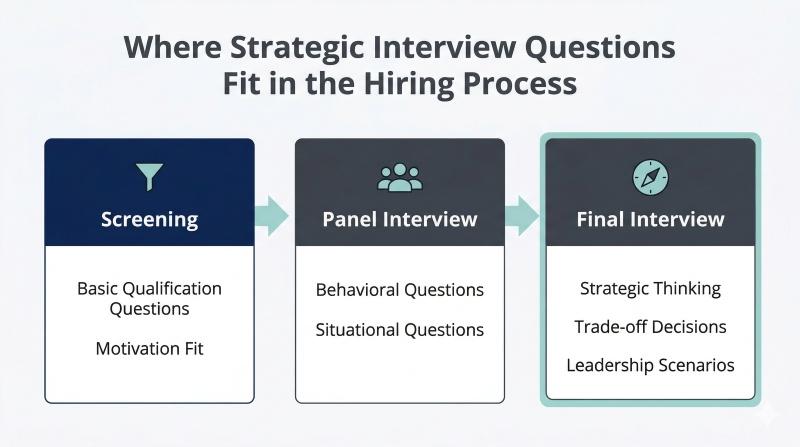
Don’t treat every stage like it has the same job. That’s how you end up doing 7 rounds and still learning nothing.
Phone screen (20–30 min)
- Goal: fast signal, low cost
- Best question types: light situational, short behavioral
- Competencies: trade-offs, clarity, basic foresight
Panel interview (45–90 min)
- Goal: depth and consistency across interviewers
- Best question types: behavioral + structured situational
- Competencies: alignment, stakeholder input, execution clarity, risk judgment
Final interview (45–60 min)
- Goal: role-specific strategy test
- Best question types: strategic plan prompt, high-stakes scenario, calibration follow-ups
- Competencies: foresight, prioritization, strategic direction, adaptability under pressure
Embed core values into question prompts (without turning it into culture theater)
Values matter, but most “culture fit” questioning is sloppy and biased. Instead, embed values as constraints in strategic scenarios.
Example:
- “We value speed, but we also value quality. Here’s the situation. What do you prioritize and why?”
- “Our company culture rewards ownership. A stakeholder wants you to take the safe route. What do you do?”
This forces candidates to show how they balance broader objectives, risk management, and decision making inside your real environment.
Decide what “strategic” means in this role, specifically
Strategic thinking depends on context. Define it in one sentence:
- “In this role, strategic means prioritizing initiatives across teams to hit revenue targets without burning out the org.”
- “In this role, strategic means anticipating market dynamics and shaping product direction based on customer feedback and competitor strategies.”
- “In this role, strategic means building a scalable operating model and allocating resources across competing internal demands.”
This becomes the filter for everything that follows: question selection, scoring rules, and interviewer training.
4) Build the Scoring Rules Before You Ask a Single Question
Most hiring teams score after the interview, which is a polite way of saying “we let our memory and bias do it.”
If you want strategic interview questions to improve hiring outcomes, you need scoring rules that are:
- defined in advance
- consistent across interviewers
- anchored in observable behaviors
What you score in a “strategic” answer
Use a rubric that evaluates the decision-making process, not just the conclusion.
Core scoring dimensions that map cleanly to strategic thinkers:
- Problem framing
- Do they clarify the objective?
- Do they identify key factors and constraints?
- Do they separate signal from noise?
- Trade-offs and prioritization
- Do they make real trade-offs or try to “do everything”?
- Do they explain why one initiative outranks another?
- Do they acknowledge opportunity cost?
- Use of data and feedback
- Do they request the right information?
- Do they use data analysis appropriately?
- Do they incorporate customer feedback and stakeholder perspectives?
- Risk assessment
- Do they consider likelihood and impact?
- Do they anticipate potential risks and failure modes?
- Do they name mitigation steps without over-engineering?
- Execution clarity
- Can they translate strategy into steps?
- Do they identify dependencies and sequencing?
- Do they propose measurable indicators (KPIs where relevant)?
- Adaptability
- What would change their decision?
- How do they handle unforeseen circumstances?
- Do they show a learning process?

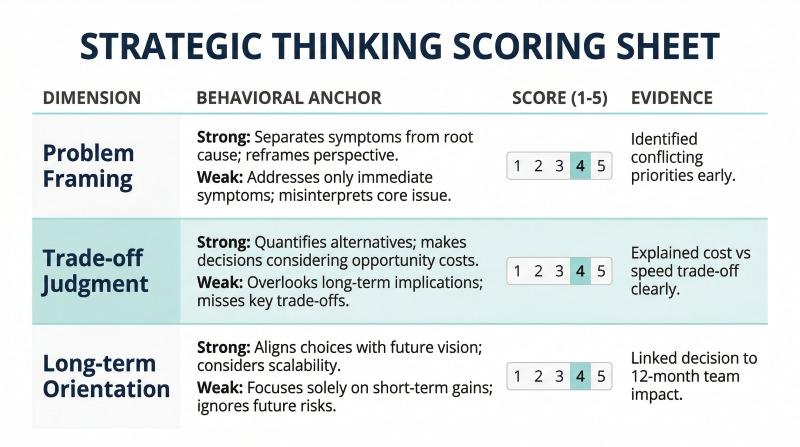
Simple 1–5 anchored scoring (fast and usable)
Don’t build a 20-point rubric. Nobody uses it. Use 1–5 with anchors.
1 = Weak
- vague, no constraints, no trade-offs, no clear rationale
3 = Competent
- clear objective, some trade-offs, reasonable rationale, basic execution steps
5 = Strong
- tight framing, explicit trade-offs, integrates internal and external factors, realistic plan, clear metrics, anticipates risk, adapts with signals
The goal is not perfection. The goal is consistency.
Avoid the three scoring traps that ruin everything
Trap 1: Mixing multiple criteria in one question
Example:
- “Tell me about a time you led a strategic initiative, influenced stakeholders, managed risk, and improved operational efficiency.”
That’s four competencies. You’ll score whatever you feel like.
Fix:
- One question, one primary competency. Follow-ups can probe adjacent ones.
Trap 2: Letting “great storytelling” inflate scores
A polished narrative is not evidence of strategic thinking skills. Score the reasoning and the trade-offs, not the performance.
Fix:
- Require specifics: constraints, decision points, what they cut, what they measured.
Trap 3: Scoring without notes
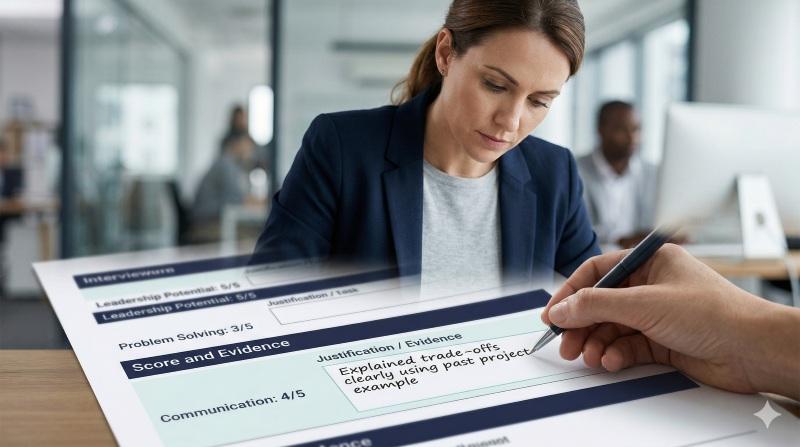
If you do not write down evidence, you are not scoring. You are voting.
Fix:
- Require one sentence of justification per score:
- “Scored 4 on trade-offs because they cut X, protected Y, and explained opportunity cost.”
5) The Three Types of Strategic Interview Questions (And When to Use Each)
If your interview questions all sound the same, you’re not evaluating. You’re hosting a conversation and hoping competence shows up.
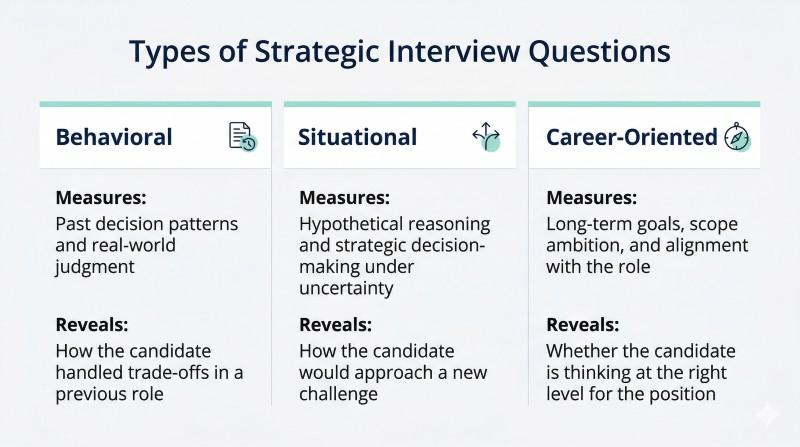
Strategic interview questions work best when you mix three types on purpose, then assign them to the right stage of the interview process.
Type 1: Behavioral questions (proof from the past)
Best for: validating real experience, decision-making patterns, and follow-through.
Behavioral interview questions force specificity because they anchor to a real event. They are your best tool for spotting candidates who can talk strategy but have never actually developed plans, managed trade-offs, or delivered strategic initiatives.
What you learn:
- How they framed the problem
- What constraints they had
- What they prioritized and why
- What changed their approach
- What outcomes they drove (and how they measured impact)
Where to use them:
- Panel interview (deep dive)
- Final interview (role-critical validation)
Type 2: Situational questions (judgment under constraints)
Best for: roles with ambiguity, new domains, or incomplete info.
Situational interview questions test how the candidate thinks in the moment. You give them a realistic scenario with limited resources and competing goals, then watch how they allocate attention, make strategic decisions, and manage risk.
What you learn:
- Their decision making process and trade-off discipline
- Whether they can prioritize under pressure
- How they handle internal and external factors
- How they think about stakeholders and customer feedback
Where to use them:
- Phone screen (light version)
- Panel interview (structured scenario)
- Final interview (high-fidelity scenario)
Type 3: Career-oriented questions (strategy maturity and learning loops)
Best for: exposing judgment, self-awareness, and strategic growth over time.
These are not “tell me your strengths” questions. They’re designed to uncover how the candidate becomes a better strategic thinker, how they correct errors, and how they build strategic thinking skills.
What you learn:
- Their learning process, including whether they take a proactive approach to professional development and continuous learning
- Whether they demonstrate a growth mindset focused on learning and improving, not just completing daily tasks
- How they respond to feedback
- How they handle strategic shifts and uncertainty
- Whether they can articulate strategic direction without hand-waving
- If they can express their weaknesses openly, which shows honesty and self-awareness and makes them likely to be great candidates for the organization
- A candidate’s ability to self-reflect and learn from failure, which is crucial for growth; asking about past failures allows interviewers to assess how they handle setbacks and apply insights to future situations
Where to use them:
- Phone screen (quick signal)
- Final interview (calibration and risk check)
Assign question types to interview stages
Aligning each stage with clear competencies also makes it easier to bring in Job Behavior Insights that match role to behavior, so the same profile guides both interviews and selection decisions.
Screening
- 1 short behavioral question (proof)
- 1 situational question (judgment)
- 1 career-oriented question (learning loop)
Panel
- 2 behavioral deep dives (different contexts)
- 1 structured situational scenario (resource allocation)
- targeted follow up questions tied to the rubric
Final
- 1 strategic plan prompt (one-page level)
- 1 high-stakes scenario (unforeseen circumstances)
- 1 calibration set (values, risk management, strategic shift triggers)
6) Behavioral Strategic Thinking Interview Questions That Reveal Real Pattern-Spotters
Behavioral questions are where “strategic thinkers” either show their work or collapse into vague storytelling.
Your job is to force decision detail:
- What did you decide?
- What did you not do?
- Why?
- What changed?
- What was the measurable impact?

Prompts that probe real strategy development
Use these when the role requires creating or influencing strategic plans. These prompts are designed to assess a candidate’s experience with developing plans that align with organizational goals, including their ability to formulate long-term, actionable frameworks and communicate strategies that consider future trends and risks.
- “Tell me about a time you developed a strategy to reach a specific business outcome. What was the goal, and what constraints did you have?”
- “Describe a strategic initiative you led from idea to execution. What were the key steps and dependencies?”
- “About a time you inherited a plan that was not working. How did you diagnose the problem and decide on a strategic shift?”
- “Tell me about a time you had to align multiple teams around a strategic direction. What did you do when priorities conflicted?”
Questions that expose long-term planning
These work when strategic vision matters, but you still want reality.
- “Tell me about a decision you made that paid off later, not immediately. What made you confident it was worth it?”
- “Describe a time you anticipated future trends or market dynamics that others ignored. What signals did you act on?”
- “Tell me about a time you planned for a risk that never happened. How did you justify the work and cost?”
Follow-up questions that stop bluffing:
- “What did you cut to make room for that?”
- “What data or customer feedback mattered most?”
- “What would have made you change course earlier?”
Prompts that require measurable impact (without forcing fake metrics)
You want substance, not spreadsheet cosplay.
- “What outcome did you aim for, and how did you measure success?”
- “What were the key performance indicators, and which ones did you stop paying attention to over time?”
- “What did you learn after implementation that changed how you approach strategy development now?”
If the candidate can’t offer numbers, that’s not automatically bad. The problem is when they can’t offer evidence at all: trade-offs, decision points, stakeholder input, or clear before/after impact.
7) Situational Questions for Resource Allocation and Strategic Decision Making
Situational questions are where you see whether the candidate can actually prioritize, or whether they just describe “best practices” until time runs out. These questions are designed to assess how candidates approach complex situations and develop solutions, revealing their ability to assess complex situations and demonstrate critical thinking.
A good scenario forces:
- limited resources
- competing strategic objectives
- internal politics or stakeholder conflict
- customer feedback or market trends that contradict the internal narrative
To assess problem-solving and critical thinking, prioritize questions that reveal a candidate’s process rather than just the outcome.
How to craft strong resource allocation hypotheticals
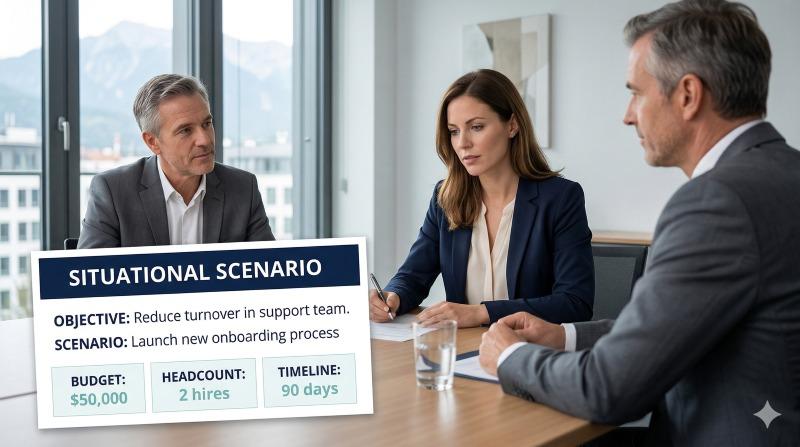
Use a structure like this:
- Objective: “Reduce churn in a key segment this quarter.”
- Constraints: “No new headcount. Budget cut by 15%. Two teams already overloaded.”
- Complication: “Sales wants features. Support wants fixes. Product wants platform work.”
- External factor: “Competitor launched a similar offer last month.”
Then ask:
- “Walk me through how you would prioritize initiatives in this situation. What do you do first and why?”
- “What information would you request before committing, and what decision would you make if you could not get it?”
- “What are the trade-offs you accept, and what risks do you actively mitigate?”
Require the decision-making process, not just the answer
Use process forcing follow-ups:
- “Name three options you considered and why you rejected two.”
- “What would change your mind?”
- “What is the earliest signal you would watch to know this is failing?”
- “How do you communicate the decision to stakeholders who disagree?”
Scoring focus:
- Trade-offs and prioritization
- Risk assessment
- Adaptability
- Execution clarity
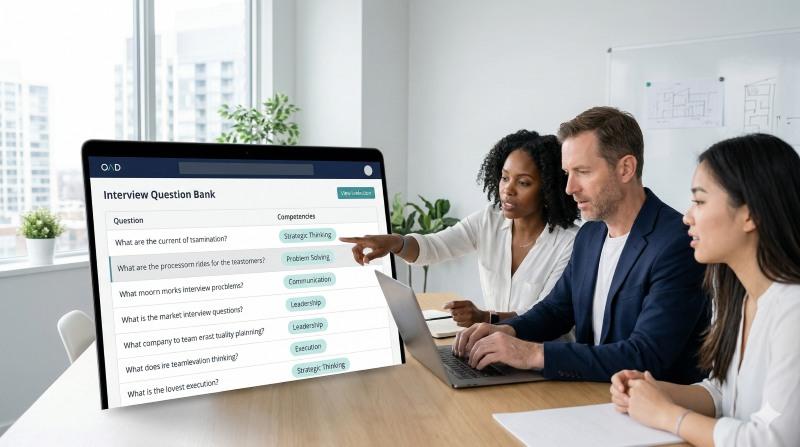
8) Sample Resource Allocation Questions (Plug-and-Play)
These are ready to drop into your interview process and tag to competencies.
Some of these questions may require candidates to reference extensive market research to justify their decisions, especially when evaluating new opportunities or informing strategic choices, which is critical in contexts like private equity, where behavioral insight into leadership and culture reduces post-deal risk.
Budget constraints
- “You inherit a budget that is 20% lower than forecast. Which strategic initiatives do you protect, and which do you cut?”
- “A senior stakeholder wants to fund a new initiative. Your data analysis suggests it will not move key performance indicators. What do you do?”
- “You have two competing proposals. One is low risk and incremental. One is higher risk but could create competitive advantage. How do you decide?”
Headcount constraints
- “You cannot hire for six months. How do you reallocate headcount and protect operational efficiency?”
- “Your best performer is leaving mid-project. How do you adjust priorities without derailing strategic objectives?”
- “Two teams are overloaded and pushing back. How do you decide what work stops?”
Time constraints and high pressure situations
Under tight deadlines, early warning around burnout, disengagement, or misaligned leaders becomes crucial, which is where OAD’s Risk & Readiness Alerts can complement what you hear in interviews.
- “You have 30 days to show progress. What do you ship, what do you delay, and what do you communicate?”
- “An executive wants a quick win that conflicts with longer-term strategic direction. How do you handle it?”
- “A key assumption fails halfway through execution. What triggers a strategic shift for you?”
Each of these should be paired with the rubric and a one-line note requirement, so interviewers score what happened in the reasoning, not how confident it sounded.
9) Strategy Development Questions: Can They Actually Build a Strategic Plan?
If a candidate can’t turn a messy situation into a coherent plan, they’re not “strategic.” They’re articulate.
These prompts are designed to assess a candidate’s ability to develop plans and translate strategy into actionable steps, evaluating how well they can demonstrate key skills like self-reflection, task management, and strategic thinking in real scenarios. Those are exactly the capabilities founders and CEOs need when they hire with long-term leadership fit in mind.
Use these prompts when the role requires strategy development, strategic direction, or leading strategic initiatives.
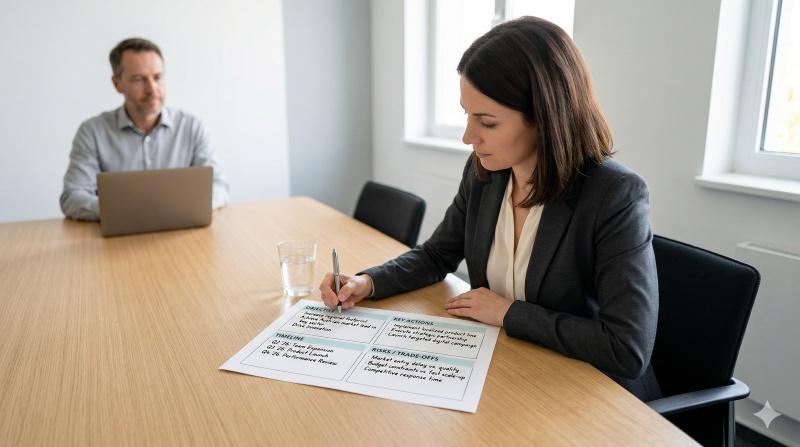
The one-page strategic plan prompt
This is the cleanest way to separate real strategic thinking from “framework reciting.”
- “Draft a one-page strategic plan for this goal: [insert role outcome]. Include your assumptions, priorities, and first 90 days.”
Force structure so you can score it:
- Objective and success definition (what changes, by when)
- Key factors (internal and external factors that matter)
- Strategic initiatives (3–5 max, with rationale)
- Resource allocation (time, budget, people)
- Risks and mitigations
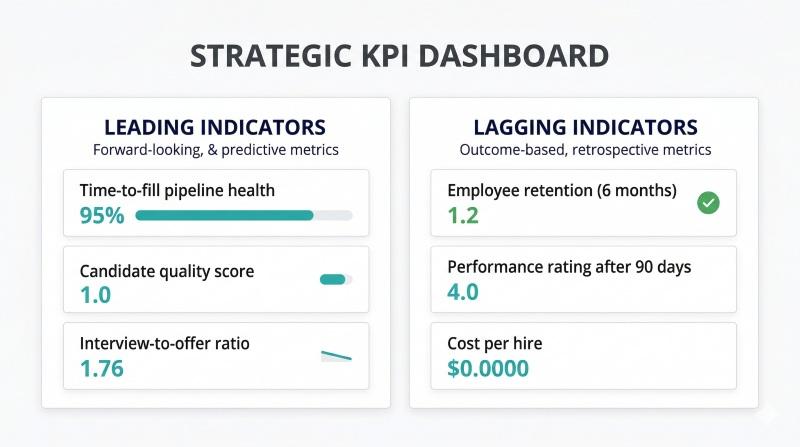
- Measures (key performance indicators, leading indicators)
Scoring focus:
- Problem framing
- Trade-offs
- Execution clarity
- Risk assessment
Implementation steps that expose whether they can execute strategy
A “strategy” that can’t be implemented is a mood board.
- “Walk me through the steps you’d take to implement that plan. What happens in week 1, month 1, and quarter 1?”
- “What dependencies could block execution, and how would you remove them?”
- “What would you delegate, what would you personally own, and why?”
Follow-up questions:
- “What work stops to make room for this?”
- “Who do you need aligned early, and who can wait?”
- “What would make you re-sequence your plan?”
Measuring plan success without vanity metrics
Candidates often hide behind generic metrics. Make them pick.
- “What are the 2–3 signals you’d track weekly to know the plan is working?”
- “Which metric would you ignore early because it lags the real outcome?”
- “If results are flat after 60 days, what do you change first: the strategy, the execution, or the measurement?”
Scoring focus:
- Measurement discipline
- Adaptability
- Decision quality under uncertainty
10) Questions for Stakeholders, Internal Politics, and Customer Feedback
Strategy fails more often from people than from math. Stakeholders disagree, incentives conflict, and customer feedback arrives late or gets ignored.
These questions test whether the candidate can involve stakeholders without surrendering decision-making, while tools that assess communication skills across channels in interviews help you separate clear, audience-aware communicators from confident talkers.

Gathering stakeholder input without getting paralyzed
- “Tell me about a time you involved relevant stakeholders in a decision without slowing execution. How did you structure input?”
- “When stakeholders disagree, how do you decide whose perspective carries more weight?”
- “What’s your method for documenting decisions so teams stay aligned?”
Follow-up questions:
- “What did you do when a powerful stakeholder pushed for a weaker option?”
- “How did you communicate trade-offs to people who lost resources?”
Scoring focus:
- Stakeholder management
- Alignment
- Trade-off clarity
Using customer feedback to pivot strategy
This filters out candidates who say “customer obsessed” but only listen when it’s convenient. Pairing these prompts with OAD’s Motivations & Drivers insights helps you see whether their stated priorities match what actually drives them.
- “Describe a time customer feedback caused a strategic shift. What changed, and what stayed the same?”
- “How do you separate noisy feedback from signal when making strategic decisions?”
- “Tell me about a time you ignored customer feedback. Why was that the right call?”
Scoring focus:
- Judgment
- Data and feedback use
- Risk management
Keeping stakeholders informed during execution
- “How do you keep stakeholders informed without turning it into constant meetings?”
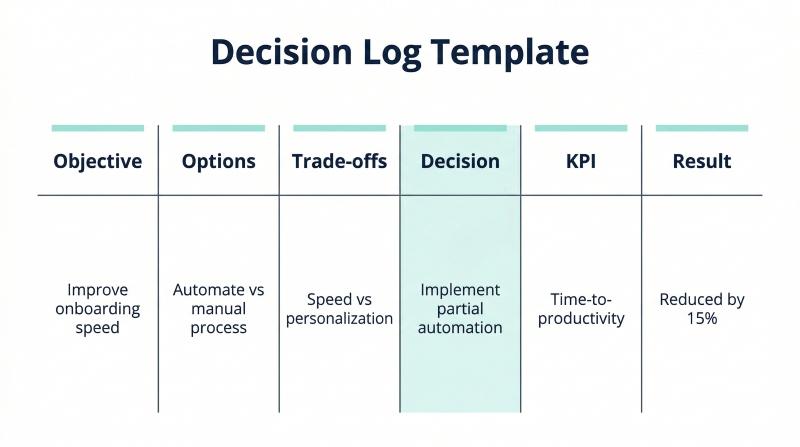
- “What artifacts do you use: dashboards, decision logs, written updates, review cadences?”
- “When progress is bad, how do you report it and reset expectations?”
Scoring focus:
- Execution hygiene
- Communication clarity
- Accountability
11) Strategic Vision Questions That Don’t Reward Buzzwords
Plenty of candidates can talk about “vision.” Fewer can connect strategic vision to constraints, market dynamics, and real choices.
These prompts test whether the candidate can anticipate future trends without pretending they can predict the future, and they pair well with behavioral interview questions that assess cultural fit and values so your “visionaries” also align with how your company actually operates.
Anticipating future trends without fantasy
- “What future trends do you think will matter most in this function over the next 12–24 months, and why?”
- “What signals would you monitor to validate that view?”
- “Tell me about a time you anticipated industry trends correctly. What did you do differently because of it?”
Follow-up questions:
- “What trend did you get wrong, and what did you learn?”
- “What would make you reverse your view quickly?”
Scoring focus:
- Foresight with discipline
- Learning process
- Adaptability
Internal vs external factors
Strategic thinkers separate what they can control from what they must adapt to.
- “In your last role, what external factors mattered most, and how did you adjust strategy?”
- “What internal constraints limited strategic direction, and how did you work around them?”
- “How do you avoid overreacting to market noise while still staying proactive?”
Scoring focus:
- Judgment
- Constraint awareness
- Strategic approach under uncertainty
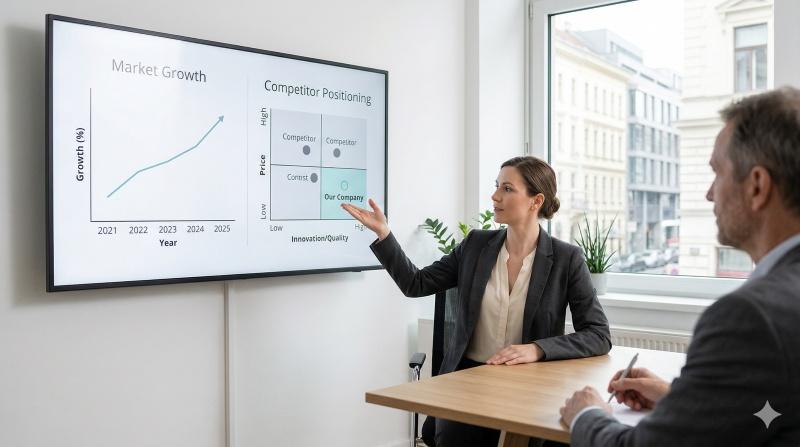
Competitor strategies and competitive advantage (role-appropriate)
This is not a test of trivia. It’s a test of thinking.
- “How do you evaluate competitor strategies without copying them?”
- “Tell me about a time you changed an initiative because of competitor movement. What did you change and why?”
- “When do you ignore competitor strategies completely?”
Scoring focus:
- Clear reasoning
- Trade-offs
- Strategic clarity over ego
12) Risk Management and Strategic Shifts: How They Think When Plans Break
Every plan looks smart until reality shows up. This section tests whether the candidate can manage potential risks, make clean adjustments, and avoid emotional thrashing. These patterns become even clearer when coaches use behavioral data for executive coaching alongside interview feedback.
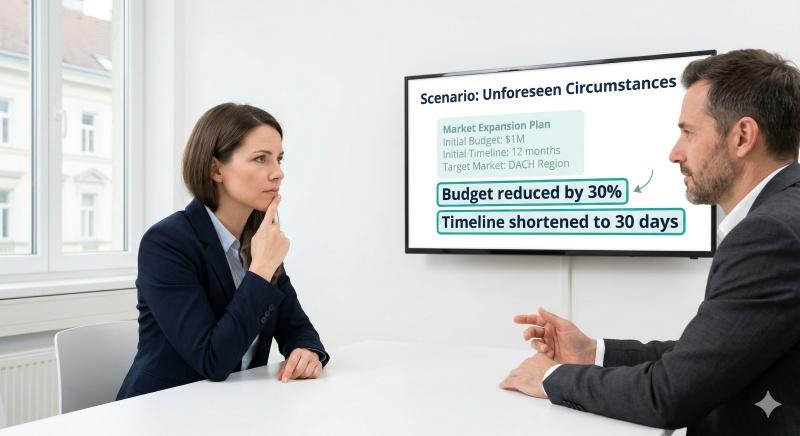
Unforeseen circumstances: what they do when assumptions fail
- “Tell me about a time unforeseen circumstances forced you to change a strategic plan. What changed, and how did you decide the new direction?”
- “Describe a situation where your strategy was right but execution failed. What did you fix first?”
- “Tell me about a time you realized late that your initial framing was wrong. What was the signal you missed?”
Follow-up questions:
- “What did you stop doing immediately?”
- “Who did you inform first, and why?”
- “What did you protect even while changing direction?”
Scoring focus:
- Adaptability without chaos
- Problem framing
- Ownership and learning process
Risk assessment: do they think in likelihood and impact
Plenty of candidates say “risk management.” Fewer can show how they evaluate risk and decide what matters.
- “How do you assess risk when you don’t have complete data?”
- “What’s an example where you accepted a meaningful risk to achieve a competitive advantage?”
- “Tell me about a time you over-mitigated risk and slowed progress. What would you do now?”
Follow-up questions:
- “What were the top two failure modes?”
- “What was your mitigation plan, and what did you intentionally not mitigate?”
- “What would have made you pull the plug earlier?”
Scoring focus:
- Decision quality under uncertainty
- Trade-offs
- Execution clarity
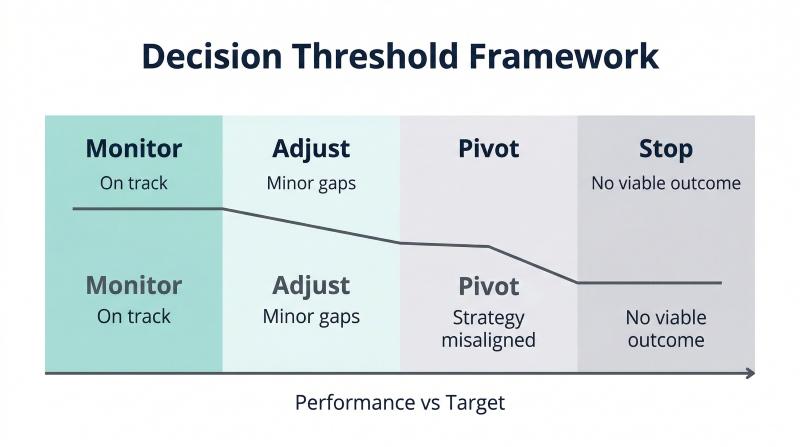
What triggers a strategic shift (and what should not)
A strategic shift should not happen because someone got anxious, or because a loud stakeholder demanded it.
- “What triggers you to reconsider a strategy mid-execution?”
- “What signals do you treat as noise rather than reasons to pivot?”
- “Tell me about a time you held course when others wanted to change direction. How did you justify it?”
Scoring focus:
- Discipline
- Foresight
- Stakeholder pressure handling
13) A 30+ Strategic Interview Question Bank (Tagged by Competency)
Below is a structured question bank you can copy into a scorecard. Each question is tagged with the primary competency it assesses and the best stage to use it.
Competency tags:
- FR = Framing
- TR = Trade-offs / Prioritization
- FO = Foresight / Future trends
- RS = Risk assessment
- EX = Execution clarity
- ST = Stakeholders
- AD = Adaptability / Strategic shift
- DA = Data analysis / Feedback use
- VA = Values alignment

Phone screen (quick signal)
- “What’s a strategy decision you made that had real trade-offs?” (TR)
- “Tell me about a time you had limited resources. How did you prioritize?” (TR)
- “Describe a decision that changed after you got new data.” (DA, AD)
- “What do you do first when you’re dropped into a messy problem?” (FR)
- “Give an example of when you pushed back on a stakeholder request.” (ST)
Panel interview (depth and consistency)
- “Tell me about a strategic plan you built. What were the key steps?” (EX)
- “About a time you led a strategic initiative end-to-end. What did you cut?” (TR, EX)
- “Describe a time customer feedback caused a pivot. What changed?” (DA, AD)
- “Tell me about a time you anticipated future trends and acted early.” (FO)
- “Describe a time internal constraints blocked progress. What did you do?” (EX, ST)
- “Tell me about a time you changed priorities mid-quarter. Why?” (TR, AD)
- “Give an example of a risk you took intentionally. How did you assess it?” (RS)
- “Describe a cross-functional conflict over priorities. How did you resolve it?” (ST, TR)
Final interview (role-specific and high fidelity)
- “Draft a one-page strategic plan for this goal: [role outcome].” (FR, TR, EX, RS)
- “Here’s a scenario with constrained budget and headcount. Prioritize initiatives.” (TR, RS, EX)
- “What signals would trigger a strategic shift in this plan?” (AD)
- “How would you align stakeholders on a decision they disagree with?” (ST)
- “How would you measure success in the first 30/60/90 days?” (EX, DA)
Situational plug-and-play (resource allocation)
- “Budget is cut 15%. What do you protect and what do you cut?” (TR)
- “You cannot hire for six months. How do you reallocate headcount?” (TR, EX)
- “Sales wants features, Support wants fixes, Product wants platform work. Decide.” (TR, ST)
- “Competitor launched a similar offer. What do you change, if anything?” (FO, TR)
- “A senior leader wants a quick win that conflicts with strategic direction. What do you do?” (ST, VA, TR)
- “Your key assumption fails halfway through execution. What happens next?” (AD, RS)
Behavioral proof (strategy development and decision quality)
- “Tell me about a time you reframed a problem and it changed the outcome.” (FR)
- “Describe your most impactful strategic initiative. What made it work?” (EX)
- “Tell me about a strategic decision you regret. What did you learn?” (AD)
- “About a time you used market research to change direction.” (DA, FO)
Note: Extensive market research can provide the foundation for strategic shifts and informed decision-making, especially when identifying new markets, assessing trends, or evaluating opportunities for business growth. - “Tell me about a time you managed risk well and still moved fast.” (RS, EX)
- “Describe a time you had to choose between two good options.” (TR)
- “Tell me about a time values guided a difficult trade-off.” (VA, TR)
- “Give an example of keeping stakeholders informed during bad progress.” (ST, EX)
That’s 32 questions, already tagged and stage-ready.
14) How to Evaluate Answers With People Analytics (Without Pretending You’re a Data Scientist)
People analytics here means: make your interview data structured enough to learn from it.
Use a standardized scoring rubric for strategic answers
Use the same 1–5 anchors across interviewers. Require:
- a score per competency
- one sentence of evidence per score
- one “uncertainty note” when the signal is weak
This reduces noise and makes panel discussions about evidence, not opinions.
Map interview scores to behavioral assessment data
This is where OAD can add value without turning it into a personality horoscope.
Process:
- Tag each strategic interview question to the competency it measures.
- Compare interview scores to assessment patterns that relate to strategic execution risks or strengths.
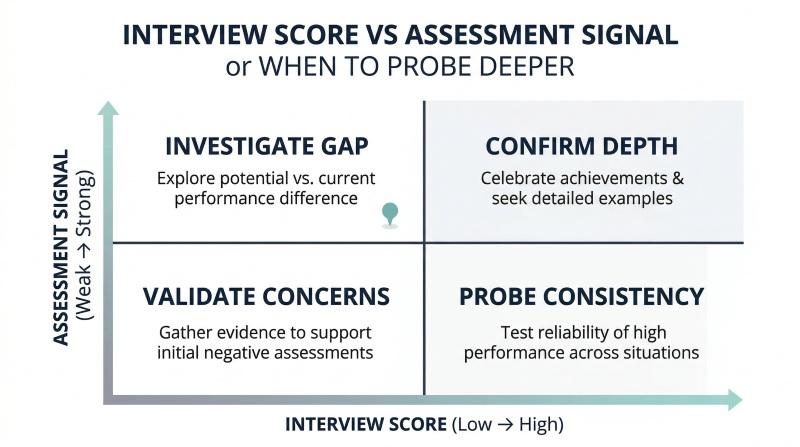
- Use mismatches as follow-up targets, not as automatic rejection.
Example mismatch handling:
- Strong interview, weak assessment indicators: probe consistency, stress response, execution reliability.
- Weak interview, strong assessment indicators: probe communication, interview pressure effects, or role mismatch.
Design teams with data, not gut feel.
Most org-design decisions come down to role fit, leadership style, and team dynamics. OAD reads those signals from a 7-minute behavioral survey, so you can reconfigure roles and teams with evidence instead of guesswork.
Flag mismatches instead of hand-waving them away
When interview and assessment disagree, hiring teams often do one of two lazy things:
- ignore the data because it’s inconvenient
- over-trust the data because it feels “scientific”
Better approach:
- treat mismatches as hypotheses
- write follow up questions to test them
- document the resolution
15) How to Measure Strategic Thinking Skills Beyond Interviews
Strategic interview questions are necessary, but they are not sufficient. Interviews are a performance environment. Some candidates under-signal. Some over-signal. If the role is strategy-heavy, add one or two lightweight measures that force real decisions, and make sure candidates access them through secure individual profiles rather than ad-hoc links and one-off reports.
Use scenario-based assessments to simulate decisions
A good scenario exercise is short, role-relevant, and scored with the same rubric you use in interviews.
What it should include:
- a clear objective tied to strategic objectives
- limited resources (budget, headcount, time)
- internal and external factors (constraints, market dynamics, stakeholder pressure)
- one surprise variable (unforeseen circumstances) to test adaptability
What you score:
- framing and assumptions
- trade-offs and prioritization
- risk assessment
- execution clarity
- what triggers a strategic shift
Keep it simple. The goal is to observe judgment, not create an MBA final exam.
Review past project outcomes and measurable results responsibly
Past outcomes matter, but they can mislead if you ignore context.
When you review outcomes, probe:
- what was within their control vs external factors
- what constraints shaped the work
- how they measured success (key performance indicators where relevant)
- what they learned and changed afterward
Avoid the lazy version of this (brand-name worship). A candidate from a famous company can still have weak strategic decision making process.
Score answers for foresight, alignment, and adaptability
If you want strategic thinking skills, score these three consistently across all inputs (interview, scenario, work sample):
- Foresight: did they anticipate future trends, second-order effects, and failure modes?
- Alignment: did they connect decisions to broader objectives and company culture?
- Adaptability: did they show a disciplined learning process and clear pivot triggers?
16) Integrate Strategic Questions Into Your Hiring Process
If strategic interview questions live in a separate document no one opens, they don’t exist. Integration means they show up in the same places your team already uses.
Insert strategic questions into job briefs and scorecards
Add a small section to the job brief:
- role outcomes (3–5)
- top strategic competencies (weighted)
- 6–10 approved strategic thinking interview questions tagged to competencies
Add the same tags to the interview scorecard. This makes interviewer notes comparable.
Train interviewers on consistency and bias reduction
Most interviewer training is vibes and reminders to “be fair.” What you need is operational training:
- how to ask the question without leading
- how to use follow up questions to force trade-offs and specifics
- how to score with anchors, not impressions
- how to document evidence
Minimum standard: every interviewer can explain what a “3” vs “5” looks like for trade-offs, risk assessment, and execution clarity.
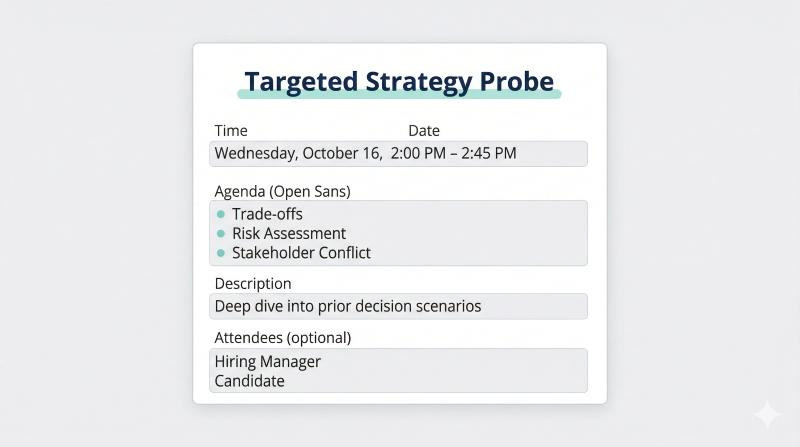
Schedule follow-up interviews for deeper strategy probes
Don’t add more rounds by default. Add targeted probes only when needed.
Use follow-up interviews when:
- interview score and behavioral assessment signals conflict
- two finalists are close but differ on strategic direction or decision making
- the role requires complex stakeholder management under pressure
17) Use OAD Behavioral Data to Inform Strategic Interviews
OAD should not replace interviews. It should make them sharper.
The clean use case: use OAD behavioral data to decide what to probe, then use strategic interview questions to validate observed behavior in job context.
Link question tags to OAD assessment dimensions
Set up a simple mapping:
- each question in your bank has a competency tag (trade-offs, foresight, adaptability, etc.)
- each competency tag aligns to relevant OAD dimensions that influence behavior under pressure and ambiguity
The output is not “this person is strategic.” The output is: “probe these decision patterns more deeply.”
Use assessment reports to tailor interview focus
Examples of tailoring:
- If a profile suggests high speed and assertiveness, probe risk assessment and stakeholder input discipline.
- If a profile suggests high caution, probe prioritization and willingness to make hard cuts under constraints.
- If a profile suggests high novelty-seeking, probe execution clarity and follow-through on operational processes.
This is how you avoid hiring someone who interviews well but struggles in the business environment once real pressure hits.
Incorporate early warning signals for burnout or risk
Do not diagnose. Do not speculate. Do probe.
If signals suggest potential risk patterns (stress tolerance, volatility, overload response), use interview prompts like:
- “Tell me about a time priorities exploded and you had to protect focus.”
- “How do you decide what stops when you take on a strategic initiative?”
- “What do you do to maintain decision quality in high pressure situations?”
Design teams with data, not gut feel.
Most org-design decisions come down to role fit, leadership style, and team dynamics. OAD reads those signals from a 7-minute behavioral survey, so you can reconfigure roles and teams with evidence instead of guesswork.
18) Assess Cultural Fit and Core Values Without Bias Theater
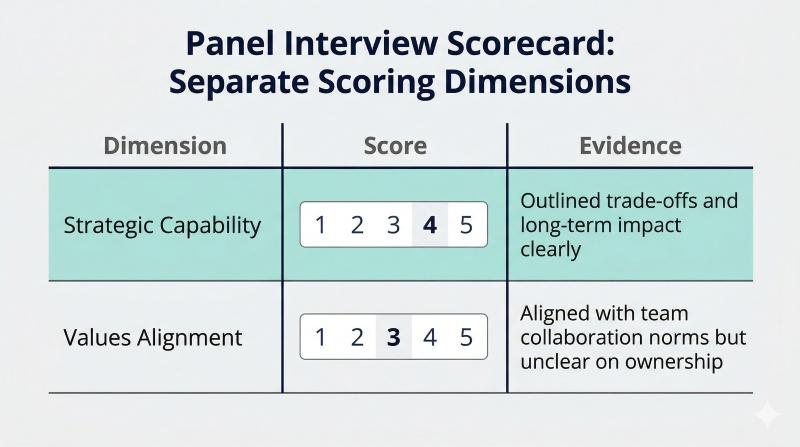
“Culture fit” is where hiring teams accidentally optimize for sameness. Better approach: score values-based decision making separately from strategic capability.
Design questions that reveal alignment with core values
Use values as constraints, not as “do you like our culture” prompts.
- “Tell me about a time company culture or core values forced a decision you did not personally prefer.”
- “Describe a trade-off you made to protect quality, ethics, or customer trust.”
- “When speed conflicts with doing it right, how do you decide?”
Ask for examples where values guided difficult choices
- “About a time you had to say no to a powerful stakeholder because it violated a core value.”
- “Tell me about a time you took accountability for a decision that did not work.”
Score cultural fit alongside strategic capability, not instead of it
Two separate scores:
- strategic thinking: framing, trade-offs, risk, execution, adaptability
- values alignment: how they handle pressure, fairness, honesty, accountability, customer impact
This prevents “I liked them” from becoming a proxy for “they match our values.”
19) Scoring, Calibration, and Panel Best Practices
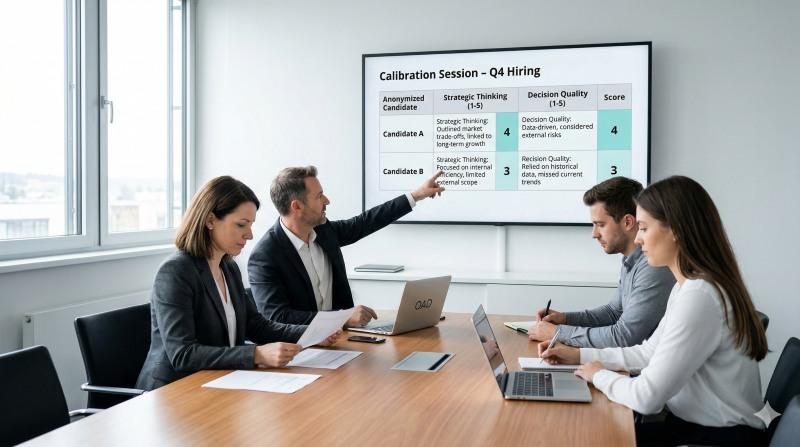
If you want consistency across candidate interviews, you need a calibration habit. Otherwise, every panel is a new set of rules.
Hold calibration sessions after initial interviews
Short, structured, and evidence-based:
- each interviewer shares scores with one-sentence evidence
- compare deltas (where scores differ by 2+ points)
- resolve by revisiting anchors, not arguing opinions
Anonymize answers during scoring where possible
Even partial anonymization reduces bias:
- score based on written notes tied to rubric categories
- avoid discussing pedigree or past employer early
- discuss resume only after scoring the interview evidence
Rotate interviewers to diversify evaluation perspectives
Rotation helps, but only if the rubric stays stable. Diversity of evaluators with inconsistent scoring is still noise.
Minimum standard:
- same question set for comparable candidates
- same scoring anchors
- same evidence requirement
20) Common Mistakes to Avoid in Strategic Interviews
These mistakes are why hiring teams think they are evaluating strategy while actually evaluating comfort in conversation.
Avoid unstructured, ad-hoc questioning formats
If every interviewer invents their own prompts, the data is not comparable. You will not reliably evaluate candidates.
Fix:
- approved question bank
- mandatory tags and scoring anchors
- consistent follow up questions
Avoid mixing multiple evaluation criteria in one question
Double-barreled questions destroy scoring.
Fix:
- one question, one primary competency
- follow-ups only to clarify or probe adjacent competencies
Avoid neglecting customer feedback when probing strategy
Strategy disconnected from customers is internal politics with charts.
Fix:
- include at least one customer feedback or market research prompt for any role that influences product, service, marketing strategy, or strategy development

21) Final Checklist for Interviewers
This is the operational checklist that stops interviews from drifting.
- Role outcomes defined (3–5)
- Strategic competencies selected and weighted
- Questions chosen and tagged by competency
- Each question linked to a scoring criterion
- Interviewers trained on anchors and follow up questions
- Notes captured with evidence, not adjectives
- Scores recorded independently before panel discussion
- Calibration run on big scoring deltas
- Final decision references evidence and role outcomes, not “gut feel”
Appendix: Quick Templates and Prompts
One-page interview script template (structure)
Intro (2 minutes)
- confirm role scope and time horizon
- explain structure: questions, follow-ups, scoring
Question set
- 2 behavioral questions (strategy development, trade-offs)
- 1 situational scenario (resource allocation)
- 1 stakeholder/customer feedback prompt
- 1 risk and pivot trigger prompt
Close
- candidate questions
- confirm next steps
Sample prompt blocks (ready to adapt)
Strategy development
- “Draft a one-page strategic plan for [goal] with assumptions, priorities, risks, and measures.”
Resource allocation
- “Given constrained budget and headcount, prioritize these initiatives and explain the trade-offs.”
Stakeholders
- “Two leaders disagree. How do you gather input and make the decision without stalling execution?”
Conducting a Strategic Interview: Live Facilitation and Best Practices
A strategic interview is not a rigid question list. It is a structured conversation designed to show how a candidate actually thinks. The interviewer’s job is to set up the conditions for that evidence to appear, then capture it consistently.
Structuring the interview for strategic depth
Strategic depth does not happen by chance. Open with a short introduction that sets expectations, then move through a planned mix of behavioral, situational, and career-oriented questions. Prompts like “Can you describe a time when you developed a strategic plan to address a complex business problem?” or “How do you stay current with industry trends and anticipate changes that could impact your team?” show how a candidate identifies the factors that matter and connects day-to-day actions to a larger direction. When every candidate gets the same structure, you can compare their decision-making on real strategic challenges instead of on who told the best story.
Adapting follow-up questions in real time
The most useful evidence usually comes from the follow-up, not the first answer. Listen for how decisions were made, how competing priorities were balanced, and what changed along the way. Then probe with precision: “What specific decision did you make when priorities conflicted, and how did you evaluate the trade-offs?” or “What would you have done differently if new data had emerged?” Follow-ups like these separate candidates who can recite frameworks from candidates who can apply strategic thinking when it matters.
Managing candidate nerves and encouraging authentic responses
Strong strategic thinkers can still freeze under interview pressure. Rapid-fire questioning or a confrontational tone shuts down exactly the thinking you want to see. Keep the setting professional but calm, show that you are interested in their reasoning rather than a single right answer, and give them room: “Take a moment to think through your approach,” or “Walk me through your reasoning step by step.” You will get a far more accurate picture of how they handle complex problems at work.
Ensuring consistency and fairness during the conversation
Consistency is what makes interview evidence usable. Use a structured interview guide, the same core questions for comparable candidates, and a scoring rubric that is filled in for every answer. Avoid leading prompts. When you ask follow-ups, tie them to the competencies you are scoring, not to personal curiosity or gut feel. This reduces bias and turns subjective conversations into comparisons you can defend.
A strategic interview run this way shows each candidate’s real capacity to drive initiatives, anticipate change, and contribute to long-term results, and it gives every candidate a fair chance to show it.
FAQ: Strategic Interview Questions (People Also Ask)
What are strategic interview questions?
Strategic interview questions are prompts designed to reveal how a candidate makes decisions under ambiguity. They test problem framing, trade-offs, resource allocation, risk judgment, and how someone turns strategic plans into execution, not how confidently they talk.
How do you assess strategic thinking in an interview?
Use a mix of behavioral and situational interview questions, then score answers against clear anchors. Strong answers show: clear objectives, relevant internal and external factors, explicit trade-offs, risk assessment, and measurable indicators. Weak answers stay abstract, avoid constraints, and skip decision rationale.
What are good strategic thinking interview questions for managers?
Manager-level strategic thinking is usually local strategy: prioritizing team initiatives, allocating limited headcount, and aligning execution to broader objectives. Good questions focus on prioritization, decision making under pressure, stakeholder alignment, and how they protect operational efficiency while driving strategic initiatives.
How do you score strategic thinking objectively?
Pre-define what “good” looks like using a 1–5 rubric with anchors. Require one sentence of evidence per score. Score independently first, then calibrate as a panel. If you cannot justify a score with an observable behavior, it’s not a score. It’s a vibe.
What’s the difference between situational and behavioral interview questions?
Behavioral questions ask about a real past situation (“about a time…”), so you can evaluate evidence of decision quality and outcomes. Situational questions present a hypothetical scenario, so you can evaluate judgment and trade-offs in real time. Use both. Behavioral proves, situational stress-tests.
How do you avoid bias when evaluating strategic decision making?
Standardize the questions, score with anchors, and require evidence notes. Keep “pedigree talk” out of early scoring. Calibrate deltas (2+ point differences) by revisiting rubric anchors, not by debating personality. The moment you score “presence,” you’re back to hiring for charisma.
Turn This Into a Repeatable Hiring System
Strategic interview questions are not a clever list you sprinkle into interviews. They are a control mechanism.
If you do three things, you will improve hiring outcomes fast:
- Define role outcomes first so “strategic” means something real.
- Use a structured question set (behavioral + situational) tied to those outcomes.
- Score with anchors and evidence, then calibrate as a panel.
That’s how you stop hiring the best talker and start hiring the best decision-maker.
Want to see what your best decision-makers have in common? Start with the person you already trust most in the role. Get your free Top Performer Profile: 7 minutes, results in 24 hours, no credit card. Then use that behavioral benchmark to focus your interviews on what actually drives performance, risk, and long-term fit.