A 9/80 schedule is a compressed work schedule that gives employees one extra day off every two weeks without reducing total hours. For HR leaders, the appeal is obvious: a built-in retention perk that does not require a new headcount model. The risk is less obvious: payroll, overtime, and coverage rules can get messy fast, especially for non-exempt roles and jurisdictions with daily overtime laws.
This guide is written for HR professionals and people managers in organizations with 50+ employees who need to evaluate a 9/80 schedule like an operating model change, not a morale experiment. We’ll treat the schedule as a behavioral lever: it changes fatigue, focus, handoffs, and perceived fairness. Those variables drive engagement and retention outcomes more than the calendar itself.
What is a 9/80 schedule?
A 9/80 schedule compresses 80 hours of work into nine workdays across a two-week pay period. Most employees work eight nine-hour days plus one eight-hour day. The payoff is one additional day off every two weeks, often creating a three-day weekend.
The structure matters because a 9/80 schedule is not just “longer workdays.” It is a specific way of grouping hours into two separate workweeks for payroll purposes. That is why HR and payroll need to define the workweek precisely before rollout, especially in the United States where overtime is typically calculated weekly under the Fair Labor Standards Act framework, and in certain states where daily overtime rules can apply.
The nine-day, two-week cycle in plain English
In a typical 9/80 work schedule:
- Employees work Monday through Thursday for nine hours each day.
- Friday is shorter (often eight hours), and that Friday is split across two workweeks for timekeeping.
- The following week repeats the nine-hour days Monday through Thursday.
- The second Friday becomes the scheduled day off.
This split-week design is what makes the two-week total still equal 80 hours while keeping each workweek aligned to 40 hours for overtime tracking in many setups. If you do not set up the split correctly, the “benefit” can quietly turn into overtime pay exposure, inconsistent timecards, and employee distrust when payroll corrections start happening.
Who it fits best (and who should avoid it)
A 9/80 schedule tends to work best when three conditions are true:
- Work can be measured by output, not seat time. Professional services, project-based teams, engineering, some internal operations, and certain government agencies often fit. Work has deliverables, and managers can judge performance without micromanaging hours.
- Coverage needs are predictable. Teams can plan handoffs. Customers and internal stakeholders can be supported with clear hours, escalation rules, and back-up coverage.
- Managers are consistent. A 9/80 schedule exposes weak management quickly. If one manager approves exceptions freely and another does not, perceived unfairness rises, and morale drops.
It tends to fail, or require heavy modification, when any of these are true:
- High client-facing or always-on coverage. Support queues, frontline operations, and high-touch client teams can struggle with the staggered day off unless staffing and escalation are redesigned.
- Work is interruption-heavy. If the day is already chopped into meetings and urgent requests, adding an extra hour can increase fatigue without creating meaningful deep-work time.
- Non-exempt roles in jurisdictions with daily overtime laws. Nine-hour days can trigger overtime depending on local rules and policy design. Even when legal, the admin overhead can be real.
From a people-ops perspective, the key question is not “Do employees want this?” Most will. The question is: “Can we run this without creating hidden friction?” The friction points are typically fatigue, fairness, and handoffs. Those are behavioral factors, and they predict retention outcomes better than a calendar perk alone, especially when paired with scalable behavioral insight plans for every team.
Sample 9/80 schedule (with a real two-week example)
Most confusion around a 9/80 schedule comes from one thing: people picture “nine-hour days and a day off” and stop thinking. Payroll does not get that luxury.
A classic 9/80 schedule is built around an 80-hour total across a two week pay period, with hours distributed so that each workweek can be treated as 40 hours (depending on how the employer defines the workweek). The split Friday is the mechanism that makes that math work.
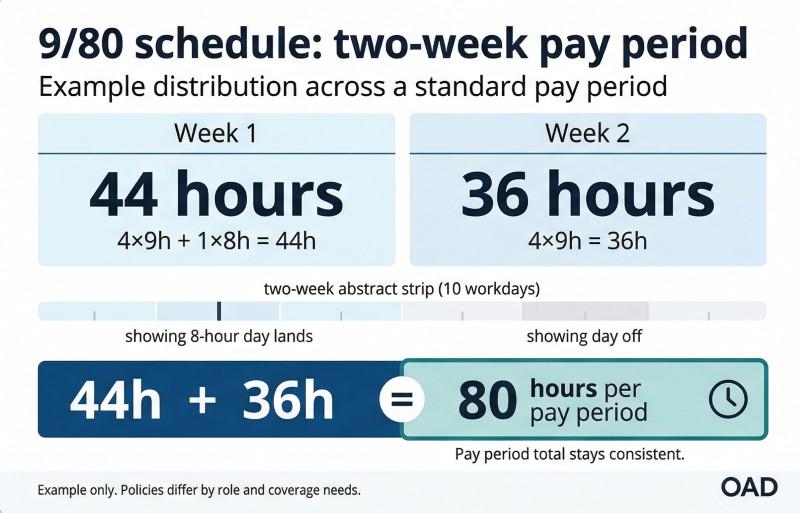
Week 1 (44 hours) and Week 2 (36 hours)
Here’s a simple example that matches the most common pattern (eight nine-hour days plus one eight-hour day, with one Friday off):
Week 1
- Monday: 9 hours
- Tuesday: 9 hours
- Wednesday: 9 hours
- Thursday: 9 hours
- Friday: 8 hours
Total paid time in the calendar week: 44 hours
Week 2
- Monday: 9 hours
- Tuesday: 9 hours
- Wednesday: 9 hours
- Thursday: 9 hours
- Friday: Off
Total paid time in the calendar week: 36 hours
Across the two weeks, employees work 44 + 36 = 80 hours, across nine workdays.
That is the employee-facing story. The HR-facing story is how that Friday is treated for timekeeping and overtime pay.
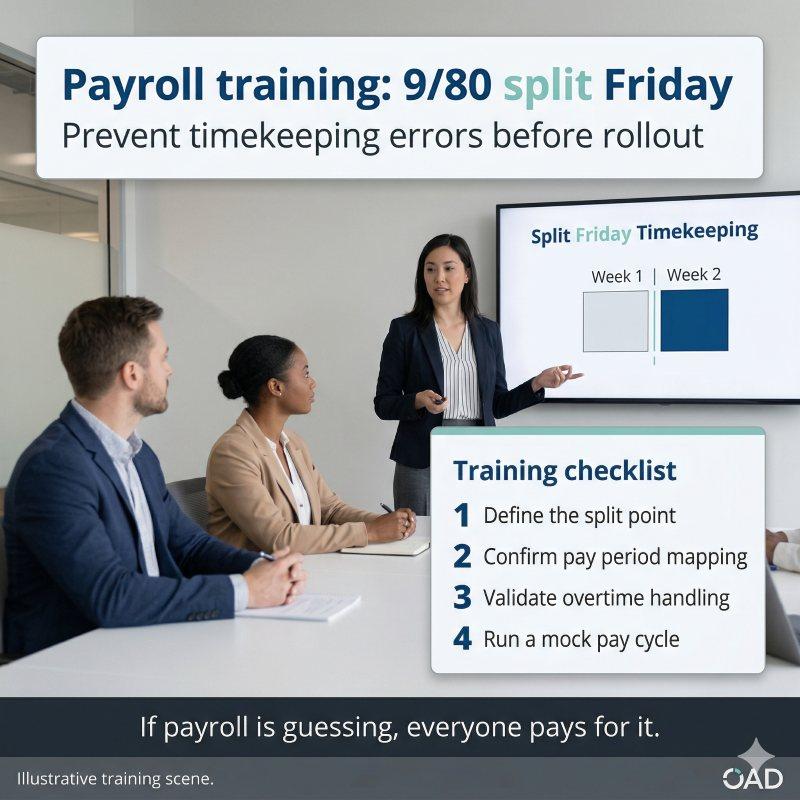
The split Friday explained (how it creates two workweeks)
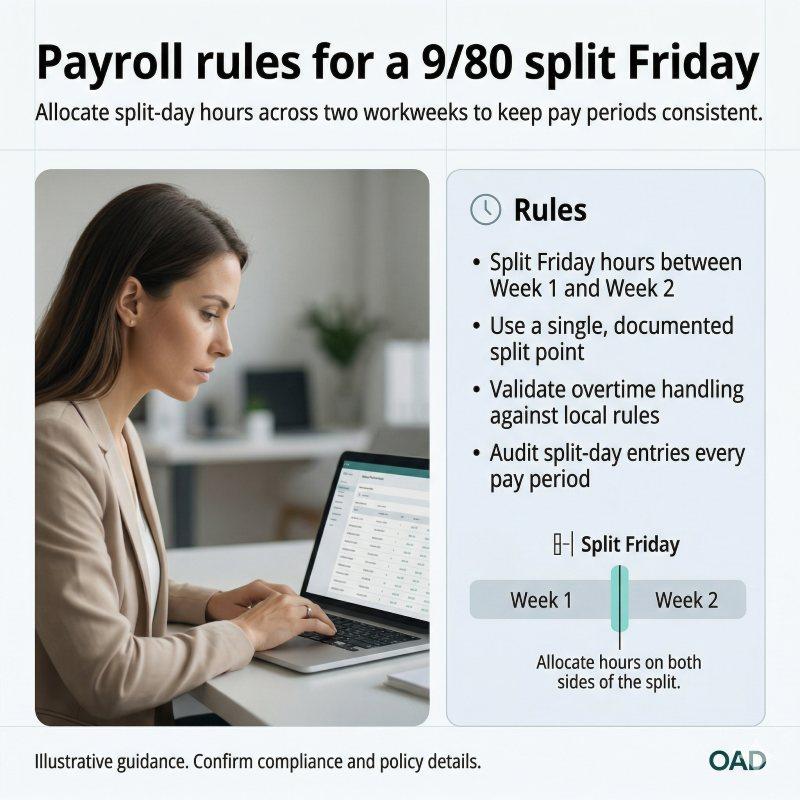
In a typical 9/80 schedule, the eight-hour Friday is split into two chunks, often 4 hours in the first workweek and 4 hours in the second workweek.
That means, for payroll purposes, the “workweek” is not Monday to Sunday. It’s often defined as Friday midday to Friday midday (or a similar split point), so each workweek totals 40 hours:
- Workweek A: includes four nine-hour days (36 hours) plus the first 4 hours of Friday = 40 hours
- Workweek B: includes the second 4 hours of Friday plus four nine-hour days the following week = 40 hours
This is why people ask “how many hours” and get different answers depending on whether they mean calendar week or defined workweek. Employees see 44 hours in the first calendar week. Payroll may still see 40 hours in that defined workweek if the split is configured correctly.
If you do not define the workweek and split correctly, you can unintentionally stack hours into one workweek and trigger overtime pay for non-exempt employees.
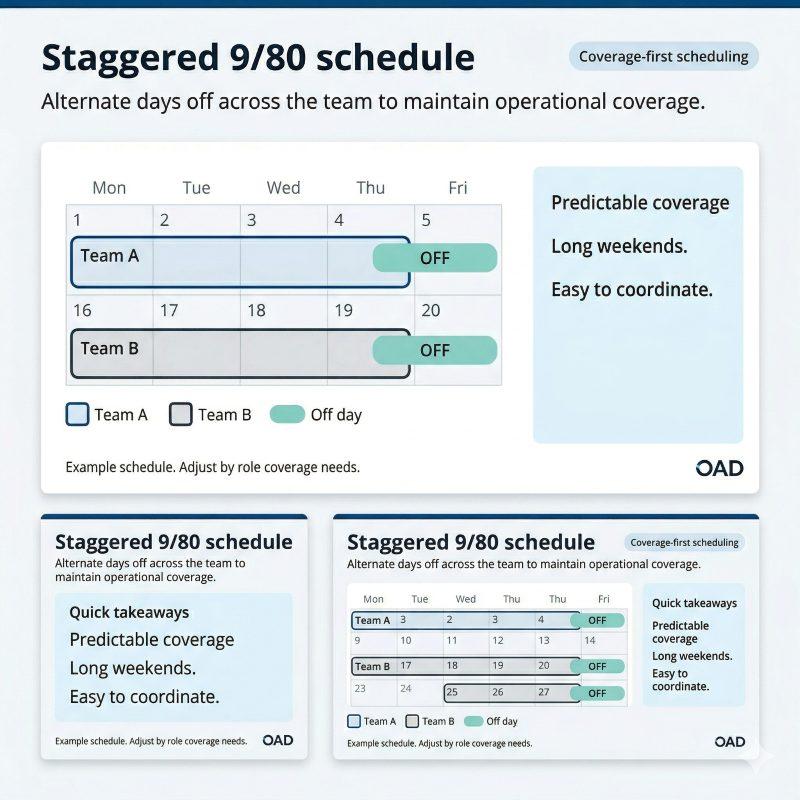
Alternating day-off model for coverage
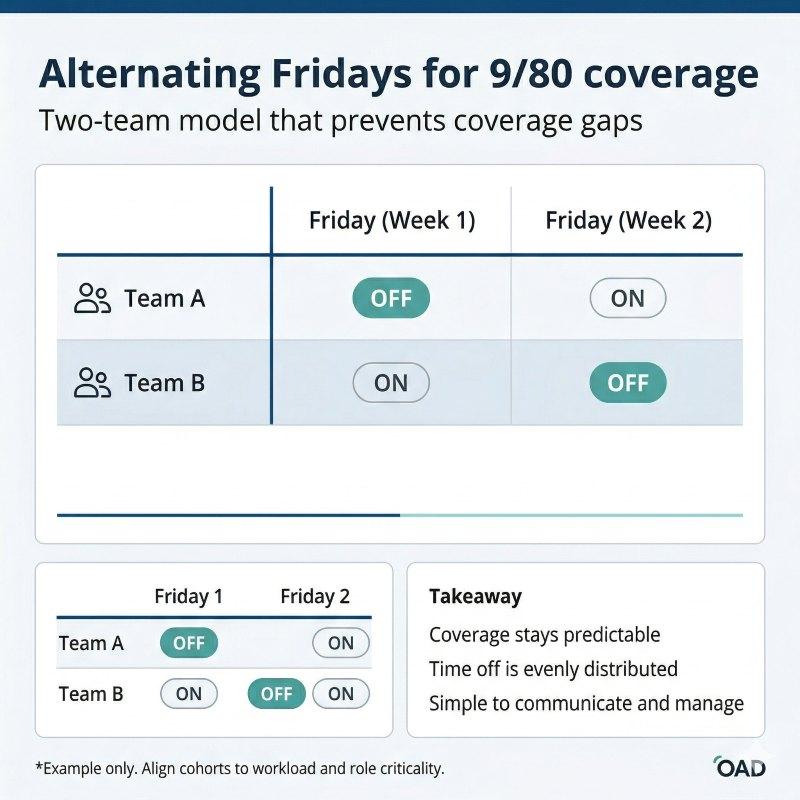
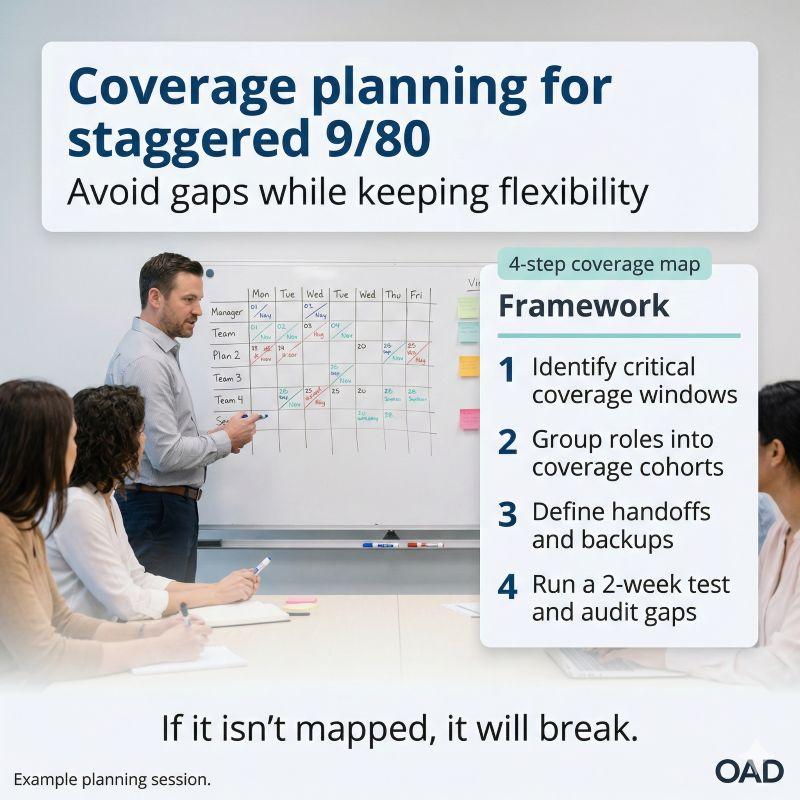
The “everyone is off the same Friday” version looks great on paper until you run into operational coverage. Many organizations solve this with an alternating day roster:
- Group A is off every other Friday (for example, the first Friday off in the cycle)
- Group B is off the opposite Friday
This gives the business consistent end-of-week coverage while still delivering the three-day weekend benefit to employees on alternating cycles.
The tradeoff is coordination. When teams are staggered, meeting schedules, approvals, and handoffs need a basic operating rule-set. If you do not define those rules, you often get collaboration friction that quietly offsets the performance gains from deeper work blocks.
Payroll, compliance, and overtime (what HR must get right)
This is the part most people managers want to skip. It is also the part that decides whether the rollout becomes a retention win or an HR fire drill.
A 9/80 schedule changes how hours fall within a workweek, which can affect overtime pay, especially for non-exempt employees. The details vary by country and, in the U.S., by state. You do not need to be a lawyer. You do need a process that prevents sloppy timekeeping and inconsistent manager exceptions.
FLSA basics: defined workweek and overtime exposure
In U.S. contexts, overtime is typically calculated based on the employer’s defined workweek, not a two-week pay period. That is why the split Friday exists. It is designed to keep each workweek near 40 hours for most employees, assuming they do not work extra time.
Two practical implications for HR:
- Define the workweek in writing before rollout (often a fixed 168-hour period).
- Align timekeeping and manager behavior so employees do not unintentionally exceed 40 hours in the defined workweek.
If managers treat “the day off” as flexible and still expect extra hours, you can create a scenario where employees work nine-hour days, answer messages on the off day, and accumulate overtime. Employees experience this as “compressed schedule theater.” It harms morale quickly.
Daily overtime laws and why nine-hour days can trigger them
In some jurisdictions, overtime is not only weekly. It can also be daily.
This matters because nine-hour days may trigger daily overtime rules depending on local regulations and the type of alternative workweek arrangement allowed. For global organizations, the safest approach is to treat a 9/80 schedule as a policy that requires jurisdiction-specific review.
Practical HR guidance:
- If you have non-exempt employees, do a country and state scan before you pilot.
- If daily overtime applies, decide whether the 9/80 schedule is limited to exempt employees, limited to certain locations, or redesigned.
Timekeeping rules for split Fridays (payroll purposes)
If your payroll system cannot handle the split Friday cleanly, stop. Fix that first.
A workable timekeeping policy usually includes:
- A clear definition of when the workweek starts and ends
- A rule that Friday hours must be allocated correctly (for example, first four hours into one workweek, second four into the next)
- Guidance for partial-day PTO on a nine-hour day
- Clear manager approval rules for exceptions
Even in exempt populations, timekeeping clarity matters. If employees feel the rules are arbitrary or constantly changing, perceived unfairness rises. Perceived unfairness is one of the fastest accelerants of disengagement.
Non-exempt employees: practical guardrails
If you include hourly employees, guardrails prevent accidental overtime pay surprises and reduce manager inconsistency:
- No “quick calls” on the off day unless it’s true on-call work with compensation rules
- Cap daily hours unless pre-approved
- Standardize break policies across longer workdays
- Clarify “make-up time” rules if someone misses hours midweek
- Train managers on approving exceptions consistently
If you cannot operationalize these guardrails, a 9/80 schedule often becomes a perk for some teams and a headache for others. That split outcome is how you get internal resentment.
Benefits and tradeoffs (work-life balance, retention, performance)
A 9/80 schedule works when the extra day off creates real recovery time and when the longer workdays do not quietly increase total workload. If the business treats the schedule as “same output, plus extra availability,” employees will feel tricked. That is not a retention strategy. That’s just admin-flavored burnout.
Work-life balance: what improves and what does not
What improves for many employees:
- A predictable three-day weekend every other week. That makes caregiving responsibilities, appointments, and travel easier without constant PTO usage.
- Fewer “life admin” interruptions. People can consolidate errands and recovery into the off day rather than breaking up the workweek.
What does not automatically improve:
- Daily energy. Nine-hour workdays can feel fine for some roles and exhausting for others, especially when the work is emotionally demanding, interruption-heavy, or physically active.
- Workload. If the workload remains identical and meeting volume stays the same, employees often experience longer days as pure compression, not flexibility.
If you want the schedule to improve work life balance, the operating model has to respect the intent. That usually means fewer low-value meetings, clearer prioritization, and better focus blocks. Otherwise, the schedule becomes a calendar trick.
Retention and recruiting: when flexible schedules actually help
Flexible work schedules can improve employee retention, but only when employees experience the flexibility as genuine and stable. In practice, retention lifts come from three mechanisms:
- Perceived control. People stay where they feel they can manage their time without punishment.
- Reduced burnout. Recovery time lowers the chance that normal stress becomes chronic.
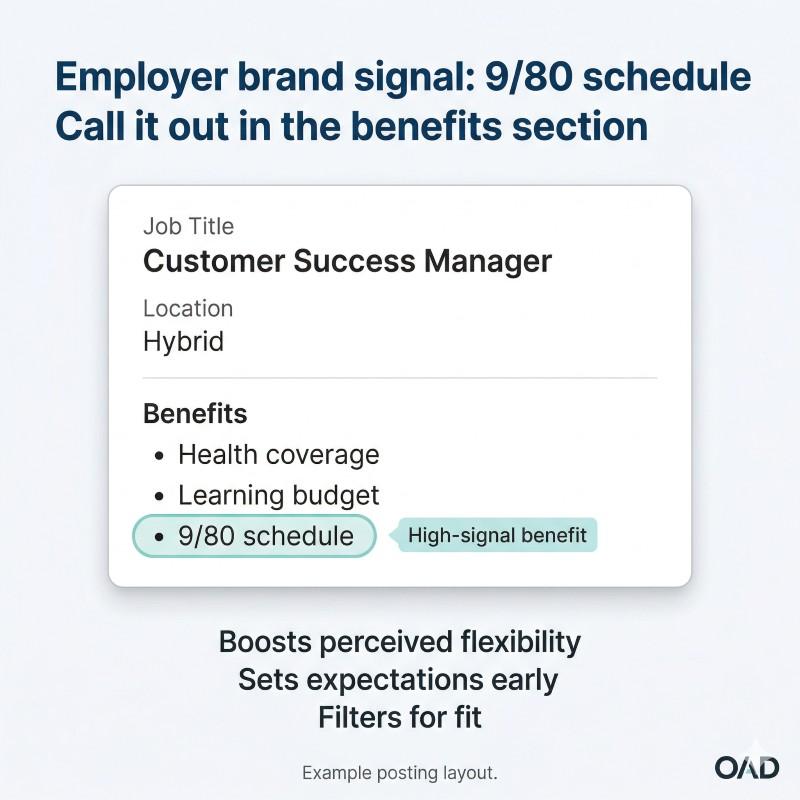
- Signal value. The policy signals trust and modern management, which strengthens employer brand.
The catch: these benefits depend on execution quality. A 9/80 schedule with inconsistent approvals, constant exceptions, or poor coverage planning does not feel flexible. It feels chaotic.
From a talent attraction perspective, this perk is most useful in competitive hiring markets where candidates compare work schedules as part of total compensation. It is especially relevant for professional services and knowledge work, where “flexible schedules” can be the difference between getting a yes and losing a candidate to a competitor, especially when paired with a science-backed hiring system for founders and CEOs.
Performance: deep work gains vs collaboration friction
A 9/80 schedule can improve performance when it creates longer, uninterrupted work blocks. That helps roles where output depends on focus, problem-solving, and cycle time.
Where it can improve performance:
- Project work with defined deliverables
- Analytical work that benefits from sustained attention
- Roles where employees can “batch” tasks effectively
Where performance can slip:
- Cross-team work with frequent handoffs
- Customer-facing teams with unpredictable demand
- Work that depends on real-time collaboration
The common failure mode is meeting design. If your organization already runs meetings poorly, staggered days off and longer workdays do not fix that. They expose it. People end up using the extra hour to catch up on Slack, not deep work. This is especially visible in sales organizations, where using behavioral tools to build and coach winning sales teams can matter as much as the schedule itself.
Risks: fatigue, coverage gaps, fairness issues
The biggest risks are predictable:
Fatigue and burnout risk
Longer workdays increase fatigue for some employees, especially when commutes are long, caregiving is demanding, or the work is socially draining. Fatigue shows up first as lower patience, lower quality, and higher conflict.
Coverage and handoff gaps
If a team is out on alternating Fridays without a clear back-up plan, work stacks up. That creates “catch-up Mondays,” which cancel the recovery benefit of the off day.
Fairness and exception handling
If one employee can “leave early” or swap days informally while another is told “policy is policy,” morale drops. Fairness is not about identical treatment. It is about consistent rules and transparency.
This is why a 9/80 schedule should be treated like a controlled change, not a vibes-based perk. The only reliable way to make it fair is to design it like an operating system: roles, rules, exceptions, and measurement. For acquisitions and major org changes, behavioral due diligence for PE firms can surface culture and leadership risks before they collide with new schedules and policies.
How to implement a 9/80 schedule (90-day pilot plan)
If you roll this out company-wide on day one, you are choosing pain. A 9/80 schedule is simple for employees and complex for the organization. Pilot it.
A 90-day pilot is long enough to see real patterns in productivity, engagement, and absenteeism, and short enough to reverse without major reputational damage if it does not work.
Pick the right pilot teams and roles
Select teams where:
- Demand is predictable and coverage can be planned
- Work can be measured by output or cycle time
- The manager has a track record of consistent decision-making
- Cross-team dependencies are manageable
And make sure employees have individual, secure access to their behavioral data and feedback via personalized application access for every employee.
Avoid starting with:
- Frontline, shift-based, or high-volume service environments
- Teams with frequent urgent escalations
- Roles where daily overtime laws create high compliance risk
If you want the pilot to tell the truth, you need a clean test environment. Otherwise, you will confuse “9/80 doesn’t work” with “we piloted it in the hardest possible place.” Behavioral fit tools like Job Behavior Insights for role alignment can also help you select pilot roles where the schedule is most likely to work.
Pilot success metrics (output, cycle time, absenteeism, turnover)
Pick a small set of metrics that match the work, then track them weekly:
- Output metrics: completed tickets, closed projects, processed cases, shipped deliverables
- Cycle-time metrics: time from request to completion, approval turnaround time, backlog age
- Absenteeism: sick leave frequency and patterns (especially around longer workdays)
- Quality signals: rework, defect rates, customer complaints, missed handoffs
- Voluntary turnover and intent-to-stay: track resignations and use a short pulse question monthly
The goal is not to prove the schedule is amazing. The goal is to detect whether it creates net improvement without hidden costs.
Manager training and exception handling
Managers decide whether the schedule feels fair. Train them on, and consider giving them behavioral coaching tools for leaders so they can tailor how they set expectations and support different team members:
- What counts as an exception and how to approve it
- How to handle coverage when someone is out sick on a nine-hour day
- How to prevent “off-day work creep” (messages, quick calls, informal asks)
- How to run meetings so staggered schedules do not create chaos
If you do not train managers, you will get inconsistent rules. Inconsistent rules are perceived as favoritism. Favoritism kills trust.
Internal communication essentials
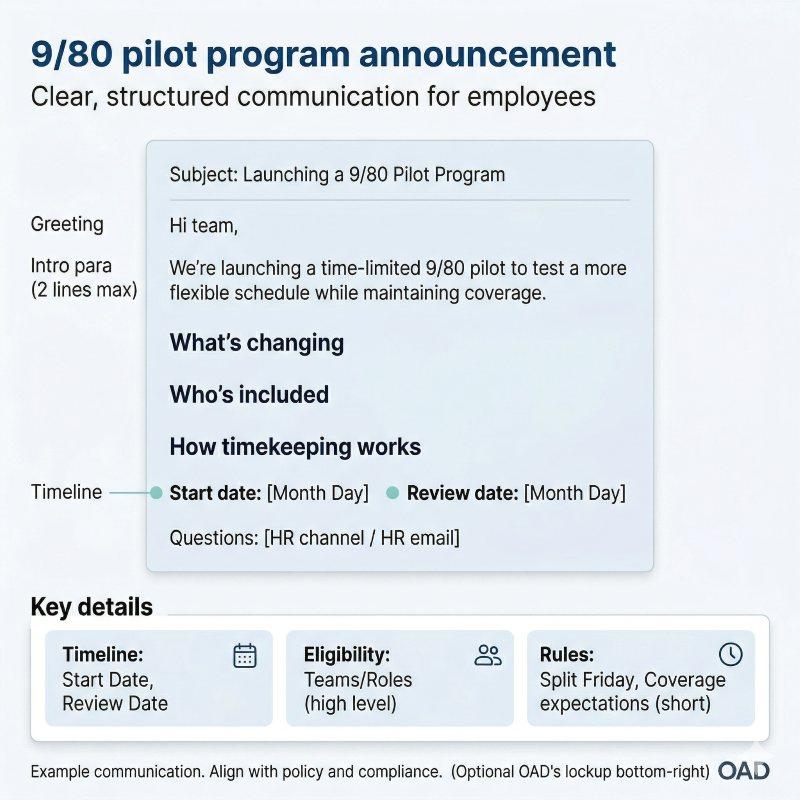
Your rollout message should set expectations clearly:
- Why the organization is piloting the schedule
- How success will be measured
- What employees can expect day-to-day
- What is not changing (workload expectations, performance standards)
- How employees can give feedback safely
A simple line to include: “This is a pilot. We will keep what works and adjust what doesn’t.”
OAD behavioral-data lens: detect fit, friction, and flight risk early
A schedule change is also a behavior change. Some people thrive with longer workdays and consolidated recovery time. Others experience it as a steady drain. The same policy can increase retention in one team and increase flight risk in another, depending on their underlying motivational drivers and behavioral needs.
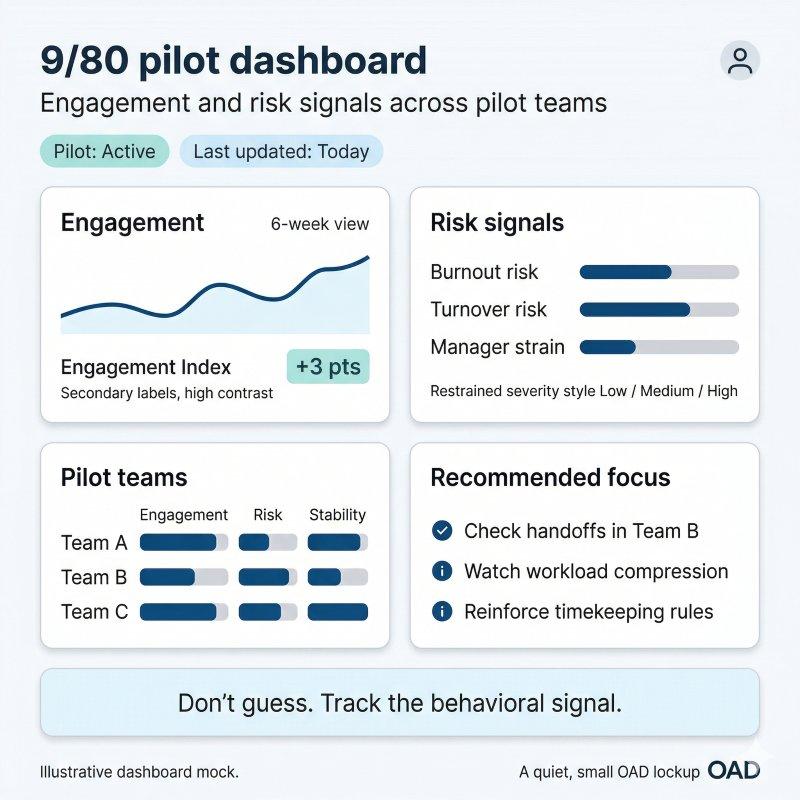
This is where behavioral data becomes useful. Instead of relying on manager impressions alone, you can monitor whether the pilot is changing using tools like Risk & Readiness Alerts for burnout and flight risk:
- Engagement and job satisfaction signals
- Stress and burnout risk indicators
- Team friction patterns that predict turnover
- Manager behavior consistency (the hidden driver of perceived fairness)
If you want to run the pilot with fewer surprises, start by scanning for role and team risk factors before rollout, then measure engagement shifts during the pilot.
If you want to see how a schedule change might affect different roles and teams before you commit, you can use the OAD Survey personality assessment with a pilot group and compare outcomes using structured behavioral data instead of gut feel.
Policy details HR can’t ignore (PTO, holidays, paid time)
This is where good intentions go to die: paid time rules that were built around an eight hour day suddenly have to work in a world of nine-hour days and split Fridays. If you do not document the rules up front, managers and payroll will improvise. Improvisation is expensive.
PTO on nine-hour days (full day, partial day, sick leave)
On a 9/80 schedule, a “day” is not always eight hours. Decide what a full day of PTO means for employees working nine-hour days.
Common policy approaches:
- PTO tracked in hours. A full day off equals the scheduled hours for that day (9 hours on most weekdays, 8 hours on the split Friday). This is the cleanest for accuracy.
- PTO tracked as days with conversion rules. This can work, but it often creates confusion unless the conversion is explicit and consistent.
Also define partial day scenarios:
- If an employee needs to leave early on a nine-hour day, how many hours are charged?
- If someone is sick for half a day, what is the minimum increment?
- What happens if someone takes PTO on the split Friday? Which workweek gets those hours for payroll purposes?
If your teams have hourly employees, clarity matters even more. You want policies that reduce disputes, not create new ones.
Holiday pay when a holiday falls on a nine-hour day
Holidays are another trap. If a holiday falls on a day when the employee was scheduled for nine hours, the policy has to define whether holiday pay covers:
- The scheduled hours (9), or
- A standard day (8), with make-up rules
Either choice can be defensible, but inconsistency is not. Document:
- How holiday pay is calculated by role type (exempt vs non-exempt)
- Whether employees must use paid time to “top up” a holiday if the policy only covers eight hours
- What happens when a holiday falls on the scheduled day off
- Whether floating holidays exist and how they interact with nine-hour days
Documentation checklist (so payroll doesn’t improvise)
If you want the schedule to run smoothly, publish the essentials in one place:
- Defined workweek start and end time (especially for split Friday timekeeping)
- Timekeeping instructions for split Fridays
- PTO accrual rules and usage examples for nine-hour days
- Holiday rules with at least three examples (holiday on a nine-hour day, holiday on split Friday, holiday on the day off)
- Overtime and premium pay rules for non-exempt employees (including daily overtime where applicable)
- Exception approval rules (who approves, what qualifies, how it’s recorded)
- Coverage expectations for alternating day rosters
Decision checklist for HR leaders (go/no-go)
A 9/80 schedule is a decision with operational consequences. Use this as a go/no-go filter before you scale beyond a pilot.
[Image: HR leader using a checklist during a policy review meeting. Alt: “Decision checklist for HR leaders considering a 9/80 schedule”]
Operational coverage and client-facing feasibility
- Can client-facing teams maintain service levels on staggered schedules?
- Do you have a clear escalation path on off days?
- Are handoffs and approvals structured enough to prevent bottlenecks?
- Will the schedule increase “catch-up Mondays” due to work stacking?
If your operation depends on real-time availability, you need a coverage model first. The schedule does not create coverage. People do.
Payroll readiness and legal review
- Can your payroll system handle split Fridays without manual workarounds?
- Do managers and employees understand the defined workweek for payroll purposes?
- Have you reviewed daily overtime laws and local regulations for every impacted location?
- Do you have a written policy and training plan before launch?
If the answer is “we’ll figure it out,” you are not ready. Payroll errors are not neutral. They destroy trust fast.
Employee preference and cultural readiness
- Have you gathered employee preferences via survey or focus groups?
- Do employees have constraints that make nine-hour days difficult (caregiving, commute, health)?
- Do managers have the maturity to run a schedule with consistent exceptions?
- Is autonomy real, or does the culture rely on constant visibility?
A 9/80 schedule works best in cultures that reward output and clarity, not constant availability.
ROI hypothesis you can measure (and defend)
Decide what “success” means before the pilot begins:
- Reduced absenteeism?
- Improved engagement?
- Faster cycle times?
- Lower voluntary turnover?
- Better recruiting outcomes?
If you cannot define the outcome, you cannot defend the policy when tradeoffs appear.
FAQ: People Also Ask about 9/80 schedules
Place this section near the end so it can support FAQ schema later and satisfy common search intent quickly.
How many hours is a 9/80 schedule?
A 9/80 schedule is 80 hours over a two week period, worked across nine workdays. Most employees work eight nine-hour days and one eight-hour day, with one day off every two weeks. In calendar terms, employees often work 44 hours the first week and 36 hours the second week, even though payroll may treat each defined workweek as 40 hours when the split Friday is configured correctly.
How does overtime work on a 9/80 schedule?
Overtime depends on local law and how the employer defines the workweek. In many U.S. setups, overtime is calculated weekly, not across a two week pay period. That is why the split Friday exists: it can help keep each defined workweek at 40 hours. For non-exempt employees, extra hours, off-day work, and mis-tracked split Fridays can trigger overtime pay. In some jurisdictions, daily overtime laws can also apply to nine-hour days.
How do you calculate PTO and holiday pay on nine-hour days?
The cleanest method is to track paid time in hours, not days, and charge PTO based on the employee’s scheduled hours for that day (often nine hours on most weekdays). For holidays, the policy must define whether holiday pay covers scheduled hours or a standard eight-hour day, and what happens when a holiday falls on the scheduled day off. Document examples in the policy so managers do not improvise.
Which roles should not use a 9/80 schedule?
Roles that require continuous coverage, frequent urgent handoffs, or high-volume frontline availability often struggle without a strong coverage plan. Many hourly employee groups also require more compliance review due to overtime pay exposure and daily overtime laws in certain jurisdictions. If your work is interruption-heavy and meeting-driven, the extra hour can increase fatigue without improving output.
Is a 9/80 schedule the same as a compressed work schedule?
A 9/80 schedule is a type of compressed work schedule. “Compressed schedule” is the broader category that includes variations like 4/10 (four ten-hour days) and other arrangements that compress full-time hours into fewer workdays.
Next steps
A 9/80 schedule can improve work life balance, employee morale, and retention, but only when the operational design is solid: coverage, timekeeping, PTO, and manager consistency.
If you want to reduce risk, run it like a controlled pilot:
- Define the workweek and timekeeping rules up front
- Use alternating day rosters where coverage matters
- Track cycle time, absenteeism, engagement, and voluntary turnover
- Train managers on exceptions and fairness rules
If you want to see how different teams and roles are likely to respond before you scale, start with the free Top Performer Profile: 7 minutes, results in 24 hours, no credit card. You can compare engagement and retention risk signals using structured behavioral data instead of relying on manager impressions alone.