Hiring for “skills” is easy. Hiring for how someone behaves when deadlines hit, priorities change, or customers get difficult is where most teams quietly bleed money.
Personality data can help, but only if you treat it like decision support, not a verdict. Used well, a science-backed system like OAD sharpens job fit, improves structured interviews, and reduces bad hires. Used badly, it becomes corporate astrology with nicer charts.
Why assess personality traits in the hiring process?
What personality assessments can and cannot predict
What they can do:
- Add signal about behavioral tendencies that are hard to observe in a short interview: reliability, stress tolerance, teamwork style, learning orientation.
- Help you standardize parts of the evaluation process, especially when hiring managers interpret “culture fit” differently.
- Improve decision quality when you use them to ask better interview questions, not to auto-filter candidates.
What they cannot do:
- They do not predict job performance on their own with high precision. Personality is one input among several, and it works best when paired with structured methods.
- They cannot “prove” someone will behave a certain way in every situation. Context matters: manager, workload, incentives, team norms.
- They should not be used as a replacement for job-relevant evidence like work samples, structured interviews, or reference checks.
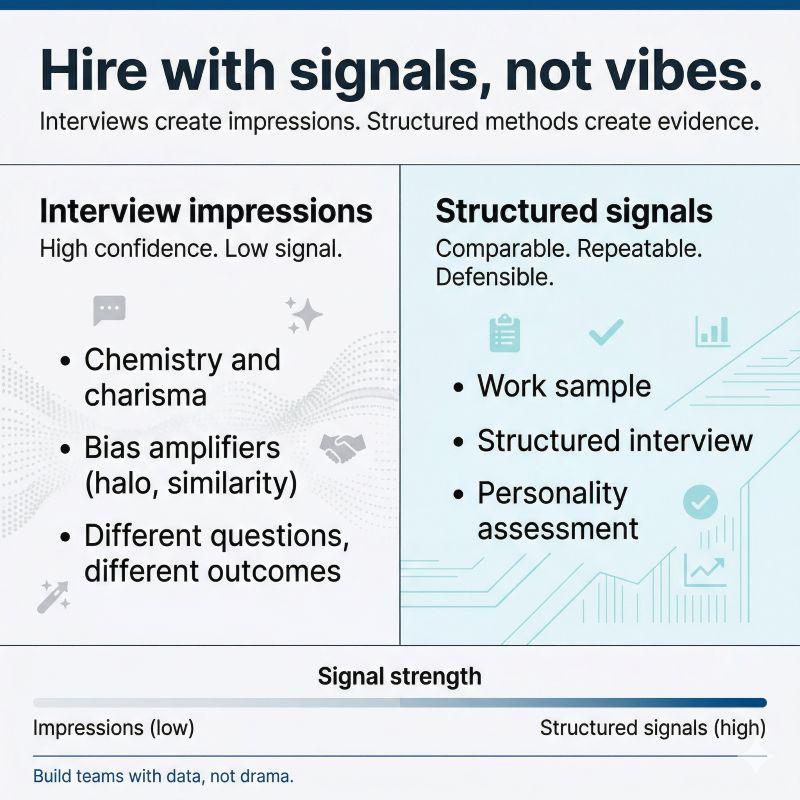
If you want one mental model: personality assessments are best at improving how you evaluate, not at acting as the evaluation.
When they help most (and when they backfire)
They help most when:
- You hire for roles where day-to-day success depends on consistent behavior (follow-through, attention to detail, staying calm under pressure).
- You have multiple interviewers and need a shared language to reduce “same person, different ratings.”
- You use results to drive behavior-based probing (“Tell me about a time you…”) instead of relying on vibes.
They backfire when:
- You use “type labels” as shortcuts and confuse them with competence.
- You treat the score like a pass/fail gate instead of a hypothesis to test.
- You run assessments without role clarity, then retroactively decide what a “good profile” looks like.
There’s also a real-world constraint: in hiring, candidates have an incentive to present themselves in the best possible light. Research on applicant “faking” suggests predictive validity tends to drop in high-stakes selection contexts, even if useful signal remains.
Which personality traits predict job performance? Use the Big Five (OCEAN)
If you want personality data that can actually support hiring decisions, anchor it in the Big Five (OCEAN) model:
- Openness to Experience
- Conscientiousness
- Extraversion
- Agreeableness
- Neuroticism (often reported as the inverse: Emotional Stability)
Why Big Five? Because it’s a trait model with decades of research behind it, and it avoids the “personality types” trap where people get boxed into labels that sound clean but predict little. Meta-analytic work has consistently found that conscientiousness is the most consistent trait predictor across jobs, while other traits matter more depending on role and what “performance” means in that context.

Conscientiousness (most consistent across roles)
Conscientiousness covers things like reliability, persistence, organization, follow-through, and impulse control. In plain hiring terms, it answers: Will this person do what they said they’d do, consistently, when nobody is watching?
Across occupations and performance criteria, conscientiousness shows the most consistent relationship with job performance in classic meta-analytic findings (estimated true correlations often reported around the low .20s).
Two practical implications for hiring managers:
- If you’re hiring for roles where mistakes are costly or follow-through is non-negotiable, conscientiousness belongs in your decision model.
- Treat it as risk reduction, not talent detection. High conscientiousness does not mean high skill. It often means fewer preventable problems.
One caution: in applicant settings, the observed predictive link can be smaller than what you see in incumbent studies, partly because hiring is a high-stakes context and people manage impressions. A recent meta-analysis focused on conscientiousness reported an overall correlation around r = .17 with job performance and flags sample/design issues that can inflate estimates.
Emotional stability (high-pressure work)
“Emotional stability” is basically low neuroticism: steadier mood, lower reactivity to stress, better recovery after setbacks.
This trait matters more when the job includes:
- High ambiguity
- Customer conflict
- Time pressure
- Frequent negative feedback
- High stakes (financial, safety, reputation)
If you’re screening for a role where people get hit with stress daily, emotional stability helps you estimate whether the candidate’s baseline coping style will support consistent performance. Big Five research summaries typically find it relates to performance outcomes, but usually less universally than conscientiousness.
Hiring translation: emotional stability is a load-bearing trait for roles that punish emotional volatility.

Openness (learning, change, creative roles)
Openness is about curiosity, learning orientation, comfort with new ideas, and adaptability to change.
It tends to matter more when the role requires:
- Problem solving in novel situations
- Learning new tools fast
- Working in changing environments
- Creativity or experimentation
Big Five meta-analytic findings suggest openness is not a universal predictor of core task performance across every job, but it becomes more relevant when the outcome is training proficiency or work that rewards innovation and learning.
Hiring translation: openness is a future-proofing trait. It’s valuable when the job is evolving faster than your job description can keep up.
Extraversion and agreeableness (role-dependent)
These two traits are where a lot of teams mess up, because they confuse “pleasant in the interview” with “effective in the job.”
Extraversion tends to matter more in jobs with heavy social influence demands, like sales or some leadership roles. Meta-analytic results have found extraversion is more predictive in occupations like managers and sales than across all jobs.
Agreeableness can support collaboration, service orientation, and conflict management, but it can be a downside in roles that require tough negotiation, direct performance management, or high confrontation tolerance.
Hiring translation:
- Extraversion is not “confidence.” It’s social energy and assertiveness.
- Agreeableness is not “kindness.” It’s cooperation and conflict avoidance.
Neither is inherently good or bad without role context.
Quick mapping: traits by job type (3 mini examples)
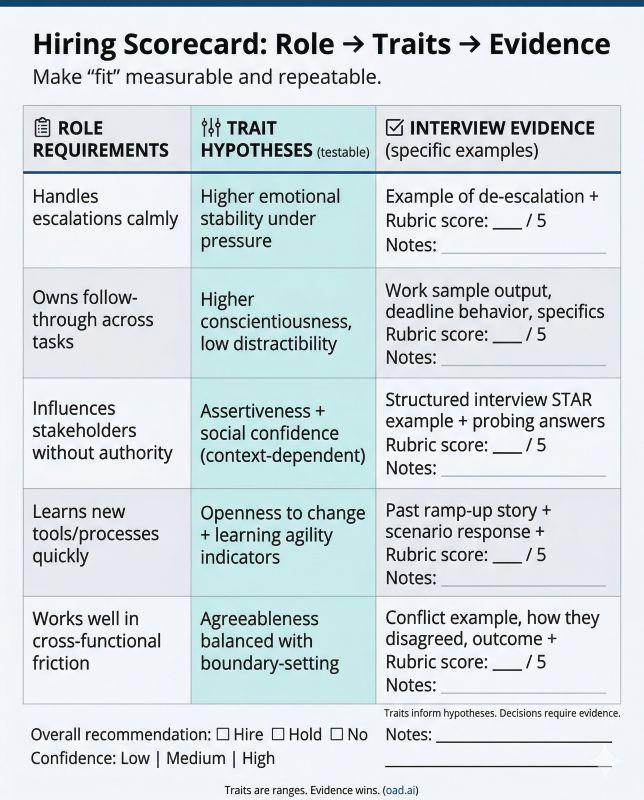
This is the part most hiring processes skip: translating traits into job requirements instead of vibes.
Customer service representative
- Likely helpful: emotional stability (stress), agreeableness (service), conscientiousness (process consistency)
- Watch for: low emotional stability plus high exposure to conflict
Data analyst
- Likely helpful: conscientiousness (accuracy), openness (learning tools), moderate introversion can be fine
- Watch for: low conscientiousness if quality depends on detail and documentation
People manager
- Likely helpful: conscientiousness (consistency), emotional stability (pressure), extraversion (influence), agreeableness (team climate)
- Watch for: extreme agreeableness paired with low assertiveness if the role requires hard calls
The key is weighting traits based on what the job demands, not based on what your team “likes.”
How to assess personality traits in job candidates
Personality assessments only become useful when they’re anchored to a job-relevant question. Otherwise you get “interesting insights” that never improve the hiring decision.
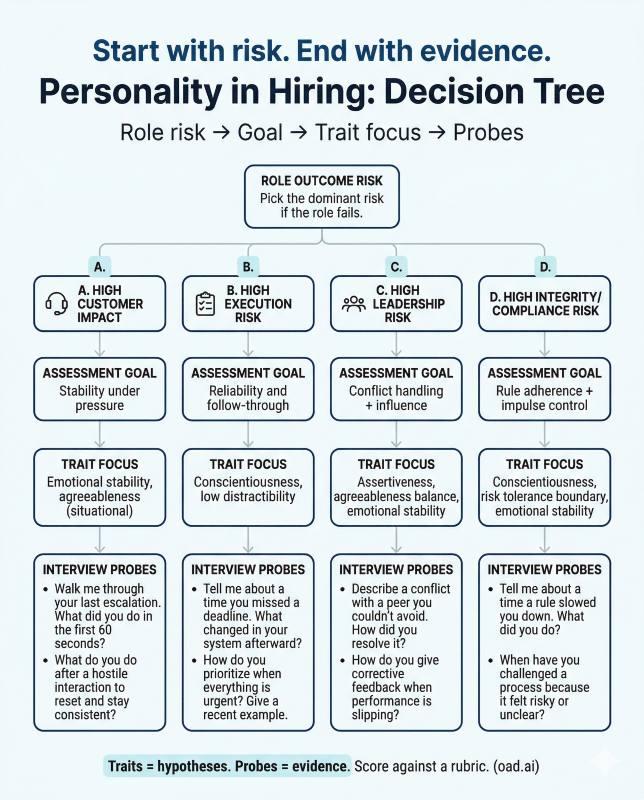
Set the assessment goal (job fit, team dynamics, leadership risk)
Pick one primary goal per role. Secondary goals are fine, but one goal needs to drive the setup.
1) Job fit (day-to-day execution)
Use this when success depends on consistency: process adherence, quality control, attention to detail, reliability.
What you measure: traits tied to dependable execution (often conscientiousness) and pressure tolerance (emotional stability) where relevant.
2) Team dynamics (how they work with others)
Use this when coordination and collaboration are core: cross-functional roles, matrix environments, client-facing teams, and you need behavior fit reports that match role to personality.
What you measure: role-specific interpersonal tendencies (often agreeableness and extraversion, plus communication style indicators). Treat this as a “how” signal, not a “hire/no hire” gate.
3) Leadership risk (derailers under pressure)
Use this when the role holds power or leverage: people managers, executives, high-impact IC roles, and you want proactive risk alerts that flag turnover and team-fit issues.
What you measure: stress responses, impulse control, interpersonal risk patterns, and consistency in judgment. This is where occupational personality tools can be most useful.
If the goal is unclear, fix the role definition. Don’t “hope the test tells you.”
Choose the right tools (validated assessments, not “types”)
A practical rule: traits beat types for hiring.
- Traits are measurable dimensions. They support weighting and comparison.
- Types create categories that sound decisive but often collapse nuance and encourage overinterpretation.
That doesn’t mean “types” are useless. It means they should be treated as a shared language tool (communication style, team reflection), not as a selection tool.
What you want for hiring is a tool that, like the OAD Survey with psychometric precision,:
- Is designed for workplace use (not general self-discovery)
- Has documented evidence for reliability and validity
- Produces results you can translate into behavior-based interview questions
- Can be administered consistently across candidates
Reduce skewed results (faking-good, coaching, context effects)
Yes, candidates can game assessments to a degree. You don’t solve this by pretending it doesn’t happen. You solve it by designing the process so one instrument can’t dominate the outcome.
Use these controls:
1) Don’t rely on a single score.
Treat the assessment as one signal inside a candidate profile that includes structured interviews and job-relevant exercises.
2) Use consistency checks.
Many reputable tools include response-consistency indicators or impression-management scales. You don’t need to accuse anyone of lying. You use it as a flag to probe further.
3) Probe for behavioral evidence.
If a profile suggests high conscientiousness, ask for specifics:
- How do you track work?
- How do you prevent mistakes?
- What do you do when priorities collide?
If it suggests emotional stability, probe:
- Tell me about your last high-pressure week.
- What went wrong?
- What did you do next?
4) Standardize the context.
Same instructions, same time window, same point in the hiring process. If one candidate takes it after a great interview and another takes it after a rejection scare, results can drift.
Personality tests and tools: what to use, what to avoid
This is where hiring processes go off the rails: teams pick a “popular test,” then reverse-engineer meaning from the report. Do it the other way around. Define what you need to predict, then select tools that can credibly support that, ideally using a validated OAD Survey tool that reveals fit before the interview.
What “validated” means (test’s validity, reliability, fairness)
In practical terms, you want three things:
Reliability: the tool measures consistently (not random noise).
Validity: the tool relates to job-relevant outcomes (job performance, training success, retention).
Fairness and defensibility: the tool is appropriate for the population and used consistently, with documentation that it’s job-related.
If you can’t explain in one paragraph how the tool is job-related and how you use it in the evaluation process, you’re not “data-driven.” You’re decorating.
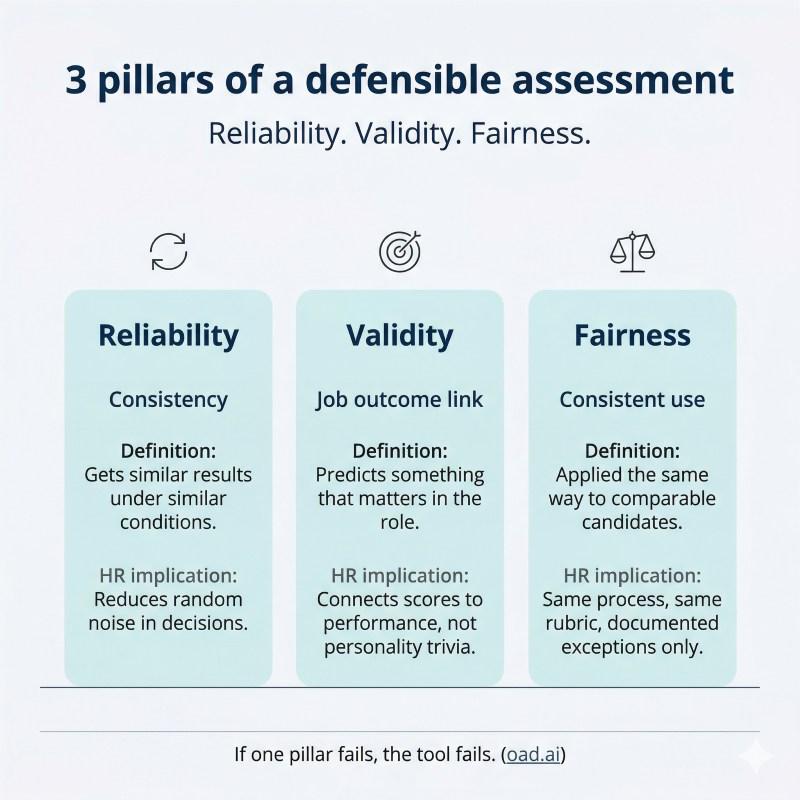
MBTI and DISC: useful for communication style, weak for hiring
MBTI (Myers-Briggs Type Indicator)
MBTI can be helpful as a shared language for team reflection and communication. It is not designed to predict job performance, and even its publisher’s guidance restricts it from selection decisions.
Hiring translation: MBTI is fine for workshops. It is not a hiring tool.
DISC / DiSC
DISC-style tools are often used to describe behavioral tendencies and communication style at work. The problem is not that “DISC is always bad.” The problem is that many DISC implementations are not built or validated for selection decisions, and teams treat behavioral labels like they equal capability.
Hiring translation: DISC can help you discuss work styles, but do not use it as the sole filter for qualified candidates unless the specific instrument you’re using is validated for selection, for your population, and you can document job-relatedness.
Role-oriented tools (Hogan, SHL OPQ, Predictive Index, 16PF)
If you want workplace-relevant outputs, you typically look for instruments built for occupational contexts that can surface motivation insights about what truly drives your hires.
- Hogan Personality Inventory (HPI) and related Hogan tools are commonly used for occupational personality and leadership contexts, including risk patterns under stress. Treat them as a structured input for leadership screening and targeted probing, not as an automatic pass/fail gate.
- SHL Occupational Personality Questionnaire (OPQ) is positioned as work-focused trait profiling and is often used in corporate assessment settings.
- Predictive Index, 16PF, and similar tools can be used responsibly when they provide role-relevant trait outputs and have documentation you can stand behind.
Key point: the tool name is not the important part. The important part is whether it helps you make more consistent, job-related decisions and whether you can support its use.
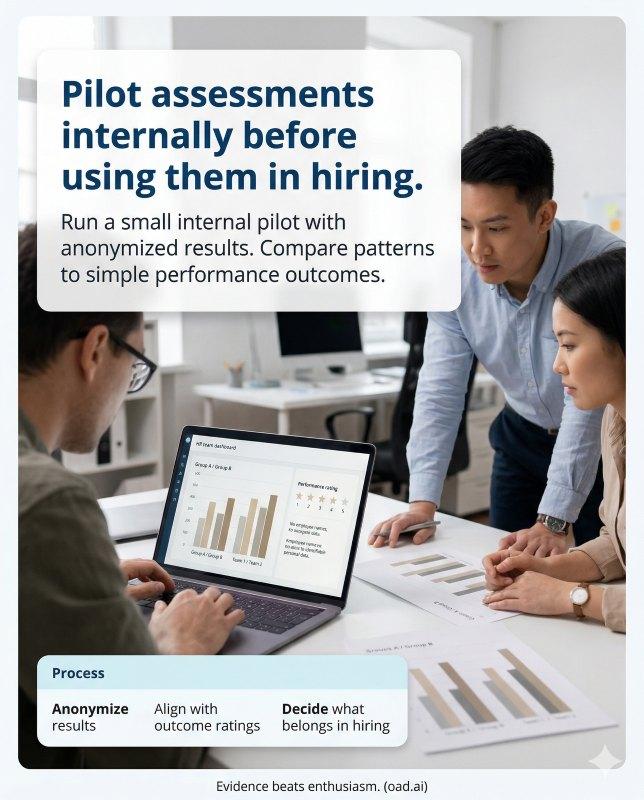
Pilot with current employees before rollout (fast, practical method)
Before you push any assessment into your recruitment process, run a pilot and consider how a tool like the OAD platform’s scalable pricing for behavioral insights will fit your hiring volume and budget:
- Pick one role with clear success metrics.
- Assess a small group of current employees (mix of high performers and average performers).
- Compare patterns directionally. You’re not publishing a paper. You’re checking whether the outputs are useful and plausibly job-related.
- Use what you learn to write better structured interview probes and adjust weighting.
This step prevents the classic failure mode: adopting a “powerful tool” that produces pretty reports but no measurable improvement.
Stronger prediction: combine personality with cognitive ability tests
Personality can add signal, especially around reliability and stress tolerance. But if your goal is predicting job performance across many job types, cognitive ability measures are consistently among the strongest predictors in selection research.
Why cognitive ability predicts workplace performance
General cognitive ability (often called GMA) tends to relate strongly to performance because it supports learning speed, problem solving, and handling complexity. The classic Schmidt and Hunter meta-analysis is widely cited for showing strong validity for GMA in predicting job performance.
Design teams with data, not gut feel.
Most org-design decisions come down to role fit, leadership style, and team dynamics. OAD reads those signals from a 7-minute behavioral survey, so you can reconfigure roles and teams with evidence instead of guesswork.
How to combine without over-weighting tests
A clean approach for hiring managers:
- Use cognitive ability to estimate learning and problem-solving capacity where the job requires it.
- Use personality traits to estimate behavioral consistency, stress response, and collaboration tendencies.
- Use work samples and structured interviews to confirm job-relevant behavior with real evidence.
This avoids two common mistakes:
- Treating personality as destiny
- Treating cognitive ability as the only thing that matters
Incorporating personality assessments into the hiring decision
If you want assessments to improve hiring outcomes, the output needs to land in a simple place: the candidate scorecard, ideally within behavioral team software that helps you lead with certainty. Not in a PDF nobody reads after the first week.
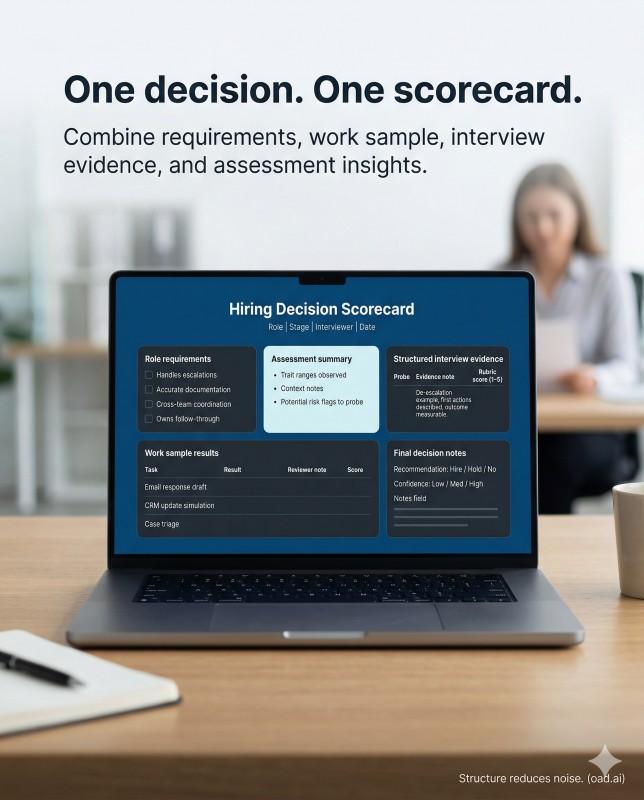
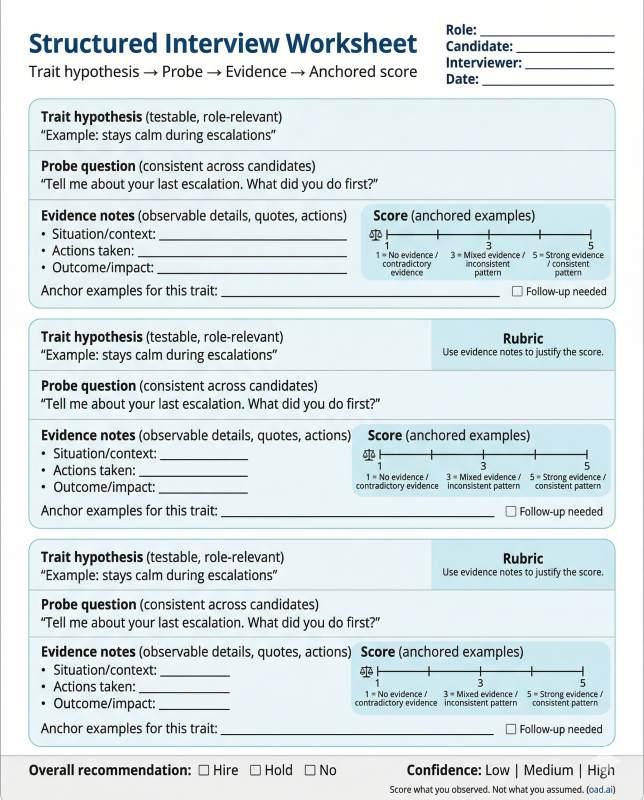
Candidate profile: assessment + structured interview + work sample
Use personality results to generate hypotheses and then test them with evidence.
A practical candidate profile usually includes, where possible, structured behavior fit reports that match role to personality and motivation insights into what truly drives your hires:
- Personality traits / behavioral tendencies: what the candidate is likely to do under typical work conditions
- Structured interview evidence: specific examples anchored to role competencies
- Work sample or job simulation: proof of job-relevant performance
- Reference checks: confirmation of patterns (not “Do you like them?”)
Example: if an assessment suggests lower conscientiousness, you do not auto-reject. You test for it, and for leaders you might pair this with coaching that uses behavioral data to guide development:
- Ask how they track work and prevent errors.
- Look for patterns in work samples (missed requirements, sloppy handoffs, weak documentation).
- Validate with references using behavior-based questions.
This makes assessments valuable without turning them into a blunt instrument.
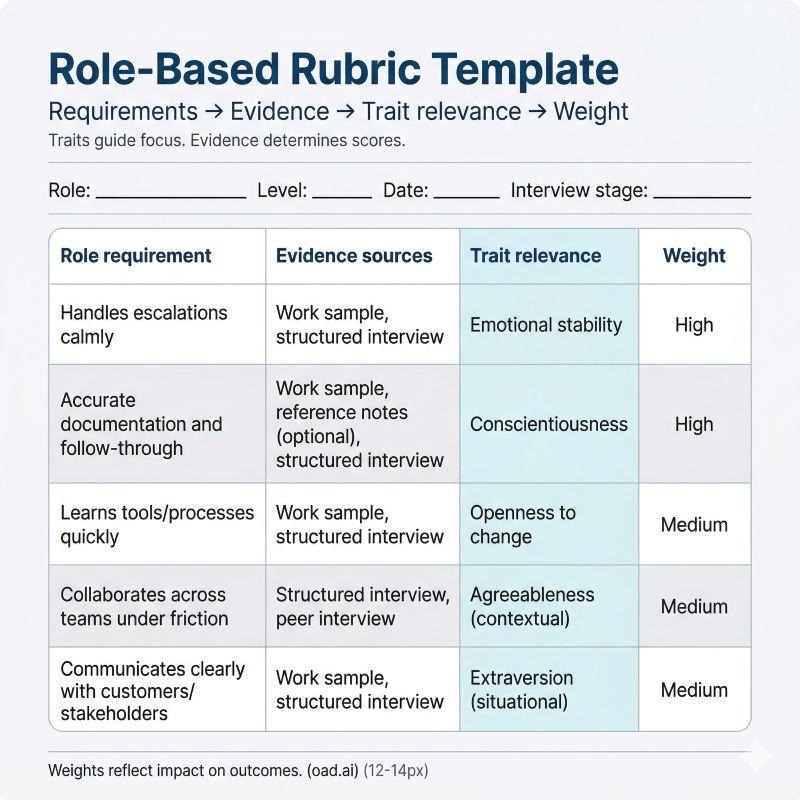
Weighting by role (simple scoring rubric concept)
The fastest way to keep this fair and useful is to define weights before you meet the candidate and combine them with behavioral interview questions that assess cultural fit.
A basic rubric looks like this:
- Define 4–6 role requirements that actually drive job success.
- Decide which traits are most relevant to each requirement.
- Weight them lightly unless the job makes them mission-critical.
Example weighting logic:
- For a compliance-heavy operations role: conscientiousness gets more weight.
- For a high-conflict customer role: emotional stability and agreeableness matter more.
- For a change-heavy growth role: openness becomes more relevant.
The goal is not to find the “perfect candidate.” It’s to avoid predictable mismatches.
Candidate communication and consistency across hiring managers
Candidate experience matters because inconsistency creates noise and legal risk.
Keep the messaging plain:
- Explain the purpose: “This helps us evaluate work preferences and behavioral tendencies relevant to the role.”
- Set expectations: “There are no right or wrong answers, but consistency matters.”
- Be honest: “It’s one input alongside interviews and job-relevant tasks.”
Internally, keep hiring managers aligned, ideally through application access that empowers each team member with secure behavioral profiles:
- One shared scorecard
- One shared interpretation guide (what the scores mean and do not mean)
- One shared rule: no single assessment decides the outcome
This is where a structured system beats gut feel. If two hiring managers see the same candidate and reach opposite conclusions, the problem is rarely the candidate. It’s the process.
Legal, ethical, and cultural fit considerations
This is the part where companies get sued or quietly build biased hiring systems and then act surprised when it backfires.
Cultural fit vs values alignment (reduce bias)
“Culture fit” is often code for “similar to us,” which is a shortcut to homogenous hiring.
A safer, more useful framing is values alignment tied to observable behavior and communication skills assessed systematically in interviews.
Instead of:
- “Would I enjoy working with this person?”
Use:
- “Do they work in ways that match how this team must operate to succeed?”
Define it transparently:
- Decision-making style (fast vs deliberate)
- Feedback norms (direct vs diplomatic)
- Ownership expectations (autonomy vs escalation)
- Collaboration requirements (solo depth vs cross-functional rhythm)
Then assess those behaviors consistently in structured interviews.
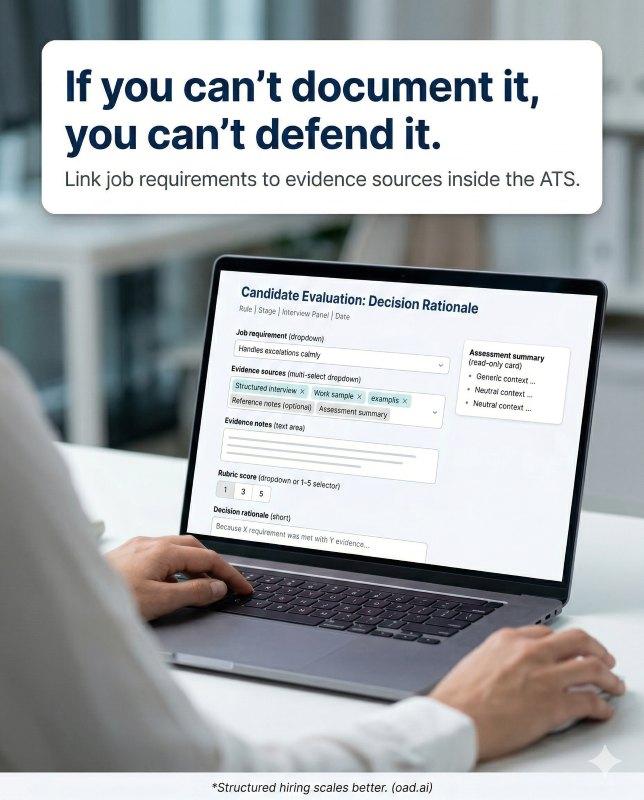
Documentation and consistency (defensibility)
If you use personality assessments in hiring, you need a defensible workflow:
- Use tools that are validated for workplace use and appropriate for your candidate population.
- Administer them consistently: same stage, same instructions, same time window.
- Document how results are used: as a structured input, not as an automated rejection engine.
- Keep decision records tied to job requirements and evidence.
For US-leaning global practice: if you operate in the US, the EEOC and related legal standards push you toward job-relatedness and consistent selection procedures. If you operate across regions, assume scrutiny will vary, but the safest baseline is the same: job-related, consistent, documented—especially for investors or PE firms who also need behavioral hiring strategies to protect ROI post-acquisition.
FAQ: How to assess personality traits in hiring
Are personality tests accurate for hiring?
They can be useful, but “accurate” is the wrong question. The right question is whether the assessment adds incremental signal beyond interviews alone. Trait-based tools can support more consistent evaluation, especially when combined with structured interviews and work samples.
Can candidates fake results?
To some extent, yes. That’s why you should treat the results as hypotheses, use tools with validity safeguards where possible, and validate through structured interview evidence and job-relevant tasks.
Is MBTI or DISC okay to use in hiring?
As a general rule: not as selection tools. They’re commonly used for communication style and team development, but they are not designed to predict job performance in hiring decisions.
Which traits matter most for job performance?
Conscientiousness is the most consistent predictor across many roles, while emotional stability, openness, extraversion, and agreeableness become more relevant depending on job demands and performance criteria.
How do you assess culture fit without bias?
Define values alignment in behavior-based terms, assess it with structured questions, and score it against job requirements. Avoid vague “I liked them” judgments, and document evidence.
Conclusion and next steps
If you want personality data to improve hiring, keep it simple:
- Start with the Big Five (traits, not types).
- Map traits to job requirements and define weights before interviewing.
- Use assessments to generate structured interview probes.
- Combine with work samples and, where relevant, cognitive ability tests.
- Pilot on one team, learn, then scale.
If you want to see how a structured, science-based approach looks on your own roles and candidates, start with the free Top Performer Profile: 7 minutes, results in 24 hours, no credit card. To hire with long-term leadership and culture fit in mind and build winning sales teams by aligning roles to personality, and compare your next hires with data instead of gut feel.