The OAD Survey is an adjective-based assessment used to support hiring, leadership development, and organizational diagnostics. It uses a free-choice format: people select words that fit, instead of rating statements on a scale.
What the OAD Survey Measures and Why It Exists
Purpose: selection, development, and organizational diagnosis
OAD is designed for workplace decisions, not personal curiosity. It is used to clarify fit, reduce hiring risk, and support coaching. It also supports organizational analysis by comparing how people are versus how roles pressure them to behave.
Practical HR takeaway: you can use OAD outputs to spot mismatch patterns early. That includes role overload, team friction, and poor role design.
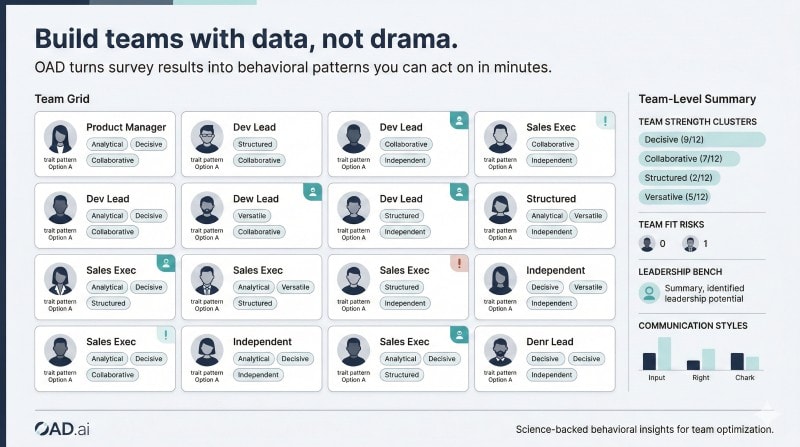
The two-part adjective format: traits vs perceived job behaviors
The OAD Survey uses two matched sections with the same adjectives in the same order. In section one, respondents choose adjectives that describe themselves. In section two, they choose adjectives describing how they must behave at work.
This structure matters because it separates:
- Baseline tendencies (traits)
- Perceived role demand (job behaviors)
The gap between the two can signal role stretch, sustained adaptation, or friction with the environment.
Questionnaire length: two matched sets of 110 adjectives
Each section contains 110 adjectives. That means 220 adjective opportunities total, presented as two identical lists.
This is not a “type” quiz. It is a structured word-selection instrument that produces scale scores.
Estimated completion time
7 minutes for most respondents.
Time varies by reading speed, device, and how carefully someone reflects.
Where OAD Fits Among Personality Tests Used at Work
OAD sits in the “workplace personality and behavior” category, but it does not work like the typical statement-based inventories where people rate agreement on items. Instead, it uses a free-choice adjective format: respondents select the words that fit.
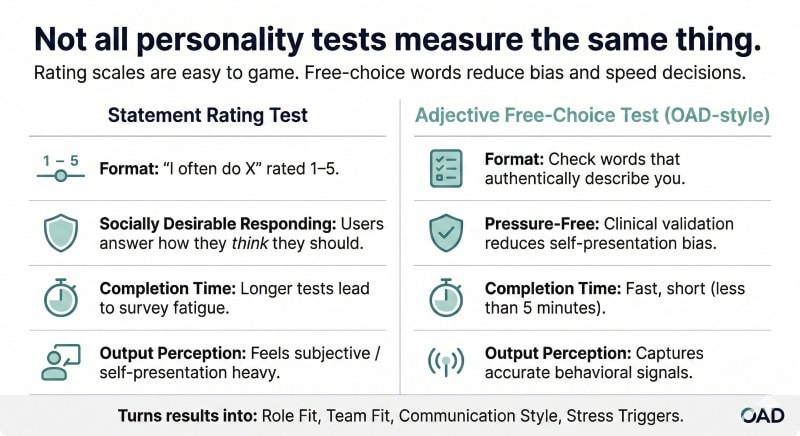
How adjective-based inventories differ from rating-scale tests
Most workplace personality tests ask people to rate statements (for example, “I like being the center of attention”) on a scale. OAD avoids that structure by asking respondents to select adjectives, which reduces the obvious “right answer” feel that comes with direct statements.
HR implication: this format tends to be easier to complete quickly and can feel less like a compliance chore, especially for candidates. OAD’s own platform positioning emphasizes speed and low friction.
Typical use cases: hiring, team fit, leadership, job analysis inputs
OAD is positioned for practical workplace decisions: selection, development, and organizational diagnostics, including behavior fit reports that match roles to personality.
Common use cases in practice:
- Hiring and role fit: clarifying whether a candidate’s baseline traits align with role demands.
- Leadership and coaching: identifying behavior patterns that affect communication, decision speed, conflict style, and consistency under pressure.
- Team diagnostics: spotting predictable friction points and gaps across a group, not just within one person.
- Organizational analysis: using the “traits vs perceived job behaviors” split to highlight where roles are pushing sustained adaptation.
Design teams with data, not gut feel.
Most org-design decisions come down to role fit, leadership style, and team dynamics. OAD reads those signals from a 7-minute behavioral survey, so you can reconfigure roles and teams with evidence instead of guesswork.
What OAD is not (quick positioning vs DISC/MBTI-style typing)
OAD is not positioned as a “type” system like DISC or MBTI. OAD’s own product FAQs explicitly frame it as behavioral analytics for hiring, leadership, and organizational clarity, rather than a typology.
Practical consequence: treat the output as decision support, not a label. If someone uses it as a personality verdict, they are doing the classic human thing: turning a measurement tool into an identity story.
Methodology: Item Design, Scoring, and Trait Extraction
OAD uses a controlled adjective list and a consistent scoring model. The goal is simple: turn word choices into stable trait scales you can use for hiring, coaching, and organizational analysis.
Adjective pool development and reduction
Adjective-based assessments live or die on item quality. If the words are vague, trendy, or redundant, the output becomes noise.
A typical development path looks like this:
- Start with a large pool of workplace-relevant adjectives.
- Remove ambiguous terms (words people interpret differently).
- Remove near-duplicates (words that measure the same thing twice).
- Keep words that load cleanly onto stable traits.
- Keep language plain enough for broad candidate pools.
Two-pass procedure: self descriptors vs perceived job behaviors
This is the part that makes OAD more useful than a single-output personality test.
Pass 1 asks: “Which words describe you?”
Pass 2 asks: “Which words describe how you must act at work?”
Same list. Same order. Two different lenses.
That design gives you two signals:
- A baseline snapshot of the person’s typical tendencies.
- A role-pressure snapshot of how they believe the job wants them to behave.
Scoring overview: scale sums, norms, and practical banding
At a high level, scoring works like this:
- Convert word selections into scale scores.
- Compare scores to a reference distribution (norms).
- Present results in a format that supports decisions.
For HR users, the point is not the math. It’s consistency. You want the same inputs to produce the same outputs, and you want outputs that can be compared across people and roles without interpretive gymnastics.
Core scales and why scale-based output beats “types”
Type systems flatten people into categories. Scale systems keep the nuance. That matters because hiring decisions are rarely binary.
Scale-based output supports questions like:
- Is this person high or low on emotional control relative to role demands?
- Are they consistent under pressure, or context-dependent?
- Do they show a predictable mismatch between self and role behavior?
This is where OAD becomes an organizational tool, not just an individual profile. When you see the same “stretch pattern” across a department, the problem is often the role design, not the people.
Factor Analysis and Validation (What “Science-Based” Actually Means Here)
If a personality test claims it’s “validated,” that should mean something concrete: the items group together in a stable way, the scales are internally consistent, and the outputs relate to real constructs in a predictable way. Not “we feel it’s accurate because vibes.”
Exploratory factor analysis: finding the structure
Exploratory factor analysis (EFA) is used when you want the data to show you how items cluster, rather than forcing a structure upfront. In simple terms: it helps identify which adjectives “hang together” as a trait.
In the OAD technical material, factor-analytic work is reported on large datasets, including a UK dataset with N = 2,842 used for factor analysis outputs shown in the taxonomy document.
Why HR should care: if the underlying structure is unstable, your “traits” are just random bundles of words.
Confirmatory factor analysis: testing the structure on new data
Confirmatory factor analysis (CFA) is the opposite move. You specify a model (which adjectives should load onto which traits) and then test whether new data fits that model well.
In practical terms: EFA helps discover the structure, CFA checks that you did not just overfit a single dataset.
Reliability checks: consistency, not perfection
Reliability is about whether a scale behaves consistently. In workplace assessments, you usually see reliability discussed as internal consistency (for example, whether items in a trait scale correlate well enough to justify a single score).
What to communicate in the article without pretending you ran the stats yourself:
- Reliability should be reported per scale, not as one global “reliability score.”
- Reliability needs context: selection decisions demand tighter measurement than casual development use.
- If reliability is weak on a scale, the correct response is narrower interpretation, not pretending it is fine.
Validity checks: does it relate to real constructs the way it should?
Validity is the bigger claim: that the assessment measures what it says it measures, and that it behaves as expected when compared with established instruments and relevant outcomes.
A sane validity discussion includes:
- Construct validity: do the scales align with well-known personality domains in predictable ways?
- Convergent validity: does OAD correlate with conceptually similar scales from established instruments?
- Discriminant validity: does it avoid collapsing into one “general good employee” factor?
The OAD taxonomy documentation positions the survey as a selection, development, and organizational diagnostic instrument with two matched questionnaires of 110 identical adjectives each. That structure supports validity arguments about separating baseline traits from perceived role demands, because it creates two distinct measurement lenses from the same item set.
Comparing OAD to the Five Factor Model (Big Five)
The Five Factor Model (often called the Big Five) is the most common “shared language” for personality research. OAD can be discussed in that neighborhood, but it is not a one-to-one clone. The useful move for HR is to treat Big Five as the reference map and OAD as a work-focused instrument with a different output design.
Where constructs overlap conceptually
At a high level, you will see familiar territory:
- Extraversion-style themes: social energy, assertiveness, outward engagement.
- Conscientiousness-style themes: reliability, structure, persistence, follow-through.
- Emotional stability themes (reverse of Neuroticism): emotional control, stress reactivity, composure.
- Agreeableness-style themes: cooperation, warmth, conflict approach.
- Openness-style themes: curiosity, creativity, flexibility in thinking.
That overlap is normal. Workplace behavior does not magically escape basic human traits.
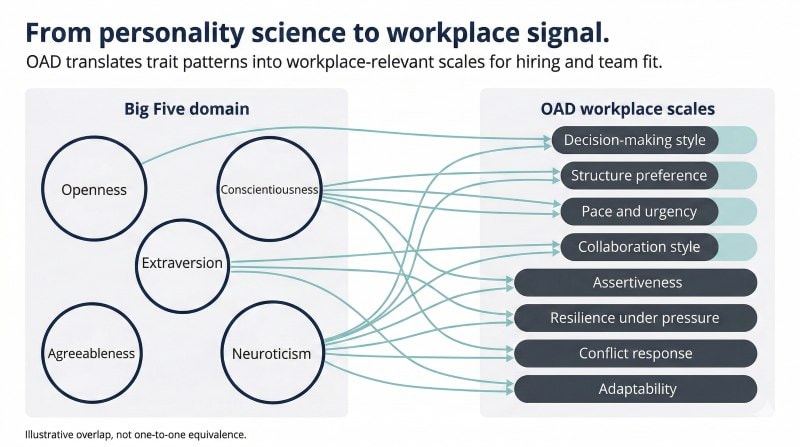
Where OAD differs
Two differences matter in practice.
1) Two outputs instead of one.
Big Five inventories typically give you one personality profile. OAD’s design separates “how the person describes themselves” from “how they believe they must behave at work.” That second lens is the part most HR teams actually need, because jobs create pressure and people adapt.
2) Work interpretation is built in.
Many Big Five tools are general-purpose and then translated into work language. OAD is structured to land closer to workplace decisions out of the box: selection, coaching, team patterns, and organizational diagnostics.
Assessment limits and what not to claim
If you want this article to stay credible, avoid two common overclaims:
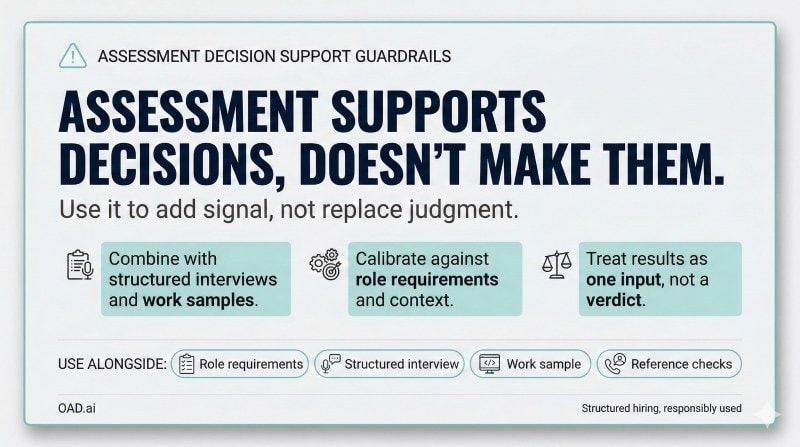
- Do not claim any personality test “predicts performance” on its own. At best, it adds incremental signal when combined with structured interviews, job-relevant skills evidence, and role clarity.
- Do not claim personality is fixed. Traits are relatively stable, but behavior is context-sensitive. That is the entire point of separating traits from perceived job behaviors.
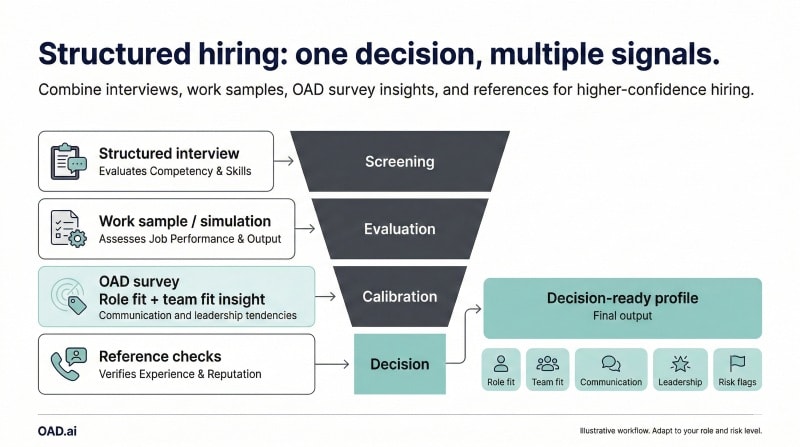
When to prefer each instrument (decision guide)
Use a Big Five instrument when:
- You need a widely recognized research baseline.
- You want comparability across studies, vendors, or academic frameworks.
- The main goal is general personality profiling, not workplace adaptation.
Use OAD when:
- You want workplace-oriented interpretation without translating everything yourself.
- You care about the difference between baseline tendencies and role pressure.
- You want to use results at team or organizational level, not only individual feedback.
Organizational Analysis Applications
OAD gets more useful when you stop treating it like an individual “personality test” and start using it as organizational signal. The design (traits vs perceived job behaviors) makes that possible because it surfaces role pressure, not just preference.
Leadership style and leadership coaching workflows
In leadership work, the value is rarely “here’s your profile.” It’s “here’s what your default tendencies create under stress, and what the role is forcing you to do instead,” which is exactly the kind of signal data-driven coaching tools for leaders are built to surface.
Use OAD in a leadership workflow like this:
- Establish the role context (what the organization actually expects).
- Review the leader’s trait pattern.
- Review perceived job behaviors (how they think they must show up).
- Identify the gaps that will create friction, burnout, or inconsistency.
- Convert 1–2 gaps into observable coaching targets.
OAD’s positioning explicitly frames the survey for hiring, leadership, and organizational clarity, and distinguishes it from typology tools like DISC/MBTI.
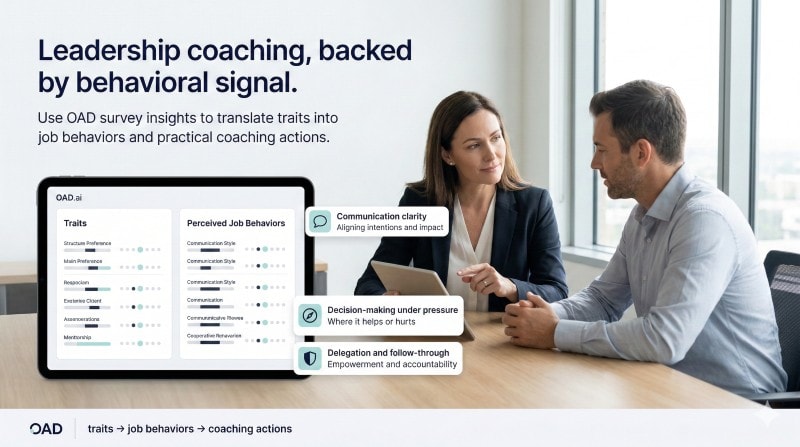
Team diagnostics: fit, friction, and role demands
Team diagnostics is where HR usually wastes time, because teams love blaming “culture” when the real issue is predictable mismatch, which is why combining structured assessments with behavioral interview questions to assess cultural fit tends to produce better signals.
A clean way to use OAD at team level:
- Aggregate trait patterns across the team.
- Compare perceived job behaviors across roles doing similar work.
- Look for consistent stretch signals: the same “must behave” pattern repeated across multiple people.
When many people report the same role pressure, that is rarely an individual problem. It’s usually workload, unclear decision rights, broken incentives, or a manager who rewards the wrong behavior.
The OAD taxonomy material describes the two matched questionnaires and the intent to support selection, development, and organizational diagnostics, which is the foundation for using it beyond one person at a time.
Integrating OAD into organizational design and intervention planning
If you want this to connect to org design without turning into consultant fog, keep it practical, especially in high-stakes contexts like private equity hiring and post-acquisition integration:
- Use role families (not job titles) as your unit of analysis.
- Define 3–5 behavioral demands per role family.
- Compare those demands to the perceived job behaviors pattern from incumbents.
- Decide whether the fix is role redesign, manager behavior, staffing, or training.
OAD survey instructions explicitly state it is not a skills or intellect measure, and that it is intended to help understand and manage work temperaments and job behaviors. That framing supports using it as one input into role clarity and interventions, not as a standalone verdict.
Design teams with data, not gut feel.
Most org-design decisions come down to role fit, leadership style, and team dynamics. OAD reads those signals from a 7-minute behavioral survey, so you can reconfigure roles and teams with evidence instead of guesswork.
Interpreting “Traits” vs “Perceived Job Behaviors” in Practice
Most personality tests give you one profile and call it a day. OAD gives you two matched outputs from the same 110 adjectives: how someone describes themselves, and how they believe they must behave at work.
Reading the self description output
The “Traits” section is the baseline. It reflects what the respondent believes is true about them across contexts, not just on the job.
How to interpret it without getting lost in psych jargon:
- Treat it as a starting point, not a verdict.
- Look for extremes (very high or very low bands) because those tend to show up in behavior more reliably.
- Translate traits into observable workplace behaviors (communication style, pace, tolerance for ambiguity, follow-through).
Reading perceived job behaviors
“Perceived Job Behaviors” is the role-pressure lens. Same words, same order, different question: how the person thinks they must show up at work to succeed.
This is useful because it surfaces things HR usually learns too late:
- The role may be pushing constant urgency or constant restraint.
- The environment may be rewarding control over collaboration, or the reverse.
- The person may feel forced into a style that is not sustainable.
OAD’s own survey instructions explicitly frame section two as describing how someone “must behave” in their current work environment.
Comparing the two outputs
The real value is the comparison, especially when you are trying to spot early turnover risk, burnout, and team fit issues.
A simple interpretation method HR teams can actually use:
- Identify the top 2–3 strongest signals in Traits.
- Identify the top 2–3 strongest signals in Perceived Job Behaviors.
- Look for a pattern: alignment, stretch, or conflict.
What the patterns usually mean:
- Alignment: the role rewards the person’s natural tendencies. This often supports performance and retention.
- Stretch: the role consistently pulls them away from baseline. This can be fine short-term, but it raises burnout and inconsistency risk.
- Conflict: the role demands behaviors that directly oppose baseline tendencies. This is where you see chronic stress, disengagement, or messy team dynamics.
This “two matched questionnaires” structure is a core feature of OAD’s taxonomy documentation.
Implementation, Reporting, and Data Handling
The OAD Survey is built to be operationally boring (compliment): short completion time, low friction, and fast reporting. The value is in what you do with the outputs, not in making candidates suffer through a 45-minute questionnaire.
Admin flow: deployment, completion, instant reporting
A defensible, HR-friendly implementation flow looks like this when each person has individual application access to their own assessment profile:
- Define the use case (selection, leadership, team diagnostic).
- Select the population (candidates, incumbents, leaders, whole team).
- Administer the survey in a consistent window (reduces context noise).
- Review reports in structured order (role first, then person).
- Use results as decision support, not as the decision.
OAD positions the tool as mobile-friendly, fast, and instantly reportable for admins, with no training required to run the survey.
Reporting structure: make it usable, not decorative
A good report layout for HR and executives should answer three things quickly and connect clearly to motivation insights about what truly drives people at work:
- What stands out? (top strengths and likely risks)
- What does it mean at work? (behavioral implications)
- What should we do? (interview probes, coaching targets, role-fit notes)
If you include visuals, keep them simple:
- Two-column “Traits vs Perceived Job Behaviors”
- A gap indicator (low, moderate, high)
- A short “Do / Watch” section tied to the role
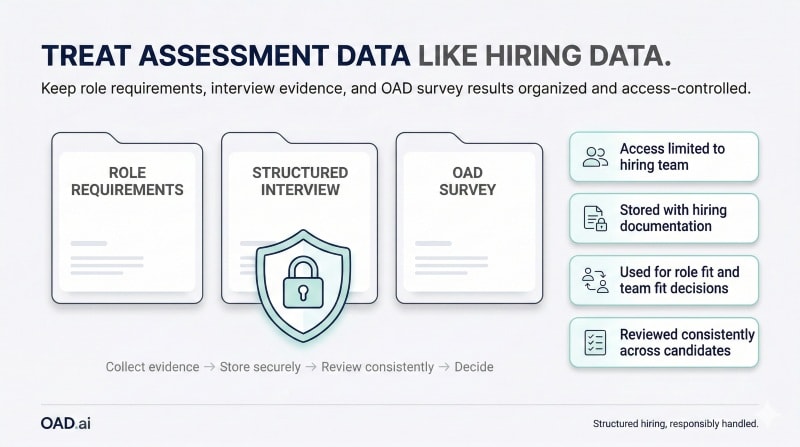
Data confidentiality and responsible use
Keep this high-level and globally workable:
- Limit access to HR and trained decision-makers.
- Separate assessment data from informal notes and rumor pipelines.
- Document decision logic (assessment supports, not replaces, structured evidence).
- Avoid sensitive or irrelevant data collection and stick to job-related use.
If you want a sharp line in the sand, OAD’s own public materials emphasize that reputable assessment publishers publish validity work and don’t hide behind “proprietary” hand-waving. That supports a governance posture: evidence-based, documented, and job-relevant.
Use Cases, Workshops, and Consulting
This is where the survey becomes valuable instead of just “another HR tool.”
Team workshop agenda using OAD
A clean 90-minute workshop agenda can sit alongside interview practices like assessing communication skills in-depth during hiring:
- Set purpose and guardrails (no labeling people, no “types,” job context matters).
- Review aggregated patterns (team-level themes, not individuals first).
- Surface friction points (where gaps cluster: speed, detail, emotional control, etc.).
- Role alignment check (what the work actually demands versus what people report).
- Two decisions (one process change, one behavior norm to trial for 2–4 weeks).
The two-section design (self vs “must behave at work”) is the backbone for productive workshop conversations because it gives you a shared language for role pressure.
Leadership coaching session flow
A simple coaching flow that doesn’t turn into therapy cosplay:
- Define the leadership context (team size, decision cadence, conflict load).
- Review trait baseline.
- Review perceived job behaviors.
- Identify one “overuse” risk and one “missing behavior” risk.
- Build a 30-day experiment with observable behaviors (not personality slogans).
Selection process use case (how to keep it legally and practically sane)
Use OAD to sharpen your selection process, not replace it, especially in high-variance, high-stakes areas like building and promoting winning sales teams:
- Start with role requirements and structured interview rubric.
- Use OAD to generate targeted probes, not shortcuts.
- Combine with work samples and consistent scoring.
If you want a concrete, sourced line for the “science” layer: OAD’s taxonomy/validity documents describe the instrument as a selection and development tool built from two matched 110-adjective questionnaires.
Limitations, Ethics, and Best Practices
Humans love turning measurements into destiny. Don’t.
Measurement limitations
- It’s self-report. People can misunderstand words, rush, or answer strategically.
- Context matters. Mood, recent events, and job stress can shift perceived job behaviors.
- No personality survey measures skills, experience, or job knowledge.
OAD’s own instructions frame the survey as a two-part self-selection task and explicitly describe the “must behave at work” lens, which helps, but it’s still respondent-reported.
Ethical considerations
- Don’t use it to justify discrimination or lazy screening.
- Don’t “typecast” people into fixed roles.
- Use it consistently and transparently within your process.
Revalidation and governance
Best practice: re-check measurement and job validity as your roles and organization change. OAD explicitly describes conducting job validity studies that correlate traits and job behaviors with performance measures for clients, which is particularly relevant for founders and CEOs making long-term leadership bets.
Resources and Further Reading
Keep this section tight and credible. Suggested inclusions:
- OAD technical documentation: “Taxonomy of General Traits” / validity materials.
- Survey instructions (for administration clarity):
- Job validity studies overview (how OAD approaches performance linkage):
FAQ
What is an OAD survey?
The OAD Survey is an adjective-based assessment used for selection, development, and organizational diagnostics. It uses two matched questionnaires to capture both self-described traits and perceived job behavior demands.
What does OAD stand for? What is the full form of OAD?
OAD stands for Organization Analysis and Design.
What are the OAD personality types?
OAD is primarily presented as a scale-based assessment (traits and job behaviors) rather than a typology system. If you use “types” language in the article, frame it carefully as shorthand categories derived from scale patterns, not fixed identities.
How long does the OAD Survey take to complete?
It can be completed in as little as 7 minutes.
Conclusion: Use OAD to Replace Guesswork With Structured Signal
If you treat the OAD Survey as a quick label-maker, you’ll get the same quality of decisions you get from horoscopes, just with better typography. Used properly, it supports clearer hiring decisions, sharper coaching, and more honest organizational analysis by separating who someone is from what the job pressures them to do, and it does so in a scalable, priced-for-growth platform.
Start with the free Top Performer Profile: 7 minutes, results in 24 hours, no credit card.