Leadership “evaluation” usually means one of two things: a vague performance review that rewards confidence, or an overly complex assessment program nobody trusts. Neither improves leadership effectiveness.
A useful leadership assessment does three things well:
- It defines what “good” looks like in your specific leadership roles.
- It measures leadership behaviors with enough structure to reduce bias and politics.
- It turns assessment findings into actionable insights: development plans, coaching priorities, promotion readiness, or role fit decisions.
This guide lays out a practical, evidence-informed evaluation process for leaders that HR teams and executives can actually run, repeat, and scale, without turning it into a bureaucratic side quest.
Overview: Why evaluation for leaders matters
Purpose: improve leadership effectiveness and organizational success
Leadership effectiveness shows up in outcomes that matter: retention, execution speed, decision quality, psychological safety, and team performance. But those outcomes are lagging indicators. By the time performance reviews catch a pattern, the damage is already done, and the best people have updated their LinkedIn.
A leadership evaluation system closes that gap by measuring what leaders do, not just what their teams produced in the last quarter. It makes leadership performance reviews more accurate, makes professional development more targeted, and reduces the cost of “fixing” problems that were predictable.

Set evaluation objectives clearly (what decisions this will inform)
Most evaluation process failures happen because nobody agrees on what the assessment is for. Pick the decisions upfront. Typical objectives include:
- Identifying strengths and leadership abilities to scale across teams
- Diagnosing leadership skills gaps that weaken team dynamics
- Determining readiness for promotion, expanded scope, or critical leadership roles
- Building individual development plans tied to measurable improvement
- Improving leadership success in hard-to-fill leadership roles and succession pipelines
If you skip this step, you end up with a report that looks impressive and changes nothing.
Align leadership evaluation with organizational growth goals and culture
Leadership competencies are not universal. The leadership approach that works in a stable environment can fail in a fast-scaling organization, and the style that works in a highly autonomous culture can break in a compliance-heavy one.
Alignment means your leadership assessment tool and rubrics reflect:
- Business goals (growth, transformation, consolidation, turnaround)
- Operating model (centralized vs distributed decision making)
- Risk tolerance and quality standards
- Desired organizational culture (speed, accountability, collaboration, innovation)
This keeps the evaluation for leaders grounded in reality instead of leadership folklore.
Who this is for: people managers, team leaders, senior leaders, high potentials
A single framework can serve multiple leadership roles, but the expectations and thresholds should change by level:
- Team leaders / first-time managers: coaching, communication skills, delegation, feedback, conflict resolution
- Mid-level leaders: cross-functional influence, team building, decision quality, managing performance at scale
- Senior leaders: strategic thinking, building strong leaders under them, system-level decisions, culture shaping
- High potentials: leadership potential indicators plus stress tests (ambiguity, pressure, complexity)
The core structure stays consistent. The weighting changes.

What leadership evaluation should measure
Leadership competencies vs leadership skills (what’s the difference)
This is where most organizations get sloppy. Leadership skills are learnable actions (running 1:1s, giving feedback, setting goals). Leadership competencies are broader capability clusters that predict leadership performance across situations (influence, judgment, developing others, execution).
You need both:
- Skills tell you what to train in the next 30–90 days.
- Competencies tell you whether the leader can reliably perform in the role over time.
Treating skills like competencies leads to shallow training programs. Treating competencies like skills leads to generic development plans that never change behavior.
Critical leadership competencies for leadership roles
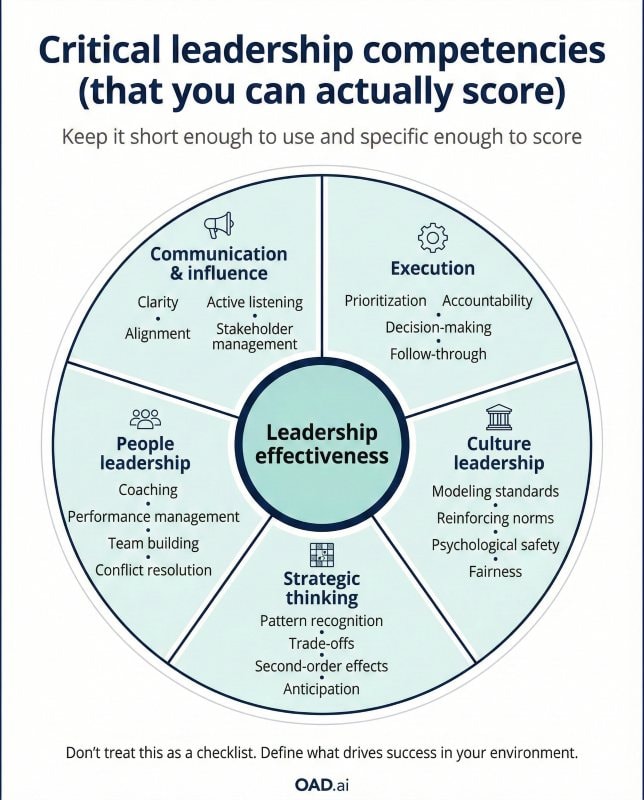
A competency model should be short enough to use and specific enough to score. In most organizations, the “critical leadership competencies” that matter tend to fall into a few categories:
- Communication and influence: clarity, active listening, alignment, stakeholder management
- Execution: prioritization, accountability, decision making, follow-through
- People leadership: coaching, performance management, team building, conflict resolution
- Strategic thinking: pattern recognition, trade-offs, anticipating second-order effects
- Culture leadership: modeling standards, reinforcing norms, psychological safety, fairness
Don’t treat these as a checklist. The point is to define which ones actually drive organizational success in your environment.
Leadership behaviors: mapping competencies to observable actions
Competencies only become measurable when they’re translated into leadership behaviors. “Strategic thinking” is abstract. “Uses decision criteria, communicates trade-offs, and revisits assumptions when data changes” is observable.
A behavior map should answer:
- What does strong performance look like in meetings, 1:1s, planning, conflict?
- What does weak performance look like, specifically?
- What evidence can raters reasonably observe?
This is the foundation for 360 degree feedback, simulations, performance reviews, and meaningful insights that leaders accept as fair.
Leadership potential vs current performance (avoid confusing the two)
High performance in an individual contributor role is not leadership potential. Strong results in a small team is not proof someone can lead at scale.
Leadership potential is a prediction. It should be assessed with evidence like:
- learning agility and growth mindset under pressure
- ability to handle ambiguity without freezing or thrashing
- pattern of developing others, not just delivering personally
- capacity to influence without authority
- response to feedback and developmental feedback
Keep “potential” separate from current performance to reduce favoritism and protect the pipeline from confident underperformers.

Define leadership competencies for your organization
Build a role-specific competency model (by level and scope)
If your competency model reads like it was copied from a leadership poster, it will produce leadership performance reviews with the same scientific credibility as astrology.
Make it role-specific. Start with 3 inputs:
- Role requirements: What decisions does this leader own? What do they influence?
- Failure patterns: Where do leaders typically break things here (execution, conflict, accountability, retention)?
- Success patterns: What do your strongest leaders do consistently that others do not?
Then build a simple matrix by level, and use behavior fit reports that match roles to personality to clarify which traits really matter in each box:
- First-line leaders: coaching, feedback, prioritization, team dynamics
- Mid-level leaders: cross-team alignment, delegation systems, managing managers
- Senior leaders: strategy, org design thinking, succession, culture shaping
Keep the model consistent enough to benchmark, but specific enough that “managing teams” means something observable.
Prioritize the top competencies per role (avoid “everything matters”)
If you score 14 competencies, you will change none of them.
For each leadership role, pick:
- 3–5 core competencies that drive leadership effectiveness
- 1–2 “risk competencies” that are non-negotiable (for example: ethics, emotional control, basic communication)
Everything else becomes secondary. This makes development plans realistic and makes training programs measurable.
A practical rule: if a leader improved only these core competencies, would team performance and organizational success noticeably improve? If the answer is “maybe,” you picked too many or the wrong ones.
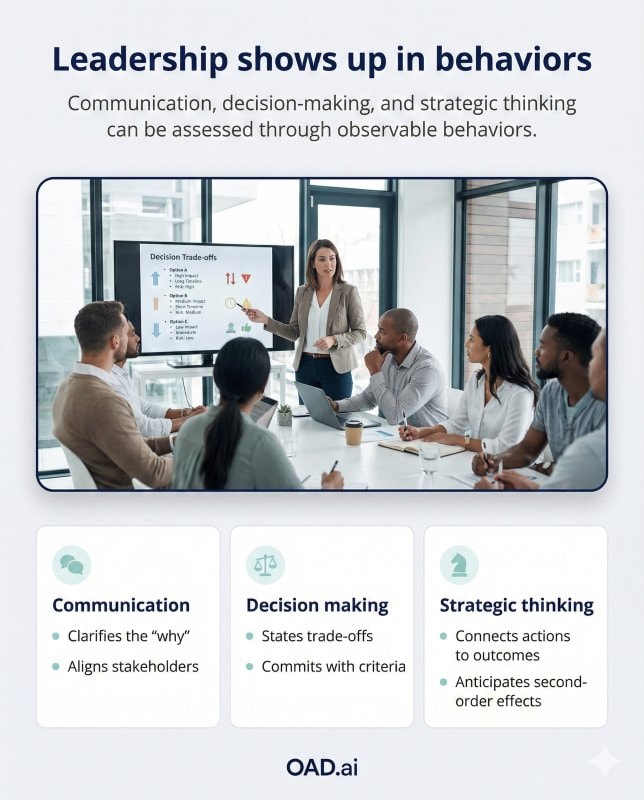
Include communication skills, decision making, strategic thinking
These show up everywhere, which is exactly why they need tight definitions.
Communication skills (observable):
- explains priorities and trade-offs clearly
- listens, checks understanding, and adjusts
- addresses conflict directly without escalating it
Decision making:
- uses criteria and data, not mood
- makes decisions at the right speed for the risk level
- owns outcomes and revises when evidence changes
Strategic thinking:
- connects short-term actions to longer-term outcomes
- anticipates second-order effects
- spots patterns and constraints across systems, not just their team
Notice how none of these say “is a great communicator.” That sentence means nothing and still shows up in thousands of performance reviews every day.
Add team building, conflict resolution, and active listening skills
The fastest way to destroy team collaboration is to promote someone who avoids conflict and calls it “being nice.”
Define these in behaviors:
Team building skills:
- sets clear roles and expectations
- creates norms for feedback and accountability
- recognizes contributions fairly (not just loud people)
Conflict resolution:
- surfaces issues early
- separates facts from stories
- drives toward agreements and follow-through
Active listening skills:
- reflects back what they heard accurately
- asks clarifying questions instead of defending
- notices misalignment and emotional signals in the room
These are not “soft.” They’re operational. They determine whether the team can execute without constant HR interventions.
Add indicators tied to organizational culture and a positive work environment
Culture is not the company values page. Culture is the behavior leaders tolerate and reward.
If your organization cares about a positive work environment, define indicators like:
- fairness and consistency in decision making
- psychological safety (people can disagree without punishment)
- accountability (standards enforced without humiliation)
- inclusion behaviors (who gets heard, who gets developed)
- ethical judgment and boundary setting under pressure
Then tie these to “non-negotiables” in the evaluation process. If a leader hits targets while breaking trust, they’re not a strong leader. They’re a short-term liability.
Assess leadership style and self awareness
Leadership style: what you should assess (and what to ignore)
Leadership style assessments can be useful, as long as you don’t treat them like fate.
Assess style to answer:
- How does this leader default under stress?
- How do they influence others?
- Where do they overuse strengths until they become weaknesses?
Ignore anything that turns into: “That’s just my style.” Style explains behavior. It does not excuse it.
Choose a validated leadership assessment tool for style
Use tools with evidence behind them and clear constructs. Avoid anything that produces flattering labels and vague descriptions.
Selection criteria:
- published validity and reliability information (at least some transparency)
- clear definitions tied to workplace behavior
- norms or benchmarks relevant to working adults
- practical reporting that supports coaching and development plans
If you can’t explain what a scale measures in one sentence, it’s probably not useful for HR decision making.
Self awareness: structured self-assessment + reflection
Self awareness is one of the best multipliers of leadership development because it determines whether feedback turns into change.
A strong approach combines:
- a structured self-assessment aligned to your competency model
- a short reflection questionnaire (strengths, stress triggers, blind spots)
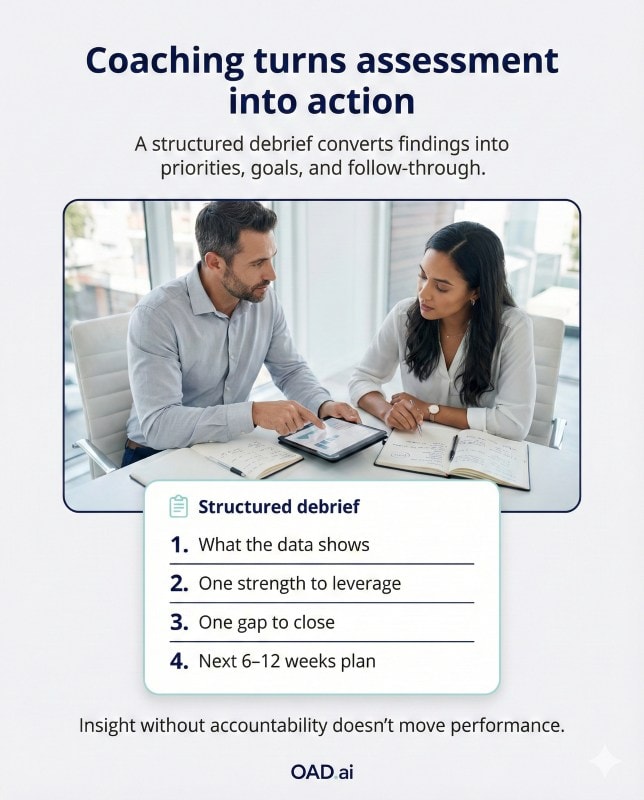
- a facilitated debrief session that turns insights into commitments
Common traps: leaders overrating strengths, blind spots, impression management
Leaders are humans. Humans are unreliable narrators.
Common patterns you should plan for:
- overrating strengths (especially communication and “people skills”)
- blind spots (what they do that others experience negatively)
- impression management (gaming assessments to look promotable)
This is why you never rely on a single method. The point of comprehensive evaluation is triangulation: multiple perspectives, multiple tools, one coherent picture.

Assessment process: methods and tools
Selecting assessment tools: validity, fairness, and practicality
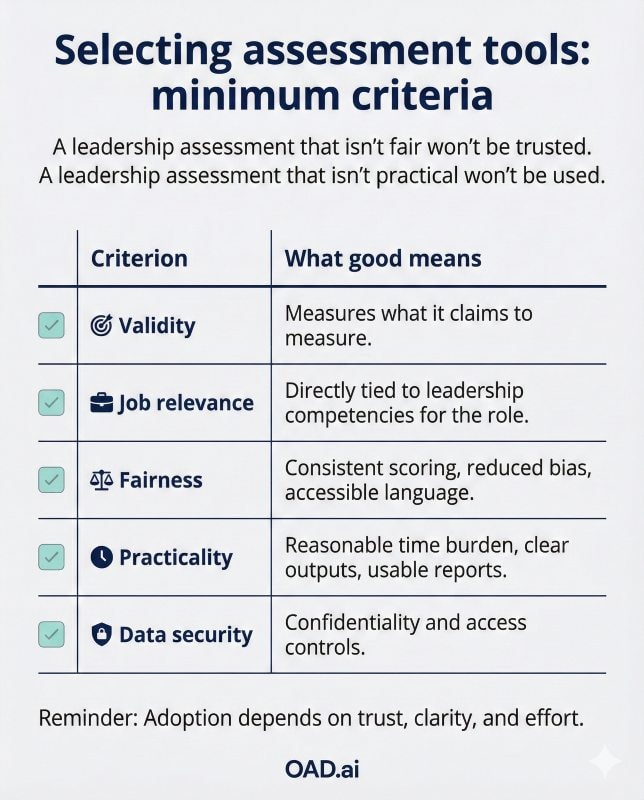
A leadership assessment that isn’t fair won’t be trusted. A leadership assessment that isn’t practical won’t be used, which is why many organizations lean on fast, validated tools like the OAD Survey.
Minimum criteria:
- validity: measures what it claims to measure
- job relevance: tied to leadership competencies for the role
- fairness: consistent scoring, reduced bias, accessible language
- practicality: reasonable time burden, clear outputs, usable reports
- data security: confidentiality and access controls
Building an evaluation process that HR can run consistently
Consistency matters more than complexity.
A repeatable evaluation process usually includes:
- competency model and rubrics
- 360 degree feedback setup
- self-assessments and strengths tools
- structured performance review data
- behavioral interview and/or simulations
- synthesis and decision review
- individual development plans and coaching
- progress measurement and reassessment
Run it like a system, not like a one-time event.
How to combine multiple perspectives without creating noise
Multiple perspectives only help if you know how to weigh them.
Practical weighting rules:
- Direct reports: strongest signal for leadership behaviors that affect engagement and team dynamics
- Peers: strongest signal for collaboration, influence, and team collaboration
- Manager: strongest signal for scope, outcomes, and strategic thinking
- Simulations/interviews: strongest signal for decision making under pressure
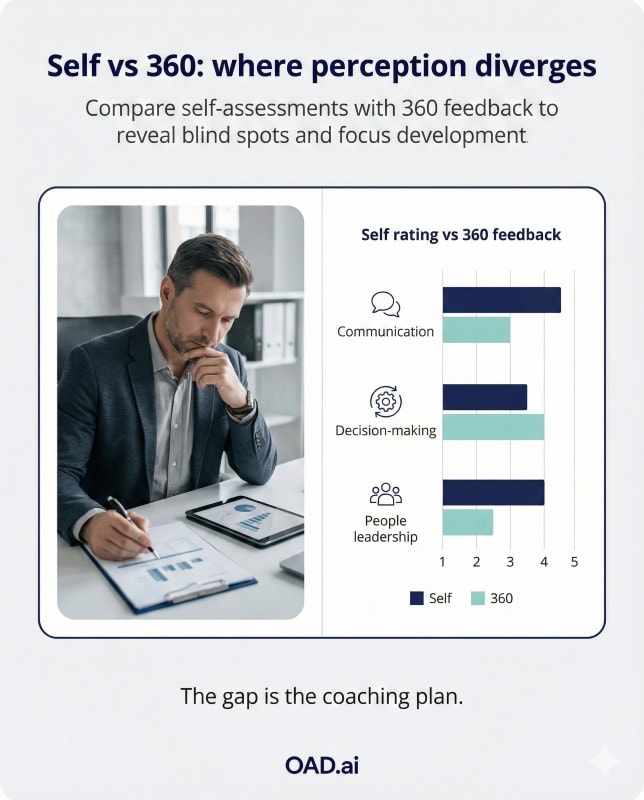
- Self-assessments: strongest signal for self awareness gaps (compare self vs others)
When sources disagree, don’t average them into mush. Treat discrepancies as diagnostic data. A leader who rates themselves high and gets low scores from direct reports is not “balanced out.” That’s the story.
360 degree feedback: getting comprehensive feedback from diverse perspectives
360 degree feedback is one of the fastest ways to surface leadership behaviors that don’t show up in a standard performance review. It’s also one of the fastest ways to create chaos if you run it like a popularity contest.
The goal is simple: collect comprehensive feedback from the people who experience the leader’s decisions and behaviors, then translate it into developmental feedback and actionable insights.
Design rater groups (manager, peers, direct reports, stakeholders)
Rater selection is where bias enters the system, so design it intentionally.
A solid structure:
- Manager: 1 (the leader’s direct manager)
- Peers: 3–5 (cross-functional partners, same-level leaders)
- Direct reports: 4–8 (enough to protect anonymity)
- Stakeholders: 2–4 (internal clients, project partners, matrix relationships)
Rules that prevent “gaming”:
- HR defines eligibility criteria (not the leader alone).
- Leaders can suggest names, but HR finalizes the list.
- Include diverse perspectives: not just allies, not just critics.
- Keep the group stable across cycles for cleaner trend comparisons.
For global orgs: watch cultural differences in rating behavior. Some regions avoid extreme scores. Others use them freely. This is why you need behavior anchors, not just a 1–5 scale.
Use behaviorally anchored rating scales (BARS)
If your 360 questions sound like “Is this leader inspiring?” you’re measuring charisma, not leadership effectiveness.
Behaviorally anchored rating scales (BARS) force clarity. Instead of vague traits, you score observable behaviors with examples of what “1,” “3,” and “5” look like.
Example (Communication skills: clarity and alignment)
- 1: Communicates priorities inconsistently. Team is often unsure what matters.
- 3: Communicates priorities clearly in most cases. Occasional confusion gets corrected.
- 5: Communicates priorities and trade-offs clearly and repeatedly. Team alignment stays high even under change.
Example (Decision making: speed and accountability)
- 1: Avoids decisions or reverses without explanation. Ownership is unclear.
- 3: Makes decisions with reasonable speed. Explains rationale when asked.
- 5: Makes timely decisions using clear criteria. Communicates rationale proactively and owns outcomes.
BARS does two things:
- improves rating reliability across raters
- produces meaningful insights leaders can act on without arguing about “tone”
Ensure anonymity and confidentiality for raters
If raters don’t trust anonymity, you’ll get safe, useless feedback.
Minimum protections:
- Require a minimum number of direct reports before reporting that category (commonly 4+).
- Aggregate written comments and remove identifiers (names, project references if needed).
- Keep raw rater-level data restricted to HR/assessment admins only.
- Communicate clearly: what’s confidential, who sees what, and how it will be used.
Also: don’t pretend it’s anonymous if it isn’t. In small teams, people can infer. In those cases, lean more on qualitative themes and less on “who said what.”
Turning 360 results into developmental feedback (not punishment)
If leaders think the 360 is a disciplinary tool, they will resist it, and your evaluation process becomes political theater.
Make the developmental intent explicit:
- 360 feedback informs professional development and leadership development planning, especially when paired with data-driven coaching tools for leaders.
- It should not be the sole input for compensation or termination decisions.
- It is best used alongside performance reviews, interviews, and simulations.
How to convert results into action:
- Identify the top 2 strengths (the ones worth scaling).
- Identify the top 1–2 gaps that most damage team performance or team dynamics.
- Pull behavioral examples from comments (themes, not individual quotes).
- Agree on one behavior change per gap that can be practiced weekly.
- Put it into the development plan with a timeline and measurement.
Example gap: “Avoids difficult conversations”
- Behavior change: “Address performance issues within 72 hours using a structured script.”
- Practice habit: weekly review of pending conflicts + scheduled conversations.
- Measurement: direct report follow-up pulse on clarity and fairness.
This is where “evaluation for leaders” becomes leadership success, instead of a PDF that dies in someone’s inbox.
Self-assessments and strengths tools
Self-assessments are useful for one thing in particular: showing how leaders see themselves, then comparing that to how others experience them. That gap is often where the real development work lives.
Used badly, self-assessments become personality entertainment and a convenient excuse to stay the same. Used well, they sharpen self awareness and make professional development concrete.
Pick validated instruments (and avoid personality “toys”)
Selection standards for assessment tools should be stricter than “someone in HR liked it.”
Look for:
- Evidence of reliability and validity (even a basic technical manual is better than vibes)
- Workplace relevance (leadership behaviors, decision making, communication)
- Clear constructs (you can explain what a score means without mystical language)
- Practical output (reports that translate into action plans)
Avoid tools that:
- provide flattering labels with no behavioral specificity
- claim to predict everything with one score
- produce recommendations so generic they apply to anyone
For global orgs: ensure language and norms are appropriate across regions, or at least interpret results cautiously where norm groups don’t match.
Instructions for leaders: accuracy over image
Leaders will optimize for looking promotable unless you set the frame.
Make the instruction blunt and practical:
- The goal is accurate inputs for leadership development, not passing a test.
- Nobody gets “graded” on a self-assessment alone.
- The most useful results come from honest responses, especially around stress behavior.
If you want higher honesty:
- Give leaders a private preview of their report before a debrief.
- Use a trained facilitator or coach for interpretation.
- Pair results with behavioral evidence so it doesn’t feel like a label.
Create an individual report: leader’s strengths + development needs
A self-assessment report should not be a personality biography. It should be a decision-support document.
Minimum sections:
- Top strengths (linked to leadership competencies and leadership roles)
- Risk areas under stress (where strengths flip into problems)
- Blind-spot hypotheses (likely gaps to test against 360 feedback and observation)
- Coaching focus (1–2 themes that will improve leadership effectiveness fastest)
- Next actions (practice habits and on-the-job experiments)
Make the output skimmable. Executives will read a page. They will not read twelve.
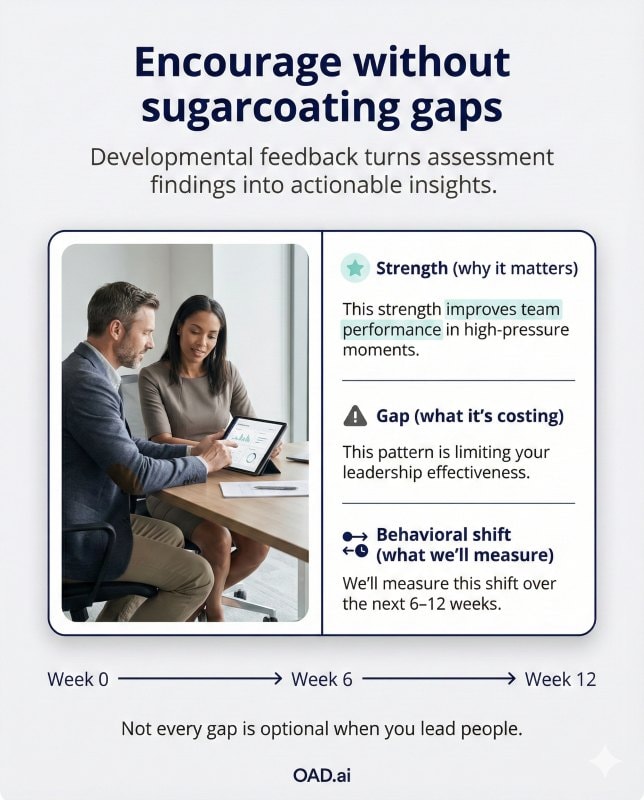
Use results to encourage leaders without sugarcoating gaps
Encourage leaders by being specific, not by being nice.
Good encouragement sounds like:
- “This strength is valuable because it improves team performance in these situations.”
- “If you apply it here, it will enhance team dynamics and reduce friction.”
Good gap framing sounds like:
- “This pattern is limiting your leadership effectiveness.”
- “Here’s the behavioral shift we’ll measure over the next 6–12 weeks.”
Avoid the common failure mode: calling everything a “growth opportunity” until nothing feels urgent. Some gaps are not optional if someone is managing teams.
Leadership performance reviews that measure behaviors, not vibes
Performance reviews are often treated like a memory test: whoever tells the best story wins. A structured leadership evaluation makes performance reviews less political and more predictive.
What to capture in leadership performance reviews
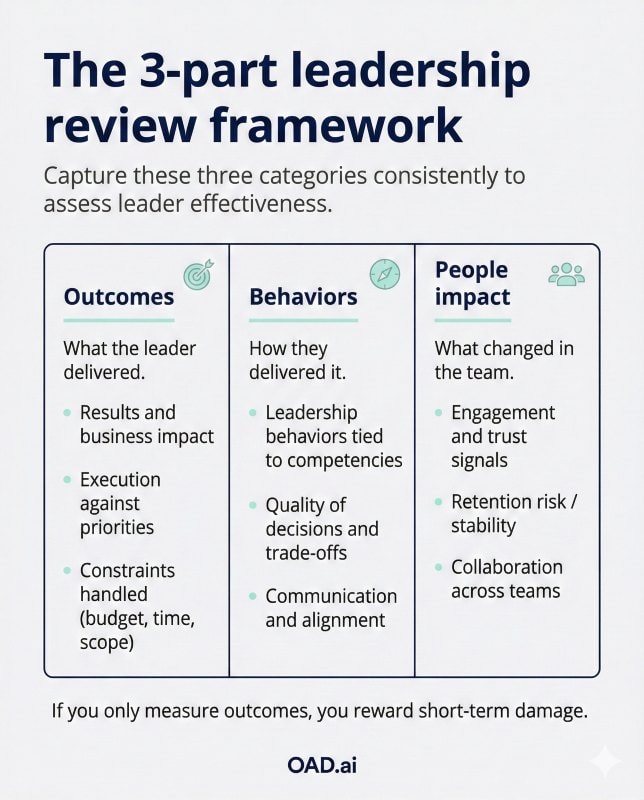
A leadership performance review should capture three categories, consistently:
- Outcomes: what the leader delivered (results, execution, business impact)
- Behaviors: how they delivered it (leadership behaviors tied to competencies)
- People impact: what changed in the team (engagement, retention risk, collaboration)
A leader can hit numbers while eroding trust. Another can build a high-performing team while inheriting a messy quarter. If you only measure outcomes, you reward short-term damage.
Separating outcomes from behaviors (team performance can lag)
Team performance is influenced by many factors: workload, market shifts, legacy systems, staffing gaps. Behaviors are the inputs leaders control directly.
Examples:
- A team misses targets due to a delayed dependency, but the leader shows strong prioritization, communication, and escalation behavior.
- A team hits targets, but the leader hoards decisions, avoids conflict resolution, and burns out high performers.
One is a leadership development opportunity. The other is a leadership risk disguised as success.
Calibration: keeping standards consistent across leaders
Calibration is where you prevent two leaders from getting different ratings for the same behavior.
Simple calibration mechanics:
- Use the same rubric and definitions across functions.
- Require evidence: examples of leadership behaviors, not adjectives.
- Run a calibration session with HR as moderator.
- Watch for common bias patterns: likability, similarity bias, recency bias, “halo” from one big win.
If your org is global, also watch for cultural differences in self-promotion and directness. Calibration is how you stop “confidence” from becoming the hidden competency.
Behavioral interviews and simulations
If you want to assess leadership abilities under real constraints, interviews and simulations are hard to beat. They reveal how leaders think, decide, communicate, and handle conflict when it’s messy, and they’re one of the best ways to assess communication skills effectively in interviews.
Script competency-based interview questions
Scripted does not mean robotic. It means consistent.
Use questions that force behavioral evidence:
- “Tell me about a time you had to make a decision with incomplete information. What criteria did you use?”
- “Describe a conflict between two high performers. What did you do in the first 48 hours?”
- “When did a direct report disagree with you publicly? How did you respond and what happened after?”
- “What’s a leadership mistake you made in the last year? What did you change?”
Score against your competency model, not the story quality.
Run real-world leadership simulations (conflict, prioritization, ambiguity)
Simulations work because they remove the “I would do X” fantasy and replace it with behavior.
High-value simulation themes:
- Prioritization under constraints: limited budget, staffing gap, urgent deadline
- Conflict resolution: peer disagreement, underperformance, interpersonal tension
- Stakeholder influence: resistant executive, cross-functional trade-off
- Crisis communication: mistake, escalation, reputational risk
Make scoring criteria explicit: decision quality, clarity, listening, composure, follow-through.
Record behavioral examples for analysis
The power move here is evidence.
Capture:
- what the leader said (key phrases)
- what they asked (quality of questions)
- how they handled pushback
- how they closed the loop (next steps, accountability)
Then translate into assessment findings that are hard to argue with. “You interrupted stakeholders five times in ten minutes” lands differently than “You need to listen more.”
Scoring rubric: meaningful insights and actionable insights
A rubric should make it difficult for evaluators to drift into personal preference.
Include:
- behavior anchors (what 1/3/5 looks like)
- evidence requirements (examples needed for high or low scores)
- weighting by role (a senior leader’s bar is higher for strategic thinking and influence)
This produces actionable insights that actually translate into leadership development plans and training programs.
Measure emotional intelligence
Emotional intelligence gets abused as a buzzword, but the underlying point matters: leaders with poor emotional control and weak interpersonal awareness reliably damage team dynamics. They create avoidable conflict, reduce employee engagement, and make managing teams harder than it needs to be.
The goal is not to label someone “high EQ.” The goal is to identify specific patterns that affect leadership effectiveness and then build habits that change day-to-day behavior.

What emotional intelligence predicts in managing teams
In practice, emotional intelligence shows up in a few predictable outcomes:
- how well a leader notices tension before it becomes conflict
- whether they can deliver constructive criticism without triggering defensiveness
- whether they can hear feedback without retaliating or withdrawing
- how effectively they regulate their own stress responses
- how consistently they build trust through fair, calm decision making
This is why EI often sits behind “mysterious” leadership failure. The leader is smart, experienced, and still keeps blowing up relationships.
Select and administer an EI scale responsibly
If you decide to measure emotional intelligence, treat it like any other assessment tool: validity, fairness, and proper interpretation.
Basic rules:
- Use a tool with transparent constructs and evidence.
- Don’t treat a single EI score as a promotion gate.
- Interpret results alongside 360 degree feedback and observed behavior.
Also, be careful with global rollouts. Communication norms differ. “Direct” can be experienced as “aggressive” in one culture and “clear” in another. This is why behavior examples matter more than labels.
Link EI findings to communication, conflict resolution, and team dynamics
EI becomes useful when it’s translated into “what changes on Monday.”
Example patterns and their practical impact:
- Low impulse control: escalates conflict, undermines psychological safety
- Low empathy accuracy: misreads direct reports, misses burnout signals
- Low emotional awareness: poor timing in feedback, reduced team collaboration
- High stress reactivity: inconsistent leadership approach, unpredictable meetings
Tie each pattern to a small number of targeted habits, not vague goals like “be more empathetic.”

Include EI coaching in professional development plans
If EI gaps matter, they need coaching, not a training video.
Effective EI coaching includes:
- identifying triggers (what situations create the reaction)
- defining replacement behaviors (what to do instead)
- practicing in real interactions (1:1s, feedback, conflict)
- measuring progress using follow-up pulses or reassessment
This is one of the highest ROI areas for leadership development, because small behavior shifts can meaningfully enhance team dynamics and retention.
Evaluate team leaders and high performing teams
If your leader evaluation ignores the team, you’re missing the point. Leaders create the conditions for high performing teams, or they quietly dismantle them.
This section focuses on measuring leader effectiveness through the lens of the team experience and team performance, without blaming individual team members for leadership failures, which is critical for founders and CEOs building leadership capacity as they scale.
Survey individual team members on leader effectiveness
Direct reports are the most consistent source of data on day-to-day leadership behaviors. They see:
- how priorities get set
- how conflict resolution actually happens
- whether feedback is fair
- whether communication skills show up under stress
Use short, focused surveys that map directly to your competency model. Aim for behavior-based items, not “Do you like your manager?”
Example items:
- “My leader sets clear expectations and follows up.”
- “When priorities change, my leader explains why.”
- “My leader addresses issues directly and respectfully.”
- “My leader supports professional growth with specific guidance.”
Track team performance metrics over time (with context)
Team performance metrics can add value, but only when interpreted with context.
Useful indicators (depending on role):
- delivery reliability (on-time completion, quality)
- retention and internal mobility
- engagement trend (direction matters more than a single score)
- customer satisfaction or internal stakeholder satisfaction
- rework, escalation volume, error rates
Avoid simplistic attribution. A leader can inherit a struggling team and improve team dynamics before outcomes move. Watch trends over time.

Observe leader behaviors in team meetings
Observation fills a gap surveys can’t: what leaders do in real time.
Look for:
- who speaks and who gets ignored
- whether the leader asks questions or just broadcasts
- how disagreement is handled
- whether decisions are closed with owners and timelines
- whether active listening skills show up (summarizing, clarifying, inviting dissent)
You can do this with HR partners, trained internal observers, or external coaches. The key is consistency and a structured rubric.
Link leader actions to employee engagement and team collaboration
Employee engagement is often treated like a benefits problem. It’s frequently a leadership behavior problem.
Leadership actions that reliably improve engagement and collaboration:
- clear priorities and fewer last-minute reversals
- predictable feedback and fair standards
- autonomy with accountability (not control)
- fast conflict resolution
- recognition tied to real contribution
Tie these back to your leadership competencies so the leader understands exactly what drives outcomes.
How to enhance team dynamics without blaming the team
When teams underperform, organizations often default to training the team. That’s convenient and usually wrong.
A better sequence:
- Diagnose leadership behaviors affecting the system (clarity, conflict, accountability).
- Fix leader habits first (because they set the constraints).
- Only then add team-level training programs if a skills gap remains.
This is how you avoid “continuous improvement” becoming “everyone gets training except the person causing the problem.”
Analyze results: turning assessment findings into decisions
A leadership assessment that ends with “interesting” insights is a failure. The point is decision making: what changes, what gets developed, what gets supported, and what should not be rewarded.
Aggregate quantitative scores across methods
Aggregation is where you either build credibility or create a confusing spreadsheet that nobody trusts.
A clean approach:
- Normalize scores to a consistent scale (don’t mix apples, oranges, and “strongly agree”).
- Group by competency (communication skills, decision making, team building, etc.).
- Show score ranges by rater group (self vs peers vs direct reports).
- Flag confidence levels (more raters and consistent patterns = higher confidence).
Do not pretend precision you don’t have. A 0.2 difference on a five-point scale is rarely meaningful without context.
Interpret qualitative data: recurring themes and pattern detection
Comments and interview notes are where the story becomes clear, if you process them correctly.
Rules that keep qualitative data useful:
- Code feedback into themes tied to leadership competencies and leadership behaviors.
- Separate “style preferences” from impact patterns (some complaints are just taste).
- Look for repetition across rater groups and situations.
- Pull representative examples, stripped of identifiers.
Good theme statements sound like:
- “Direct reports describe unclear priorities during changes, leading to rework.”
- “Peers report slow decision making on cross-functional trade-offs.”
- “Multiple perspectives note avoidance of conflict resolution with high performers.”
Bad theme statements sound like:
- “Needs to be more confident.”
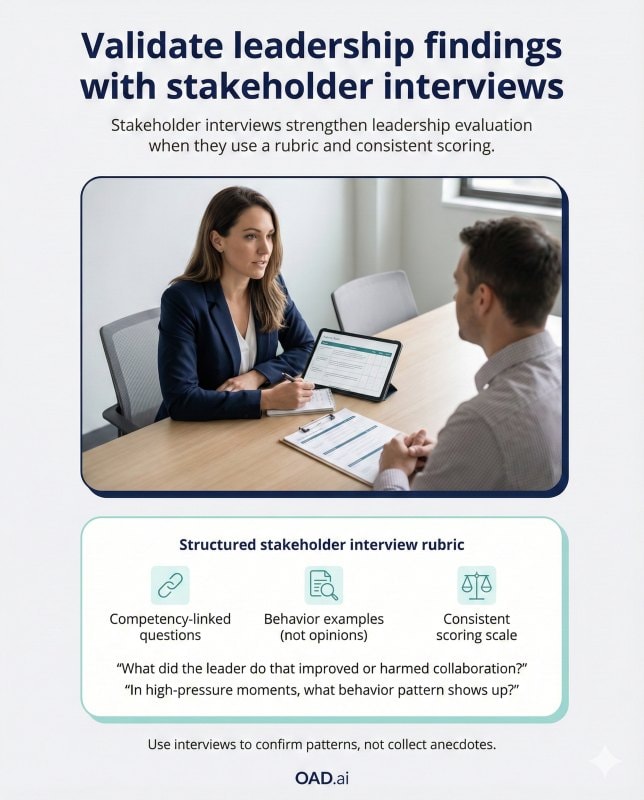
Validate findings with stakeholder interviews
Validation is how you prevent one loud rater from shaping the narrative.
Use short stakeholder interviews to answer:
- Where does this pattern show up most?
- What’s the impact on team performance or organizational culture?
- What’s the earliest observable behavior that signals the issue?
- What’s already been tried, and what happened?
This also gives the leader a better chance of accepting the results, because the findings are tied to reality, not HR impressions.
Resolve contradictions between data sources (what to do when it disagrees)
Contradictions are not a problem. They’re information.
Common contradiction patterns:
- Self high, others low: self awareness gap or impression management
- Manager high, direct reports low: managing up well, managing down poorly
- Peers high, team low: collaborative externally, inconsistent internally
- Strong outcomes, weak behaviors: leadership risk, potential burnout driver
- Weak outcomes, strong behaviors: inherited constraints, needs resourcing or time
Don’t average contradictions into neutrality. Diagnose them, then decide what evidence to collect next (observation, simulation, additional interviews).
Prioritize development needs and decision making
Rank gaps by impact on organizational growth
Not all gaps matter equally. Prioritize by impact, not annoyance.
A practical ranking approach:
- Impact on organizational success (execution, retention, risk)
- Frequency (daily behaviors beat rare events)
- Contagion (does it spread bad norms across teams?)
- Fixability (can coaching change it within 3–6 months?)
This helps you avoid spending six months “developing” a minor preference issue while ignoring a real leadership effectiveness problem.

Identify strengths worth scaling across teams
Development is not only about fixing problems. It’s also about scaling what works.
Examples of scalable strengths, particularly in functions like sales where you’re also building winning, leadership-ready sales teams:
- strong decision making frameworks others can adopt
- excellent active listening skills that raise team engagement
- consistent coaching that accelerates professional growth
- strong team building habits that stabilize high performing teams
Codify the strength into a practice and spread it through mentoring, peer learning, or internal training programs.
Decide interventions: training programs, coaching, role changes
Pick interventions based on the type of gap.
- Skill gap (can do, doesn’t know how): targeted training programs + practice plan
- Habit gap (knows, doesn’t do): coaching + accountability + measurement
- Will gap (won’t do): clarify expectations, consequences, and role fit
- Scope gap (outgrown role): rescope, add support, or redesign responsibilities, using risk and readiness alerts to flag burnout or misalignment early
- Values gap (trust/ethics): treat as non-negotiable, not “development”
This is where HR credibility is won or lost. Vague plans signal you don’t believe your own evaluation process.

Present results to sponsors: clear, defensible, non-political
Leadership evaluation becomes political when outputs are ambiguous.
A sponsor-ready summary should include:
- top strengths (with evidence)
- top gaps (with evidence and impact)
- recommended interventions and why
- risks if nothing changes
- the measurement plan (how you’ll monitor progress)
Avoid personality language. Sponsors want decisions, not descriptions.
Action plans: leadership development and continuous improvement
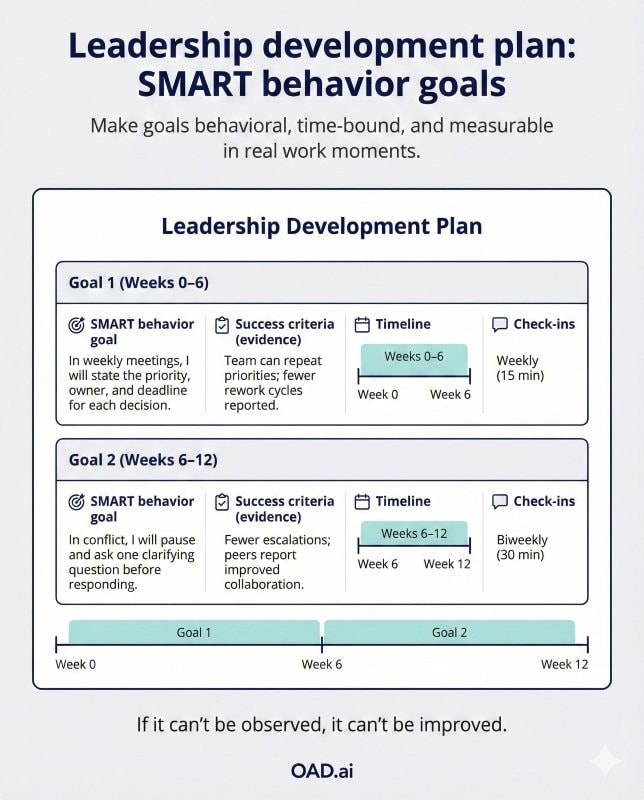
Set SMART goals for each leader
SMART goals should describe behavior change, not intentions.
Bad: “Improve communication.”
Better: “At weekly team meetings, communicate top 3 priorities and trade-offs, confirm understanding, and publish decisions within 24 hours.”
Tie each goal to:
- the competency
- the measurable behavior
- the timeline
- the evidence source (survey pulse, observation, 360 follow-up)
Create individual development plans with timelines
A usable development plan fits on one page and includes:
- 1–2 priority development competencies
- the behavior shifts required
- weekly practice habits
- coaching cadence
- success measures
- reassessment date
If the plan is longer than the leader’s attention span, it won’t be executed.
Assign internal or external coaches
Coaching choice depends on sensitivity and capability.
- Internal coach: good for lower-risk skill and habit gaps, cheaper, scalable
- External coach: better for senior leaders, high-stakes issues, or trust-sensitive gaps
- Manager-as-coach: useful only if the manager is trained and consistent
Also: don’t assign a coach and then disappear. HR should track whether coaching translates into behavior change.
Build weekly practice habits (active listening, feedback, delegation)
Leadership development fails when it stays intellectual.
Pick habits that are small, frequent, and observable:
- active listening: summarize before responding in 1:1s
- feedback: deliver one piece of specific developmental feedback weekly
- delegation: assign outcomes and constraints, not steps
- conflict resolution: address issues within 72 hours using a script
- decision making: publish decision criteria and owners
Weekly habits create continuous improvement because they compound.
Tie development to organizational success, not self-improvement theater
The point of leadership development is better execution and a healthier organization.
Connect each leader’s plan to:
- team performance metrics and retention
- employee engagement trends
- quality and speed of decisions
- team collaboration and stakeholder satisfaction
This keeps development grounded and reduces resistance from executives who think development is “nice to have.”
Monitor progress and measure impact
Leadership development without measurement is just journaling with extra meetings. If you want leadership effectiveness to improve, you need a simple system to track progress, catch drift, and adjust strategies before six months disappear.
Define KPIs tied to leadership competencies and team outcomes
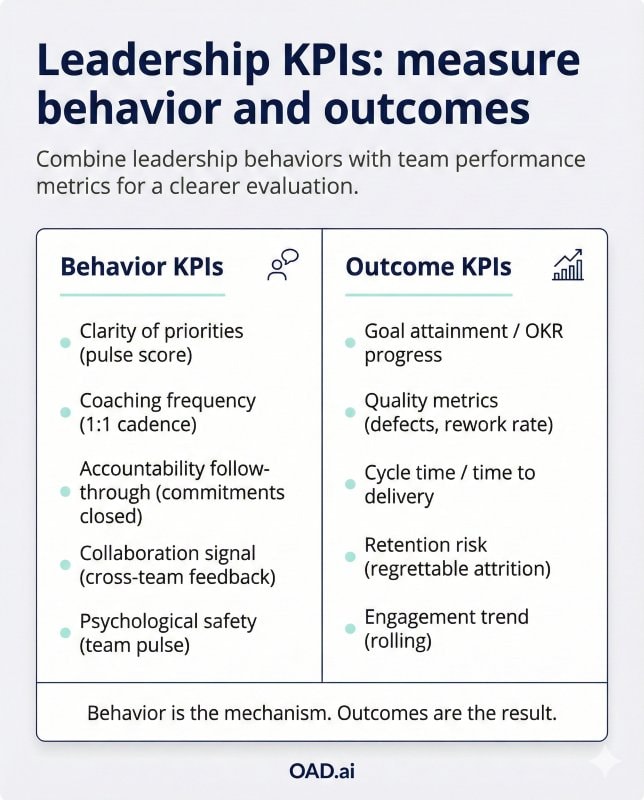
KPIs should match what you’re trying to change. Use a mix of behavior indicators and outcome indicators.
Behavior KPIs (fast feedback):
- direct report pulse on clarity of priorities (communication skills)
- frequency and quality of feedback conversations (coaching behavior)
- conflict resolution cycle time (issue surfaced to resolution)
- decision making cadence (time-to-decision by risk level)
- meeting effectiveness ratings (listening, clarity, accountability)
Outcome KPIs (lagging but important):
- retention risk and regretted attrition
- engagement trend (direction over time)
- team performance reliability (delivery, quality, rework)
- internal stakeholder satisfaction
Keep it lean. More metrics does not equal better insight. It usually equals nobody looking at them.
Quarterly reviews: track progress and adjust strategies
Quarterly reviews work because they’re frequent enough to correct course, but not so frequent they become noise.
A strong quarterly review agenda:
- What behavior goals were practiced weekly?
- What evidence changed (pulse, observation, stakeholder feedback)?
- What improved, and where is progress stuck?
- What’s one adjustment to the development plan for the next quarter?
If the leader made progress, reinforce and raise the bar. If not, you need to find out whether it’s a skill gap, habit gap, will gap, or scope mismatch.
Re-administer key assessments after 6 months
Reassessment is how you prove the evaluation process has value.
A practical cadence:
- 6 months: re-run a shortened 360 (focus competencies only) or targeted direct report pulse + observation
- 12 months: full 360 + updated self-assessment + sponsor review
Don’t re-run everything if you don’t need it. Reassess what you’re actively developing. The point is to validate improvement and recalibrate next priorities.
Sustain professional growth with feedback loops
Leaders improve fastest when feedback is normal, not ceremonial.
Build a feedback loop:
- monthly micro-pulses (3–5 items) for direct reports
- structured 1:1 check-ins with manager or coach
- periodic observation (even short, 20-minute meeting drop-ins)
- visible habit tracking for 1–2 behaviors
This supports continuous improvement and makes leadership development part of the operating system.
Governance and scaling the evaluation process
Scaling matters because one-off leadership evaluations don’t change organizations. Systems do.
Standardize the process: templates, rubrics, timelines
Standardization is what makes leadership evaluation fair and repeatable across teams and regions.
At minimum, document:
- competency definitions and behavior anchors (BARS)
- rater selection rules for 360 degree feedback
- interview and simulation guides with scoring rubrics
- reporting templates (one-page leader summary + sponsor summary)
- confidentiality rules and data access roles
- timeline for each cycle (setup, collection, synthesis, coaching, reassessment)
Without standards, you’ll get different results based on which HRBP ran the process, which kills trust.
Train HR and stakeholders to run it reliably
If only one person understands the evaluation process, it won’t scale.
Train:
- HRBPs and TA/OD partners on tool administration and interpretation
- managers on giving developmental feedback and coaching
- sponsors on how to read reports and make decisions responsibly
- facilitators on running debriefs without turning them into therapy
Global note: train on cultural differences in feedback styles so results don’t get misread as “weak leadership” when it’s actually a rating norm issue.
Build a benchmarking database (by role, level, function)
Benchmarking turns anecdotes into pattern recognition.
A useful benchmarking database tracks:
- competency distributions by role and level
- typical strengths and gaps by function
- improvement rates over time (what coaching actually changes)
- team outcome trends linked to leadership behaviors
This helps you identify what “strong leaders” look like in your organization and where leadership development investments pay off, especially when anchored by a highly validated psychometric like the OAD Survey.
Design teams with data, not gut feel.
Most org-design decisions come down to role fit, leadership style, and team dynamics. OAD reads those signals from a 7-minute behavioral survey, so you can reconfigure roles and teams with evidence instead of guesswork.
Ethics, privacy, and confidentiality rules that prevent trust collapse
If people don’t trust how data is used, participation and honesty collapse. Then you’re measuring fear.
Non-negotiables:
- clear purpose and boundaries (development vs discipline)
- strict access control to raw data
- retention policy (how long data is stored and why)
- transparency about who sees summaries and how decisions are made
- consistent handling of sensitive comments and small-team anonymity risks
If your organization operates across regions, align with local privacy requirements and keep practices consistent. Variation creates suspicion fast.
FAQ: leadership evaluation and leadership reviews
How do you evaluate a leader?
A strong leadership evaluation uses multiple methods to measure leadership behaviors, not just outcomes. Combine structured performance reviews, 360 degree feedback, self-assessments, and behavioral evidence (interviews, simulations, observation). Then translate the results into specific development priorities and measurable action plans.
How to write a good review for a leader?
A good review is specific, behavior-based, and tied to impact. Use examples: what the leader did, when it happened, what the effect was on team performance, team dynamics, or stakeholder outcomes. Balance strengths and constructive criticism. End with clear next steps for professional development and how progress will be measured.
What are the 5 C’s of leadership?
Different sources define the 5 C’s differently, but common versions include competencies like communication, collaboration, courage, clarity, and consistency. The useful approach is to translate any “C” into observable leadership behaviors and then score those behaviors through feedback and evidence.
What are the 7 qualities of a good leader?
Lists vary, but most include qualities tied to leadership effectiveness like communication, integrity, decision making, emotional intelligence, accountability, strategic thinking, and developing others. To make this practical, define each quality in behaviors and measure them through comprehensive feedback and real examples, not impressions.
Conclusion: next steps
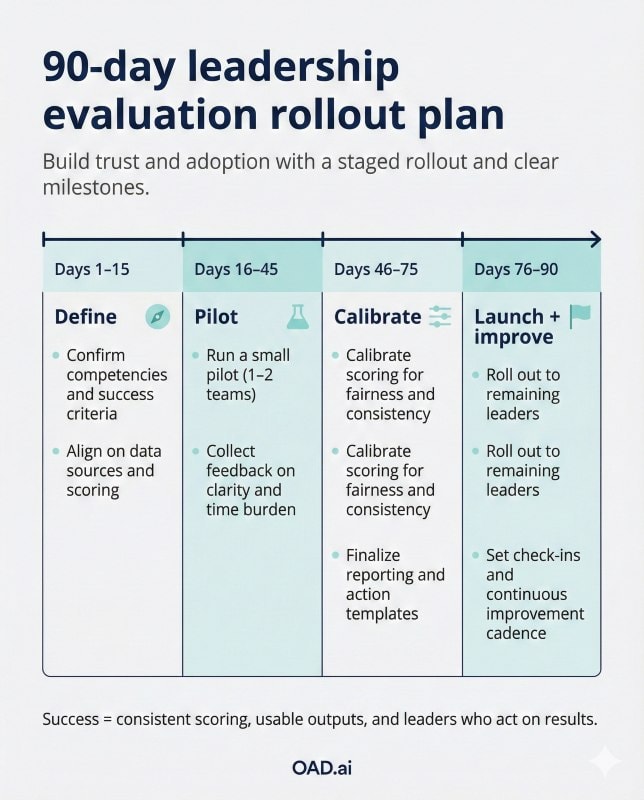
Simple rollout plan for the first 90 days
A realistic rollout looks like this:
- Weeks 1–2: finalize competency model and rubrics; define objectives and confidentiality rules
- Weeks 3–6: run 360 degree feedback + self-assessments for a pilot leader group
- Weeks 7–9: synthesize assessment findings; deliver leader and sponsor summaries
- Weeks 10–12: launch development plans with coaching; set KPIs and review cadence
This is enough to generate valuable insights, start development, and prove the process can work at scale, especially when supported by scalable, affordable OAD pricing plans.
Start with the free Top Performer Profile: 7 minutes, results in 24 hours, no credit card.