A team evaluation is only useful if it produces decisions: what to keep, what to fix, who needs support, and what “good” looks like next cycle. This template is built for HR teams and people leaders who want a consistent evaluation process that reduces bias, surfaces team strengths, and translates performance evaluations into clear expectations and measurable improvement.
Document Purpose and How to Use This Template
This document gives you a repeatable structure to evaluate team performance and individual contributions without turning the process into a personality contest. It includes:
- A one-page team summary you can use in team meetings or leadership reviews
- A competency-based evaluation framework (work ethic, time management, problem solving, communication)
- Rating scales and calibration rules to keep scoring consistent across teams and departments
- Performance review phrases and example phrases that stay specific and goal-linked
- Self-assessment prompts and follow-up development plan structure
Use it when you want to identify team strengths, spot improvement areas early, and create a clean record of outcomes, not just effort.

What this team evaluation template covers (and what it doesn’t)
Covers
- Team collaboration and shared goals
- Role-relevant outcomes and work assignments
- Reliable evidence: clear examples, customer impact, deadlines, quality
- Professional development: new skills, continuous learning, next steps
Doesn’t cover
- Personal traits disguised as feedback (“not a culture fit,” “bad attitude”)
- One-off incidents without context (unless they are repeated or high-risk)
- Vague labels without examples (“exceeded expectations” with no proof)
Intended readers (HR, hiring managers, people leaders)
This is written for:
- HR professionals coordinating the evaluation process
- Hiring managers and department leads running performance reviews
- Executives who need a clear view of employee performance, team strengths, and risk areas
- Team leads who want to give positive feedback and constructive feedback without guesswork
If you manage a marketing department, a customer-facing team, or a cross-functional project group, the structure stays the same. Only the examples and metrics change, which is why founders and CEOs benefit from a strategic, systematized approach to building teams and leadership.
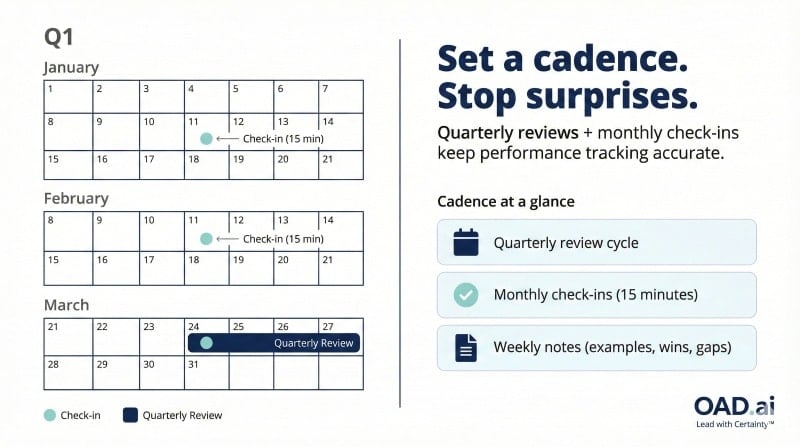
Set the evaluation timeframe and review cadence
Pick a timeframe that matches how work actually happens in your organization:
- Quarterly (best for fast-moving teams, changing priorities, or project work)
- Biannual (good for stable operations with meaningful cycles)
- Annual (use only if you also do quarterly check-ins, otherwise recency bias wins)
Define the review window clearly (example: “Oct 1 to Dec 31”) and require reviewers to reference evidence from inside that window. This is the simplest way to stop “last two weeks” from becoming the whole story.
What Is a Team Evaluation
A team evaluation is a structured review of how a team performs against shared outcomes: delivery, quality, collaboration, and execution against team goals. It looks at patterns across team members, not just individual performance in isolation.
A basic rule: if the output requires coordination, the evaluation should include team-level performance, not just individual performance evaluations.
Team evaluation vs individual performance evaluations
A team evaluation answers: did the group produce results together, and what helped or blocked that?
An individual performance evaluation answers: did a specific person deliver outcomes in their role, and how consistently?
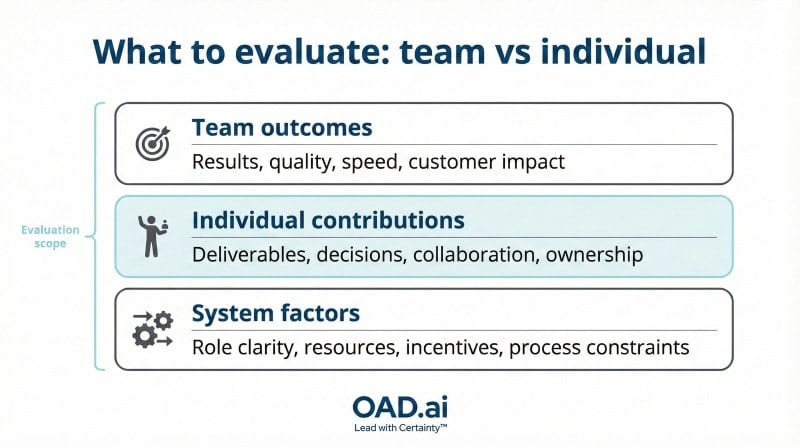
They overlap, but they’re not interchangeable. A team can hit targets while one person quietly carries the load, or miss targets because dependencies or leadership decisions made success impossible. Your evaluation process should separate:
- Team outcomes (shared goals, cross-functional execution, team collaboration)
- Individual contributions (work assignments, decision making, follow-through, skill development)
- System factors (priorities changing weekly, unclear expectations, understaffing, broken workflows)
If you don’t separate those, you end up punishing people for the system or rewarding the loudest person in the room.
How team evaluations connect to team goals and shared outcomes
A team evaluation should start with shared goals, not personalities. Tie the evaluation to outcomes like:
- Delivery: meeting deadlines, consistent throughput, predictable execution
- Quality: high quality work, fewer rework cycles, fewer customer complaints
- Collaboration: smooth handoffs, fewer escalations, better team meetings
- Improvement: continuous learning, new skills adopted, reduced recurring issues
Then link each competency to those goals. Example: if the team goal is faster delivery without errors, time management and problem solving matter more than “positive attitude.”
When to use a team evaluation
Use a team evaluation when:
- You need to identify team strengths and gaps across a whole function (marketing department, sales ops, customer support)
- You have recurring issues that involve coordination (handoffs, missed deadlines, duplicated work)
- You want to improve performance without guessing whether the issue is skill, process, or leadership
- You’re seeing signs of disengagement, turnover risk, or inconsistent execution
Use individual evaluations alone when work is mostly independent and dependencies are low.
Why Performance Reviews Matter for Employee Performance
Performance reviews are one of the few moments where an organization formally decides what “good” looks like, what gets rewarded, and what gets improved. That’s why sloppy reviews cause damage. They teach employees that outcomes don’t matter, only optics.
If reviews are consistent and evidence-based, they increase clarity, improve skill development, and strengthen accountability across team members — especially when they’re informed by a fast, validated personality assessment like the OAD Survey.

Retention and employee engagement (include sourced stats if available)
High performers leave when expectations are unclear, feedback is random, or rewards feel political. The review is where you correct that. It’s also where you spot “silent failure” early: missed deliverables, weak follow-through, or collaboration breakdowns that haven’t turned into a crisis yet.
When you bring in stats here, they must be sourced. Otherwise keep it directional: consistent feedback is strongly associated with engagement and retention, especially when employees understand what improvement looks like and believe performance is evaluated fairly.
Design teams with data, not gut feel.
Most org-design decisions come down to role fit, leadership style, and team dynamics. OAD reads those signals from a 7-minute behavioral survey, so you can reconfigure roles and teams with evidence instead of guesswork.
Skill development and continuous learning
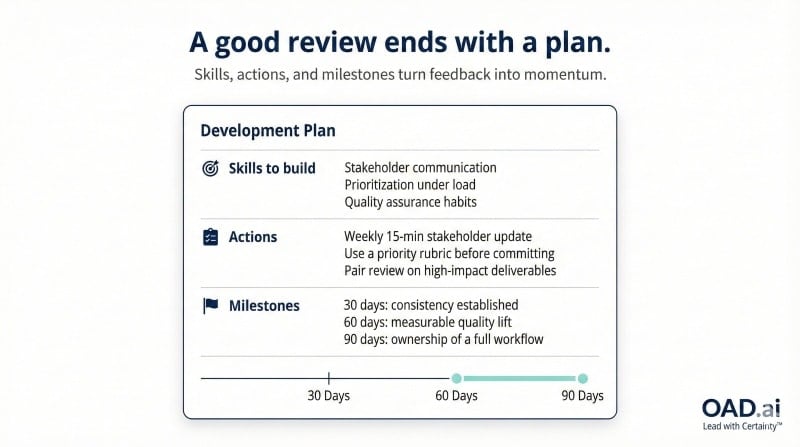
Performance evaluations should not be a history lesson. They should produce forward motion.
A useful evaluation includes:
- What the employee did well (positive feedback tied to outcomes)
- What needs improvement (constructive feedback with examples)
- What skill to build next (professional development with a plan informed by motivation and behavioral drivers)
The difference between “feedback” and “development” is specificity. “Improve communication style” is vague. “Summarize decisions in writing after team meetings to prevent rework” is actionable.
Why review frequency matters (annual vs quarterly check-ins)
Annual reviews create two predictable problems:
- Recency bias (last month dominates)
- Surprise feedback (people hear problems too late to fix them)
A better cadence:
- Quarterly check-ins for goals and blockers
- Mid-year review for deeper performance evaluation
- Annual review for compensation and promotion decisions, supported by the prior check-ins
This keeps feedback timely and reduces the temptation to invent a narrative at the end of the year.
Core Components of a Performance Review (Built for Team + Individual Use)
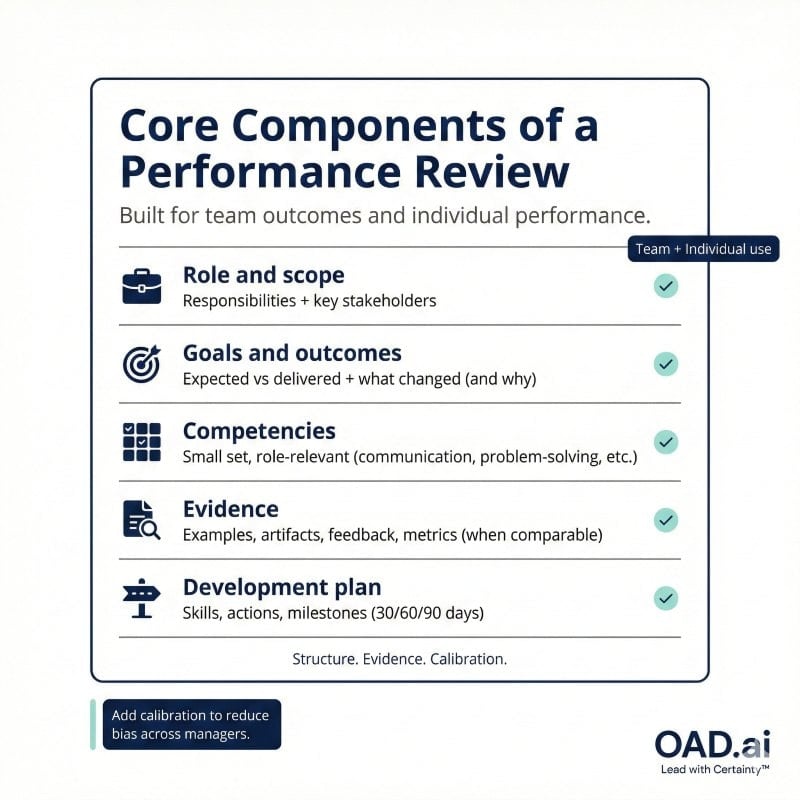
This section is the backbone. If you skip structure, you get vibes. If you skip evidence, you get politics. If you skip calibration, you get bias disguised as “manager judgment.”
Required sections (goals, competencies, outcomes, development)
A complete performance review should include:
- Role and scope
- What the role is responsible for
- Key stakeholders (team members, other departments, customers)
- Goals and outcomes
- What was expected
- What was delivered
- What changed (and why)
- Competencies
- Work ethic
- Time management
- Problem solving
- Communication and collaboration
(You can add role-specific competencies like customer service skills, but keep the set small.)
- Evidence
- Specific examples
- Work artifacts (tickets, project docs, customer feedback, deliverables)
- Metrics (only when meaningful and comparable)
- Development plan
- Improvement areas
- New skills to build
- Next steps and milestones
Rating scale options (simple 3-point vs 5-point)
Use a scale people can apply consistently.
Option A: 3-point scale (best for speed and consistency)
- Needs improvement: below expectations, repeated gaps, requires intervention
- Meets expectations: solid track record, reliable employee, consistent delivery
- Exceeds expectations: repeatedly delivers above role level, raises team output
Option B: 5-point scale (only if you can calibrate well)
- 1 Needs improvement
- 2 Inconsistent / partial
- 3 Meets expectations
- 4 Strong
- 5 Exceptional
Rule: if you use 5 points, define what “4” and “5” mean in observable terms. Otherwise people hand out 4s like candy and call it a system.
Evidence requirements (specific examples, work artifacts, metrics)
Every rating must have evidence. Minimum standard per competency:
- At least 2 specific examples from the review window
- At least one example tied to outcomes (quality, deadlines, customer impact, team goals)
- Avoid proxy signals like “always online” or “stays late” unless you tie them to results
Examples of acceptable evidence:
- “Delivered X project by date Y, reduced rework in Z phase”
- “Handled escalation from customer, used active listening skills, resolved within agreed SLA” — the kind of behavior you can screen for using structured methods to assess communication skills in interviews
- “Proposed creative solutions that removed a recurring blocker, team throughput improved”
Unacceptable evidence:
- “Good attitude”
- “Nice to work with”
- “Sometimes difficult”
Those can be true and still useless.

Calibration rules (to reduce bias across managers and departments)
Calibration is how you stop one manager from being overly critical while another gives everyone “exceeded expectations.”
Minimum calibration rules:
- Calibrate within each department first (same role context)
- Then do a cross-department check for rating drift (especially leadership roles)
- Require reviewers to bring evidence, not just opinions
- Flag patterns: one reviewer rating everyone low or everyone high
If you don’t calibrate, your rating scale becomes decoration and your employees notice.
Competency 1: Work Ethic (Observable Behaviors + Examples)
Work ethic is not “being busy.” It’s reliability, follow-through, and commitment to outcomes when things get messy.

What “work ethic” looks like in practice (reliable employee, follow-through)
Observable behaviors:
- Follows through on commitments without constant reminders
- Raises risks early instead of hiding problems
- Maintains quality under pressure
- Supports team members during crunch periods without martyr behavior
- Shows strong commitment to shared goals, not just personal tasks
This is where “solid track record” belongs, but only if you can point to results.
What to cite (attendance patterns, ownership, responsiveness, quality)
Cite evidence like:
- Consistent delivery across the timeframe (not one heroic week)
- Ownership of work assignments: proactive updates, clear handoffs, documentation
- Responsiveness to stakeholders and other employees, especially in high-stakes roles like sales teams where fit and motivation drive performance
- Quality indicators: fewer defects, fewer revisions, fewer escalations
Avoid “leave early” or “works late” unless it directly impacts outcomes. Time spent is not performance.
Improvement expectations and “next step” standards
If work ethic is below expectations, define improvement as behavior, not intent.
Bad: “Be more committed.”
Good: “Provide status updates twice per week, flag blockers within 24 hours, and close tasks by agreed deadlines.”
A useful rule for managers and coaches using behavioral data to guide coaching conversations:
- Improvement expectations must include a measurable behavior
- The employee must know what “good” looks like next cycle
- The manager must commit to support (removing blockers, clarifying expectations)
Competency 2: Time Management (Metrics That Don’t Lie)
Time management is not “being fast.” It’s prioritizing the right work, meeting deadlines consistently, and keeping work manageable without dumping chaos on other team members.
Deadline adherence and managing work assignments
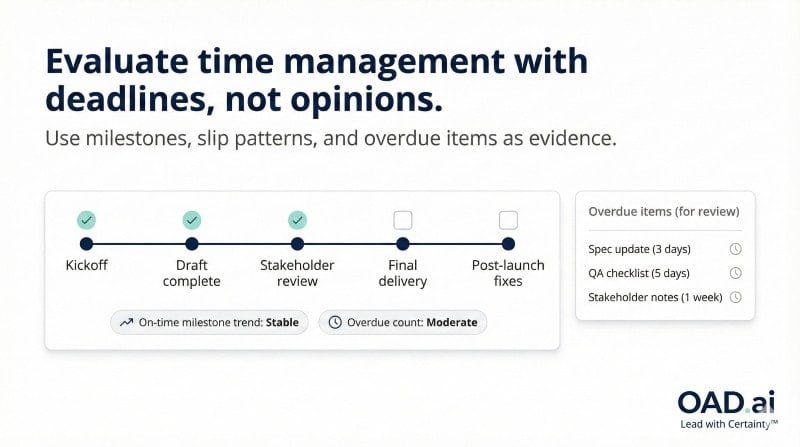
Track deadline performance in a way that’s fair and role-appropriate:
- Delivery commitments met vs missed (within the timeframe)
- Predictability: do estimates match reality?
- Follow-through on work assignments without constant re-planning
If someone misses deadlines but the team still ships, check whether:
- Scope was unrealistic
- Dependencies were unmanaged
- Priorities changed midstream
Time management scoring should not punish people for leadership thrash.
Task prioritization and manageable tasks (evidence examples)
Evidence of strong prioritization:
- Works the highest-impact tasks first, not the easiest
- Communicates tradeoffs when capacity is tight
- Breaks large tasks into deliverable milestones
- Protects focus time when deep work is needed
Evidence to request:
- Weekly plan or prioritization notes
- Examples of deprioritizing low-value work
- Clear handoffs to other employees or other departments when needed
If the person is always “busy” but outcomes lag, you have a prioritization problem, not a workload problem.
Meeting deadlines without sacrificing high quality work
Time management includes quality control. Watch for:
- Rushing and creating rework for the team
- “Done” that isn’t actually done
- Work that passes the buck to QA, support, or downstream teams
Stronger standard:
- Deadlines met with acceptable quality
- Fewer last-minute changes
- Reduced need for escalation or cleanup
If you can, anchor this to metrics that matter in your context (bug rate, customer complaints, rework cycles). If you can’t, use concrete examples.
Competency 3: Problem Solving and Decision Making
Problem solving is the ability to remove blockers without breaking something else. Decision making is choosing a path, explaining why, and owning the outcomes.

Documenting problem-solving instances (creative solutions, innovative ideas)
Require problem-solving examples to include:
- The problem and why it mattered
- The constraints (time, budget, people, customer impact)
- The actions taken
- The result
Strong indicators:
- Finds root causes, not just symptoms
- Offers creative solutions that are practical, not just clever
- Improves a process so the team doesn’t fight the same fire again
Weak indicators:
- Fixes the same issue repeatedly without addressing cause
- Escalates everything upward
- “Innovative ideas” that never ship
Decision-making rationale (tradeoffs, risk, customer impact)
Decision making should be explainable. In a review, you want to see:
- What options were considered
- Why the chosen option made sense
- What tradeoffs were accepted
- How customer impact and team goals were weighed
This is where “communication style” can quietly sabotage fairness. Some people narrate every thought. Others decide calmly and move. Judge the reasoning and the outcomes, not how theatrical the person is.
Rating outcomes against objectives (results, not vibes)
Rate outcomes based on objective alignment:
- Did the decision move the team toward shared goals?
- Did it reduce risk or create unnecessary risk?
- Did it improve performance, quality, or speed?
- Did it create hidden costs for other departments or team members?
If results were poor, still score fairly when the process was solid and constraints were real. If results were good but the process was reckless, don’t reward luck.
Competency 4: Communication and Collaboration
Collaboration is what separates “a group of capable people” from an actual team. Most performance issues that look like “skill” are really coordination failures.
Team collaboration and team meetings (shared goals, handoffs)
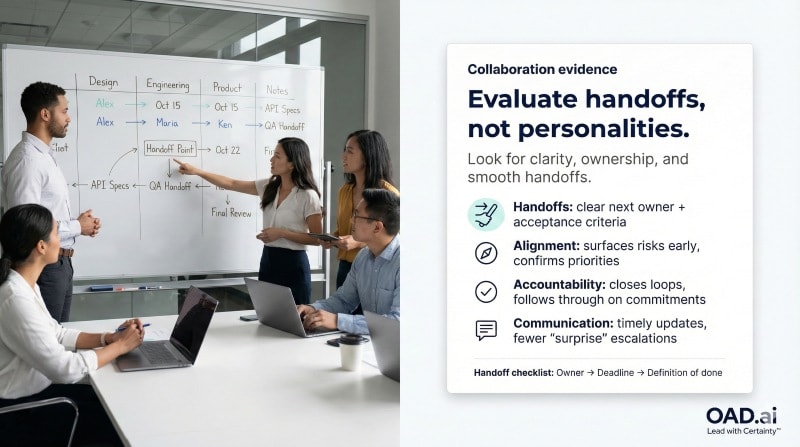
Evidence of strong collaboration:
- Shares context early, not at the last second
- Clarifies responsibilities and next steps after team meetings
- Supports handoffs with documentation, not verbal memory
- Helps unblock team members without taking over their work
Red flags:
- Withholds information
- Creates confusion about ownership
- Forces constant re-explaining due to poor documentation
- Optimizes personal output while slowing the team
Customer service skills and active listening skills (when relevant)
Not every role is customer-facing, but most roles have internal customers. When relevant, look for:
- Active listening skills: confirms understanding before acting
- Handles feedback without defensiveness
- Resolves issues without unnecessary escalation
- Maintains professional tone under pressure
This is where “positive attitude” is often misused. Don’t rate cheerfulness. Rate service behavior and results.
Cross-functional work with other departments (relationships, support)
Cross-team performance shows up in:
- Response time to dependencies
- Quality of handoffs
- Clarity in requests and specs
- Willingness to coordinate instead of blame
Ask for at least one example involving other departments if the role touches them. If it doesn’t, don’t force it.
How to Write Actionable Performance Evaluations
If a performance review can’t be translated into a decision or a next step, it’s not a review. It’s a diary entry.
Use specific outcome statements tied to data points
Use a simple structure, and when possible, let employees reference their own secure profiles and insights from an application access portal:
Behavior + Context + Evidence + Outcome
Examples:
- “In Q4, you led the launch plan, tracked dependencies weekly, and the team hit the deadline with fewer last-minute changes.”
- “You missed three agreed milestones this quarter. In each case, blockers were raised late, which created rework for other employees.”
If you have real metrics, use them. If you don’t, use verifiable artifacts: project docs, customer feedback, deliverable reviews, meeting notes.
Avoid “always” and “never.” Humans love exaggeration. Performance management should not.
Turn constructive feedback into a development plan
Constructive feedback is only useful if it defines improvement in observable terms.
Bad: “Needs to improve time management.”
Good: “For the next 60 days, provide weekly priorities, flag risks within 24 hours, and deliver milestones on the dates agreed.”
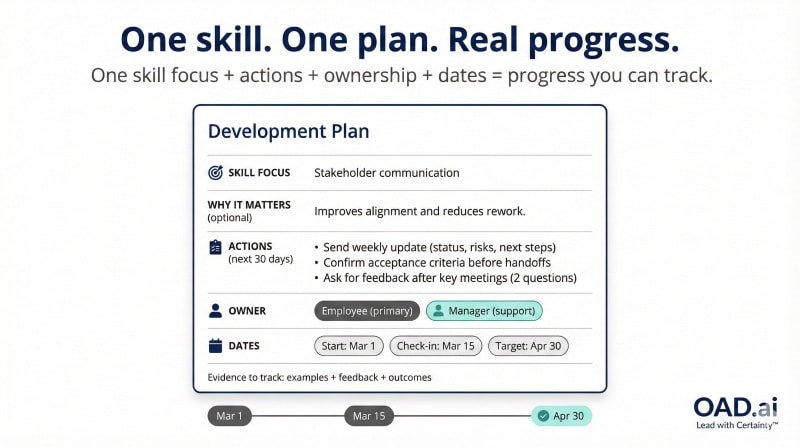
A practical development plan includes:
- One priority skill (not five)
- One behavior change you can observe
- One support action from the manager
- One milestone date for review
Professional development that has no timeline is just wishful thinking.
Avoid vague language, overly critical tone, and personality judgments
These phrases usually mean “I’m annoyed” rather than “I have evidence”:
- “Not a team player”
- “Bad attitude”
- “Too quiet”
- “Too aggressive”
- “Communication style issues”
Translate them into observable behavior:
- “Did not share status updates, which caused missed handoffs”
- “Interrupted stakeholders in meetings and dismissed concerns without addressing them”
- “Avoided customer calls despite role requirement”
This is how you keep reviews fair and reduce bias.
Performance Review Phrases (Positive + Constructive)
These phrases are meant to be used as scaffolding. If you copy-paste without adding specific examples, you’re just generating corporate noise. Humans already do that perfectly without help.
Positive feedback examples by competency (copy-paste)
Work ethic
- “Shows strong commitment to shared goals and follows through without needing reminders.”
- “Maintains a solid track record of reliable delivery, even under shifting priorities.”
- “Takes ownership of work assignments and proactively communicates progress and risks.”
Time management
- “Consistently meets deadlines and adjusts priorities without sacrificing quality.”
- “Keeps tasks manageable by clarifying scope early and setting realistic milestones.”
- “Plans work effectively and communicates tradeoffs when capacity is tight.”
Problem solving and decision making
- “Identifies root causes and proposes practical solutions that reduce repeat issues.”
- “Makes sound decisions based on objectives and communicates rationale clearly.”
- “Applies creative solutions that improve team effectiveness and project outcomes.”
Communication and collaboration
- “Strengthens team collaboration through clear handoffs and consistent updates.”
- “Uses active listening skills to confirm requirements and reduce rework.”
- “Builds strong relationships across other departments and resolves blockers quickly.”

Constructive feedback examples by competency (copy-paste)
Work ethic
- “Follow-through is inconsistent. Commitments are sometimes missed without early warning to the team.”
- “Ownership needs improvement. Tasks are completed, but stakeholders often lack clarity on status and next steps.”
- “Responsiveness is uneven, which slows coordination with team members and other departments.”
Time management
- “Deadlines are missed more often than expected, and risks are raised too late to adjust plans.”
- “Prioritization needs improvement. Lower-impact tasks sometimes take time away from key deliverables.”
- “Work is delivered on time, but quality issues create rework and slow the team overall.”
Problem solving and decision making
- “Problem-solving is often reactive. Root causes are not consistently identified, leading to repeat issues.”
- “Decisions are made without documenting rationale, which creates confusion and misalignment.”
- “Solutions sometimes optimize local results while creating downstream issues for other employees or teams.”
Communication and collaboration
- “Updates are inconsistent, which leads to missed handoffs and unclear expectations.”
- “Meeting communication needs improvement. Decisions are not always summarized, creating rework later.”
- “Cross-team coordination is slower than expected, especially when dependencies change.”
Performance review phrases that tie directly to goals
Goal-linked phrasing forces clarity. Use:
- “This improved performance against [team goal] because…”
- “This blocked progress toward [shared goals] because…”
- “Next cycle, success looks like [measurable outcome] by [date].”
Example:
- “This supported the team goal of meeting deadlines because weekly risk flags reduced last-minute changes.”
Performance Review Questions and Self-Assessment Prompts
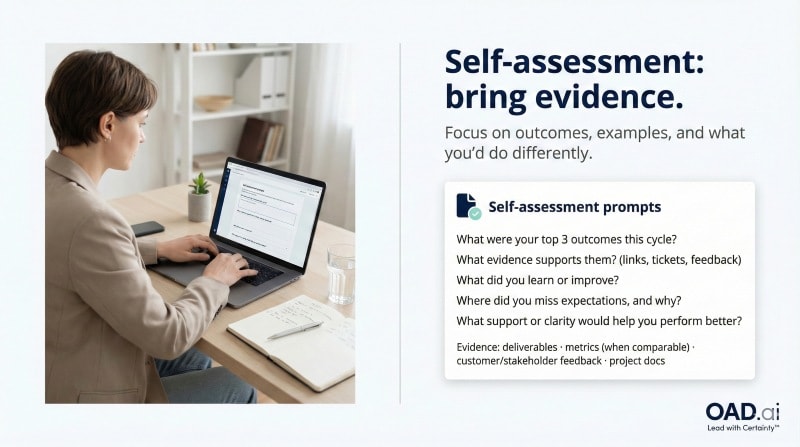
These prompts are designed to pull out real evidence, not motivational speeches. They work for performance reviews, team evaluations, and development check-ins.
Recent achievements and impact
Ask the employee (and mirror it for manager input):
- What were your 2–3 most important outcomes in this evaluation timeframe?
- Which team goals did your work directly support? How?
- What is one deliverable you’re proud of, and what evidence shows it worked?
- Where did you exceed expectations, specifically? What changed because of it?
- What feedback did you receive from team members, stakeholders, or customers?
Evidence to request:
- Links to work artifacts (docs, dashboards, tickets, customer feedback)
- A short before/after description where possible
Biggest challenges and blockers
Ask:
- What slowed you down the most this cycle: unclear expectations, dependencies, skill gaps, or workload?
- Where did you miss a goal or deadline? What caused it?
- What problem did you solve that prevented a bigger issue later?
- What tradeoffs did you make, and what did you deprioritize?
- What support did you need but did not get (from manager, process, or tools)?
Optional manager follow-up:
- Were these blockers raised early enough for the team to respond?
- Did the employee propose workable options, or only report the problem?
Development interests and new skills to build
Ask:
- What new skills do you want to build in the next 90 days?
- Which part of your role currently feels hardest, and why?
- What type of work assignments would stretch you in a useful way?
- What is one capability you want to strengthen that will improve team effectiveness?
- What support would make professional development realistic (time, coaching, training, clearer scope)?
Make it measurable:
- “By the next review, what would improved performance look like in observable terms?”

Metrics and Rating Scales for Performance Evaluations
Metrics are helpful when they measure something real and comparable. Metrics are harmful when they reward vanity, punish the wrong behavior, or pretend every role is the same. Use metrics to clarify expectations, not to cosplay objectivity, and pair them with validated psychometric data from tools like the OAD Survey.
Numerical scoring system (what each level means)
Use one scoring system across the organization, then define role-specific evidence underneath it.
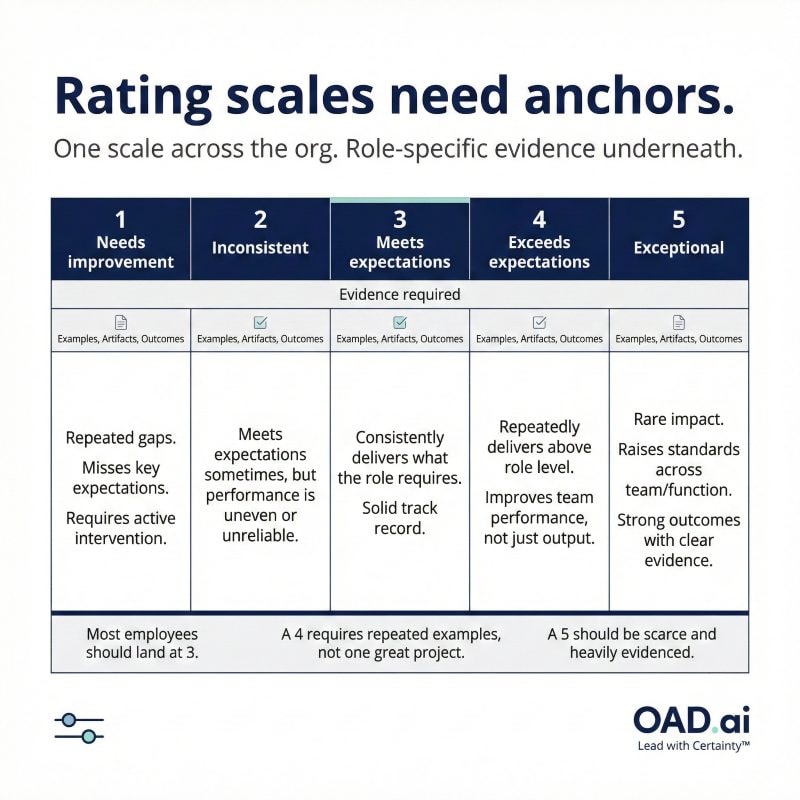
Recommended 5-point scoring (with anchors):
- 1: Needs improvement
Repeated gaps. Misses key expectations. Requires active intervention. - 2: Inconsistent
Meets expectations sometimes, but performance is unreliable or uneven. - 3: Meets expectations
Consistently delivers what the role requires. Solid track record. - 4: Exceeds expectations
Regularly delivers above role level. Improves team performance, not just personal output. - 5: Exceptional
Rare impact. Raises standards across the team or function. Strong outcomes with clear evidence.
Rules that keep this usable:
- Most employees should land at 3. That’s the point of “meets expectations.”
- A 4 requires repeated examples, not one “good project.”
- A 5 should be scarce and heavily evidenced, or your scale is meaningless.
Simple alternative (3-point):
- Needs improvement
- Meets expectations
- Exceeds expectations
Use 3-point when calibration maturity is low or leadership wants speed over nuance.
Thresholds for promotion, growth plans, or role changes
Don’t tie promotion to a single overall number. That creates gaming and politics. Tie it to specific patterns:
Promotion readiness typically requires:
- Consistent 3+ in outcomes against role expectations
- At least one competency at 4 that maps to the next role level
- Evidence the person can operate with greater scope (ownership, decision making, cross-team impact)
Growth plan triggers (examples):
- Any competency at 1
- Repeated 2s in work ethic or time management
- Patterns that damage team collaboration (missed handoffs, unclear expectations, chronic rework)
Role change or reassignment triggers:
- Strengths that don’t match current role needs (example: strong problem solving, weak customer service skills in a customer-facing role)
- Repeated friction with key job requirements despite support and coaching
If you can’t explain why a rating leads to a decision, you’re not managing performance. You’re collecting numbers — a mistake private equity firms recognize when they add behavioral due diligence on leadership teams alongside financials.
Design teams with data, not gut feel.
Most org-design decisions come down to role fit, leadership style, and team dynamics. OAD reads those signals from a 7-minute behavioral survey, so you can reconfigure roles and teams with evidence instead of guesswork.
Calibration cadence and how to run it
Cadence
- Quarterly calibration (lightweight) for teams with fast cycles
- Biannual calibration (deeper) for stable teams
- Always calibrate before compensation or promotion decisions
How to run calibration
- Review distribution by manager (spot overly critical or overly generous raters)
- Review a sample of ratings across departments for consistency
- Require evidence for 4s and 5s, and for any 1s
- Compare role expectations: are people being rated against the same standard?
- Document changes made during calibration and why
Calibration is where “fairness” becomes operational. Without it, the rating scale is just a manager mood ring.
Common Pitfalls in Performance Reviews (And How to Avoid Them)
Most review failures are predictable. The fix is boring: structure, evidence, and consistency.
Recency bias and halo/horns effect
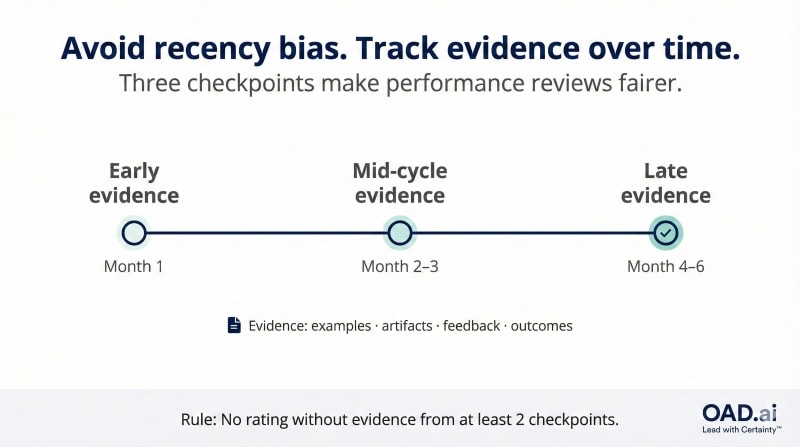
Recency bias: the last few weeks dominate the whole evaluation timeframe.
Fix: require examples from early, middle, and late parts of the period.
Halo/horns: one strong trait makes everything look good, or one mistake poisons the whole narrative.
Fix: score competencies separately, then summarize. Don’t write the summary first.
Personality-based judgments and “communication style” traps
The fastest way to introduce bias is to evaluate temperament instead of behavior.
Replace:
- “Not a culture fit”
- “Too intense”
- “Too quiet”
- “Bad attitude”
With:
- “Did not share progress updates, causing missed handoffs”
- “Interrupted stakeholders repeatedly during team meetings”
- “Avoided direct customer communication required by the role”
- “Dismissed feedback without addressing the underlying issue”
If you can’t point to observable behavior and impact, don’t put it in the review.

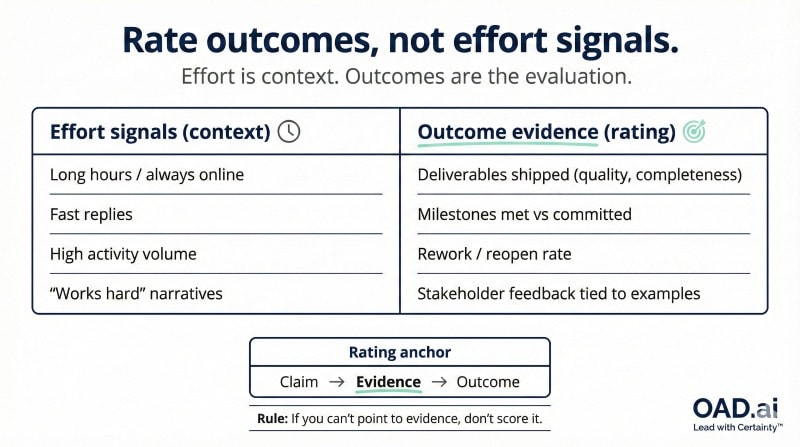
Confusing effort with outcomes (work ethic vs results)
Effort matters only when it produces outcomes or reduces risk. Otherwise you reward busyness.
Examples:
- “Stayed late” is not performance.
- “Handled more work” is not performance unless quality and priorities stayed intact.
- “Very responsive” is not performance if work is still late or wrong.
Fix: tie feedback to goals, deliverables, quality, customer impact, and team outcomes.
Follow-Up and Development Plans
This is the part most companies do badly because it requires consistency. A review without follow-up is just a ritual where everyone agrees to change later and then doesn’t.
Individual development plan template
Use a simple structure that forces focus. One plan per person, not a laundry list.
Individual Development Plan (IDP)
Evaluation timeframe: [dates]
Role: [title]
Primary focus area (choose one): [work ethic / time management / problem solving / communication / role-specific]
- What to improve (behavior-based)
- Current gap:
- Why it matters (team goals / customer impact / quality / deadlines):
- Evidence from this review (2–3 examples):
- What “improved performance” looks like
- Observable behavior standard:
- Expected outcome standard:
- By when:
- Actions (employee-owned)
- Action 1:
- Action 2:
- Practice cadence (weekly / biweekly):
- Support (manager/organization-owned)
- Remove blockers:
- Provide coaching:
- Provide training/tools:
- Clarify expectations:
- Milestones
- 30-day checkpoint:
- 60-day checkpoint:
- 90-day checkpoint:
Follow-up check-ins and measurable milestones
Set follow-ups as part of the evaluation process, not as a “nice to have.”
Recommended rhythm:
- Weekly or biweekly: short check-in on priorities, blockers, workload manageability
- Monthly: progress check against the IDP milestone
- Quarterly: formal review checkpoint aligned to team evaluation cadence
Milestones should include:
- A deliverable or behavior change
- A date
- A success definition
- Evidence to bring (artifact, metric, stakeholder feedback)
Example milestones:
- “By March 31, provide weekly status updates with risks and next steps.”
- “By April 30, deliver two projects with no last-minute rework caused by unclear handoffs.”
- “By next check-in, document decision-making rationale for major tradeoffs in the project log.”
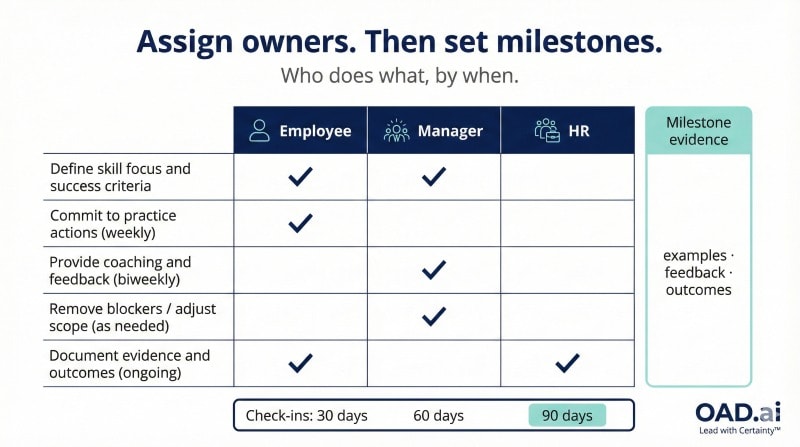
Assigning accountability
If accountability is vague, progress is optional. Define who owns what.
- Employee owns: actions, practice cadence, evidence collection, raising blockers early
- Manager owns: coaching, feedback quality, removing obstacles, clear expectations, fair scoring
- HR owns: consistency, calibration, process health, documentation standards
One more rule that stops drift: every milestone needs a named owner and a check-in date. Otherwise it disappears into “later.”
Sample Team Evaluation Templates (Download-and-Use Formats)
This section gives you three practical templates: a one-page team summary, a behavioral anchor rubric, and a peer-feedback form. Use all three if you want a complete team evaluation. Use only the one-page summary if you need speed.
One-page team evaluation summary template
Team: [name]
Department: [marketing department / operations / customer support / etc.]
Evaluation timeframe: [dates]
Evaluator(s): [names]
Team goals (top 3):
Team strengths (evidence-based)
Key outcomes delivered
Risks / improvement areas
Collaboration health
- What’s working across team members:
- What’s slowing work (handoffs, dependencies, meetings):
Next-cycle priorities
- Priority + owner:
Notes (optional)
- Hiring needs / capacity issues:
- Process fixes needed:

Behavioral anchor rubric (BARS) for consistency
Use this rubric to make ratings less subjective. Pick 3–5 competencies and define anchors for scores.
Behavioral Anchor Rubric (example structure)
Competency: Time Management
- 1 Needs improvement: misses key deadlines repeatedly, blockers raised late, work creates rework
- 3 Meets expectations: meets deadlines consistently, communicates tradeoffs, plans manageable tasks
- 5 Exceptional: improves team planning systems, raises predictability, reduces recurring delays
Repeat for:
- Work ethic
- Problem solving and decision making
- Communication and collaboration
- Role-specific skills (optional), like customer service skills
Rule: reviewers must cite at least two examples per competency. No exceptions.
Peer-feedback form (team member input)
Peer feedback should be short, structured, and evidence-based to avoid popularity contests.
Peer Feedback Form (per employee)
Name:
Evaluation timeframe:
- What did this person do that improved team performance?
- Where did this person slow the team down or create friction?
- How reliable were they on commitments and handoffs?
- How effective were they in team collaboration and team meetings?
- What is one skill they should build next for improved performance?
Optional guardrails:
- Require examples for any critical feedback
- Limit to 5–10 minutes per form
- HR reviews for patterns, not isolated complaints
FAQ
How to write a team evaluation?
Write a team evaluation by anchoring it to shared goals and requiring evidence. Use this structure:
- Define the evaluation timeframe and the top 3 team goals
- Document team outcomes (delivery, quality, customer impact)
- Evaluate core competencies that affect team performance (collaboration, problem solving, time management)
- Include specific examples, work artifacts, and role-relevant metrics
- Identify team strengths and improvement areas with clear ownership
- End with next-cycle priorities and follow-up check-ins
A team evaluation should show what happened, why it happened, and what changes next.
What are 5 examples of performance assessment?
Five common performance assessment examples you can use in performance reviews:
- Rating scale evaluation (3-point or 5-point scale with behavioral anchors)
- Goal-based assessment (progress against agreed objectives and outcomes)
- Competency assessment (work ethic, time management, communication, problem solving)
- Peer feedback (structured input from team members with evidence)
- Self-assessment (employee reflection supported by specific examples and work artifacts)
The best evaluation process combines at least two of these, not just one.
What should I write in a teamwork performance review?
Write about behaviors and outcomes that affect the team, not personal traits. Cover:
- How the person supported team collaboration and shared goals
- Reliability on handoffs and meeting deadlines
- Communication quality in team meetings (clarity, follow-through, decision summaries)
- Contributions to problem solving and reducing recurring issues
- Concrete examples showing impact on other employees, customers, or deliverables
If you can’t tie a point to an example, don’t include it.
What is an example of a good evaluation comment?
A good evaluation comment includes the behavior, evidence, and impact, plus a clear next step.
Examples:
- “You consistently met deadlines this quarter and flagged blockers early, which reduced last-minute changes for the team. Next cycle, document key decisions after team meetings to improve cross-team alignment.”
- “You delivered high quality work, but several handoffs were unclear and created rework for other departments. Over the next 60 days, share weekly status updates with owners, deadlines, and risks.”
Good comments are specific, fair, and usable.
Conclusion
A sample team evaluation template is only valuable if it produces better decisions: clearer expectations, fairer performance evaluations, and measurable improvement. Keep the system simple:
- Tie everything to team goals
- Use evidence and specific examples
- Calibrate ratings so the scale means the same thing across managers
- Convert feedback into follow-up plans with milestones
If you want to see how OAD performs on your own roles and candidates, start with the free Top Performer Profile, explore scalable OAD pricing plans for every team size, and evaluate performance with consistent data you can actually defend in leadership reviews.