Hiring “top talent” is not about luck, charisma, or whoever interviews best. It is about running a recruiting system that reliably attracts the right candidates, evaluates them consistently, and closes them quickly, without cutting corners that create expensive mis-hires.
This guide is written for HR leaders, hiring managers, and executives in 50+ employee organizations who need hiring to be faster, more consistent, and easier to scale, and it complements our comprehensive guide on hiring your first employee for earlier-stage businesses. It focuses on practical decisions you can implement immediately: job design, sourcing, interview structure, offer speed, and the metrics that tell you whether your recruiting process is actually working.
Recruiting is everything that happens before the hire. It is how you identify, attract, and move the right people into your pipeline. Hiring is the decision and the transaction: selecting a candidate, making an offer, and bringing them onboard.
That distinction matters because most “hiring problems” are actually recruiting problems.
If the pipeline is weak, teams compensate by lowering standards, stretching timelines, or overvaluing signals like pedigree and confidence. If the pipeline is strong, you can be selective and still move fast.
Recruit talent effectively means you can answer “yes” to three questions:
- Are we attracting people who can do the work, not just people who want the title?
- Are we evaluating them in a way that is consistent across interviewers and candidates?
- Are we making decisions fast enough to win strong candidates without rushing the judgment?
A useful definition for leaders is simple: recruiting is a decision system. It reduces uncertainty. It makes “good hiring” repeatable, across roles, teams, and regions, even when the labor market shifts, which is especially critical for founders and CEOs focused on long-term team fit.
Recruiting vs hiring (and why the difference matters)
When people say “we need to improve hiring,” they usually mean one of these:
- Too few qualified candidates are applying.
- Good candidates drop out mid-process.
- Interviewers disagree and decisions stall.
- The wrong people get hired, and performance or retention suffers.
Only the last one is purely “hiring.” The rest are recruiting process design problems.
A clean recruiting process does two things at once:
- It creates a better candidate experience (clear steps, fewer delays, fewer pointless interviews).
- It creates better decision quality (less bias, fewer random opinions, more job-relevant evidence).
This is where structured evaluation pays off. The goal is not to remove human judgment. The goal is to stop relying on unstructured judgment as your primary measurement tool, and to supplement it with psychometrically precise hiring data from tools like OAD.
Design teams with data, not gut feel.
Most org-design decisions come down to role fit, leadership style, and team dynamics. OAD reads those signals from a 7-minute behavioral survey, so you can reconfigure roles and teams with evidence instead of guesswork.
The real goal: predictable quality, not just filled seats
Speed matters, but speed without quality is just fast failure.
The real target is predictable hiring outcomes: performance, ramp time, and retention that hold steady as you scale. That requires two forms of clarity and benefits from behavior-fit reporting that matches roles to personality:
- Role clarity: what good performance looks like in this specific business role.
- Signal clarity: which signals predict success for this role, and how you measure them consistently.
If you treat recruiting like a system, you stop “hoping” for the right hire and start engineering the conditions that produce one.
About Recruit Talent
Recruit Talent exists to help organizations hire with more speed, more consistency, and better outcomes. The core promise is straightforward: build a recruiting process that reliably identifies strong candidates, reduces wasted interview time, and improves the quality of hiring decisions, supported by scalable OAD pricing plans for different team sizes.
This matters most in growing companies where hiring volume rises faster than process maturity. Without a clear system, teams default to inconsistent interviews, slow approvals, and gut feel instead of using fast, validated behavioral survey tools to reveal fit early. The result is predictable: longer time-to-hire, lower offer acceptance, and mis-hires that cost far more than the recruiting budget ever did.
Design teams with data, not gut feel.
Most org-design decisions come down to role fit, leadership style, and team dynamics. OAD reads those signals from a 7-minute behavioral survey, so you can reconfigure roles and teams with evidence instead of guesswork.
Mission and “talent promise”
The mission is to connect businesses with talent that fits the role, the team, and the operating reality of the company. That means focusing on three things clients usually struggle to balance:
- Role fit: can the person actually do the work, in your context?
- Team fit: will they collaborate effectively with the people they will work with?
- Execution fit: can they perform in the pace, ambiguity, or complexity your business requires?
A “talent promise” is only credible if it is operational. In practice, it shows up as consistent sourcing, structured evaluation, and faster decision-making informed by insights into what truly motivates your hires. That is what prevents the common trap of “we hired someone impressive, but it did not work out.”
Industry partnerships and sourcing reach
Most companies do not have a talent problem. They have a distribution problem. They rely on the same two or three channels, post the same generic job ads, and then wonder why the same generic applicants show up.
Recruit Talent’s approach emphasizes reach and relevance: expanding access to candidates through industry partnerships, communities, and targeted sourcing methods, rather than waiting passively for applicants to appear. This is especially valuable for roles where job boards underperform, including specialized functions, leadership positions, and post-acquisition leadership hiring in private equity portfolios.
What makes Recruit Talent different
Most recruiting support fails in one of two ways:
- It prioritizes speed over fit and creates churn later.
- It prioritizes “perfect fit” and creates a slow, bloated process that loses candidates.
The differentiator should be the ability to do both: move fast while staying structured.
In practice, that means:
- Role definition that is outcome-based, not a list of buzzwords
- Sourcing that targets the right candidate segments, including passive candidates
- A standardized interview and scorecard system so decisions do not depend on who interviewed last
- Clean handoffs and timelines so offers happen before candidates accept elsewhere
That combination is what turns recruiting into a repeatable business function instead of a recurring fire drill.
How do you recruit talent? A practical system
If you want a recruiting process that scales, stop thinking in “tips” and start thinking in stages. A functional system has four:
- Define what “good” looks like for the role
- Attract and source candidates who match that reality
- Evaluate consistently using job-relevant signals
- Decide and close fast enough to win strong candidates
Define the role outcomes (not a wishlist of skills)
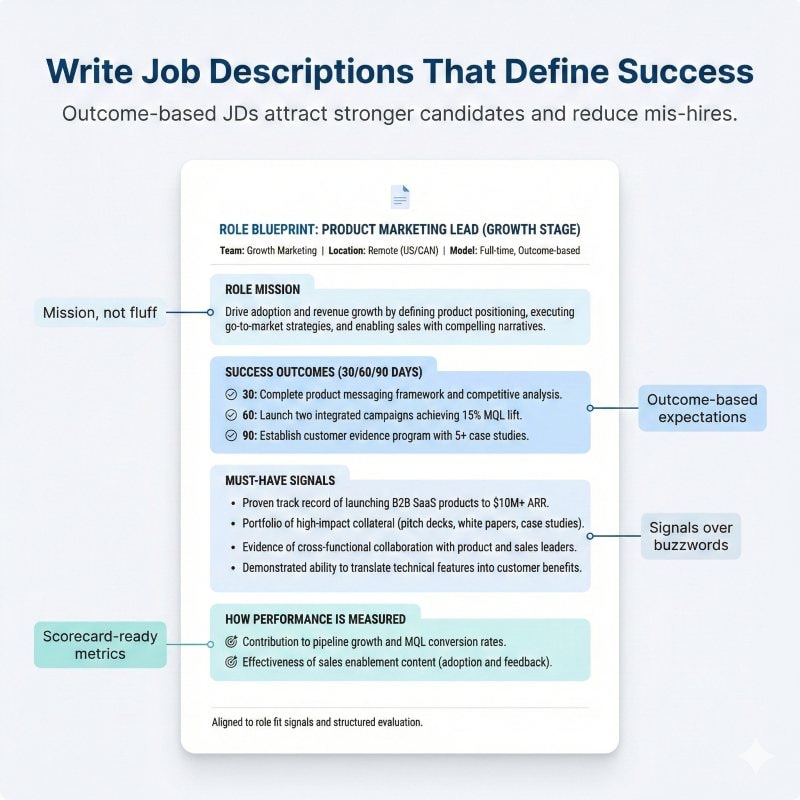
Most job descriptions are written like a shopping list. The better approach is to define outcomes and constraints.
Outcomes are what the person must produce in the first 90 to 180 days. Constraints are the realities they must operate in: pace, ambiguity, stakeholder complexity, technical environment, team dynamics, and decision-making style.
A simple method that works across industries:
- 3 outcomes the role must deliver in the first 90 days
- 3 outcomes the role must deliver in the first 180 days
- 3 “non-negotiables” (skills or behaviors required to hit those outcomes)
This is the foundation for everything else: job ad messaging, sourcing keywords, interview questions, and scorecard criteria.
Build a sourcing plan across channels (active + passive)
Top talent rarely appears by accident. Your sourcing plan should cover:
- Active candidates: job boards, inbound applications, referrals
- Passive candidates: targeted outreach, communities, events, competitor mapping, alumni networks
If you are relying on inbound only, you are basically letting the market decide your hiring quality.
A practical sourcing plan includes:
- A short list of target titles and adjacent titles
- Keyword clusters that reflect real niche skills, not generic terms
- 2 to 3 sourcing channels that match where that talent spends time
- A simple outreach message that ties the role to outcomes, not hype
Run a consistent evaluation process
This is where most teams lose control. They run interviews that feel productive but produce inconsistent information, especially when they lack behavioral interview questions designed to assess cultural fit.
Consistency does not mean robotic interviews. It means each stage has a purpose, and each interviewer measures the same core criteria. Scorecards are the simplest lever here, because they convert impressions into comparable data.
If you want better decisions, you need structure that makes “why we chose this person” explainable.
How to attract top talent
Attraction is not “employer branding.” It’s message-market fit. Strong candidates choose roles that are clear, credible, and aligned with what they care about: meaningful work, growth, competent leadership, fair pay, and a team they won’t regret joining—especially in high-impact functions like building and leading winning sales teams.
If your job post looks like every other post, you will attract the same candidates everyone else is fighting over.

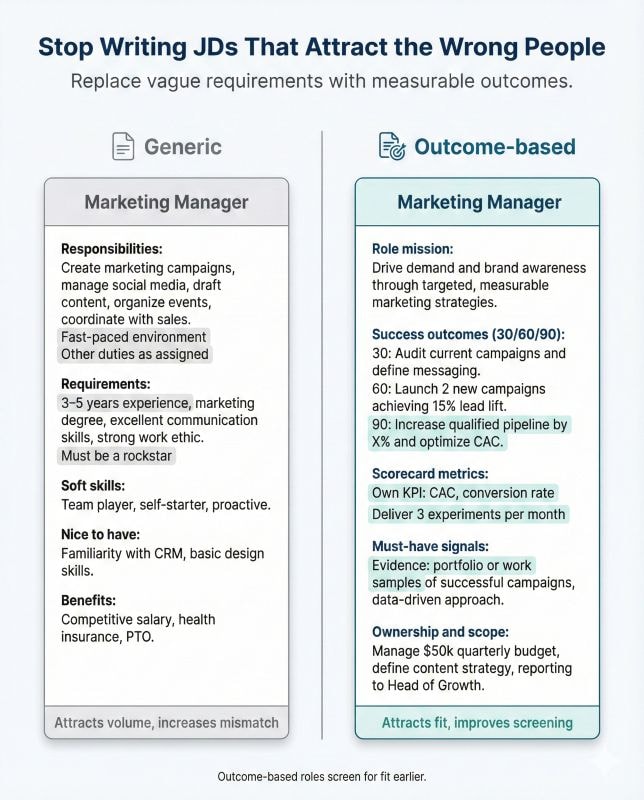
Craft role-focused, benefit-led job descriptions
A job description should not read like an internal HR document. It should help a qualified person quickly answer:
- What will I own?
- What does success look like?
- Why is this role worth switching for?
- What will make this hard, and is it a challenge I want?
The easiest upgrade is shifting from “requirements” to “outcomes.”
Instead of: “5+ years experience, strong communication skills.”
Use: “In the first 90 days, you will deliver X, fix Y, and build Z.”
Then keep requirements lean. Most lists are inflated. Overstuffed requirements reduce the pool and distort self-selection. Focus on what truly predicts performance in that specific role.
Promote employer value proposition prominently
Your EVP should not be a slogan. “Great culture” is meaningless. “Fast-paced environment” often translates to “we are disorganized.”
A credible EVP is specific and verifiable. Examples of what actually helps:
- How decisions are made (fast vs consensus, autonomous vs centralized)
- How performance is measured
- What growth looks like (real examples, not promises)
- How managers support development
- What the team is building and why it matters
For global audiences with a slight US preference, be careful with regional assumptions. Benefits, vacation norms, and compensation structures vary widely. Lead with universal value (clarity, growth, autonomy, mastery) and then specify regionally where needed.
Leverage employee testimonials on career pages
Testimonials work when they describe concrete experiences, not corporate praise.
Good testimonials answer:
- What surprised you after joining?
- What support did you get in your first 60 days?
- What growth have you experienced?
- What type of person thrives here?
Also: keep them short. One to three sentences each. Add role and tenure to make them credible.
If you want to improve attraction without a major production effort, this is one of the fastest levers.
Target passive candidates via tailored outreach
Passive outreach fails when it’s generic.
It works when it is specific, respectful, and tied to outcomes. Your message should show three things:
- You understand what they do now.
- You have a role that matches their trajectory.
- The role’s challenge is real.
A simple structure:
- One line of relevance (“You’ve done X in Y context.”)
- One line of role outcome (“This role owns A and is accountable for B in the first 90 days.”)
- One line of reason to care (“You’d have autonomy, direct impact, and a clear path to C.”)
- A low-friction next step (“Open to a 10-minute chat this week?”)
Avoid flattery. It reads like spam because it usually is.
Streamline your hiring process
Attraction gets candidates in. Process determines whether they stay in the funnel, and whether your team can make a confident decision.
A streamlined hiring process is not “fewer steps at all costs.” It’s fewer pointless steps, clearer ownership, and faster decisions.
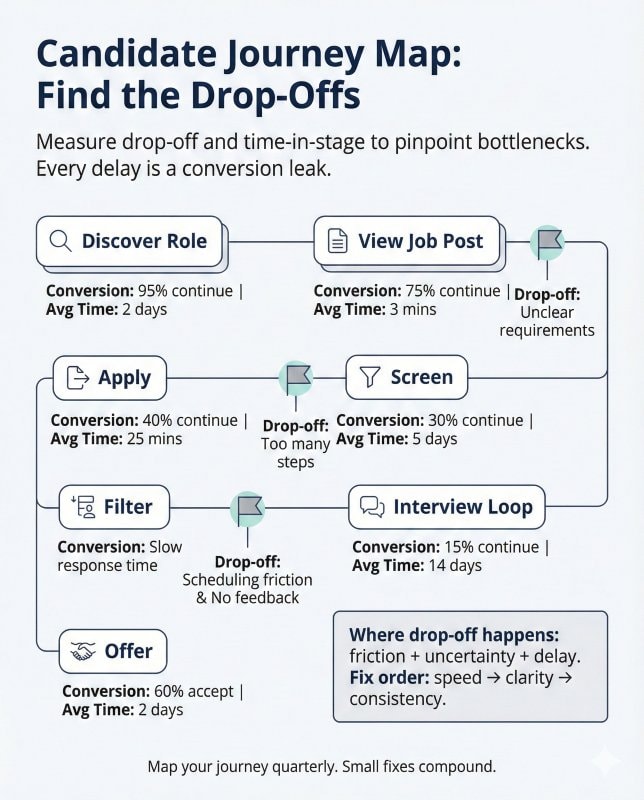
Map the ideal candidate journey
Candidates experience your process as a sequence of friction points:
- unclear next steps
- long gaps between interviews
- repeated questions
- interviews that feel unrelated to the role
- slow feedback after completing tasks
Mapping the journey means writing down each stage and asking:
- What is the purpose of this stage?
- What information does it produce that we cannot get elsewhere?
- What is the time cost for the candidate and the team?
- What would make a strong candidate drop out here?
Then remove or merge stages that do not produce unique, decision-relevant signal.
Set clear hiring timelines
Time kills deals.
Strong candidates do not sit in limbo. They interpret silence as disorganization or lack of interest, and they keep moving.
Set a timeline that your team can actually follow. A practical rule:
- Every candidate leaves each stage knowing the next step and the timeframe.
- Interview loops are scheduled before the first interview happens (or as early as possible).
- Feedback is collected within 24 hours, not “whenever.”
Even in global hiring, where time zones complicate scheduling, the principle is the same: clarity beats uncertainty.
Standardize interviewer scorecards
Unstructured interviews create opinion wars. Scorecards reduce noise.
A good scorecard has:
- 4 to 6 criteria tied to role outcomes (not personality preferences)
- clear rating anchors (what “strong” vs “weak” looks like)
- space for evidence (what the candidate actually said or did)
Scorecards also make your process more defensible and fair across candidates, which matters in every region.
Centralize candidate data in an ATS
If candidate information is scattered across inboxes, spreadsheets, and chat threads, your process will always feel chaotic. An ATS is not just software. It is the system of record for decisions.
Centralizing data helps you:
- see bottlenecks (where candidates stall)
- reduce duplicate communication
- coordinate interviewers
- preserve decision rationale
- track metrics accurately
Use the ATS as a single source of truth. If decisions happen elsewhere, you lose the benefit.
Implement structured reference checks
Reference checks are often misused. They happen too late, ask vague questions, and produce predictable praise.
Structured reference checks work when they are:
- focused on role outcomes and risk areas
- consistent across candidates
- used to validate patterns, not to “find dirt”
Ask about specific situations:
- “What did success look like for them in the first 90 days?”
- “Where did they struggle, and how did they respond?”
- “What environment brought out their best performance?”
Do not treat references as a final exam. Treat them as a calibration step.
Design efficient interview stages
Efficient interviews do not mean rushed interviews. They mean each stage has a job, and the whole loop produces enough signal to make a confident decision without exhausting candidates and internal time.
A clean interview process also protects you from a common executive failure mode: adding “just one more interview” every time someone feels uncertain. Uncertainty is not solved by more opinions. It is solved by clearer criteria and better evidence.

A concise screening interview (what to validate early)
The screening interview is a filter, not a deep dive. Its job is to confirm fundamentals and remove mismatches early.
Good screening topics, supported by structured ways to assess communication skills in interviews:
- Role clarity: do they understand the work and want it?
- Non-negotiables: do they actually have the required baseline skills?
- Motivation: why this role, why now?
- Logistics: location, work authorization where applicable, comp expectations, timeline
Keep it tight: 15 to 30 minutes. If your screening is 60 minutes, you are wasting time because you have not defined what you are screening for.
A practical skills assessment (job-relevant, time-boxed)
The best assessment is as close to the actual job as possible.
Bad assessments test trivia, stress tolerance, or free labor. Good assessments test decision-making, problem-solving, and execution in the exact context the person will face.
Rules that protect both quality and candidate experience:
- Time-box it (ideally 45 to 90 minutes).
- Make it role-relevant and realistic.
- Provide clear instructions and evaluation criteria.
- Avoid “homework” that takes half a weekend.
If you need a longer project for senior roles, structure it as a paid exercise or an in-interview working session. Otherwise, strong candidates will opt out.
A cultural-fit discussion guide (make it measurable)
“Culture fit” is where bias hides. If it’s vague, it becomes a proxy for “do I like this person.”
Make it measurable by defining the behaviors that matter in your environment:
- How do they handle conflict?
- How do they communicate in ambiguity?
- How do they prioritize under pressure?
- How do they take feedback?
- How do they make decisions and align stakeholders?
Then ask for evidence: specific past examples, not hypotheticals. Use a consistent guide so different interviewers are not evaluating different “cultures.”
The 80/20 rule in recruiting (what actually matters most)
The 80/20 rule in recruiting is simple: a small number of process decisions drive most hiring outcomes.
If you fix the high-leverage points, you can improve both speed and quality without turning recruiting into a bureaucracy.
The small set of steps that drive most hiring outcomes
For most organizations, the highest leverage improvements are:
- Outcome-based role definition
- Consistent sourcing beyond inbound applications
- Structured interviews with scorecards
- Fast scheduling and clear decision ownership
- Tight feedback loops (24-hour interviewer feedback, not weekly debriefs)
These reduce three major sources of hiring failure:
- unclear expectations
- inconsistent evaluation
- slow decision-making
Where teams waste time (and how to cut it)
The biggest time sinks are usually self-inflicted:
- Too many interviewers with overlapping questions
- No scorecards, leading to long debrief debates
- Interview scheduling done late instead of upfront
- “Nice to have” requirements that narrow the pipeline and increase time-to-hire
- Late-stage comp surprises because bands were never agreed
Cut waste by setting rules:
- Each interviewer owns a unique evaluation area.
- Every stage must produce unique signal or it gets removed.
- Hiring manager owns the final decision timeline.
- Compensation band is approved before the first interview.
You do not need a perfect process. You need a process that is consistent enough to improve.
Speed offer and onboarding
Speed matters most at the end. Offers get delayed because approvals are unclear, compensation is negotiated internally too late, or nobody owns the close.
This is where strong candidates disappear.
Pre-approve compensation bands
If your comp band is not defined upfront, you are not ready to hire. You are ready to interview.
Pre-approving compensation bands prevents two problems:
- losing candidates to faster offers
- making reactive decisions that create internal pay inequity
For global hiring, define bands by region and level. A single global number rarely reflects reality.
Prepare templated offer letters and approval workflow
Offer letters should not be built from scratch while the candidate is deciding between you and a competitor.
Templates help speed, but workflow is what really matters:
- Who approves the offer?
- What can be approved instantly?
- What requires escalation?
- What is the maximum turnaround time?
Make it explicit. Otherwise, “approval” becomes a vague waiting period that kills acceptance rates.
Design a 30-60-90 day onboarding plan
Onboarding is not a welcome email and a laptop.
A basic 30-60-90 plan gives the new hire:
- ownership areas
- key relationships
- early wins
- performance expectations
- feedback cadence
For leadership roles, include stakeholder alignment and decision rights. For specialist roles, include tool access, process context, and training milestones.
Onboarding quality directly affects early performance and retention. If you recruit talent well and then abandon them in week one, you just paid to create churn.

Strategies for inspiring skilled professionals to join and stay
“Inspiring skilled professionals” sounds like a brand campaign. In reality, skilled professionals join for clarity and challenge, and they stay for growth and competent leadership.
If you want to recruit talent consistently, you need a value proposition that holds up after the offer is signed.
Publicize clear career progression paths
Career progression is one of the strongest retention levers, but most companies describe it vaguely.
Strong candidates want to know:
- What does growth look like here?
- What do people get promoted for?
- What timelines are realistic?
- What skills or outcomes are required?
Make progression visible on career pages and in interviews. Use examples, not promises.
Even one paragraph that explains how someone moved from role A to role B, and what changed in responsibility, is more credible than a page of generic values.
Offer targeted learning stipends
Learning budgets work when they are connected to role outcomes.
A stipend is not compelling if it feels like a perk with no purpose. It becomes compelling when it is tied to a growth plan:
- “Here’s what you will learn this quarter to expand your scope.”
- “Here’s what we will fund because it improves your performance in this role.”
For global teams, be mindful of local norms and access. Some regions will value certifications and formal training more than others. Tie learning to outcomes and let the format vary.
Build mentorship and peer programs that scale
Mentorship is not a “nice to have.” It is a scaling mechanism, and leaders can amplify it with behavioral coaching tools that bring data into development conversations.
It reduces ramp time, improves cultural alignment, and gives people a reason to stay when the work gets hard.
Keep it lightweight:
- Assign a peer buddy for week one and month one.
- Create a mentorship match for the first 90 days (especially for leadership hires).
- Make it clear what the mentor is responsible for: context, relationships, and early navigation.
Programs fail when they are vague. They work when they are structured enough to be repeatable.
Finding hard-to-find talent
Hard-to-find talent is usually one of three things:
- A genuinely scarce skill set
- A role defined too narrowly, excluding adjacent profiles
- A sourcing strategy that is too passive
Fixing this starts with precision: clearer keywords, clearer target profiles, and clearer outreach, all of which are easier when your team uses individual application access and profiles for each candidate.
Map niche skill keywords for sourcing
Job titles are unreliable. Skills and tools are more stable.
Build keyword clusters that reflect how the work is actually done. Examples:
- tooling and platforms
- methodologies
- compliance or domain knowledge
- adjacent roles that share the same core skills
Then use those clusters to source in places job boards do not cover well: specialized communities, events, GitHub portfolios where relevant, industry publications, and alumni groups.
Engage specialized industry communities
Communities are where specialized talent pays attention, even when they are not actively applying.
This includes:
- industry Slack groups and forums
- professional associations
- conferences and meetups
- niche newsletters and job boards
- referral networks inside the domain
The key is contribution. If you only show up to “extract candidates,” people notice. If you show up with useful content or clear role challenges, you earn attention.
Partner with boutique recruiters (when they make sense)
Boutique recruiters can be effective for specialized or leadership roles, but only if you manage them like a performance channel:
- align on outcome-based role definition
- agree on target profiles and exclusions
- set quality expectations and turnaround times
- require structured candidate notes, not vague summaries
If you cannot define what “good” looks like, a recruiter will send you volume, not fit.
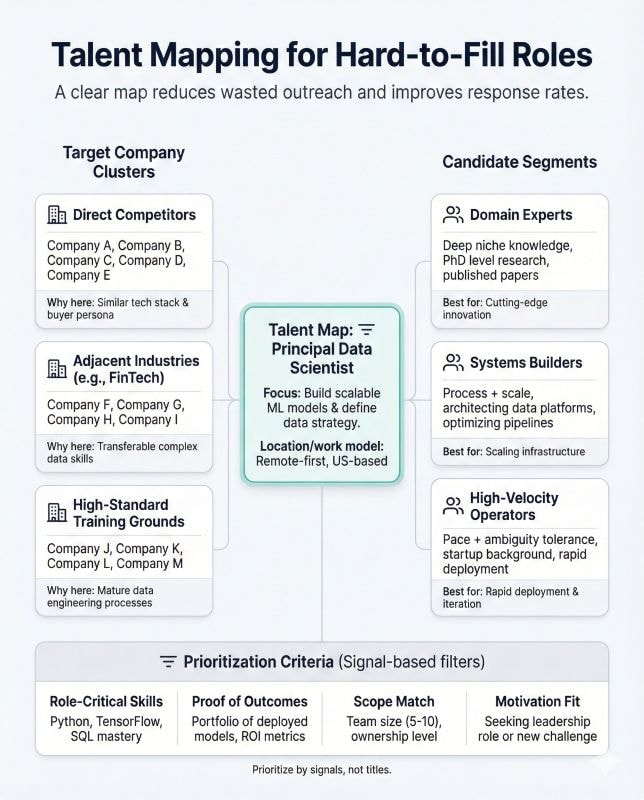
Run targeted talent-mapping campaigns
Talent mapping is useful when roles are persistent and strategic.
Instead of searching from scratch every time, you build a living map of:
- companies with the right talent pools
- candidate segments by seniority and specialty
- likely motivators for switching
- outreach angles that are grounded in reality
This reduces time-to-hire over time because you are not rebuilding your pipeline repeatedly.
Business solutions for talent acquisition
Recruiting does not live in isolation. It works best when it is connected to workforce planning and business priorities.
When hiring is reactive, recruiting becomes chaos. When hiring is planned, recruiting becomes predictable.
Bundle recruitment with workforce planning
Workforce planning is not a spreadsheet exercise. It is a decision about capacity.
At minimum, align on:
- which roles drive revenue or delivery
- which roles reduce operational risk
- which roles are bottlenecks today
- which roles will become bottlenecks in six months
Then recruit talent proactively for the roles that matter most, instead of spreading effort evenly across every open req.
Propose flexible staffing and contract models
Not every need requires a full-time hire immediately.
For some roles, contract-to-hire or project-based staffing reduces risk and speeds execution. For others, it becomes a crutch that delays building internal capability.
Use flexible models strategically:
- when demand is uncertain
- when speed matters more than long-term ownership
- when you need specialized expertise temporarily
Avoid them when the role is core to your competitive advantage.
Align hiring to business KPIs
If recruiting is measured only by activity, it stays tactical.
Align hiring to business KPIs by linking roles to outcomes:
- revenue impact
- delivery timelines
- customer retention
- product velocity
- operational error reduction
This also helps executive stakeholders make faster decisions, because they understand the cost of delay.
Metrics and continuous improvement
If you do not measure recruiting, you cannot improve it. You can only argue about it.
The goal is not a dashboard with 40 metrics. The goal is a small set of measures that tell you:
- how fast you move
- how good your decisions are
- where candidates drop out
- whether hires actually perform
Track time-to-hire (and time-to-fill)
These are often confused.
- Time-to-hire: from candidate entering the pipeline to accepted offer
- Time-to-fill: from job opening approval to accepted offer
Both matter, but they diagnose different problems.
If time-to-fill is high, your bottleneck might be approvals, role definition, or sourcing strategy. If time-to-hire is high, your bottleneck is usually scheduling, interview loop design, or slow decisions.
The key is to track by role type. Your leadership roles and specialist roles will not move like entry-level roles. Use benchmarks internally, then improve quarter over quarter.
Measure quality-of-hire
Quality-of-hire is the metric everyone wants and few define.
A practical definition uses a mix of:
- performance rating at 90 and 180 days
- manager satisfaction (structured, not vibes)
- ramp time to productivity
- retention at 6 and 12 months
The crucial step is defining what “good” looks like before you hire. Otherwise, quality-of-hire becomes a retrospective story, not a measurement.
If you want to use numbers here, only do it when you have a clear internal data source or a credible external source. If you cannot source it, keep it directional and focus on the method.
Review funnel conversion monthly
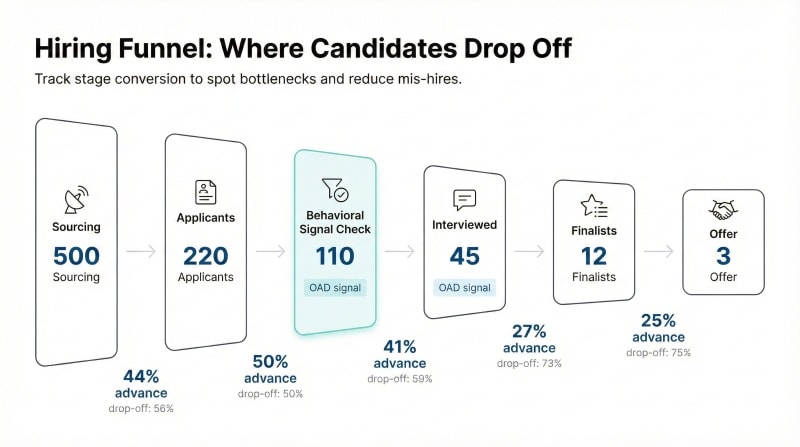
Funnel conversion tells you where your process leaks talent.
Track stage conversion rates:
- application to screening
- screening to interview loop
- interview loop to finalist
- finalist to offer
- offer to acceptance
Then review monthly, not annually. Recruiting problems compound quickly. If a stage conversion drops, it is usually caused by one of these:
- unclear criteria at that stage
- inconsistent interviewer behavior
- slow scheduling
- compensation mismatch discovered too late
- poor candidate communication
Fixing funnel leaks is one of the fastest ways to reduce time-to-hire without lowering standards.
Case studies and testimonials
Case studies do not need to be long. They need to be specific.
A good vignette answers:
- What role was being hired?
- What was the constraint (speed, scarcity, quality issues)?
- What changed in the process?
- What result followed (time-to-hire improvement, better fit, stronger retention)?
Short client success vignettes
Example structure you can use:
- Role: Senior Operations Manager in a fast-scaling region
- Challenge: inconsistent interview feedback, long decision cycles, offer delays
- Change: structured scorecards, tighter interview loop, pre-approved comp band
- Result: faster decisions and fewer late-stage drop-offs
Keep it clean. No hype. Let the process improvement carry the credibility.
Candidate quotes about career impact
Candidate quotes are strongest when they mention:
- clarity of role expectations
- professionalism of process
- fairness and consistency of interviews
- speed and communication
- onboarding support
One sentence can do more than a paragraph if it is specific.
FAQ: Recruit talent questions (People Also Ask)
What are the 3 P’s of recruitment?
The “3 P’s” are typically framed as People, Process, and Platform.
- People: who owns recruiting decisions and execution (HR, hiring managers, interviewers)
- Process: the stages, criteria, and decision rules that make hiring consistent
- Platform: the tools that support execution (ATS, scheduling, assessments, analytics)
If one is weak, the system breaks. Strong tools cannot fix a weak process, and a strong process collapses if nobody owns it.
What is the 80/20 rule in recruiting?
It means a small number of decisions drive most outcomes.
For most teams, the highest leverage is: clear role outcomes, consistent sourcing beyond inbound, structured interviews with scorecards, fast scheduling, and clear decision ownership. Fix those and you usually improve both speed and quality without adding complexity.
How do you recruit talent?
Recruiting talent is a staged system:
- Define role outcomes and non-negotiables
- Build a sourcing plan (active + passive)
- Use structured evaluation (scorecards, job-relevant assessments)
- Make decisions quickly and close with a clean offer process
- Track metrics and improve monthly
The key is consistency. The same role should not be evaluated differently depending on who interviewed.
What does it mean to recruit something?
To recruit means to actively enlist or bring in people to fill a need or join a group. In business, it typically refers to attracting and moving candidates into a hiring pipeline, rather than the final act of hiring itself.
Conclusion: A repeatable way to recruit talent
Recruiting works best when it is treated as a business system, not a set of tips.
Define the role by outcomes. Source intentionally. Evaluate consistently. Decide quickly. Onboard with clarity. Then measure what matters and improve every month.
When you do this, hiring becomes easier to scale, less dependent on heroic effort, and far more predictable.
If you want to see how a structured, data-driven approach can improve your hiring decisions, you can start with the free Top Performer Profile and compare your next hires with data instead of gut feel.