Employee motivation is not a personality trait. It’s a system outcome.
When people are motivated at work, you usually see three things: sustained effort, better choices under pressure, and fewer “I’m done” exits. When motivation collapses, performance drops first, then discretionary effort, then retention.
This guide gives managers and HR leaders a practical way to diagnose what’s driving motivation, measure it without turning the workplace into a surveillance experiment, and run interventions that produce observable change.
The core drivers of workplace motivation
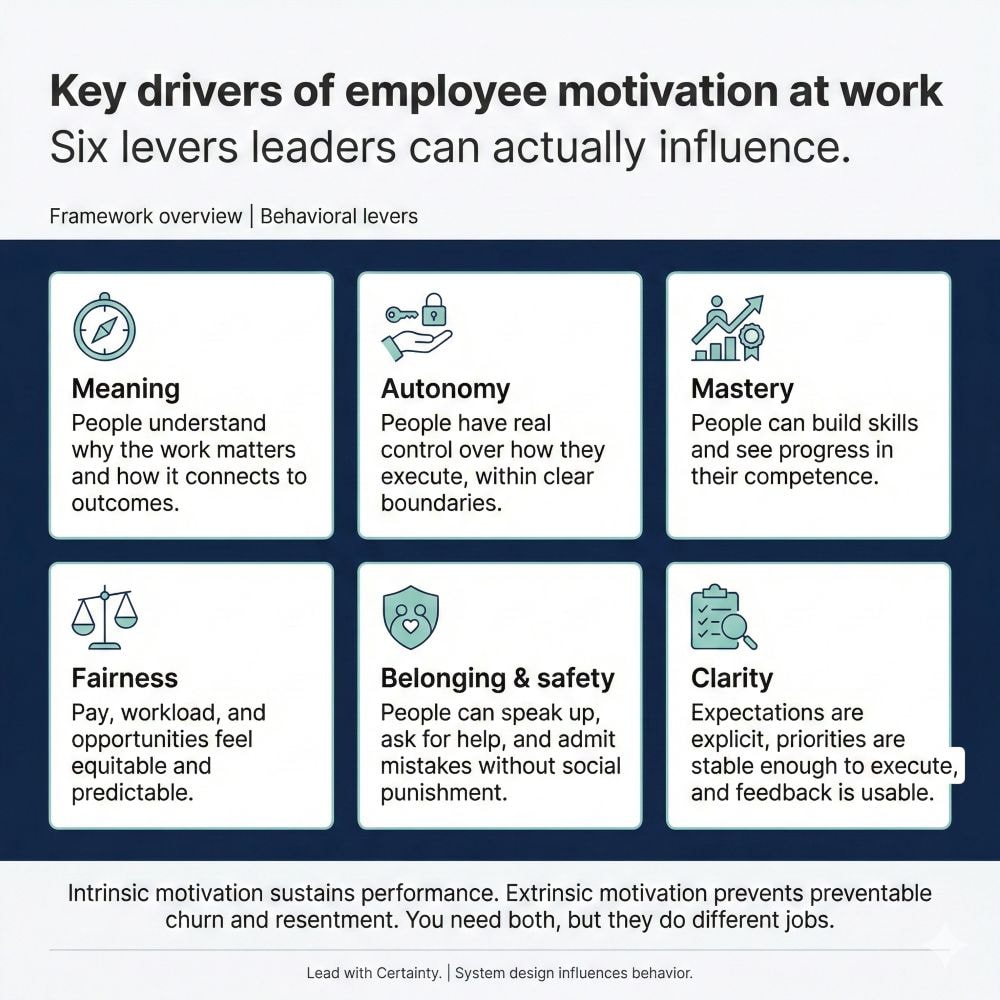
Most workplace motivation can be explained by a small set of levers:
- Meaning: People understand why the work matters and how it connects to outcomes.
- Autonomy: People have real control over how they execute, within clear boundaries.
- Mastery: People can build skills and see progress in their competence.
- Fairness: Pay, workload, and opportunities feel equitable and predictable.
- Belonging and safety: People can speak up, ask for help, and admit mistakes without social punishment.
- Clarity: Expectations are explicit, priorities are stable enough to execute, and feedback is usable.
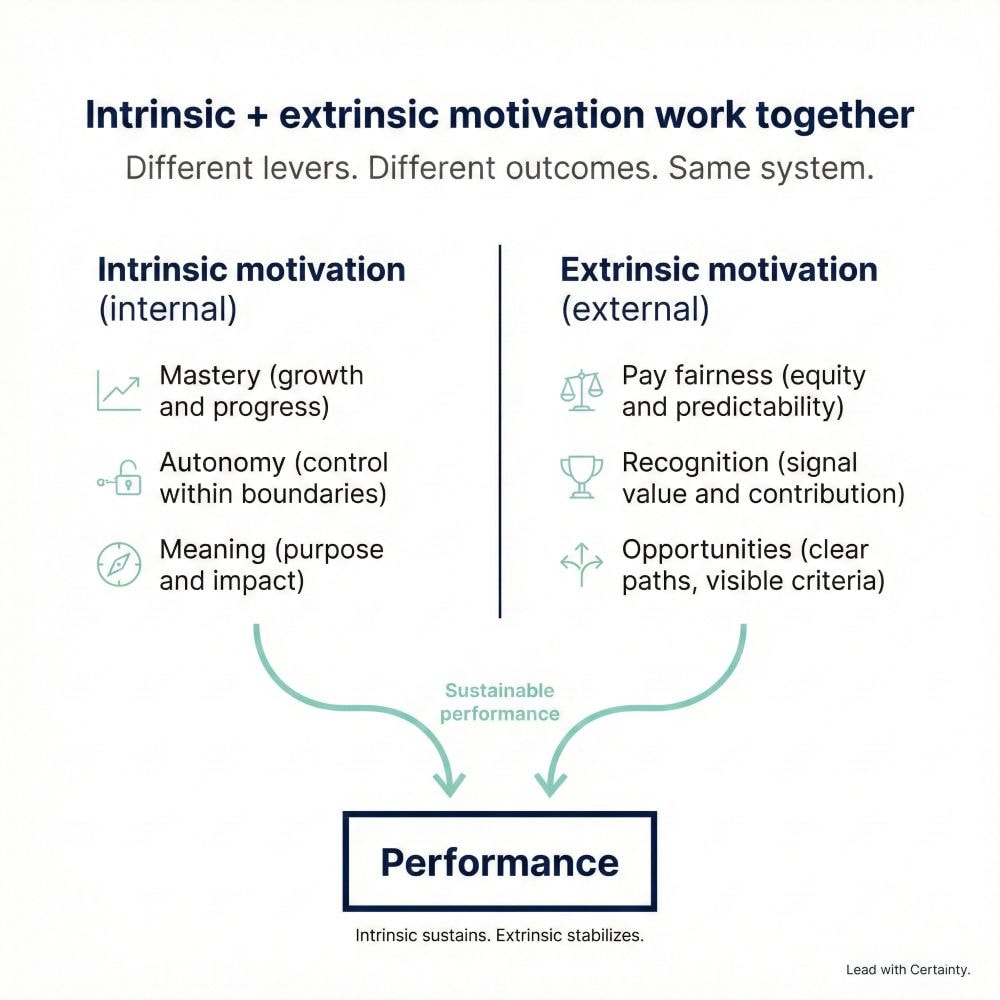
Intrinsic motivation tends to sustain performance. Extrinsic motivation prevents preventable churn and resentment. You need both, but they do different jobs.
What this framework helps you improve
Use this framework to drive measurable outcomes in:
- Retention and voluntary turnover (especially avoidable exits)
- Performance and quality (less rework, fewer escalation cycles)
- Wellbeing indicators (burnout risk, workload friction, recovery)
- Employee satisfaction (predictable fairness and growth signals)
- Manager effectiveness (coaching and feedback competence)
Measurable goals for your motivation roadmap
Set targets that leaders can actually manage:
- Pulse survey movement on 2–4 driver questions (not 40)
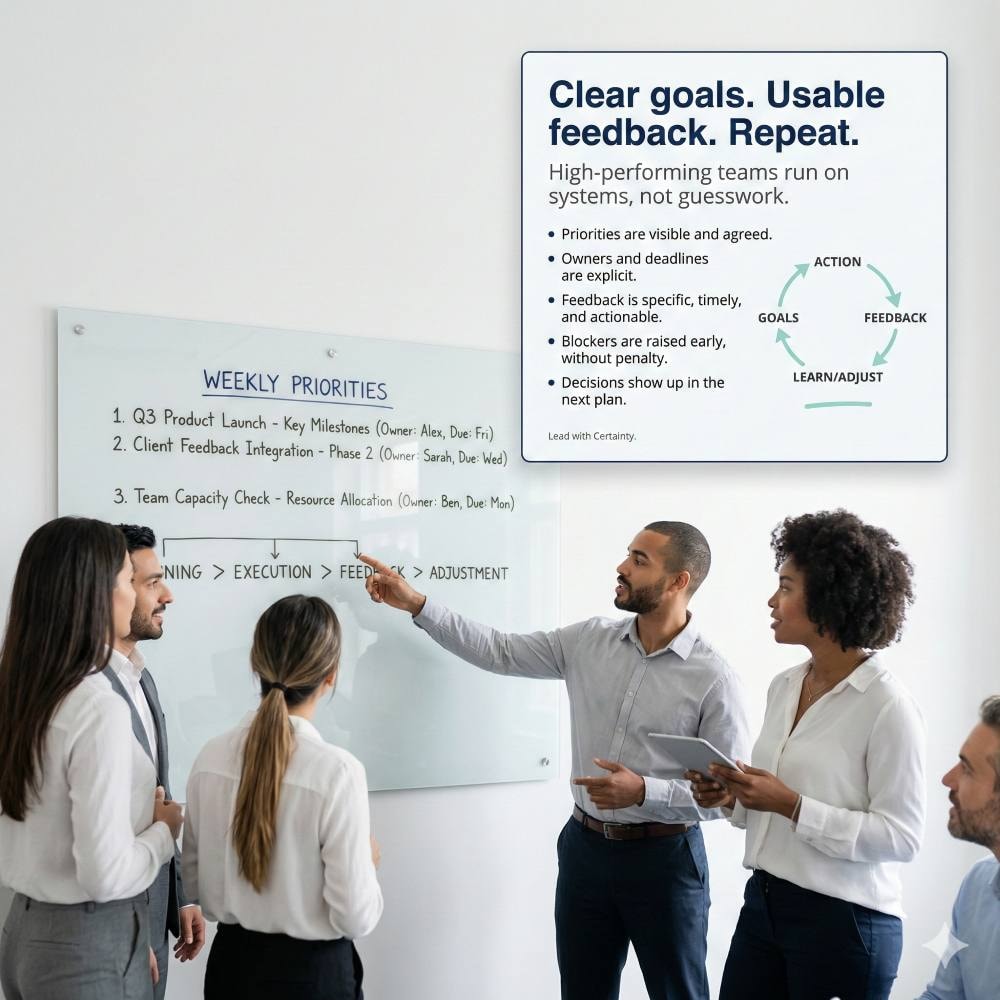
- Reduction in “I don’t know what good looks like” signals (clarity)
- Improved internal mobility participation (growth opportunities)
- Fewer avoidable exit reasons in exit interviews (fairness, manager issues)
- Stability in workload and priorities (less thrash, fewer late pivots)
A practical rule: if a manager cannot influence the metric within 30 days, it is not a “manager metric.”
Where role fit is a recurring issue, add a structured assessment layer so you are not guessing. Tools like OAD’s organization analysis and design system are useful here because they help separate “motivation problem” from “misfit problem,” and the interventions are different.

What Is Employee Motivation and Internal Drive
Employee motivation, defined
Employee motivation is the force that determines three things:
- how much effort someone is willing to invest,
- how long they sustain it,
- and whether they choose the harder, higher-quality option when nobody is watching.
It’s not the same as being happy at work. It’s not the same as being engaged. It’s closer to “how strongly a person chooses this work, day after day.”
Internal drive vs. external incentives
Internal drive (intrinsic motivation) comes from the work itself: meaning, learning, autonomy, mastery, pride, identity.
External incentives (extrinsic motivation) come from outside the work: pay, bonuses, commissions, perks, status, praise, penalties.
They interact, but they are not interchangeable.
- Internal drive is what keeps someone pushing through ambiguity and setbacks.
- External incentives are what signal fairness and priorities, and what keep dissatisfaction from poisoning performance.
If you use money to solve every motivation problem, you usually get expensive short-term compliance and quiet long-term disengagement. If you ignore compensation and fairness, you get resentment and attrition no matter how inspiring the mission statement looks on a poster.
Motivation vs. engagement vs. satisfaction
Leaders mix these up constantly, then wonder why interventions do nothing.
- Motivation: “I want to do this work and I will invest effort.”
- Engagement: “I’m psychologically present, committed, and not checked out.”
- Satisfaction: “I’m okay with the conditions: pay, workload, manager, environment.”
You can have:
- Satisfied but unmotivated employees: stable, not disruptive, not improving.
- Motivated but dissatisfied employees: high performers who leave.
- Engaged but misallocated employees: energy pointed at the wrong work.
This is why measurement needs to separate drivers. If the core problem is role fit, you can’t coach your way out of it. If the core problem is psychological safety, you can’t bonus your way out of it.
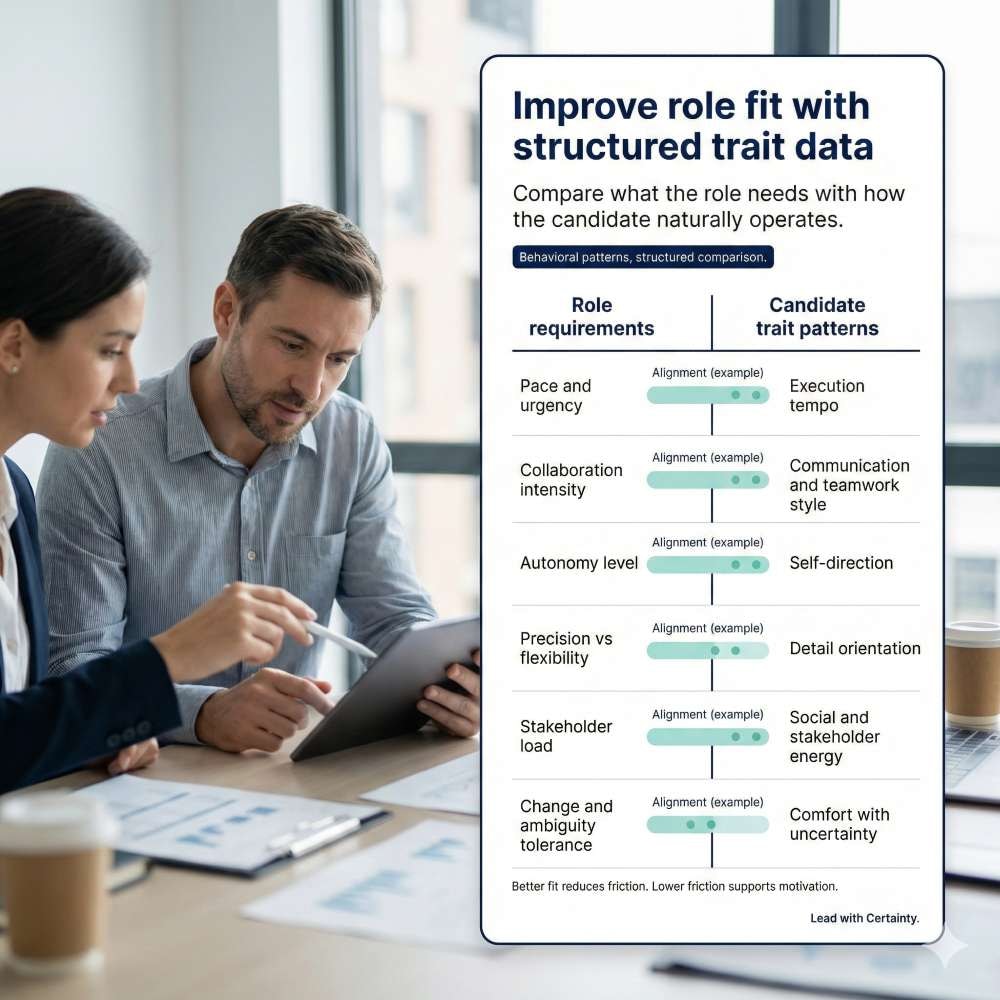
A structured assessment approach helps here. When you can compare role requirements with trait patterns and work motivations using a clinically validated personality assessment, you reduce “diagnosis by vibes,” which is how companies end up with a revolving door and a manager blamed for everything.

Types of Motivation at Work: Intrinsic Motivation and Extrinsic Motivation
Intrinsic motivation (examples in real roles)
Intrinsic motivation is when the work itself pulls effort out of someone. Not because they’re saints. Because the work hits a human need: purpose, autonomy, mastery, competence, contribution.
Practical examples by role:
- Engineering: solving hard problems, clean systems, mastery progression, autonomy in implementation choices.
- Sales: winning, skill-building, autonomy in approach, learning what works, status earned through competence, and role-fit insights that help you build winning sales teams.
- Customer support: helping someone, closing a loop, clear impact, improving systems so fewer people suffer.
- HR and people ops: building a stronger organization, reducing bad hires, improving team dynamics, protecting culture.
- Operations: reducing chaos, increasing reliability, measurable improvement over time.
The common thread is that the person can see progress and impact, and they feel ownership over how it happens.
Extrinsic motivation (examples in real roles)
Extrinsic motivation is when effort is influenced by rewards, recognition, status, or consequences. It’s not “bad.” It’s just blunt.
Practical examples:
- Pay and benefits: base pay, bonus, commission, equity, health coverage, retirement contributions.
- Recognition: public praise, awards, visibility to leadership, higher-profile projects.
- Perks and convenience: flexibility, remote options, better tools, schedule control.
- Consequences: loss of bonus, missed promotion, negative performance reviews, role changes.
Extrinsic motivators are especially relevant when people are asking: “Is this worth it?” and “Is this fair?” If the answer is no, motivation bleeds out fast.
Which lasts longer and why (what the evidence tends to show)
In most workplaces, intrinsic motivation is what sustains discretionary effort over time. Extrinsic motivation is what stabilizes behavior and signals priorities.
A simple way to think about it:
- Intrinsic motivation drives persistence, learning, and problem-solving under ambiguity.
- Extrinsic motivation drives focus, compliance, and short-term behavior shifts.
If you want long-term performance, you build the conditions for intrinsic motivation. If you want predictability and fairness, you design extrinsic systems that do not create resentment.

When extrinsic motivators backfire (and when they work well)
Extrinsic motivators backfire when they:
- reward the wrong metric (speed over quality, activity over outcomes)
- feel unfair or opaque (people assume favoritism)
- create a “gaming” culture (people optimize the score, not the mission)
- replace meaning with transactions (“I only do this if paid extra”)
- punish experimentation (people stop taking smart risks)
Extrinsic motivators work well when they:
- are tied to outcomes the employee can influence
- are transparent enough to feel fair
- reinforce the company’s goals without distorting behavior
- support basics first (pay fairness, workload sanity, tools that work)
This is also where role fit matters. If someone is in a role that constantly fights their natural drivers, you will spend forever “motivating” them. That’s not leadership. That’s denial. A structured role-fit approach (including tools like OAD) helps you avoid installing the wrong person into the wrong environment and then blaming them for being human.
Intrinsic Motivation: How to Strengthen Internal Drive
Make work meaningful (mission, impact, customer outcomes)
Most leaders try to “motivate” people with speeches. People are motivated by clarity and impact.
Meaning comes from answering, repeatedly:
- Who benefits from this work?
- What problem does it solve?
- What does “good” look like?
- How does this role contribute to the company’s mission in concrete terms?
Practical moves:
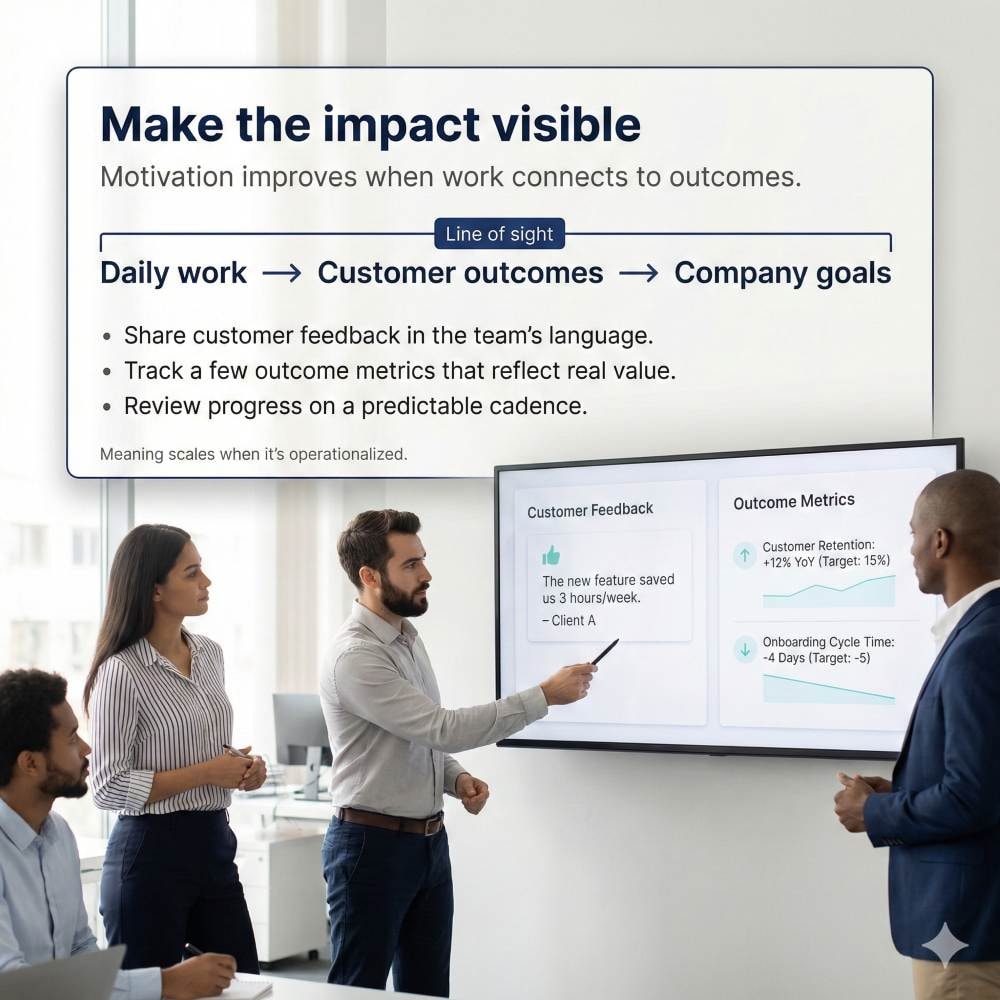
- Translate the company’s mission into role-level impact statements.
- Show the downstream effect of good work (customer outcomes, reduced risk, fewer escalations).
- Close the loop with evidence: “Because you did X, Y improved.”
Meaning is not a slogan. It’s a feedback loop.
Increase autonomy (how to give control without chaos)
Autonomy does not mean “do whatever you want.” It means control over execution within clear boundaries.
A workable structure:
- Non-negotiables: standards, deadlines, compliance, safety, customer promises.
- Negotiables: sequence, methods, tools, time-blocking, collaboration style.
- Decision rights: who decides what, and when escalation is required.
Tactics that improve autonomy fast:
- Replace “check-in approvals” with pre-agreed guardrails.
- Use “manager as coach” language: “What options do you see?” before “Do this.”
- Give teams ownership over a small set of decisions they control end-to-end.
Autonomy collapses when priorities change daily. Stabilize priorities and autonomy rises automatically.
Build mastery (learning paths tied to role skill milestones)
Mastery is one of the most reliable intrinsic motivators because it’s measurable progress a person can feel.
Make mastery practical:
- Define skill milestones for each role level (what someone can do independently).
- Create learning paths tied to real work, not generic training libraries.
- Use short cycles: practice, feedback, repeat.
If you want motivated individuals, give them a way to get better without begging for permission.
Examples:
- Weekly “skill reps” (short practice sessions on core tasks)
- Peer review that focuses on standards, not ego
- A simple rubric that explains what “excellent” looks like
Improve role fit (why misfit kills motivation fast)
A lot of “low motivation” is actually misalignment:
- the role requires behaviors the person finds draining,
- the environment clashes with their preferred work style,
- the incentives reward what they do not value,
- or the expectations are mismatched with their strengths.
When the fit is off, you’ll see:
- chronic procrastination on core tasks,
- avoidance behaviors (busywork, meetings, distractions),
- defensiveness around feedback,
- fast burnout in high-friction environments.
This is where structured assessment helps. If you can evaluate role requirements against personality and work motivations, you stop guessing. Motivation insights that surface what truly drives your hires exist for exactly this type of decision: reducing costly mis-hires and preventing teams from becoming motivation repair shops.
Extrinsic Motivation: Satisfaction Drivers That Keep People From Leaving
Fair pay and benefits (benchmarks, equity, transparency basics)
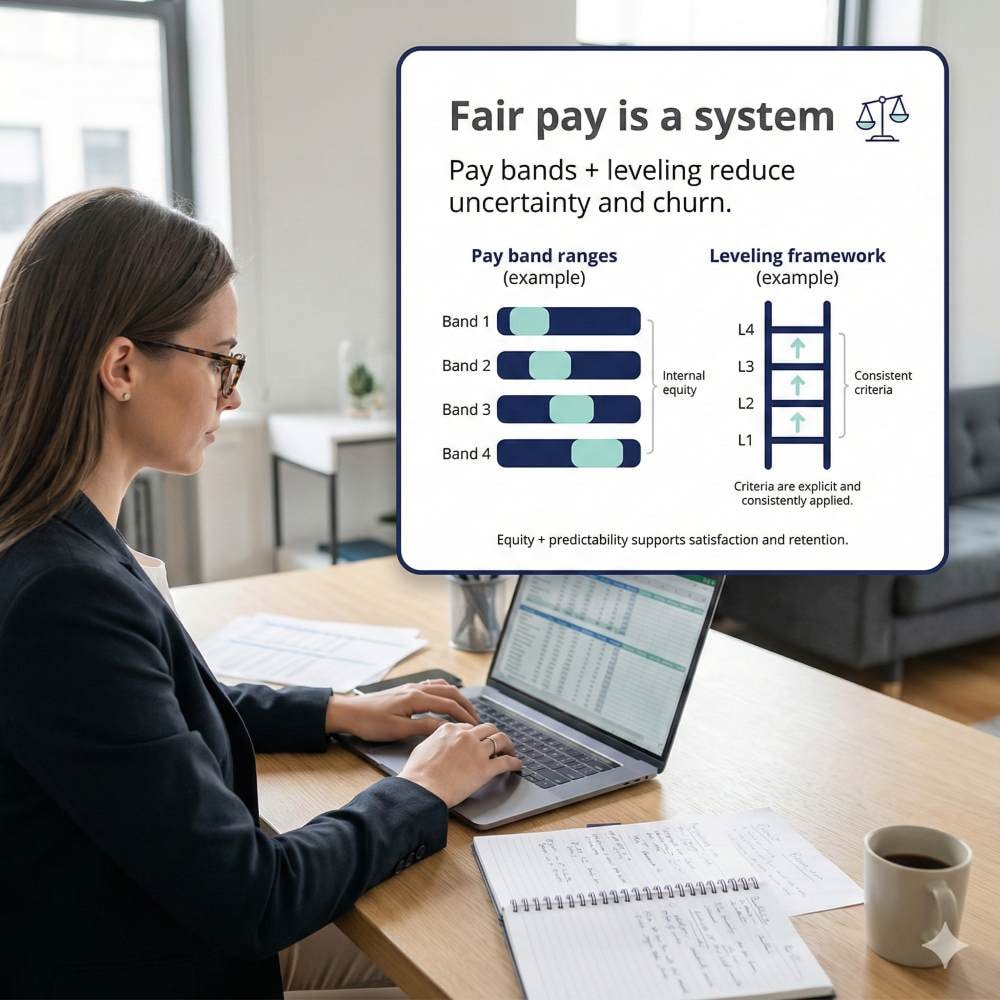
Pay rarely creates long-term motivation by itself. It absolutely destroys motivation when it feels unfair.
Focus on three basics:
- External competitiveness: are you in the market range for your roles?
- Internal equity: do people in comparable roles and performance bands feel consistently treated?
- Transparency: do employees understand how pay decisions are made?
Practical steps that reduce dissatisfaction fast:
- Define pay bands (even if you don’t publish them fully).
- Train managers to explain pay decisions without awkward improvisation.
- Audit for compression, bias, and inconsistent leveling.
- Align benefits to the reality of your workforce (health, flexibility, family needs).
If pay is a black box, employees fill the gap with stories, and the stories are never flattering.
Recognition that reinforces the right behaviors (not popularity contests)
Recognition is a powerful extrinsic lever when it’s specific and predictable.
Rules that work:
- Recognize observable behaviors tied to outcomes, not personality traits.
- Keep recognition close to the event. Delay kills credibility.
- Spread recognition across teams. Otherwise it becomes theater.
- Avoid vague praise like “great job.” Tie it to impact: “Because you did X, we achieved Y.”
Good recognition systems do two things at once:
- they make employees feel valued, and
- they teach everyone what “good” looks like.
Incentives aligned to measurable goals (and common misalignments)
Incentives should clarify priorities, not distort them.
Common misalignments:
- Rewarding speed without quality, causing rework and customer frustration.
- Rewarding individual output when collaboration is required.
- Rewarding short-term metrics that harm long-term success (churn, technical debt, burnout).
- Rewarding what’s easy to count instead of what matters.
A clean approach:
- Pick 1–3 outcomes per role that actually support the company’s goals.
- Add a quality constraint (no reward if quality drops).
- Make it auditable. If it can’t be explained in 60 seconds, it won’t be trusted.

Work environment basics (tools, workload, clarity, friction removal)
A shocking amount of “motivation” is just removing pointless friction.
Check the basics:
- Are tools reliable, or do people spend hours fighting systems?
- Is workload realistic, or is everyone permanently behind?
- Are priorities stable enough to execute?
- Do people know what matters this week, not just this quarter?
When the workplace environment is chaotic, intrinsic motivation gets consumed by survival.
Fixing friction is not glamorous. It is one of the highest-ROI moves you can make.
Psychological Safety and Company Culture
What psychological safety is (and what it is not)
Psychological safety means people can speak up, ask questions, admit mistakes, and challenge ideas without getting punished socially or professionally.
It’s not “being nice.” It’s not “no standards.” It’s not “everyone agrees.” It’s the opposite of fear-based silence.
When psychological safety is low, motivation drops because people spend energy on self-protection instead of problem-solving.
How to assess psychological safety (anonymous surveys + signals)
Use anonymous surveys to measure the basics. Keep it short enough that people actually answer honestly, and pair them with risk alerts that flag burnout, disengagement, and flight risk early.
Include questions that map to real behaviors, like:
- “If I make a mistake, it is not held against me.”
- “I can raise difficult issues without negative consequences.”
- “People here respond constructively to failure.”
Then validate survey data with signals you can observe:
- Do meetings have real debate or polite silence?
- Do people surface risks early or only at the last second?
- Do managers punish bad news indirectly (tone, sarcasm, exclusion)?
- Do high performers quietly disengage after being ignored?
If the survey says “safe” but turnover says otherwise, trust behavior over branding.
Train leaders to respond constructively to failure
Most cultures don’t kill motivation with big blow-ups. They kill it with small punishments for honesty.
Train managers to do four things consistently:
- Separate person from problem: critique the decision, not the identity.
- Run blameless reviews: focus on what happened, why, and what changes.
- Reward early warnings: treat risk-raising as competence, not negativity.
- Model accountability: leaders own their part without theatrics.
If “mistakes happen” is true, your process should act like it.
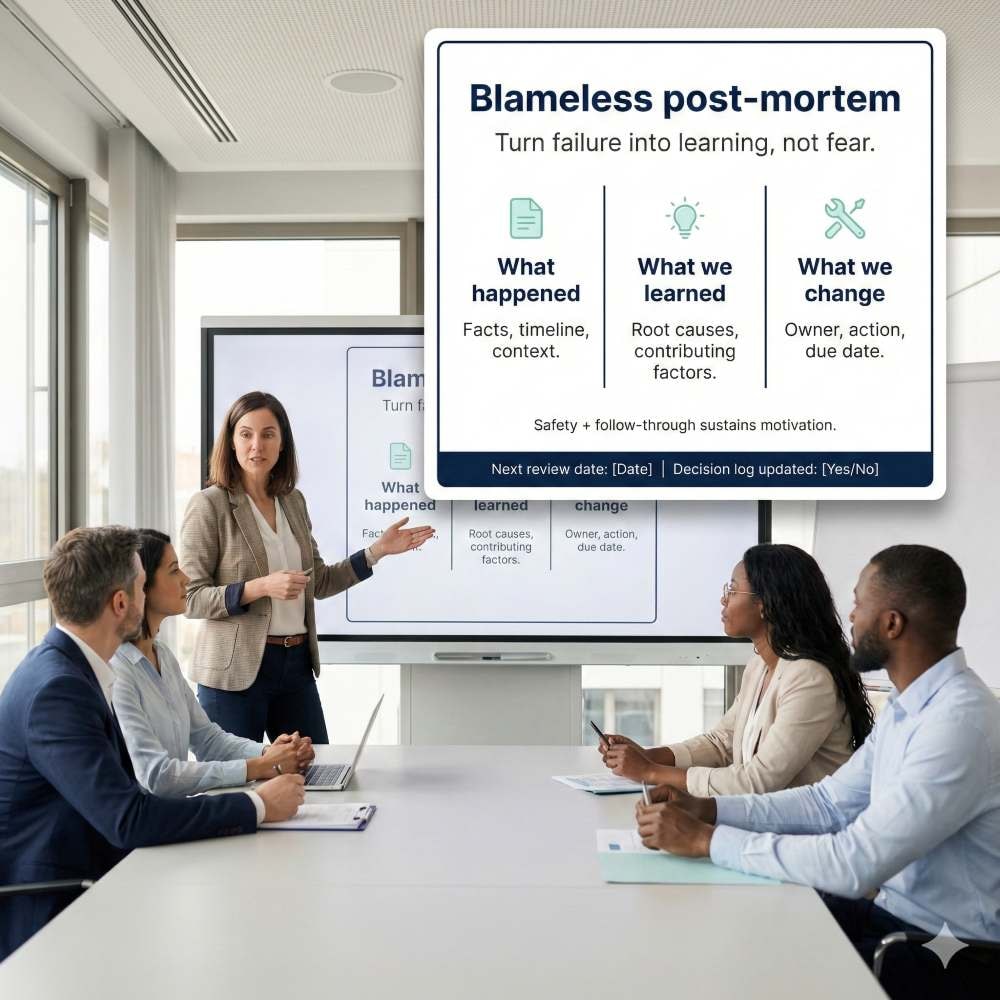
Feedback rituals that actually stick (weekly meeting patterns)
Feedback works when it’s normal, frequent, and low-drama.
Simple rituals that scale:
- Weekly “keep, stop, start” (10 minutes, structured, no rambling).
- One recurring question: “What is blocking real progress this week?”
- Short retrospectives after key deliverables: “What would we do differently next time?”
The goal is to make feedback routine, not a quarterly surprise attack.
Inclusion and belonging as motivation multipliers (practical audit points)
Belonging is not a vibe. It’s whether people feel safe to contribute fully.
Audit your culture for predictable issues:
- Who speaks in meetings, and who gets interrupted?
- Who gets stretch work, visibility, and sponsorship?
- Who gets forgiven for mistakes, and who gets labeled?
- Are expectations clear and consistent across groups?
If employees feel secure and valued, they invest more effort. If they feel like outsiders, they conserve energy and plan exits.
Career Growth and Growth Opportunities
Map career paths by role (levels, skills, expectations)
Career growth is one of the cleanest motivation levers because it answers the question people rarely ask out loud: “Is this going anywhere?” Giving employees individual application access to their own development insights also reinforces ownership over that growth.
Build role-based career paths with:
- levels (what changes from one level to the next),
- skills (what someone must demonstrate),
- expectations (scope, ownership, complexity),
- examples (what “good” looks like in real work).
Avoid vague ladders like “Senior equals more leadership.” Define it as observable behavior.

Publish internal opportunities (mobility, projects, stretch work)
Many employees lose motivation because growth is treated like an informal privilege. Make it visible.
Practical system:
- Publish internal roles and stretch projects quarterly.
- Make eligibility criteria explicit (skills, tenure, performance band).
- Offer short-term project rotations, not just permanent transfers.
Internal mobility reduces turnover because people can change their environment without leaving your company.
Promotions linked to demonstrated skill milestones
Promotions should feel earned and understandable, not political.
Link promotions to:
- demonstrated skills,
- consistent performance against clear standards,
- readiness for increased scope.
If promotions are inconsistent, employees stop believing effort matters. That kills self motivation and encourages “minimum viable work.”

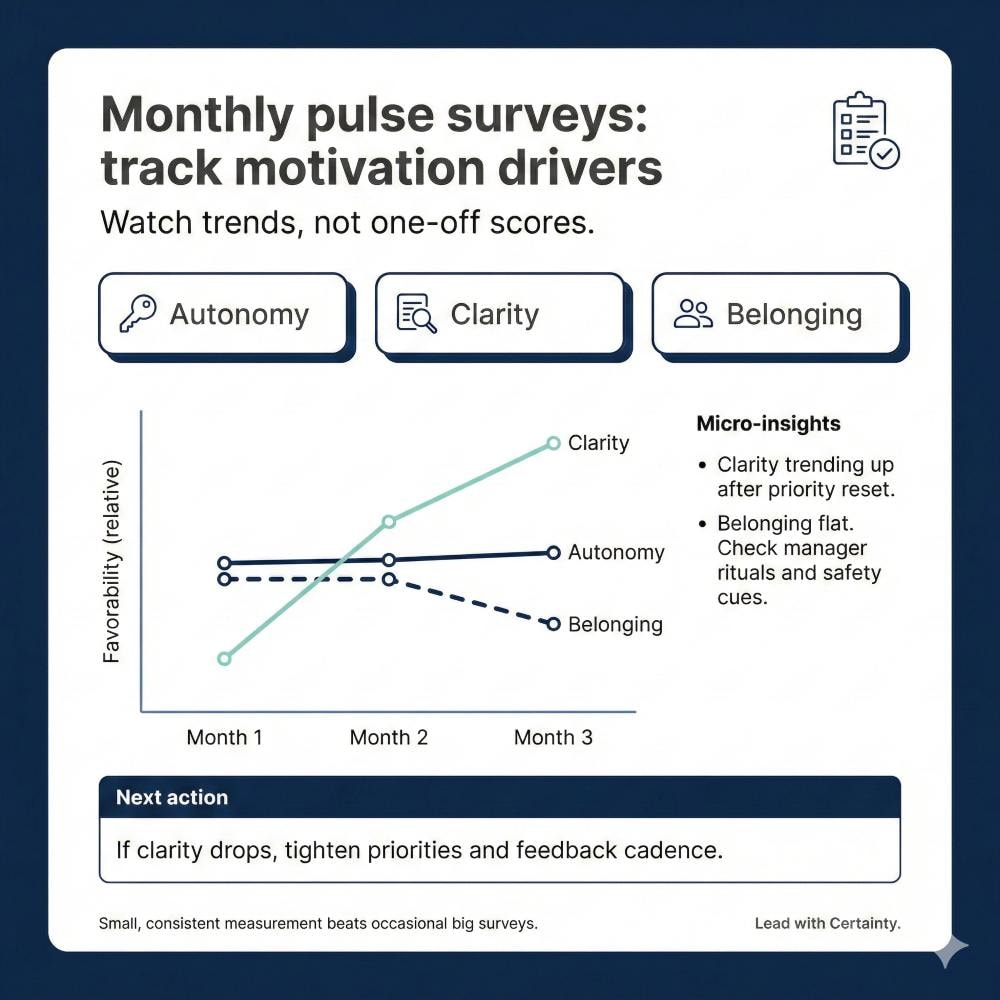
Satisfaction pulse surveys (cadence, question design, interpretation)
Use pulse surveys to detect early motivation drift, not to run an annual feelings festival.
A workable cadence:
- Monthly micro-pulses (5–8 questions max) for motivation drivers.
- Biannual deeper employee satisfaction surveys if needed.
Design principles:
- Ask about conditions (“I have what I need to do good work”) not just emotions.
- Keep wording consistent so trends mean something.
- Close the loop: “We heard X, we changed Y.”
If you ask and never act, future surveys become sarcasm.
How to Measure Motivation
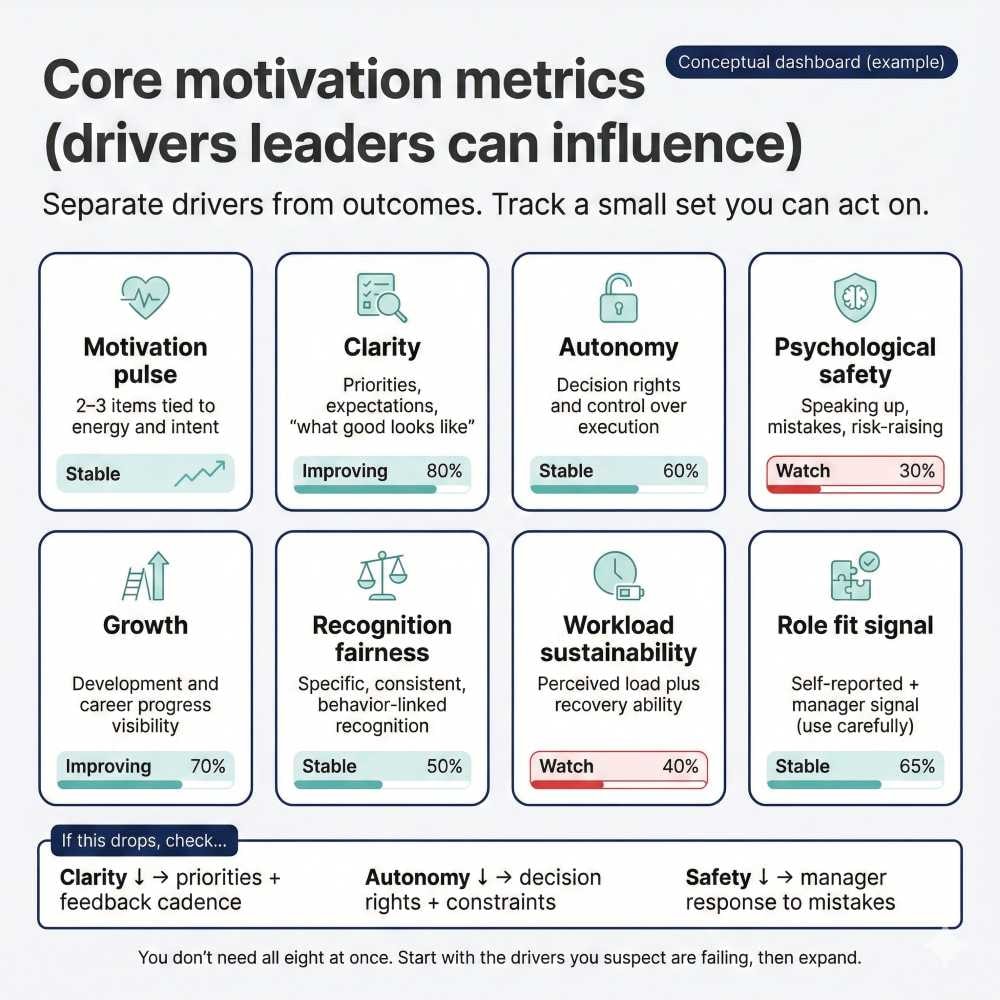
6–8 core motivation metrics (what to choose and why)
Motivation is measurable, but only if you separate drivers from outcomes. Use a small set of metrics that leaders can influence.
A practical set of 6–8 metrics:
- Motivation pulse score (2–3 items tied to energy and intent)
- Clarity score (priorities, expectations, “what good looks like”)
- Autonomy score (decision rights, control over execution)
- Psychological safety score (speaking up, mistakes, risk-raising)
- Growth score (development, career progress visibility)
- Recognition fairness score (specific, consistent, behavior-linked recognition)
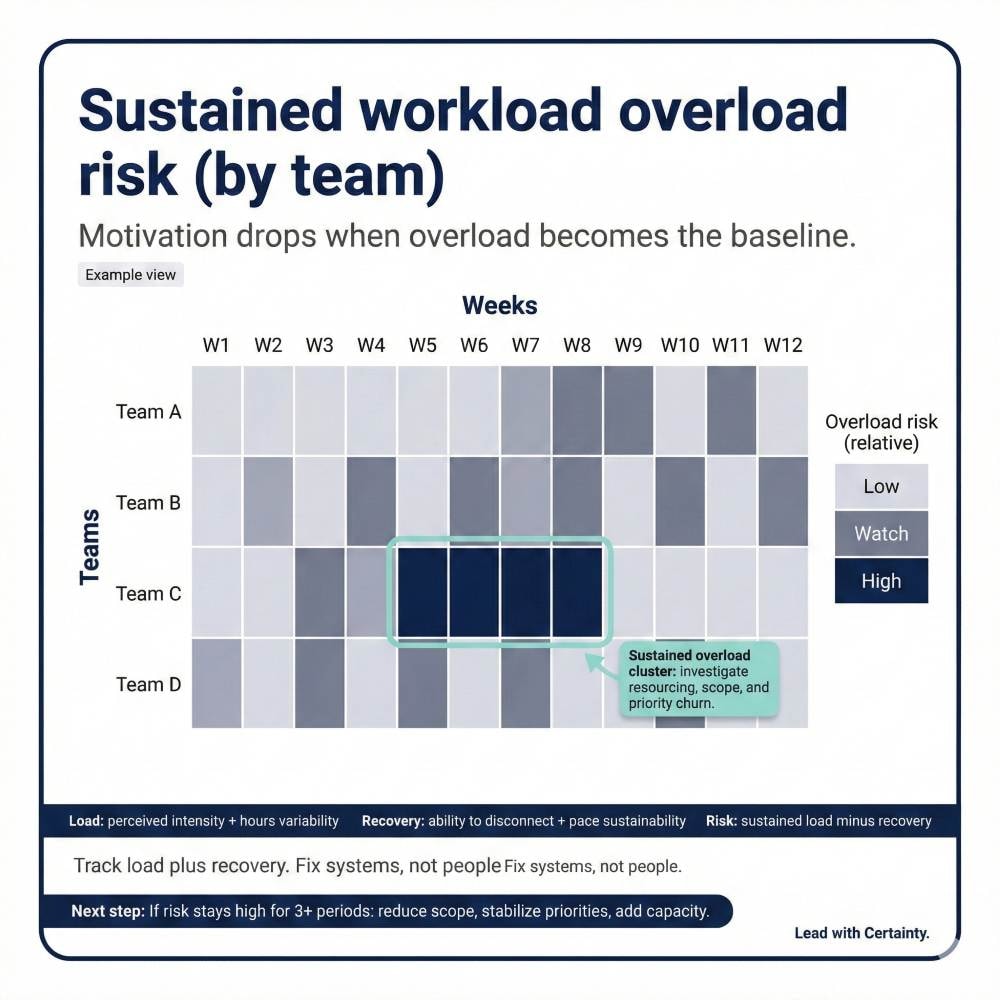
- Workload sustainability (perceived load + recovery ability)
- Role fit signal (self-reported fit + manager signal, used carefully)
You do not need all eight at once. Start with the drivers you suspect are failing, then expand.
Monthly pulse surveys (how short is “short”)
Monthly pulses should be short enough to be answered in under two minutes. Otherwise participation drops and honesty declines.
Guidelines:
- 5–8 questions total
- consistent question wording each month
- one open-ended prompt max (optional)
Use one open question when you actually plan to act, like:
“What is one change that would make it easier to do your best work this month?”
Retention and voluntary turnover (what they can and cannot tell you)
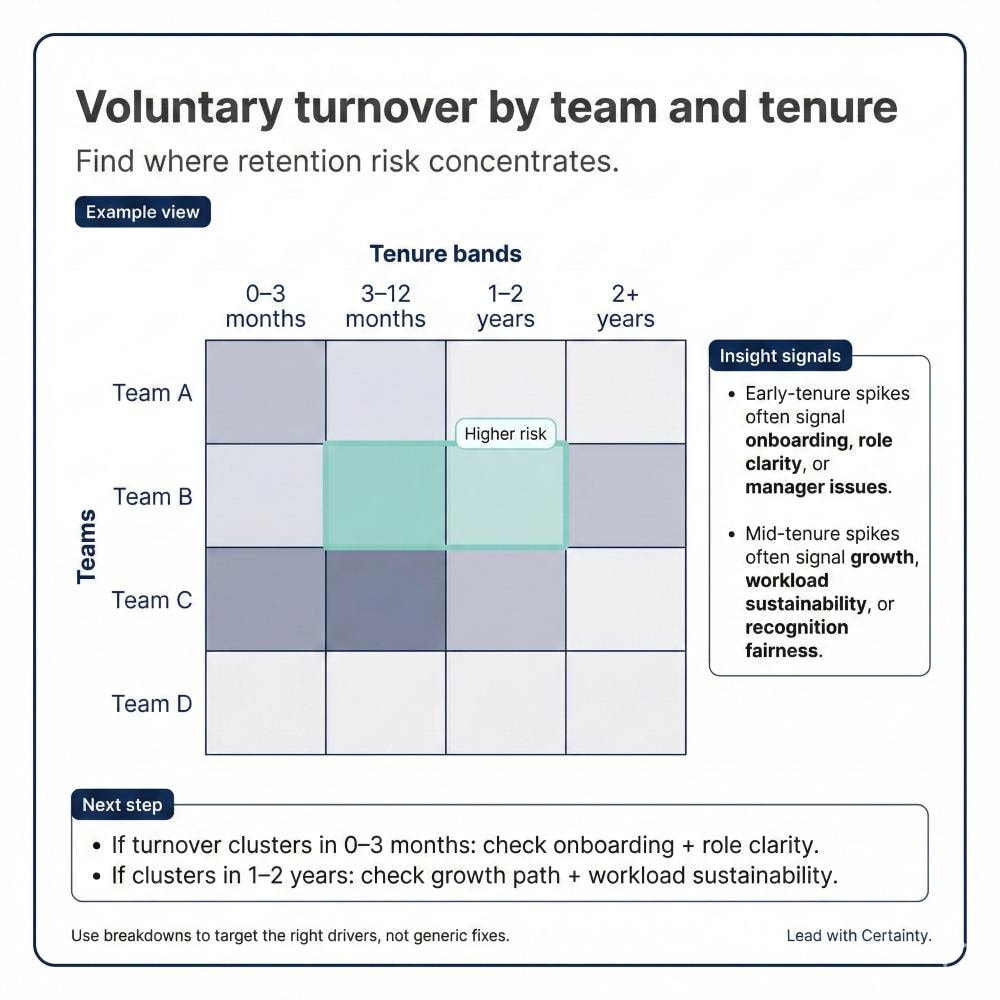
Retention and voluntary turnover are outcome metrics. They tell you motivation is broken after it has already cost you.
Use them properly:
- Segment by team, role family, tenure, location, manager.
- Track exit reasons, but treat them as imperfect data.
- Watch for patterns like “strong performers leaving at 12–18 months.”
What turnover cannot tell you: which driver failed first. That’s why you need survey drivers and manager signals, especially in high-stakes contexts like PE-backed companies where behavioral insights can prevent post-acquisition team and culture misfit.
Triangulate survey data with performance metrics
Survey data is perception. Performance data is output. Neither is complete alone.
Triangulate with metrics that match the work:
- quality defects or rework rates
- cycle time and missed deadlines
- customer satisfaction or escalations (where relevant)
- manager-rated performance distribution (used carefully, bias-aware)
If survey drivers fall and quality drops, you have a real problem. If survey drivers fall and output stays stable, you may have quiet burnout or silent disengagement brewing.
Triangulate with wellbeing indicators (without being creepy)
Wellbeing is relevant because chronic stress and poor recovery reduce motivation and decision quality.
Use non-invasive indicators:
- workload sustainability survey items
- sick days trends (high-level, not individual policing)
- burnout risk indicators from surveys
- overtime patterns at team level (if tracked)
The goal is to understand system strain, not to interrogate individuals.
Tools to Measure Motivation
Pulse survey platforms (lightweight checks)
Pulse surveys are the fastest way to see motivation drift early, before it turns into turnover.
What matters most is not the platform. It’s the design:
- consistent questions for trend tracking
- anonymity protections people trust
- segmentation that is useful but not identifying
- a clear “we act on this” loop
Use pulse surveys to measure drivers like autonomy, clarity, psychological safety, and growth opportunities. Keep them short. Leaders read short things. Sometimes.
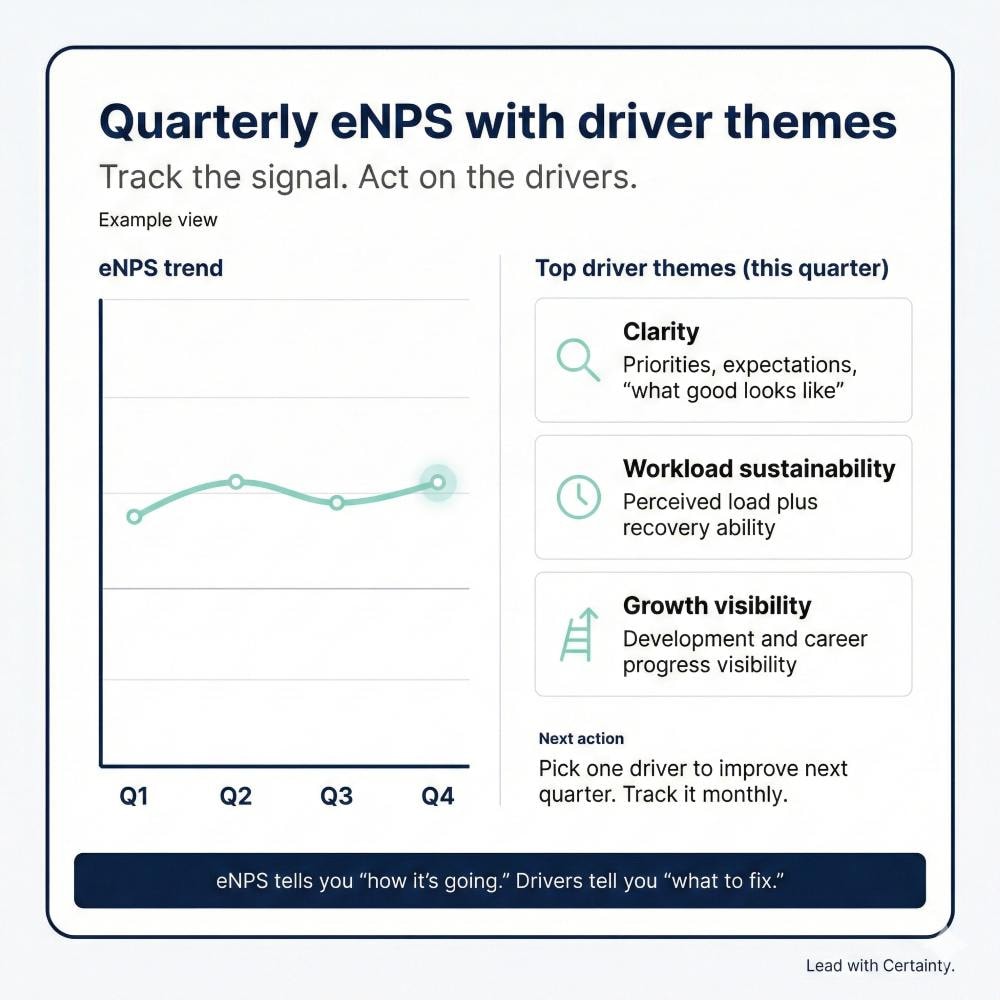
eNPS quarterly (how to use it without lying to yourself)
eNPS is popular because it’s simple: “How likely are you to recommend this company as a place to work?”
It’s also easy to misuse.
Use eNPS as:
- a quarterly temperature check
- a trend line over time
- a segmentation signal (where to look deeper)
Do not use eNPS as a single-number KPI that executives brag about while teams quietly rot. Pair it with driver questions so you know what to fix.
Motivation dashboards (HR analytics that leaders will actually read)
If your dashboard looks like an airplane cockpit, nobody will use it.
A usable motivation dashboard:
- shows 6–8 metrics max
- highlights trend changes (up, down, stable)
- links drivers to outcomes (turnover, performance, absenteeism)
- includes one “top friction theme” from open comments
Keep it decision-focused: “What changed?” and “What do we do next?”
Interventions for Continuous Improvement
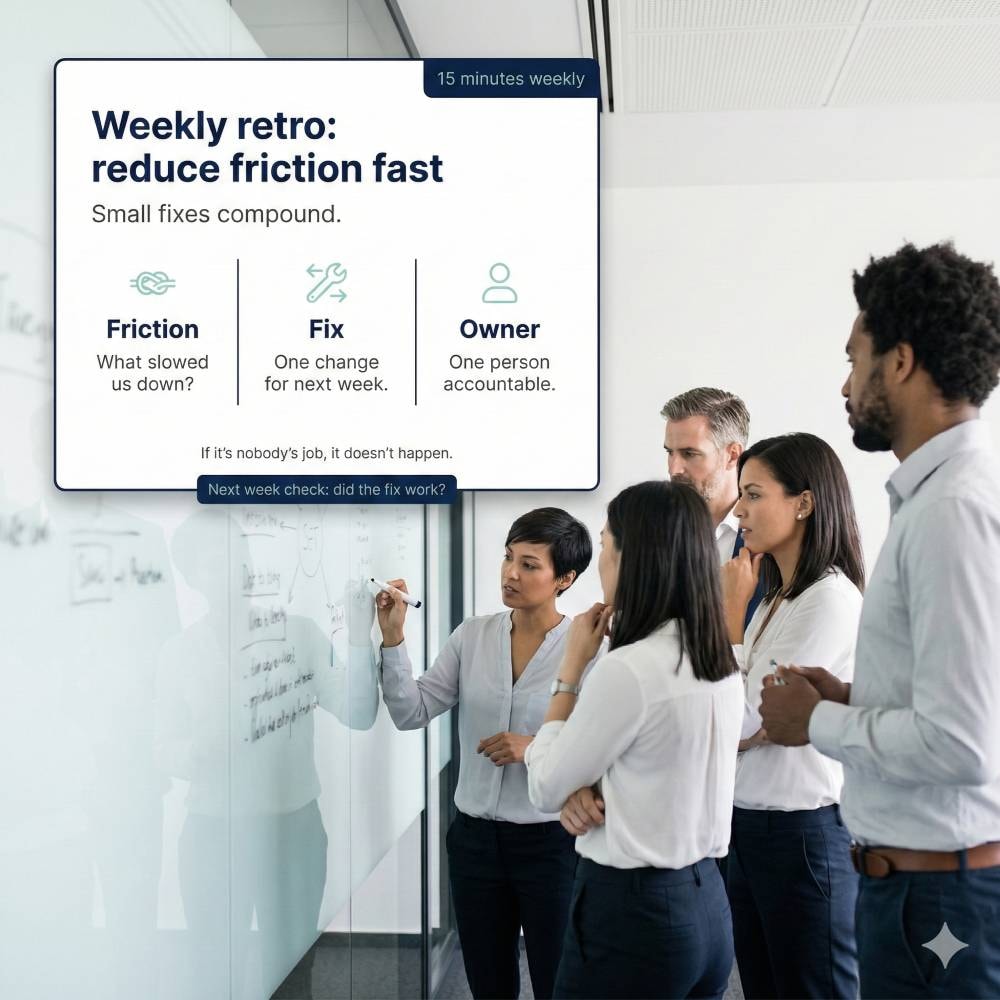
Run weekly improvement retrospectives (format and guardrails)
Retrospectives are not group therapy. They’re operational improvement.
A simple weekly format (20 minutes):
- What created friction this week?
- What prevented real progress?
- What is one change we will try next week?
- Who owns it?
- How will we know it worked?
This keeps the focus on system fixes, not blame.
Set measurable pilot goals for each intervention
Every intervention needs a target. Otherwise you get performative initiatives and no change.
Examples of measurable pilot goals:
- increase clarity score by X points over 60 days
- reduce rework rate by Y%
- reduce time-to-decision for a workflow step
- improve psychological safety item trends
- reduce avoidable overtime in one team
Only use precise numbers when you have a credible baseline and measurement method.
Celebrate small wins publicly (without rewarding noise)
Small wins matter because they prove the system can change.
But keep it grounded:
- celebrate the behavior and outcome
- keep it specific
- avoid turning recognition into a competition
If recognition becomes performative, motivated employees learn to optimize visibility instead of value.
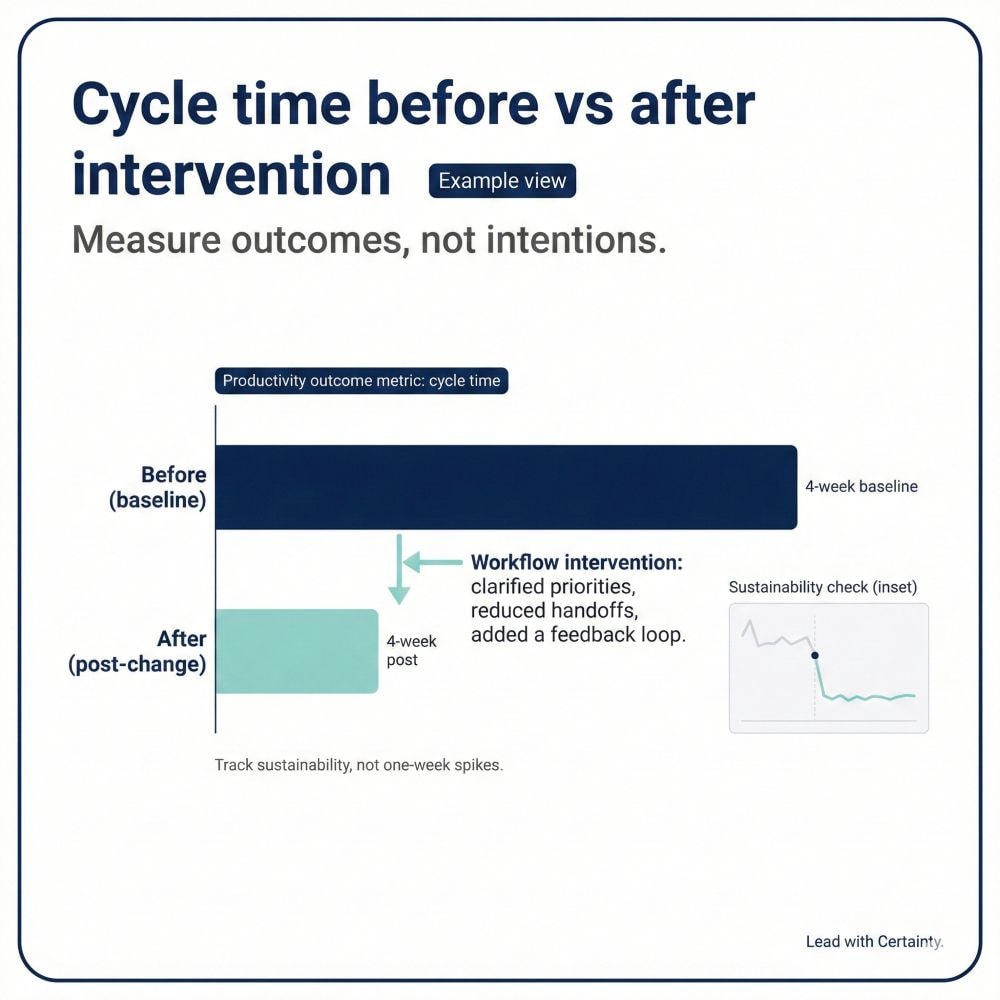
Measure productivity impact after interventions
Interventions should change observable outcomes, not just survey scores.
Track impact using:
- quality and rework metrics
- cycle time improvements
- fewer escalations or customer complaints
- stability in delivery commitments
- retention and voluntary turnover trends over time
Survey scores tell you whether conditions improved. Productivity metrics tell you whether performance followed.
Implementation Roadmap for Managers
Pilot in one team (how to pick the pilot and avoid bias)
Do not roll motivation initiatives across the whole company first. Pilot in one team so you can learn what works without creating a slow-moving mess.
Pick a pilot team that is:
- large enough to generate signal (not 3 people)
- stable enough to run a 60–90 day cycle
- willing to participate without fear
- representative of a common role family or workflow
Avoid pilots that are already “perfect.” You want a normal team with normal friction.
Define the pilot clearly:
- which motivation driver you’re targeting (clarity, autonomy, safety, growth)
- what intervention you will run
- what metrics will move if it works
Train managers on coaching basics
Coaching is a motivation tool because it increases competence, autonomy, and trust. Most managers do advice, not coaching, and benefit from behavioral tools that give data for better coaching conversations.
Coaching basics that matter:
- ask before telling: “What options do you see?”
- focus on problem-solving, not personality
- set one clear next step, not five vague ones
- follow up consistently (consistency builds safety)
Coaching fails when it becomes a lecture disguised as support.
Train managers on feedback techniques
Good feedback increases performance and motivation because it reduces ambiguity.
Effective feedback is:
- specific (observable behavior)
- timely (close to the event)
- actionable (what to change next time)
- balanced (standards plus support)
A simple structure managers can use:
- “Here’s what I observed.”
- “Here’s the impact.”
- “Here’s what good looks like.”
- “What will you do next time?”
If feedback is unclear or inconsistent, people stop trusting the system and motivation drops.
Quarterly review loop (what to review, what to change)
Review quarterly, not annually. Motivation issues compound fast.
A quarterly review should include:
- driver metric trends (pulse survey changes)
- retention and voluntary turnover signals
- quality and delivery outcomes
- top friction themes from comments
- which interventions were tried and what moved
The goal is to decide:
- what to continue,
- what to stop,
- what to scale,
- what to redesign.
Iterate based on frontline feedback (and what to ignore)
Frontline feedback is useful, but not all feedback is equal, and pairing it with behavioral interview questions that assess cultural fit makes your inputs more predictive and less subjective.
Prioritize feedback that is:
- tied to a specific blocker
- repeated across people or teams
- linked to measurable outcomes (quality, speed, errors, turnover)
Be cautious with feedback that is:
- purely preference (“I just don’t like this”)
- vague (“culture is bad” without specifics)
- politically motivated (“change this to help my group win”)
Use frontline feedback to improve systems, not to negotiate standards down.
Case Studies and Quick Wins
Two mini case studies (context, actions, outcomes, metrics)
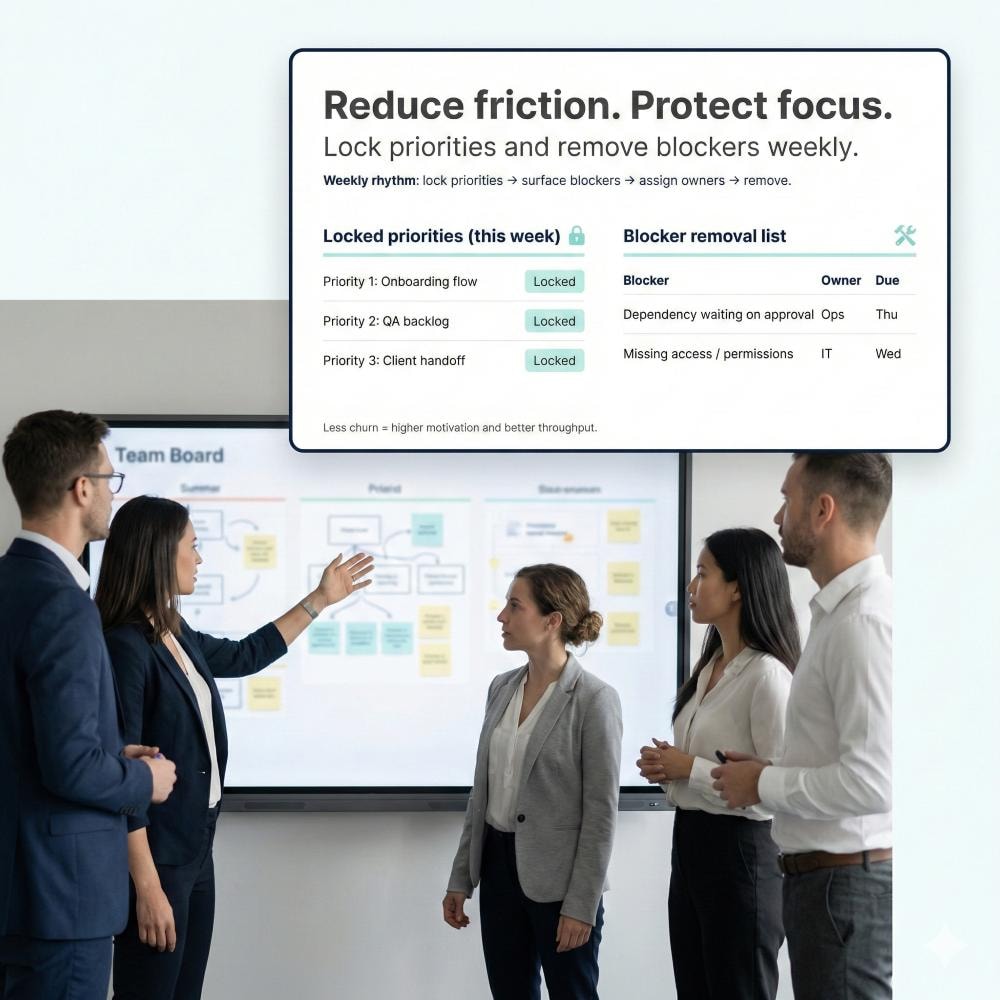
Case study 1: Motivation drop driven by clarity and workload thrash
- Context: A fast-scaling team with shifting priorities and constant “urgent” work. Many employees felt motivated in principle, but daily execution was chaos.
- Actions: The manager introduced weekly priority locking (what will not change), clarified decision rights, and added a lightweight retro focused on removing one blocker per week.
- Outcomes to track: clarity score trend, overtime trend, rework rate, missed deadline rate, voluntary turnover risk signals.
What this case typically teaches: you don’t “inspire” people out of chaos. You stabilize the system so intrinsic motivation can show up.
Case study 2: Motivation issues that were actually role fit problems
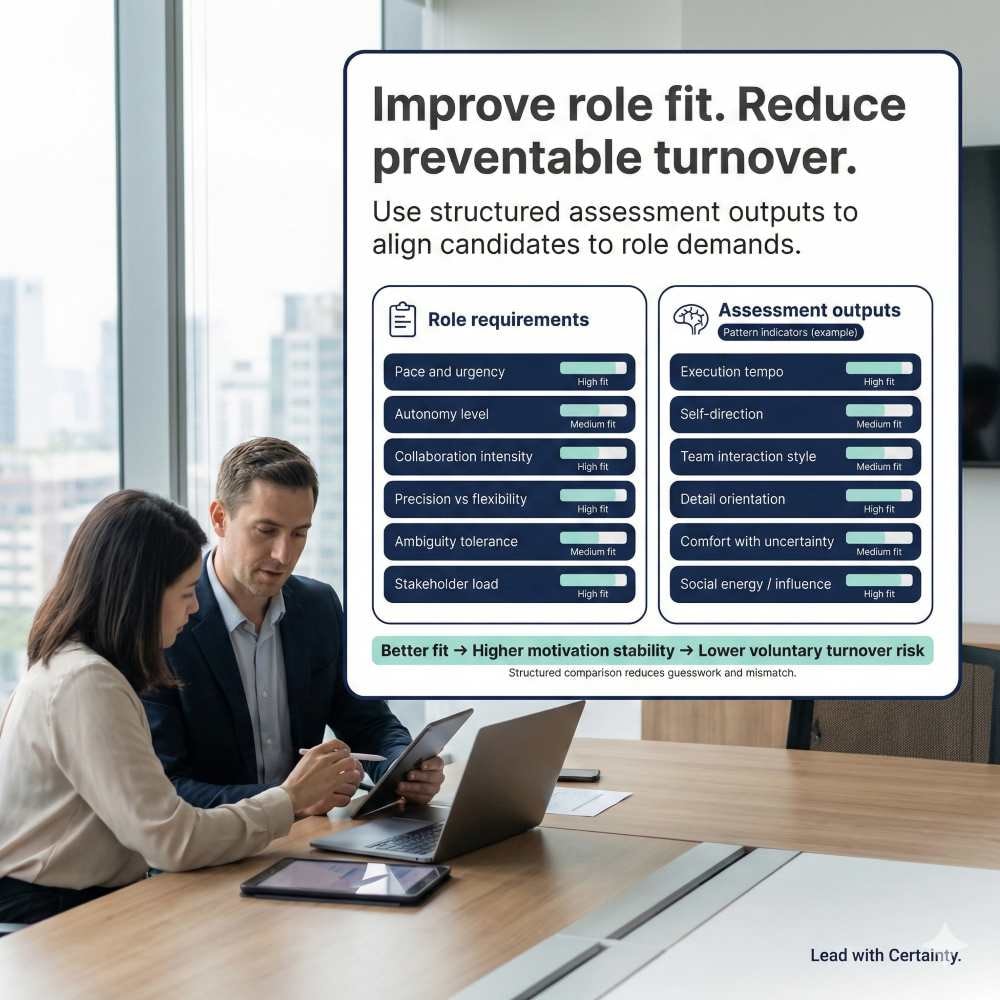
- Context: A team had recurring underperformance and “losing motivation” complaints. Coaching and recognition programs had little effect.
- Actions: The company clarified role requirements, re-evaluated fit for key roles, and used structured assessment to reduce guesswork. Some employees moved into roles better aligned with their natural drivers. Hiring criteria were updated to reduce future mis-hires.
- Outcomes to track: time-to-productivity, manager escalation rate, performance distribution, retention at 6–12 months.
Design teams with data, not gut feel.
Most org-design decisions come down to role fit, leadership style, and team dynamics. OAD reads those signals from a 7-minute behavioral survey, so you can reconfigure roles and teams with evidence instead of guesswork.
What this case typically teaches: not every motivation problem is fixable with management techniques. Sometimes the job fit is wrong, and the humane move is to fix the match.
Tools like behavioral team software that helps you lead with certainty are useful in this scenario because they help teams make role-fit decisions with data rather than assumptions, which reduces costly turnover cycles and improves long-term success.
Five quick-win tactics you can deploy this month
- Lock weekly priorities so employees can execute without constant pivots.
- Define decision rights for recurring work (who decides, who advises, who executes).
- Add one meaningful recognition habit: one specific, impact-linked recognition per manager per week.
- Run a two-minute monthly pulse focused on 3 drivers (clarity, autonomy, safety).
- Remove one blocker per week and publish the change so people see progress is real.
Quick wins work when they reduce friction or increase clarity. They fail when they are symbolic.
Before-and-after metrics to track (simple, credible, comparable)
Pick a small set that matches your intervention:
- clarity survey item trend
- autonomy survey item trend
- psychological safety item trend
- rework rate or defect rate
- cycle time or throughput
- voluntary turnover trend (lagging)
- absenteeism trend at team level (high-level)
- internal mobility participation
Measure at baseline, then again at 30, 60, 90 days. If nothing moves, the intervention is either weak or blocked by a bigger constraint (compensation fairness, manager skill gaps, or role misfit).
FAQ: Work Motivations and Employee Motivation
What are the top 5 motivations at work?
Across most roles and industries, the top five work motivations tend to cluster around:
- Fair pay and security (basic needs and predictability)
- Meaningful work (purpose and impact)
- Autonomy (control over how work is done)
- Growth and mastery (skill development and progress)
- Belonging and respect (culture, trust, and being treated fairly)
The ordering shifts by role, seniority, and life stage, but those drivers cover most workplaces.
What are the top 10 motivators at work?
A practical “top 10” list that maps to what organizations can influence:
- Fair compensation and benefits
- Psychological safety and trust
- Clear expectations and priorities
- Autonomy and decision rights
- Career growth and mobility
- Skill development and mastery
- Recognition tied to real impact
- Supportive management and coaching
- A healthy workload and good tools
- Connection to the company’s mission
If you want to use this operationally, don’t try to “fix all 10.” Pick the 2–3 most broken drivers and start there.
What is the best motivation for work?
There isn’t one universal “best” motivator. The best motivator is the one that matches the role and the person’s drivers.
That said, for long-term performance, the most reliable foundation is:
- clear work that matters,
- real autonomy within boundaries,
- visible mastery and progress,
- backed by fairness in pay and opportunity.
If any of those basics are missing, motivation becomes fragile.
What are your top 3 motivators at work?
For most people, a strong “top 3” tends to be some combination of:
- meaningful work (impact)
- autonomy (control)
- growth (mastery and progress)
- fairness (pay and opportunity)
- belonging (culture and respect)
In practice, this question is useful because it reveals fit. If a role cannot offer someone’s top motivators, you’ll see motivation issues repeatedly, no matter how good the manager is.
How do you motivate employees without money?
You build the conditions for intrinsic motivation and remove friction:
- clarify priorities and what “good” looks like
- increase autonomy through decision rights
- create mastery paths with real skill milestones
- improve psychological safety so people can contribute fully
- recognize specific behaviors tied to outcomes
- fix the environment: tools, workload, blockers
Money matters for fairness. But if the system is chaotic, extra pay just becomes “hazard compensation” and people still leave.
What causes employees to lose motivation at work?
Common causes are predictable:
- unclear expectations and shifting priorities
- unfair pay, inconsistent promotions, or perceived favoritism
- lack of growth opportunities
- low psychological safety (fear of speaking up)
- constant friction: bad tools, overload, broken processes
- role misfit (the work drains the person’s natural drivers)
The fix depends on the cause. Treating everything like a “mindset problem” is how leaders stay confused while turnover climbs.
[Image: Employee overwhelmed by unclear priorities and constant urgent requests. Alt: “Common reasons employees lose motivation at work and how to diagnose them”]
Appendix: Metrics, Survey Questions, and Resources
Sample pulse survey questions (motivation, autonomy, belonging, clarity)
Use a consistent set of questions so trends are meaningful. Keep it short and repeat monthly.
Motivation and energy
- “I feel motivated to do my best work here.”
- “I can see how my work contributes to meaningful outcomes.”
Clarity
- “I understand what’s expected of me in my role.”
- “Our team priorities are clear enough to execute effectively.”
Autonomy
- “I have enough control over how I do my work.”
- “Decision rights are clear for the work I own.”
Psychological safety and belonging
- “I can raise concerns or mistakes without negative consequences.”
- “I feel respected and included on my team.”
Growth
- “I have opportunities to learn and develop skills that matter for my role.”
- “I understand what I need to demonstrate to progress here.”
Optional open-ended (use sparingly):
- “What is one change that would make it easier to do your best work this month?”
Benchmarking sources (global with US tilt)
For benchmarking, use sources that have credibility and repeatable methods. Keep benchmarks directional unless you can cite a specific, current figure from a reliable publication.
Common benchmarking categories:
- employee engagement and workplace culture research
- compensation benchmarks by role and geography
- turnover and retention trend reporting
- psychological safety and team effectiveness research
Further reading (Self-Determination Theory and practical summaries)
If you want a research-backed foundation for intrinsic motivation, Self-Determination Theory (SDT) is a useful anchor. It maps well to workplace drivers like autonomy, competence (mastery), and relatedness (belonging).
Use SDT as a lens, not a lecture. Leaders need actionable implications, not academic jargon, supported by psychometrically precise tools like the OAD Survey.
Conclusion: How to Build a Motivation System That Scales
Motivation improves when you stop treating it like a mystery and start treating it like an operating system.
A scalable approach looks like this:
- Define motivation clearly and separate it from engagement and satisfaction.
- Diagnose which drivers are failing: clarity, autonomy, safety, growth, fairness, role fit.
- Measure a small set of drivers consistently with short pulse surveys.
- Triangulate drivers with outcomes: quality, throughput, retention, wellbeing indicators.
- Run small interventions, pilot them, and scale what actually moves metrics.
Most organizations do the opposite: they launch big initiatives, measure nothing meaningful, and then act surprised when motivation drops again.
If you want to make motivation less dependent on individual managers and more reliable across teams, add a structured role-fit layer to your talent decisions. When you can evaluate how a person’s traits and work motivations align with a role, you reduce mis-hires and the downstream “motivation repair” that follows, especially in founder- and CEO-led organizations that are trying to scale hiring and leadership decisions with long-term fit in mind.
Start with the free Top Performer Profile to evaluate role fit and work motivation drivers, then use the results to hire, place, and develop people with far fewer avoidable turnover cycles.