Turnover at work is not just an HR number. It hits business performance fast. Work slows down. Quality slips. Managers spend more time hiring than leading. Costs rise.
When employees leave, you lose more than a role. You lose know-how, relationships, and speed. That loss is biggest when strong performers walk out the door, or when new hires quit early.
Not all turnover is bad. Some turnover is expected and even healthy. The problem is avoidable turnover. That usually points to fixable issues: unclear roles, weak management, limited growth, pay problems, or poor work life balance.
This guide explains the main types of employee turnover, how to read turnover data, and what retention strategies work in practice. It is written for global teams, with a slight US lens. The goal is simple: reduce employee turnover without lowering standards, and improve employee retention in a way that scales.
What is turnover at work
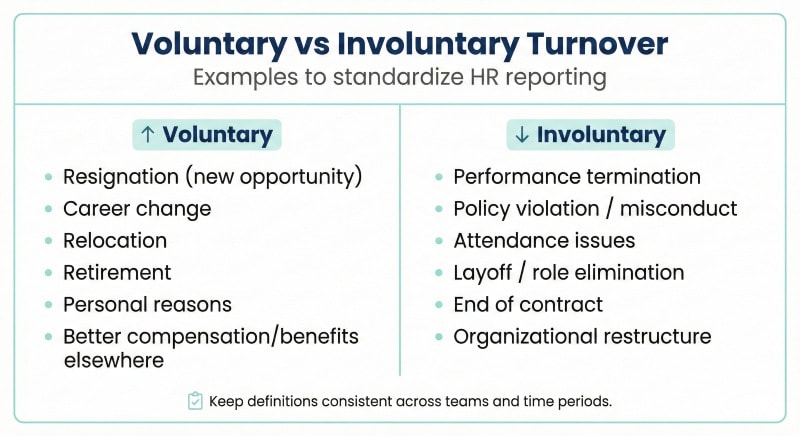
Employee turnover refers to how many employees leave a company during a set time period. It includes:
- Voluntary turnover: the employee chooses to leave
- Involuntary turnover: the company ends the employment relationship
Most teams track turnover as a rate, not just a count. A rate helps you compare across departments, regions, and time periods, even when headcount changes.
You may also hear “employee attrition.” In many companies, attrition means roles are not replaced after someone leaves. Turnover usually means the role must be filled again. The practical question is the same: are you reopening the same job openings and repeating the hiring process.
Voluntary turnover is often the most preventable. It can be linked to job satisfaction, employee engagement, manager quality, pay satisfaction, career growth, or work life balance. Involuntary turnover is different. It can point to poor performance, unclear expectations, or hiring mistakes. Both affect employee morale, but the fixes are not the same.
Types of employee turnover and why they matter
Not all employee turnover is the same. If you treat it as one bucket, you will fix the wrong problem. You will also waste money on retention strategies that look good on a slide and do nothing in the real world.
Here are the turnover types that matter most for decision-making.
Functional turnover vs dysfunctional turnover
Functional turnover happens when a low performer leaves and the team gets stronger. It can be a healthy reset, especially if performance standards were unclear or poorly managed.
Dysfunctional turnover is the dangerous one. That is when a high performer leaves, or when a hard-to-replace employee exits and takes critical skills or customer trust with them. Dysfunctional turnover is where you should focus your best retention work.
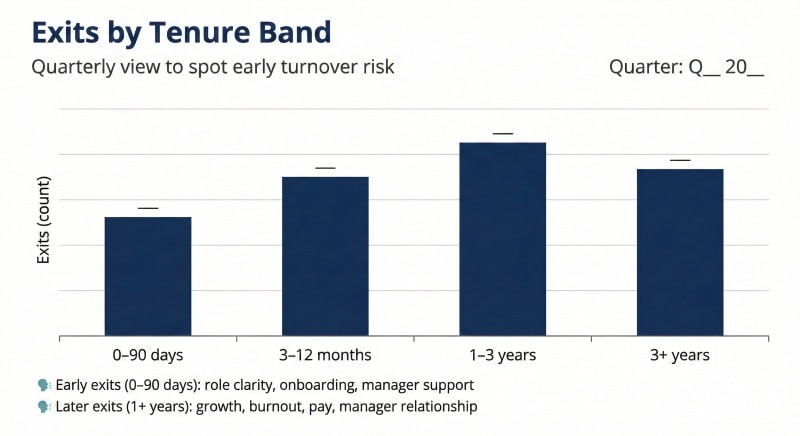
Turnover by tenure: early exits vs late-stage exits
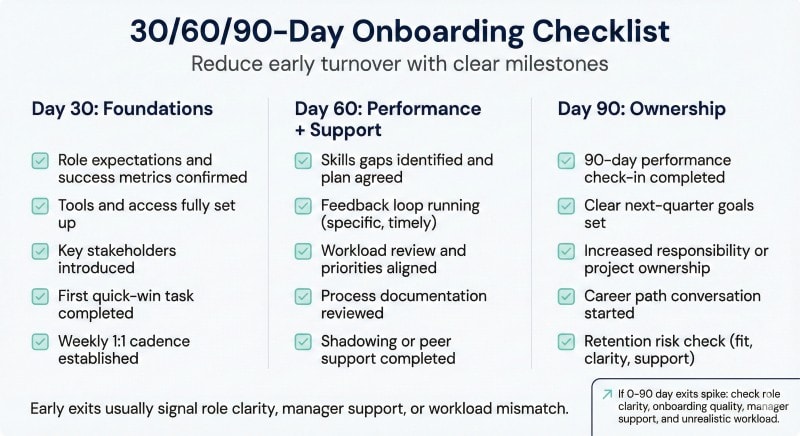
Early turnover usually means something broke in hiring, onboarding, or expectations. If new hires leave in the first 90 days, look at role clarity, manager support, training, and workload. This is often avoidable.
Late-stage turnover often has different causes. It is more likely tied to career growth, manager relationships, burnout, or pay satisfaction over time. These exits hurt more because they also drain institutional knowledge.
High turnover vs excessive turnover
“High turnover” is not a universal number. A call center and a specialist engineering team are not comparable. Context matters: role type, labor market, location, and pay competitiveness.
A more useful concept is excessive turnover. That is turnover that repeats in the same teams, under the same managers, or in the same roles. It creates a pattern. Patterns are fixable, if you look at the right data.
How to calculate turnover rate and read turnover data correctly
If you want to reduce turnover at work, start with clean basics. Many companies track turnover rate, but they do not use it well. They look at one average number and miss the real problem.
Turnover rate formula (simple, practical)
A common formula is:
- Turnover rate = (number of employees who left during a period ÷ average number of employees during the same period) × 100
Use the same period each time (monthly or quarterly works well). Keep it consistent so you can spot changes.
Also track counts, not just rates. A small team can look “high turnover” fast, even if only one person leaves. You need both views.
Segment your turnover data
The fastest way to find causes of employee turnover is to break the data into slices. Start with:
- Team and department
- Role and level
- Location and region (global teams often have different drivers)
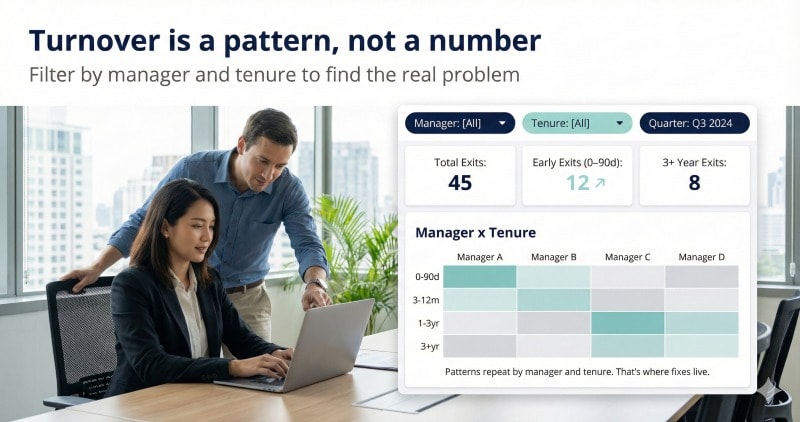
- Tenure bands (0–90 days, 3–12 months, 1–3 years, 3+ years)
- Voluntary turnover vs involuntary turnover
- Manager and direct leader
Manager-level views matter because leadership practices can create turnover hotspots. When turnover clusters around a few managers, it is rarely random.
Common interpretation mistakes
Here are the big ones that lead to bad decisions:
- Using company averages only: Averages hide hotspots. One team can be melting down while the company looks “fine.”
- Ignoring tenure: Early exits point to hiring process and onboarding process issues. Later exits often point to growth, pay satisfaction, or work life balance.
- Blaming the market too fast: External factors matter, but patterns inside your company matter more.
- Looking only at HR data: Combine turnover data with engagement, performance data, and manager feedback. That is how you find the real driver.
Your goal is not to explain turnover. It is to find the part you can control, then act on it.
The true cost of high employee turnover
High employee turnover looks like a hiring problem. It is usually a performance problem wearing a disguise.
You pay for it twice: once in visible costs (recruiting, onboarding), and again in hidden costs (lost output, errors, slowdowns). The hidden costs are often bigger.
A practical way to estimate the total cost of a resignation is to use a percentage of base salary. Work Institute suggests 33.3% of base salary as a conservative estimate for direct and indirect costs.
Academic and case-study work also lands in the same general territory. One review of 31 case studies found turnover costs averaging 39.6% of a position’s annual wage, with a median of 23.5%.
Those are not universal truths. Costs rise fast for senior roles, customer-facing roles, and roles with long ramp-up times. But the point is stable: turnover is expensive enough that prevention is usually cheaper than replacement.
Direct costs: the visible bill
Direct costs are easy to spot:
- Recruiting efforts (ads, agencies, referrals, job boards)
- Interview time from hiring managers and teams
- Background checks and admin work
- Onboarding process and training costs
- Temporary coverage and overtime
- Tools, equipment, and setup for new hires
These costs show up in budgets, but they still underestimate the impact.
Indirect costs: the hidden drag
Indirect costs show up in results, not invoices:
- Decreased productivity while the role is open
- Slower delivery because remaining employees absorb extra work
- More mistakes and rework during handoffs
- Lower employee morale when exits keep repeating
- Team dynamics getting unstable, especially in small teams
- Less time for managers to coach and improve performance because they are stuck hiring
This is where “turnover at work” turns into a compounding problem. The more churn you have, the harder it gets to stabilize.
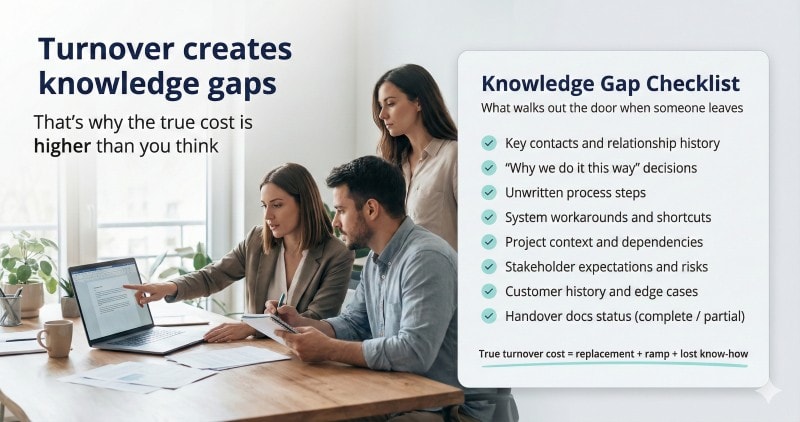
Institutional knowledge: the multiplier people forget
When experienced employees leave, you lose context that is hard to replace:
- Why certain decisions were made
- How key clients prefer to work
- Workarounds for known process gaps
- Informal networks that keep work moving
This is why dysfunctional turnover hurts more than functional turnover. Losing a high performer can lower output for months, even after you refill the seat.
Causes of turnover at work (the patterns behind why employees leave)
Turnover usually feels random when you look at it one exit at a time. It stops feeling random when you look for patterns in turnover data, exit interviews, and manager hotspots.
A useful rule: most voluntary turnover is driven by a small set of repeat causes. Work Institute consistently points to preventable reasons like career issues, management behavior, compensation clarity, work-life strain, and onboarding gaps.

Poor management and leadership (the most controllable driver)
People rarely quit because of one bad day. They quit after a pattern: unclear priorities, inconsistent feedback, weak coaching, or unfair treatment.
This is why turnover often clusters by manager. If one team has steady churn and the rest of the org does not, treat it like a leadership system issue, not “the market.”
Compensation problems (pay, fairness, and clarity)
“Inadequate compensation” is not always “pay is too low.” It is often one of these:
- Pay is not competitive for the role and location
- Pay decisions feel inconsistent or unfair
- Employees do not understand how pay grows over time
- Benefits do not match life stage needs
For strategies on smarter hiring and workforce management, see these HR resources.
Even when you cannot outpay the market, you can reduce turnover intentions by improving pay clarity and perceived fairness.
Growth gaps (career advancement opportunities)
Many employees leave when they stop seeing a future. This is not just about promotions. It is also about skill growth, better projects, and a clear path to higher impact.
If you see high turnover among strong performers at the 12 to 24 month mark, treat “career development” as a root cause until proven otherwise.
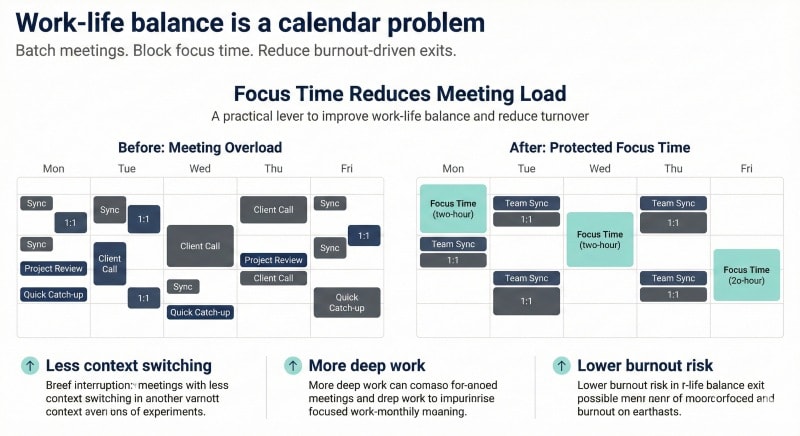
Workload and work life balance (burnout is predictable)
Work life balance issues show up as:
- Constant urgency
- Unplanned overtime
- No recovery time after peaks
- Meetings that block deep work
- “Always-on” expectations across time zones
If employees stay late, skip time off, or stop taking initiative, you are often seeing early burnout signals. Fixing work design beats adding another wellness program.
Culture, values, and recognition (how work feels day to day)
Culture sounds soft until it affects retention. Common culture-linked drivers include:
- Lack of respect or psychological safety
- Poor team dynamics
- Low recognition or “only criticism gets airtime”
- Values that are stated but not practiced
Work Institute also flags lack of recognition and low engagement as repeat contributors to turnover.
Role mismatch and hiring process gaps
Some turnover is baked in at hiring. If the job is sold one way and lived another, new hires leave fast. Early exits often trace back to:
- Vague job descriptions
- Unclear performance standards
- Weak onboarding process
- Manager not aligned with the role’s real needs
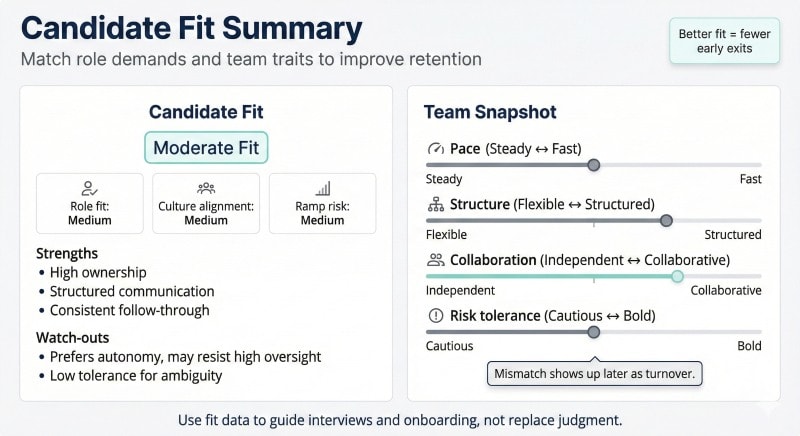
This is where structured selection helps. When you match role demands to how a person works best, you reduce the odds of early voluntary turnover and performance-based involuntary turnover.
Design teams with data, not gut feel.
Most org-design decisions come down to role fit, leadership style, and team dynamics. OAD reads those signals from a 7-minute behavioral survey, so you can reconfigure roles and teams with evidence instead of guesswork.
External factors (what you cannot control, and what you can offset)
Some employees leave due to relocation, family needs, health, or a major market shift. You cannot prevent all of it.
But you can still reduce the impact by building bench strength, improving internal mobility, and making manager practices consistent. Organizations that act on exit interview findings can reduce turnover and shift “reasons for leaving” away from preventable causes.
What actually reduces employee turnover (retention levers, not slogans)
Most retention programs fail for one simple reason: they target symptoms. People do not leave because the snack bar is sad. They leave because the work stops working for them.
Across industries, the levers that consistently matter are: growth, manager quality, fairness, and day-to-day work design. Work Institute has repeatedly found career development to be a leading driver of why people quit. HBR frames it similarly: people stay when the work is meaningful, the environment is respectful, and growth is real.
[Image: Employee and manager reviewing a simple growth plan with skill milestones. Alt: “career development plan to improve employee retention and reduce turnover at work”]
Job satisfaction and employee engagement are leading indicators
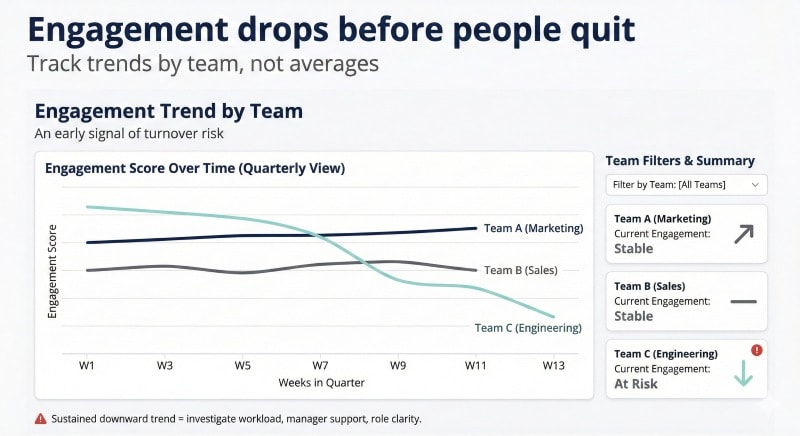
Turnover rate tells you what already happened. Job satisfaction and engagement tell you what is about to happen.
If engagement drops in one team, do not wait for resignations to prove it. Treat it as an early warning signal and investigate: workload, role clarity, manager behavior, and fairness.
Gallup’s global reporting shows engagement slipping in 2024, with manager engagement dropping at the same time. That matters because managers set the daily experience for most employees.
Employee recognition that works (not performative applause)
Recognition reduces turnover when it is specific and tied to real contribution. Generic praise is easy to ignore.
Useful recognition is:
- Timely (close to the behavior)
- Specific (what they did, why it mattered)
- Linked to outcomes or values (so it feels fair, not random)
Recognition also fails when employees feel basic issues are ignored. If pay is confusing, workload is broken, and managers avoid hard conversations, recognition becomes noise.
Growth systems that retain employees
Career development is not an annual training catalog. It is visible progress.
Retention improves when employees can answer three questions:
- What am I getting better at here
- What is the next step if I perform well
- What do I need to learn to get there
Work Institute explicitly calls out lack of career development as a top reason people leave, and it has shown up as a repeat driver in their reporting.
If you want a global-ready approach, focus on skills and internal mobility. Titles and promotion cycles vary by region. Skill growth travels well.
Manager quality is the multiplier
Manager behavior does not sit beside the other levers. It multiplies them.
- A great manager can make a heavy workload sustainable for a while.
- A poor manager can make a great job intolerable in weeks.
Recent reporting on Gallup’s global findings highlights manager engagement declines and links manager conditions to broader performance and morale outcomes.
If turnover clusters under specific managers, do not launch a company-wide retention campaign. Fix the manager system: selection, training, coaching, spans of control, and accountability.

Practical retention strategies you can implement (playbook)
Most retention strategies fail because they are vague. “Improve culture.” “Boost engagement.” Cool. How. With what owner. In what order.
Use this as a practical stack. You do not need all of it at once. You need the right few moves for your main turnover pattern.
Fix manager capability and leadership practices
If turnover clusters under specific managers, start here. It is the fastest lever you control.
What to implement:
- Weekly 1:1s with a simple structure: priorities, blockers, feedback, next step.
- Role clarity: define what “good” looks like in plain language.
- Coaching basics: reinforce the right behavior, correct the wrong behavior early.
- Manager accountability: review turnover, engagement, and performance by manager.
Global note: the style of feedback varies by region. The need for clarity does not.
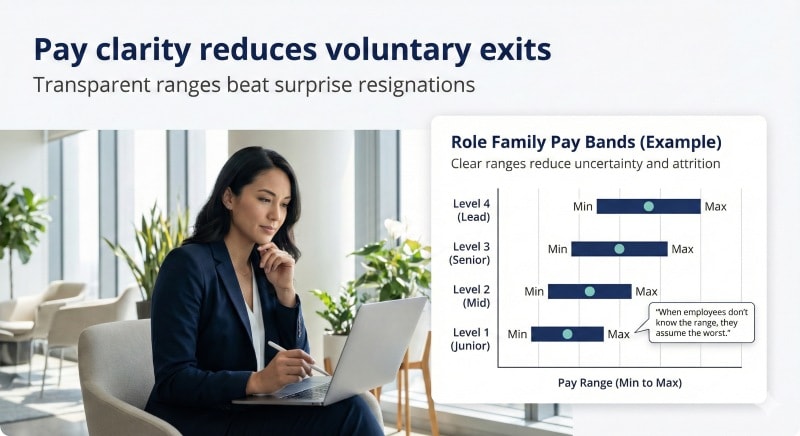
Build compensation clarity (not just higher pay)
Competitive pay matters, but clarity and fairness matter almost as much. People leave when pay feels random.
What to implement:
- Define pay bands for key roles and levels.
- Explain how raises work and what drives them.
- Train managers to talk about pay without dodging.
If you can only do one thing: make pay decisions explainable.
Create real career paths (career advancement that is not theater)
Career development is one of the most common reasons employees leave, especially high performers. Work Institute’s retention reporting consistently flags career-related drivers as top reasons for leaving.
What to implement:
- A skills map for each role: what good looks like now, what the next level requires.
- Internal mobility rules: how employees can move teams without politics.
- Development plans that connect to business needs, not generic training.
If you cannot offer promotions often, offer skill growth and better work.
Improve work life balance by fixing work design
Work-life balance is not a yoga stipend. It is workload, staffing, and expectations.
What to implement:
- Set peak-load rules: what happens after intense periods (recovery time).
- Reduce meeting drag: fewer meetings, clearer owners, fewer attendees.
- Make “urgent” mean something again.
If your best people are always covering gaps, they will eventually leave.
Strengthen onboarding process for new employees (30/60/90)
Early turnover is often a hiring and onboarding failure, not a “bad fit” mystery.
What to implement:
- A 30/60/90 plan with real work, not just training.
- Weekly manager check-ins for the first 8 weeks.
- Clear success criteria and fast feedback.
Your onboarding process should reduce uncertainty, not add to it.
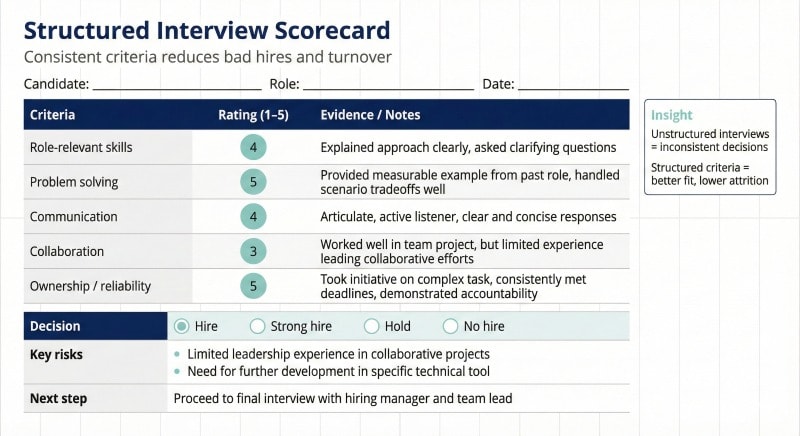
Reduce role mismatch with structured evaluation
Role mismatch creates both voluntary turnover (people quit) and involuntary turnover (performance fails).
What to implement:
- Define the role using behavioral demands, not only duties.
- Use structured interviews with consistent scoring.
- Check team dynamics: who the person will work with, and how.
This is where data beats gut feel, especially when hiring managers are rushed.
OAD angle: use data-driven fit to reduce turnover intentions
Retention starts before day one. If you hire people into roles that fight their natural working style, you get disengaged employees and repeat exits.
A scientifically validated assessment can help you:
- Spot fit risks early (work style, role demands, team match)
- Improve quality-of-hire consistency across managers
- Reduce “surprise” turnover by making expectations explicit
If you want to see how this looks in your own roles and teams, you can start with the free Top Performer Profile and compare candidates with structured data instead of gut feel.