Hiring is full of people confidently guessing. Candidates guess what the role really is. Employers guess who will actually perform. Then everyone acts surprised when “great on paper” turns into six months of friction.
“Fit for job” is the attempt to reduce that guessing. It is not about liking someone, sharing hobbies, or hiring clones. It’s about whether a person can do the work, wants to do the work, and will do it well in this environment, with these people, under these constraints.
This matters globally, whether you hire in the US, Europe, or anywhere else. The mechanisms are the same: unclear requirements create mismatches, mismatches create churn, and churn gets expensive fast.
Introduction to Job Fit
Organizations thrive or struggle on one critical foundation: how precisely talent aligns with opportunity. Job fit isn’t just compatibility — it’s the strategic intersection where individual capabilities, personality patterns, and core values converge with role demands and organizational culture. When this alignment clicks, employees don’t simply perform tasks — they flourish within systems designed to amplify their natural strengths.
Job fit assessment transforms hiring from guesswork into strategic precision. This systematic evaluation cuts through surface credentials to reveal deeper compatibility patterns between candidates and organizational needs. The process examines educational foundations, skill frameworks, and personality drivers — uncovering whether someone will genuinely thrive in the role and contribute meaningfully to team dynamics.
Prioritizing job fit during recruitment drives transformational outcomes for both talent and organizations. It slashes turnover rates, ignites authentic engagement, and creates environments where people don’t just succeed — they evolve and excel. Throughout this exploration, we’ll decode what job fit truly represents, examine why it matters strategically, and reveal how targeted assessments unlock the perfect alignment for your next critical hire.
Why “Fit for Job” Matters (Beyond Getting Hired)
Job fit is not a “nice-to-have.” It shows up as performance, speed to productivity, and retention.
Replacing a bad-fit hire is costly. SHRM is commonly cited for estimating replacement cost at roughly 6 to 9 months of the employee’s salary once you include recruiting, time, onboarding, and lost productivity. Poor job fit can negatively impact employment outcomes, leading to mismatches between candidates and roles that affect overall employment satisfaction and organizational success. High turnover can lead to low morale, overworked employees, lower productivity, and a slip in work quality.
Fit also matters because humans are inconsistent judges. Unstructured hiring tends to overweight confidence, likability, and shared background. That is how organizations end up hiring the “right person” for the wrong job.
A more reliable approach is to define fit explicitly, then measure it with structured methods. Decades of selection research show that structured interviews outperform unstructured interviews at predicting job performance. In the classic Schmidt & Hunter summary, average validity is reported as .51 for structured interviews vs .38 for unstructured.
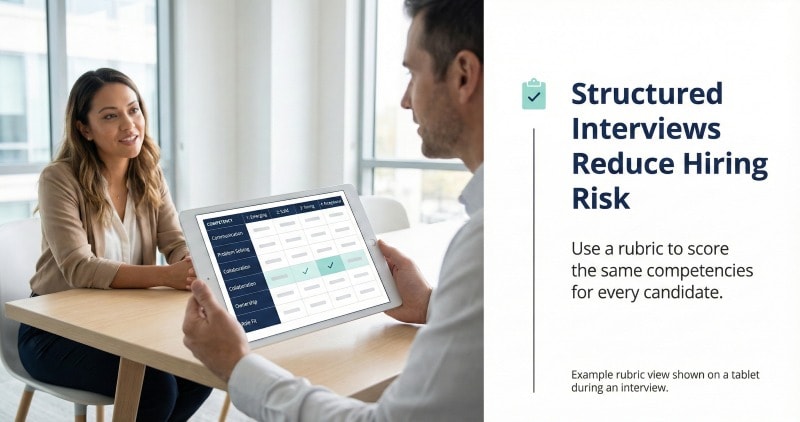
What “fit” predicts: performance, ramp time, retention, team friction
When fit is weak, you usually see some combination of:
- Slow ramp, even with strong educational background or prior titles
- Repeated “misunderstandings” that are actually work style mismatch
- Avoidance of core tasks, even if the resume looks perfect
- Team tension that shows up as communication breakdowns and conflict
For employers, fit reduces the odds of false positives. For candidates, fit reduces the odds of taking a new job that looks good but feels wrong by week three.
The two types of fit: person-job fit vs person-organization fit
Most hiring problems come from mixing these up.
- Person-job fit: match between a person’s skills and the job’s demands.
- Person-organization fit: match between a person’s values and the organization’s norms and values, also known as the company’s culture.
Person-job fit answers: “Can this person do the work here?” Person-organization fit answers: “Will this person thrive in how we operate?”
If you only hire for culture, you can get a pleasant underperformer. If you only hire for skills, you can get a high performer who burns teams down.
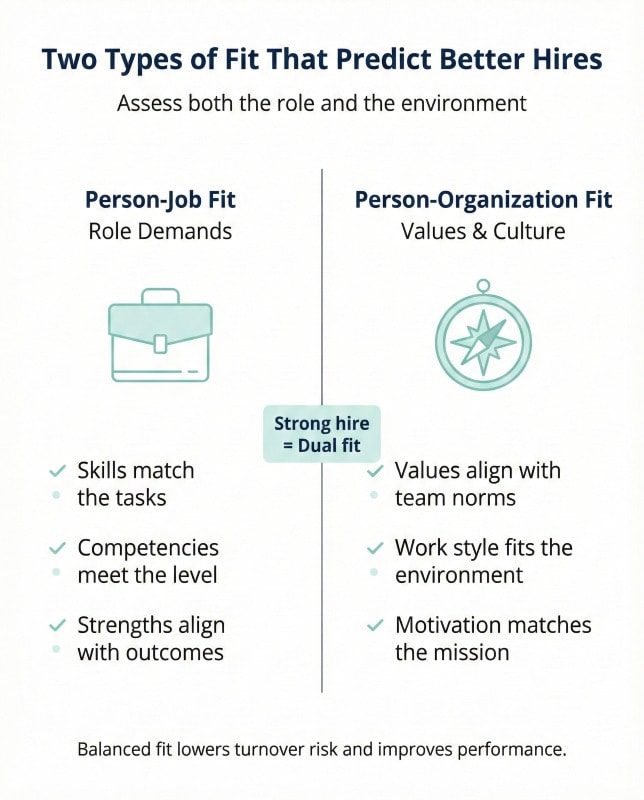
In 2026, job fit extends beyond technical qualifications to include thriving within a team and organizational culture.
What “Job Fit” Actually Includes
Most “fit” debates are really arguments about what people forgot to define. Determining job fit is multi-part. If you only measure one part, you hire blind.
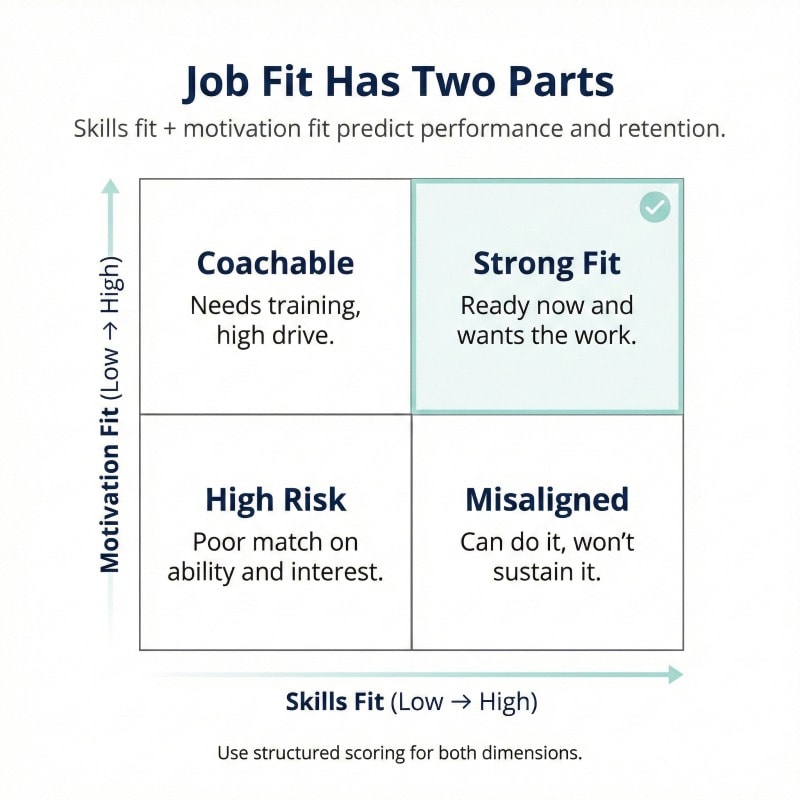
The goal of good job fit is to achieve higher productivity, increased job satisfaction, and longer tenure.
Skills fit (can you do the work)
This is the obvious part. Can the person perform the core tasks to the required standard?
Do not confuse “has done something adjacent” with “can do this.” A candidate can have impressive titles and still lack the specific skills your position requires.
Motivation fit (do you want to do the work)
A lot of underperformance is motivational mismatch, not incompetence. Often, the root cause is a disconnect between the role requirements and the candidate’s motivations.
Candidates whose motivations and expectations align with what your business offers are more likely to excel in the role.
If the role is 60% stakeholder management and the candidate wants deep work, you will see drag, avoidance, and “miscommunication” that never improves.
Work style fit (how you work)
This is where teams quietly suffer. Work style covers how someone plans, decides, communicates, and handles ambiguity.
Examples of common clashes:
- Fast, improvisational teams vs high-structure planners
- Direct feedback cultures vs harmony-first cultures
- High autonomy roles vs high coordination roles
Values and culture fit (what you will tolerate and support)
Person-organization fit is usually framed as compatibility between an individual and an organization’s norms and values.
Used correctly, it prevents predictable failure. Used lazily, it becomes “I would grab coffee with them,” which is not a hiring criterion.
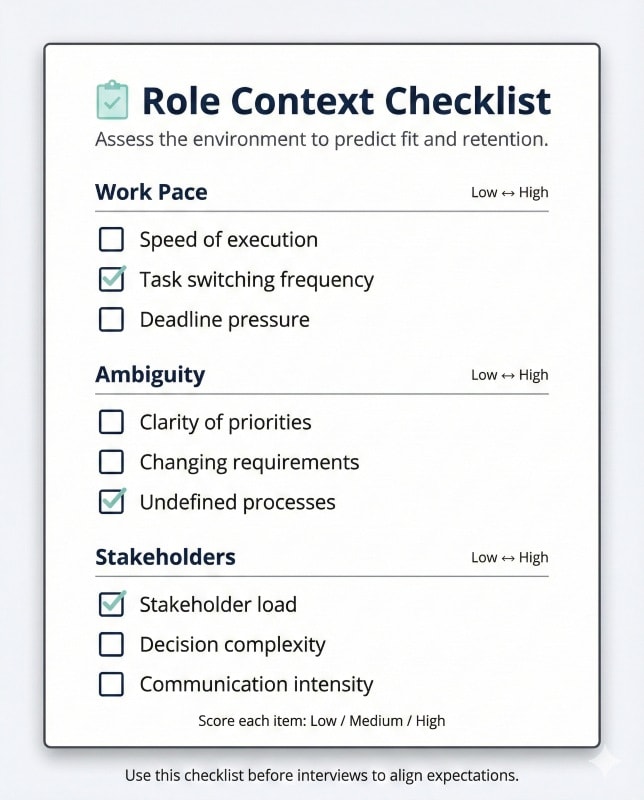
Context fit (remote/hybrid, pace, ambiguity, stakeholder load)
Same person, different context, different outcome.
Fit changes when the role is remote, the pace is high, the priorities shift weekly, or the candidate will inherit messy institutional knowledge. It’s important to consider not just the job requirements, but also the rest—such as abilities, personality, and how well the candidate may integrate with the team and company culture—when evaluating fit for job.
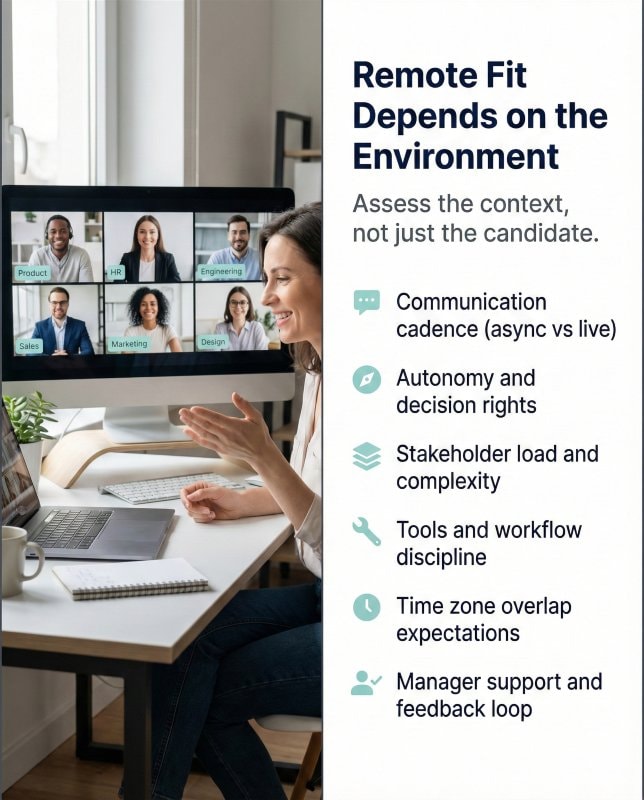
For Candidates: How to Evaluate Fit Before You Apply
Job search strategies are mostly about reducing wasted effort. To begin, focus on fewer applications that are better targeted, and consider utilizing behavioral assessments to understand and improve your job fit.
The goal is simple: only apply when you can argue, with evidence, that you are well suited.
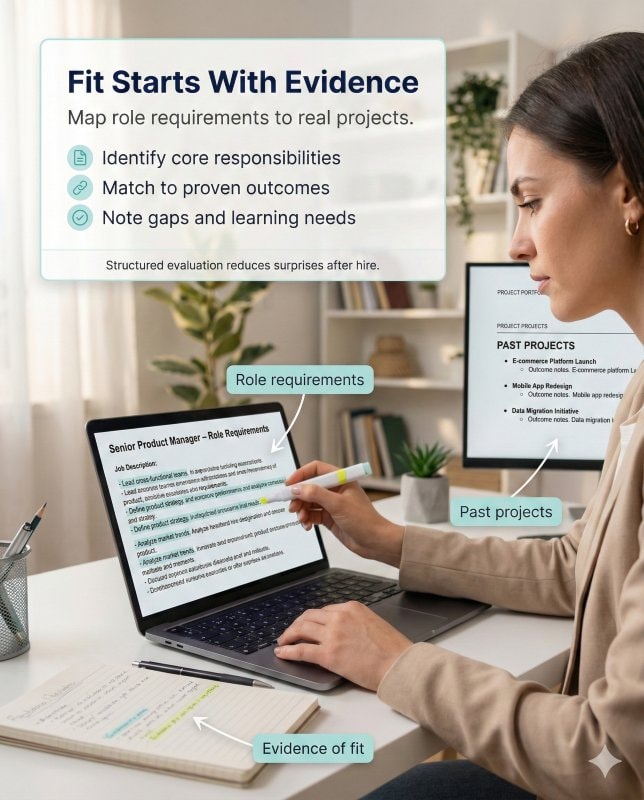
Individuals can assess their fit for a job by analyzing job descriptions, researching company culture, and evaluating their career goals, work style, and motivations.
Read the job description like a risk document
Treat job descriptions as imperfect signals, not truth.
Split requirements into three buckets:
- Must-haves: truly required to do the job on day one
- Trainable: can be learned within 60 to 90 days
- Noise: vague traits and inflated wish lists
If the description is vague, that is information. It often means the role is unclear internally – and may indicate a need to assess for cultural fit using behavioral interview questions.
Check the “position requires” list against your real evidence
Stop matching keywords. Match outcomes.
Good evidence looks like:
- “I led X, delivered Y, under constraint Z.”
- Scope: budget, stakeholders, complexity, pace
- Proof: portfolio, work samples, clear stories
Weak evidence looks like “familiar with,” “exposure to,” and “supported a project.”
Validate soft skills expectations
Soft skills are usually where fit breaks. Especially communication, prioritization, and judgment.
Look for clues in the posting: pay attention to the specific words used in the job description, as these words often signal the soft skills and qualities the employer expects.
- “Fast-paced” often means constant tradeoffs
- “Self-starter” often means unclear support and high autonomy
- “Cross-functional” often means persuasion and conflict handling
If you dislike those realities, that is not a character flaw. It is mismatch.
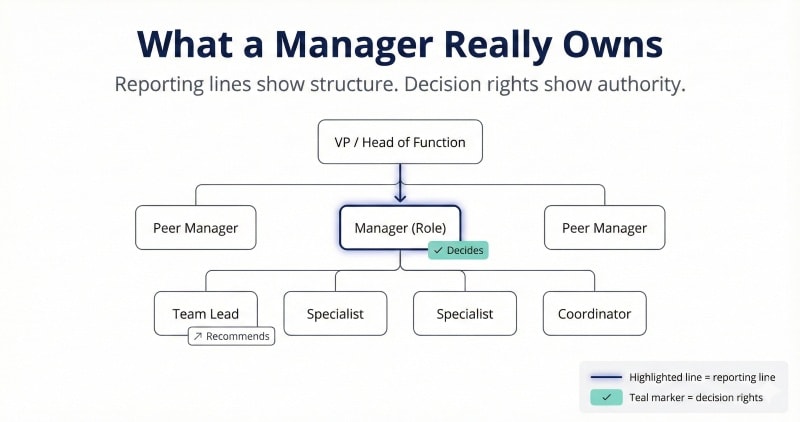
Spot the real managerial position signals
Many “manager” titles are team lead roles with no real authority. Clarify early.
Effective team building starts with the right leadership tools. Discover how OAD’s solutions for founders and CEOs can help you hire smarter and build aligned, high-performing teams.
Signals of real management:
- People leadership: hiring, feedback, performance calls
- Decision rights: the ability to set priorities
- Resource control: budget, vendors, headcount influence
If you want management but the role is coordination-only, your career progression and promotion opportunities will stall.
For Candidates: How to Test Fit During Interviews
Interviews are not auditions. They are mutual verification.
If the process is unstructured, expect more bias and less signal. Structured interviews are consistently more predictive of job performance than unstructured ones. It’s important to focus on the right questions that assess both technical skills and soft skills to ensure long-term success and organizational fit.
Questions that reveal the work environment
Ask questions that force specifics:
- What are the top 3 priorities for the first 90 days?
- What does “good” look like in this role, in measurable terms?
- What breaks people in this role, even strong hires?
- Example: Can you describe a recent situation where someone thrived in this work environment, and what contributed to their success?
Good companies answer cleanly. Weak ones sell vibes.
Questions that reveal the manager and team dynamics
Fit depends heavily on the manager.
Ask:
- How do you give feedback when something is not working?
- How are decisions made when stakeholders disagree?
- What is one thing your best team member does differently?
Engage with the interviewer by asking follow-up questions to better understand team dynamics and how the team collaborates and communicates.
You are looking for operating system, not personality.
How to avoid “wrong answers” that are really mismatch signals
Sometimes the “right” answer is to admit mismatch.
If you hate ambiguity, do not pretend you love it. If you need structure, say so. Be creative in how you present your fit for job requirements and address any potential mismatches—show your openness and willingness to find solutions. The cost of forcing a fit is paid later, with stress and performance issues.
How to evaluate career progression without getting sold a fantasy
Promotions are rarely promised. They are enabled by systems.
Ask:
- How have people in this role progressed over the last 2 years?
- What skills separate top performers here?
- Is internal mobility real, or mostly external hires?
These questions provide valuable insight into career progression opportunities and help you evaluate if the company truly supports growth.
If they cannot give examples, career progression is a marketing slide.
For Employers: Define “Fit for Job” Before You Screen Anyone
Most hiring processes fail before the first interview. Not because recruiters are incompetent, but because the organization never defined what “good fit” means for this particular position.
Poor job fit can result in increased employee turnover, which damages the company’s productivity and attracts extra costs to rehire and close the skill gap.
Person-job fit is basically the match between what the job demands and what the person can bring (abilities vs demands), plus what the person needs and what the job supplies (needs vs supplies). When defining fit for job, it’s important to also consider a candidate’s life experiences, background, and personal relationships, as these can provide valuable insights into their suitability for the role. Person-organization fit is the compatibility between a person and the organization, often framed as needs being met, shared characteristics, or both.
If you do not separate these, you get vague hiring criteria like “strong communicator” and “team player,” which means nothing until it fails.
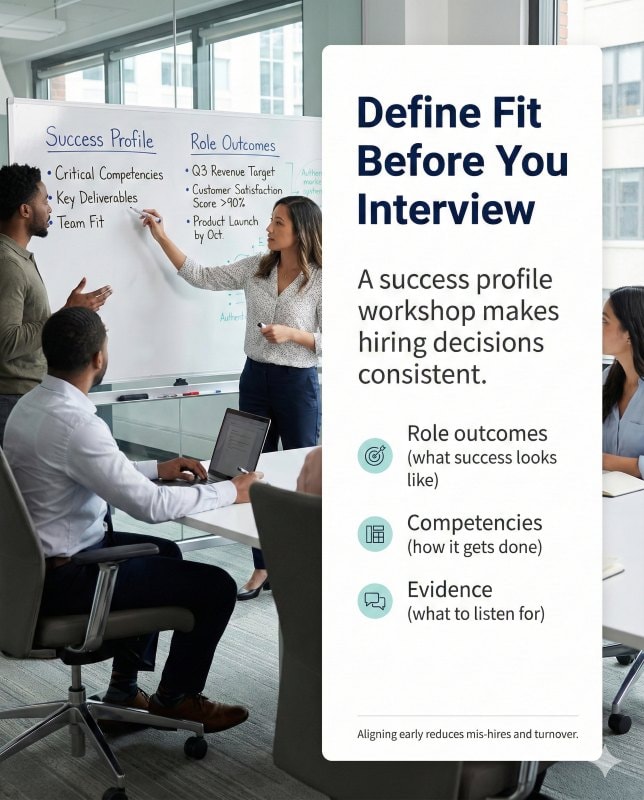
Turn the job description into a success profile
A job description lists requirements. A success profile defines outcomes.
Start with five blunt questions:
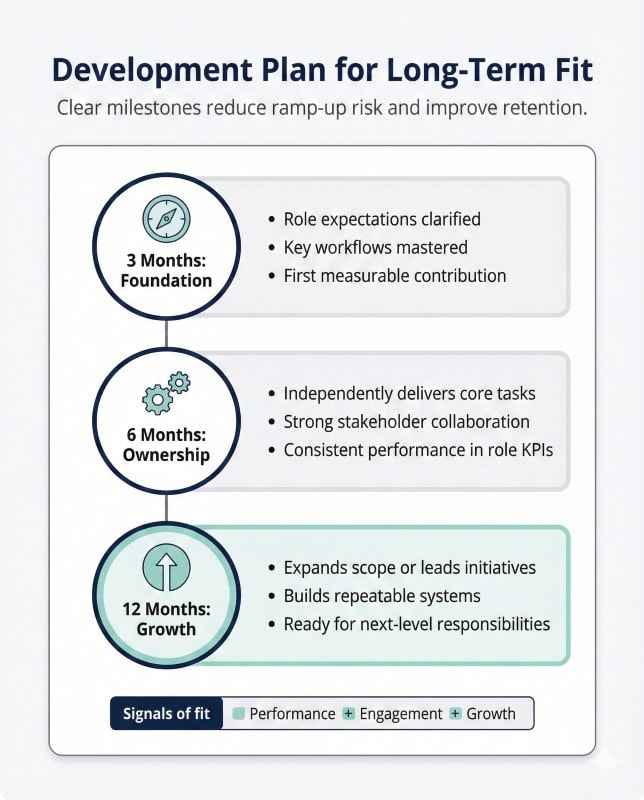
- What must this person deliver in the first 90 days?
- What must they deliver in the first 12 months?
- What decisions will they own?
- Who will they need to influence?
- What constraints will they face (pace, ambiguity, workload, compliance)?
Write answers in plain language. Avoid “optimize” and “drive.” Use verbs that can be observed.
Candidates should tailor their cover letter to address the success profile, demonstrating how their skills and experiences make them a strong fit for the job.
Separate trainable skills from non-negotiables
Trainable: internal tools, processes, product details, institutional knowledge.
Hard to train: judgment under pressure, ownership, baseline writing quality, handling conflict, ethical boundaries, and money-related factors such as salary expectations or compensation fit.
If everything is a “must-have,” you are not selective. You are confused.
Clarify what “good fit” means for this particular position
Fit depends on context. The same candidate can thrive in one team and fail in another.
Document:
- Team stage: building, scaling, stabilizing
- Work rhythm: deep work vs constant switching
- Stakeholder load: few vs many, aligned vs political
- Communication norms: direct vs diplomatic, asynchronous vs meeting-heavy
This is how you stop hiring someone who looks great, then breaks under your actual environment.
For Employers: Assess Job Fit With Less Guesswork
If you want better hiring outcomes, stop improvising. Use methods that reduce bias and increase signal.
Structured interviews are one of the most consistent wins in selection research. Schmidt and Hunter report average validity of .51 for structured interviews vs .38 for unstructured interviews in predicting job performance.
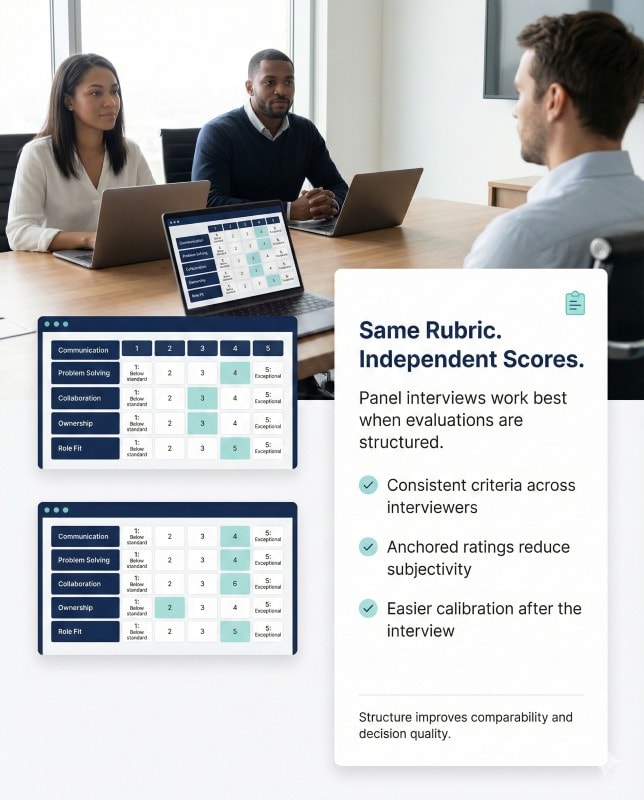
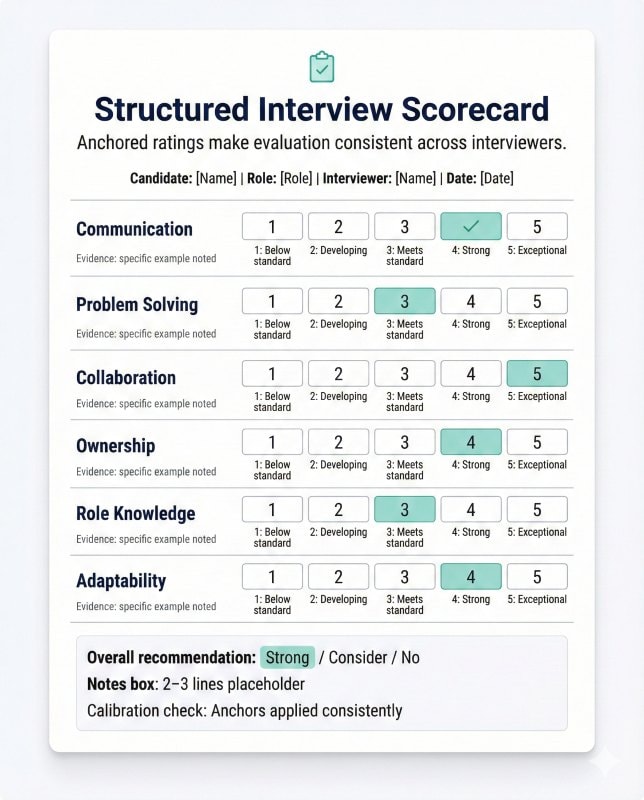
Structured interviews: scorecards, anchored rubrics
A structured interview is not “we asked everyone roughly the same questions.”
It means:
- Same questions per candidate for the role
- Clear scoring criteria (what a 1, 3, 5 looks like)
- Independent ratings before discussion
- Decisions based on evidence, not the loudest opinion
This is also easier to apply consistently across countries, even when local hiring norms differ.
Work samples and simulations: role-relevant tasks
If the job is writing, make them write.
If the job is analysis, give them a real analysis problem.
If the job is managing stakeholders, simulate a stakeholder conflict.
Work samples reduce reliance on charisma. They also reveal “can do” versus “can talk about.”
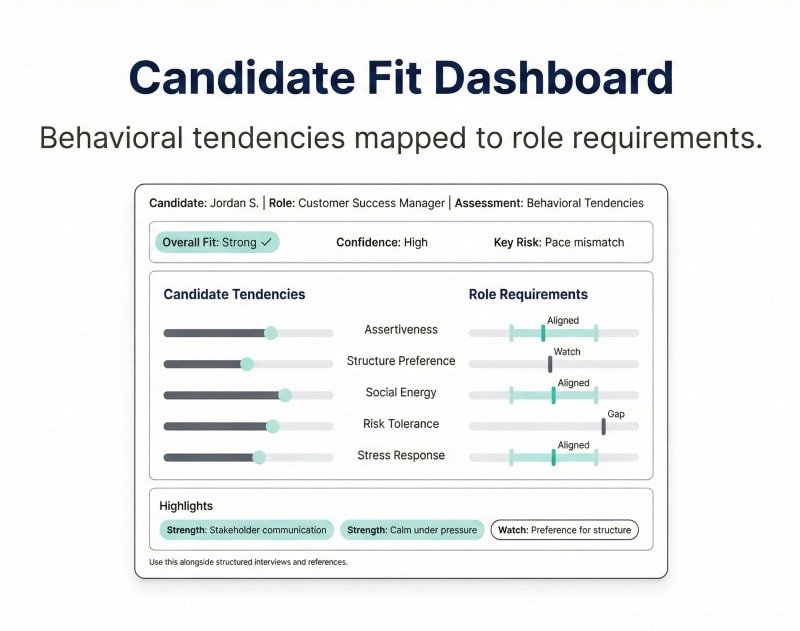
Personality test and job fit assessment, used correctly
A personality test is not a magic lie detector. It’s a structured input that can help predict how someone tends to behave at work, especially when paired with clear role requirements.
Used well, it can:
- flag predictable mismatch risks (pace, collaboration style, stress response)
- improve consistency across hiring managers
- complement interviews that tend to reward confidence
Used badly, it becomes labeling and lazy gatekeeping, especially when evaluating candidates’ communication skills in an interview.
Measuring candidate motivations
Motivation fit is where “good on paper” hires quietly fail.
Test it by asking for specifics:
- Which parts of this role will energize you weekly?
- Which parts will drain you?
- What kind of problems do you want more of?
- What kind of problems are you done with?
Then compare answers to the real job, not the fantasy version.
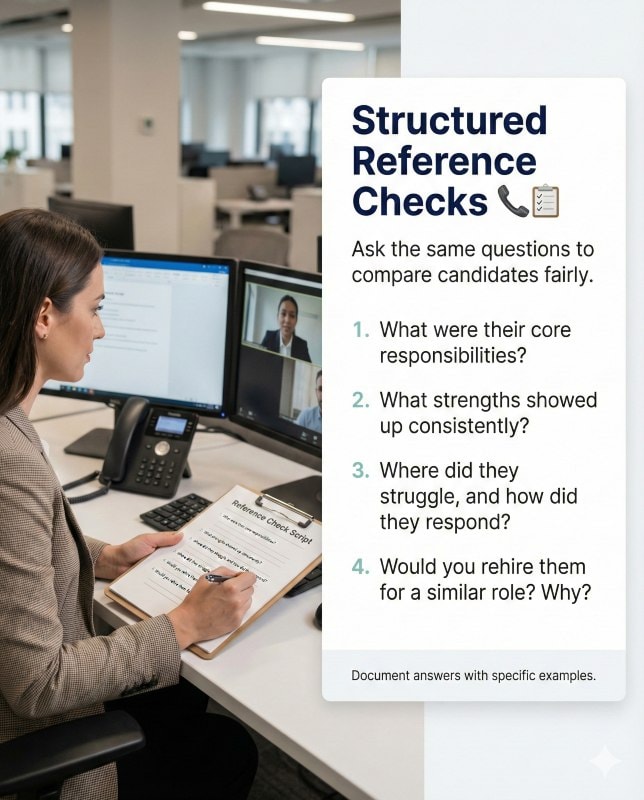
Reference checks that actually predict performance
Reference checks should verify role-relevant behaviors, not confirm that the person is “nice.” When conducting reference checks, gather information from references in the candidate’s life, such as former colleagues, managers, or mentors, to gain personal insights into their background, experiences, and relationships.
Ask:
- What were they responsible for, exactly?
- How did they handle pressure and deadlines?
- Where did they need the most support?
- Would you rehire them into a similar position?
If references cannot be specific, treat them as low-signal.
Researching company culture includes evaluating the company’s values and employee behavior, which reference checks can help illuminate by revealing how a candidate’s past actions align with your organization.
If you want to reduce hiring guesswork without turning your process into a bureaucratic ritual, a structured, science-based job fit assessment can help you compare candidates against the role requirements instead of gut feel. OAD is built for exactly that, especially when hiring managers need consistent decisions across teams and locations.
Design teams with data, not gut feel.
Most org-design decisions come down to role fit, leadership style, and team dynamics. OAD reads those signals from a 7-minute behavioral survey, so you can reconfigure roles and teams with evidence instead of guesswork.
Achieving a Perfect Fit
Perfect job fit doesn’t happen by chance — it’s engineered through precision, insight, and strategic design. The foundation starts with job descriptions that go far beyond listing requirements. They capture the essence of success: the skills that matter, the personality patterns that thrive, and the values that drive performance. Science-backed job fit assessment transforms this foundation into measurable insight, revealing how candidate abilities, interests, and motivational drivers align with both role demands and organizational culture.
True hiring success demands looking beyond surface credentials. Smart organizations evaluate career trajectory potential, work environment preferences, and personality dynamics — how each candidate will integrate with existing team chemistry. These deeper assessments ensure new hires don’t just meet qualifications; they engage fully, contribute meaningfully, and stay committed for the long haul.
The most effective hiring processes combine multiple evaluation streams — skills testing, behavioral interviews, comprehensive reference validation — creating a complete picture for informed decision-making. When organizations focus on motivational alignment and cultural fit alongside technical capability, they avoid costly hiring missteps and build teams that generate sustainable business impact. The result benefits everyone involved: employees discover roles where they feel valued and empowered, while organizations experience enhanced performance, stronger retention, and accelerated growth.
Making a Hiring Decision
Organizations rise or fall on one critical factor: how well they match talent to opportunity. Skills may capture attention, but it’s the deeper alignment — where capabilities, personality, and aspirations converge with role demands and culture — that drives sustainable success. True job fit isn’t accidental; it’s engineered through systematic evaluation, behavioral insight, and strategic alignment.
Exceptional hiring decisions emerge from understanding the complete human picture. Science-backed assessments reveal how motivational drivers, personality patterns, and career trajectories influence performance within specific environments. Forward-thinking leaders use this data to decode each candidate’s authentic potential — examining not just what they can do, but how they’ll thrive within team dynamics and adapt to organizational rhythms. When career progression goals align seamlessly with company opportunities, communication flows naturally and engagement deepens organically.
The most powerful hiring approach transcends surface-level qualifications — it engineers harmony between human complexity and business needs. This systematic alignment doesn’t just build high-performing teams; it creates ecosystems where talent flourishes, innovation emerges naturally, and people connect to something larger than individual roles. When organizations achieve this deeper understanding, they don’t just make better hires. They unlock sustained performance, accelerate adaptation, and transform everyday work into measurable competitive advantage.
Conclusion
Great hires don’t happen by chance — they emerge from precision. True job fit transcends the surface match of qualifications to requirements. It’s the deeper alignment where skills, personality patterns, and core motivations converge with an organization’s unique demands and cultural DNA. When this convergence happens, magic unfolds. When it doesn’t, even the most talented individuals struggle to thrive.
Organizations that master job fit assessment don’t just fill positions — they architect success. Through structured, science-backed evaluation processes, they eliminate the costly gamble of intuition-based hiring and unlock predictable outcomes. These forward-thinking leaders understand that sustainable growth flows from teams where every individual operates in their zone of peak contribution. Ready to transform your hiring from guesswork into precision? Discover how behavioral intelligence platforms like OAD.ai empower you to make talent decisions that don’t just fill roles — they fuel exponential growth.