Recruiting tools are not magic. They do not fix a messy hiring process. What they can do, when chosen well, is remove friction: fewer drop-offs, fewer delays, fewer rounds of back-and-forth, and fewer decisions made on vibes.
For HR teams and hiring managers in 50+ employee companies, friction is expensive. It shows up as longer time to hire, higher recruitment costs, and teams settling for “good enough” because the role has been open too long.
This guide breaks down the best recruiting tools by category and explains how to pick the right mix for your recruiting process, your open positions, and your existing tech stack. The goal is simple: more qualified candidates in front of hiring managers, with less admin work for the recruiting team.
What “best recruiting tools” means in real hiring outcomes
“Best” is not the tool with the most features. It is the tool that improves outcomes you can actually feel week to week:
- Faster movement from application to interview (less waiting, fewer scheduling stalls)
- Better screening so top candidates surface earlier
- Cleaner collaboration so recruiting teams and hiring managers stay on the same page
- A stronger candidate experience through clear communication and consistent steps
- More reliable decision making, especially when roles are hard to fill
If a tool does not reduce repetitive tasks or help you reach more relevant candidates, it is probably just a new subscription line item.

Quick view: the 5 tool categories that drive most results
Most recruiting tech stacks are a variation of five core categories. Everything else is optional until these work.
- Applicant tracking system (ATS): Applicant Tracking Systems (ATS) manage everything from the moment someone applies to the moment a job offer is extended. ATSs organize applications, track candidates, and coordinate interviews. The system of record for job openings, candidate profiles, and the recruiting process.
- Candidate relationship management (CRM): Candidate relationship management (CRM) systems work alongside ATSs to nurture relationships with candidates. CRM systems nurture relationships with past, current, and future candidates through personalized campaigns. Building a talent pool and keeping passive candidates engaged over time.
- Sourcing and job advertising: Job boards, job posting distribution, and prospect data to reach a larger talent pool. A dedicated career page is essential for posting job opportunities and attracting candidates; recruiters can use career site software to create branded websites that connect with qualified candidates directly. Employee referrals are also a valuable sourcing method, generally less expensive than recruitment marketing.
- Interview scheduling and interviewing: Scheduling interviews, structured interview questions, and smoother handoffs.
- Screening and assessment: Screening resumes, skills assessments for hard skills, and structured evaluation to find best fit candidates.
How to Choose Recruiting Tools That Actually Improve the Hiring Process
Buying recruiting software is easy. Getting better hires from it is the hard part. The difference is almost always the same: teams that win start with a clear recruiting process and buy tools to remove a specific bottleneck. Teams that lose buy “top recruiting tools,” bolt them onto a shaky process, and then wonder why the hiring managers ignore it.
A useful way to think about your recruiting tech stack is this: every tool should either (1) increase access to relevant candidates, (2) increase the signal quality of screening and interviews, or (3) reduce administrative tasks that slow time to hire. If it does none of those, it is probably a distraction.
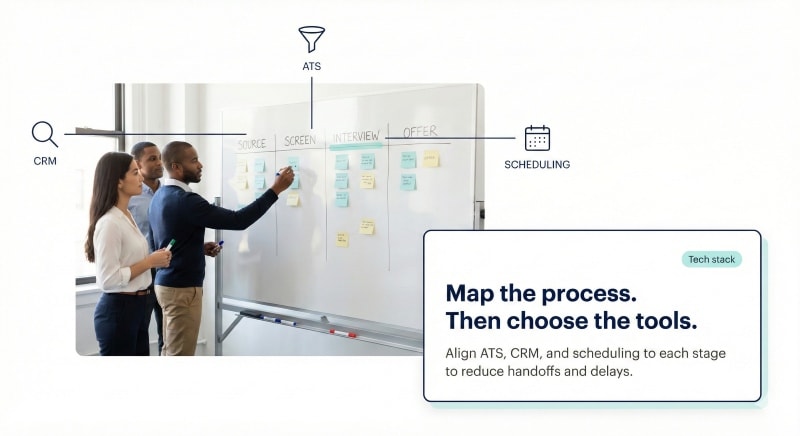
Start with your recruiting process bottleneck (sourcing, screening, scheduling, decisioning)
Before you compare features, identify where your recruiting efforts break down. Most teams can name the pain in five minutes, but they rarely translate it into tool requirements.
Sourcing Bottlenecks
- Sourcing: Not enough qualified candidates, especially for hard to fill roles, or too much time spent hunting across job boards and social media platforms. Employee referrals are a powerful sourcing strategy—recruiters can search employee networks for potential candidates and request current employees to make warm introductions, leading to more trusted and cost-effective hires. Additionally, optimizing your career page can help attract more qualified candidates by making job opportunities more visible and accessible.
Screening Bottlenecks
- Screening: Too many applicants, inconsistent screening resumes, and weak signal on who is actually a best-fit candidate.
Scheduling Bottlenecks
- Scheduling: Interview scheduling takes days, candidates drop off, and hiring managers blame “the market.”
Decisioning Bottlenecks
- Decisioning: Interviews are unstructured, interview questions vary by interviewer, and hiring teams cannot explain why one person was chosen over another.
When you name the bottleneck, you can match it to the tool category that fixes it. For example, if your problem is passive candidates and a thin pipeline, an applicant tracking system will not solve that by itself. You need candidate relationship management and sourcing tools that keep a talent pool warm and talent engaged over time.
If your problem is slow cycle time, your fastest win is usually scheduling interviews. It is not glamorous, but removing calendar chaos can improve candidate experience immediately.

Key features that matter: workflow automation, candidate profiles, analytics, compliance controls
Software demos love “key features.” Your job is to separate “useful” from “interesting.” Here is what actually changes outcomes for recruiting teams and hiring managers.
Workflow automation that reduces repetitive tasks.
Look for automation that cuts manual data entry and handoffs: auto-updating stages, templated outreach, automated follow ups, and reminders that keep candidates moving. The goal is fewer forgotten candidates and fewer bottlenecks created by internal delays.
Candidate profiles that keep signal in one place.
A strong tool centralizes candidate profiles so your team is not stitching together resumes, email threads, and interview notes from five places. The best setups make it easy to see sourcing channel, prospect data, screening outcomes, and interview feedback in one view.
Recruitment analytics that lead to actionable insights.
Analytics should answer practical questions: Where are we losing high quality candidates? Which job ads and job boards produce relevant candidates? Which hiring managers are slow to give feedback? Which steps add time without improving quality? If reporting stops at vanity dashboards, it will not change hiring efforts.
Compliance controls that fit your reality.
Even if you are not hiring in heavily regulated environments, you still need a consistent record of the recruitment process. That means permission controls, audit trails, consistent evaluation criteria, and the ability to show why decisions were made. This becomes more important when AI powered features are involved, because automation can scale mistakes as easily as it scales efficiency.
A practical note on AI tools: treat them like junior assistants. They can help with administrative tasks, screening support, and drafting outreach. They should not be the final judge of “best candidates,” especially when the underlying inputs are messy.

Integration with your existing tech stack (ATS, HRIS, calendar, email)
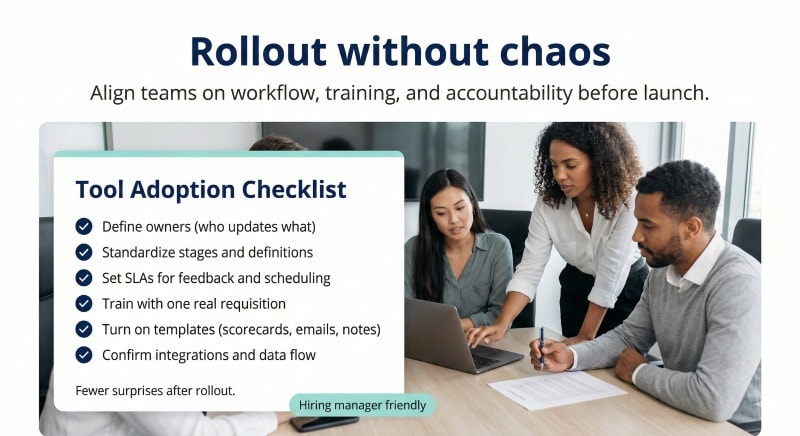
Most recruiting software disappoints for a boring reason: it does not connect to the systems people actually use. If recruiters have to duplicate work, they will. If hiring managers have to learn a new workflow, many will not. Your tech stack needs to reduce friction, not introduce it.
Prioritize integration in this order:
- Calendar integration for interview scheduling. If scheduling interviews is not effortless, time to hire will stay high.
- Email and communication integration so candidate communication is logged without manual copy-paste.
- HRIS and onboarding handoff so new hires do not disappear into spreadsheet purgatory after an offer is accepted.
- Assessment and structured evaluation tools if your goal is better fit candidates, not just faster hiring.
This is also where “best tools” lists can mislead. A tool can be excellent in isolation and still fail inside your existing tech stack. The best recruiting tools for your team are the ones that your recruiters and hiring managers will actually use, every day, without fighting the system.
Selection rule you can enforce internally: if a tool adds steps for hiring managers, it must remove at least as many steps elsewhere. Otherwise adoption will collapse, and your recruiting process will quietly revert back to inbox chaos.

Recruitment Marketing: Attracting and Engaging Top Talent
Recruitment marketing stands as the foundation upon which sustainable talent acquisition rises or falls. True talent attraction isn’t accidental — it’s engineered through strategic employer branding and proactive outreach that flows naturally to passive candidates before they even consider applying. High-performing organizations operate with this understanding: that standing out in crowded talent markets requires more than posting jobs — it demands creating magnetic pull that draws qualified candidates into your ecosystem. This approach doesn’t just fill talent pools; it transforms everyday recruitment efforts into measurable alignment between hiring managers’ needs and acquisition strategies. Because exceptional hiring isn’t just about better processes — it’s about engineering the gravitational force that makes your company irresistible. And when organizations achieve that magnetic presence, they don’t just attract talent. They unlock the full potential of their recruitment efforts, turning their brand into a beacon that draws the best candidates long before opportunities emerge.
Building employer brand with digital campaigns
Exceptional employer brands don’t just attract talent — they magnetize it. In today’s competitive landscape, organizations either master the art of authentic storytelling or watch top candidates slip away to competitors who do. Digital campaigns transform talent acquisition from passive posting into active cultivation: showcasing company culture, broadcasting values, and illuminating mission through compelling narratives that resonate deep within passive candidates’ professional aspirations. When recruitment marketing software and social media platforms become strategic weapons, teams unlock the power to amplify employee voices, spotlight organizational achievements, and position opportunities in ways that speak directly to candidates’ motivations. This isn’t just recruitment — it’s relationship building at scale. The transformation positions your organization not as another employer, but as the destination where values align, purpose intersects with opportunity, and careers flourish. The outcome: a continuous flow of qualified candidates who arrive at your door already inspired, already invested, already envisioning their future with your team.
Leveraging content and social media to reach passive candidates
Content and social media aren’t just tools — they’re the bridges that connect your organization to the talent that shapes tomorrow. Passive candidates may not be actively searching, but they’re always listening, always watching for signals that reveal where they truly belong. Strategic platforms like LinkedIn, Twitter, and Facebook become more than channels; they transform into storytelling stages where job openings, company news, and authentic cultural moments converge into compelling narratives. Masterfully crafted blog posts, videos, and employee spotlights don’t merely inform — they inspire, creating emotional connections that transcend traditional recruitment boundaries. Through consistent, purposeful content that resonates deeply, recruiting teams don’t just build relationships; they architect trust over time, ensuring your organization pulses through the professional consciousness of top talent long before they’re ready to move. This approach doesn’t simply expand your reach — it elevates the caliber of your talent ecosystem by magnetizing candidates whose values, vision, and potential align seamlessly with your organizational DNA, transforming passive observers into passionate advocates who choose you not just for what you offer, but for who you are.
Recruitment marketing tools that amplify your job postings
Successful recruitment doesn’t happen by chance — it’s engineered through strategic amplification that transforms how organizations connect with exceptional talent. Recruitment marketing tools transcend the limitations of traditional posting methods, leveraging the sophisticated networks of social media platforms, advanced recruitment marketing software, and AI-powered solutions to orchestrate job distribution with precision and impact. Platforms like LinkedIn Recruiter, Glassdoor, and Indeed become strategic allies, enabling talent acquisition teams to reach passive candidates and qualified applicants where they naturally engage and build their professional presence. AI-powered recruitment marketing tools don’t just automate — they revolutionize job posting, candidate sourcing, and initial screening processes, creating efficiency that liberates your team to focus on what truly matters: cultivating relationships with exceptional talent. When these tools integrate seamlessly into your recruiting tech stack, they don’t simply improve visibility — they fundamentally transform your organization’s ability to attract superior candidates and create a streamlined pathway from initial job advertisement to successful new hire integration, unlocking the full potential of your talent acquisition strategy.
The Top 10 Best Recruiting Tools (By Category)
When people ask for the best recruiting tools, they usually want a ranked list. Fair. The problem is that a “top tools” list without context turns into expensive tool sprawl. Different companies need different tools because their bottlenecks differ.
Today, talent teams—specialized groups within organizations responsible for sourcing, engaging, and managing candidates—leverage advanced recruiting tools to improve efficiency and effectiveness. The world’s largest professional network is a key platform for sourcing candidates, offering a vast user base and AI-assisted search capabilities that streamline proactive outreach and integration with applicant tracking systems. AI-native tools and specialized talent intelligence platforms, such as those featuring EZ Agent, are prioritizing automated sourcing, conversational engagement, and skills-based assessment in 2026.
So instead of pretending there is one universal winner, this section breaks down the top recruiting tools by category. For each category, you will see what it solves, what to look for, and what to avoid if you want more qualified candidates and a better candidate experience.
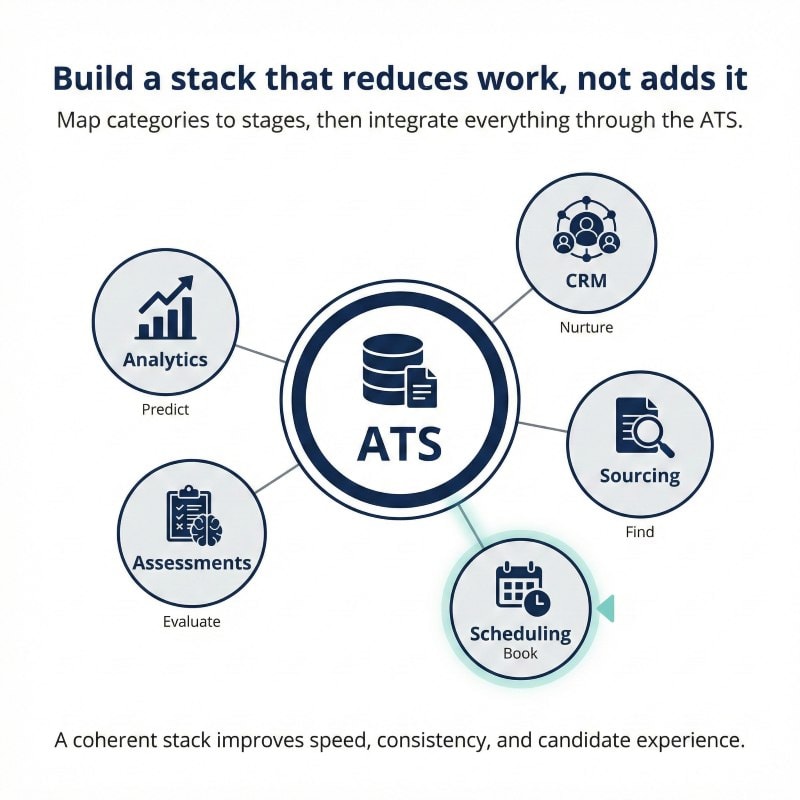
Applicant tracking system (ATS): running the recruiting process end to end
An applicant tracking system is the backbone of your hiring process. It is where job openings live, where candidate profiles are tracked, and where your recruiting teams coordinate with hiring managers. If your ATS is weak, everything downstream becomes manual data entry and guesswork.
Look for an ATS that makes the recruiting process visible in real time: stages, owners, delays, and next actions. The best systems also reduce administrative tasks through workflow automation, templated communication, and clean collaboration.
Avoid ATS platforms that prioritize “inbox replacement” over structured decision making. If the system cannot support consistent screening, scorecards, and audit trails, it will not improve quality. It will just store resumes.

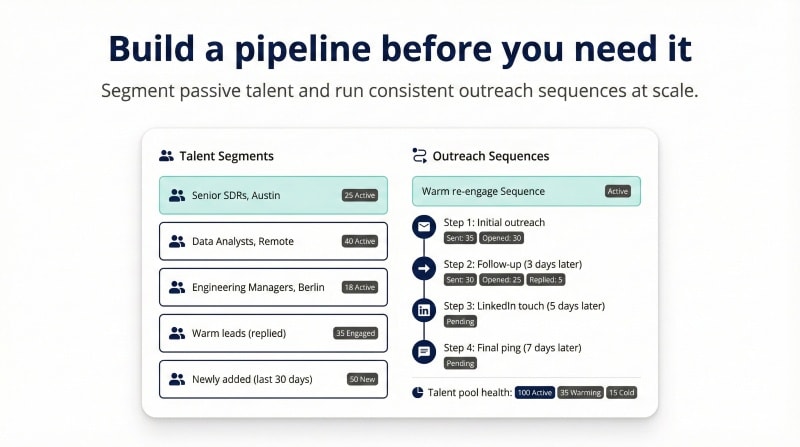
Candidate relationship management (CRM): engaging passive candidates and building a talent pool
Candidate relationship management tools exist for one reason: most high quality candidates are not applying today. They are passive candidates, and they need a different process than your inbound applicants.
A CRM helps you build a talent pool, segment it by skills and interest, and keep talent engaged with consistent outreach. The best CRM tools support automated follow ups, nurture campaigns, and outreach personalization without turning candidates into spam targets.
Avoid CRM setups that are disconnected from the ATS. If recruiters have to maintain two separate worlds, the talent acquisition team will either stop using the CRM or let the ATS become an unstructured contact list.
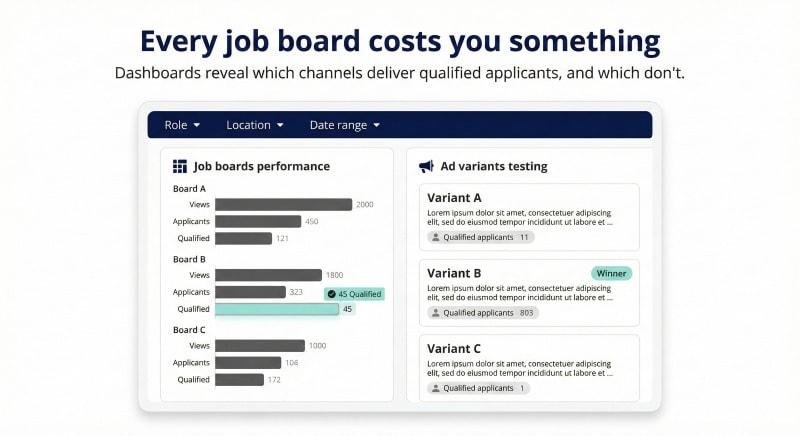
Job posting + job boards: distributing job ads and managing job openings
Job boards still matter, but “post and pray” is not a strategy. A well-designed career page serves as the central hub for job postings and is essential for attracting candidates. The best job posting tools help you publish job ads across multiple job boards, track performance, and adjust spend based on which channels produce relevant candidates. Recruiters can also surface top-notch candidates and engage with them even before the official job description is posted on the career page.
Look for distribution that reduces duplicate job posting work, supports consistent job descriptions, and shows basic funnel metrics: views, clicks, applies, and quality signals if available.
Avoid tools that optimize only for volume. More applicants can mean more screening resumes and more noise. The goal is more qualified candidates, not more tabs in your browser.
Sourcing tools: prospect data + AI powered sourcing for hard to fill roles
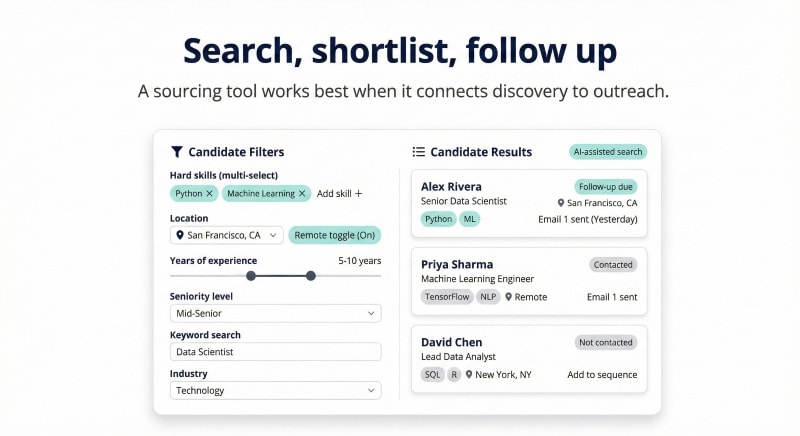
When roles are hard to fill, the bottleneck is usually sourcing, not interviewing. Sourcing tools expand your reach into a larger talent pool using prospect data, search filters, and outreach workflows. The world’s largest professional network is a key sourcing platform, offering access to a vast user base and advanced AI-assisted search capabilities for proactive talent acquisition.
AI powered sourcing can help generate candidate lists and draft outreach messages. Tools like EZ Agent automate manual sourcing tasks, enhancing speed and efficiency in sourcing and outreach processes. Used well, it reduces repetitive tasks. Used badly, it sprays generic messages at the wrong people and damages your employer brand.
Candidate Engagement & Chatbots enhance candidate experience and accelerate communication during hiring.
Look for tools that let recruiters validate prospect data, track outreach, and collaborate with hiring managers on what “top candidates” actually look like. Avoid tools that promise an “AI agent” will replace sourcing strategy. If your inputs are sloppy, automation scales sloppiness. Recruiting automation tools can also help source candidates from a wider range of platforms, including social media.
Some standout sourcing tools and features include:
- Juicebox (PeopleGPT): Uses a conversational engine to search over 800 million profiles, ideal for high-growth teams.
- hireEZ: Automates candidate discovery and multi-channel outreach, excelling at ‘talent rediscovery’.
- AI-powered outreach: Recruiting automation tools can craft personalized email sequences that improve response rates.
Interview scheduling: scheduling interviews faster and cutting time to hire
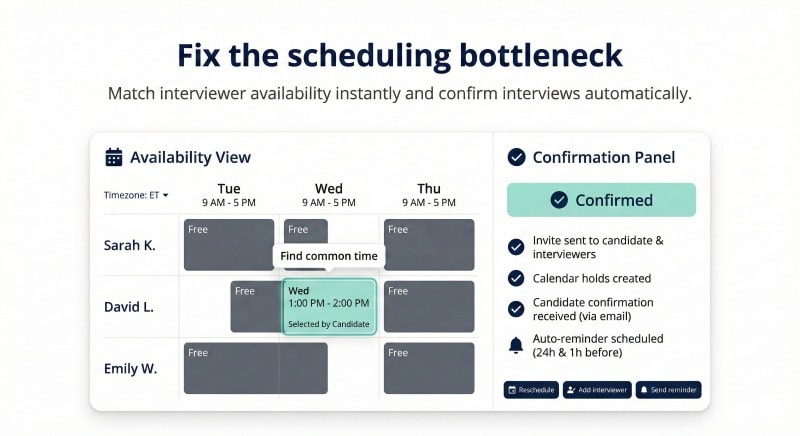
Interview scheduling is one of the fastest ways to reduce time to hire. It is also one of the most common reasons candidates drop off, especially when hiring managers respond slowly.
The best interview scheduling tools automate availability matching, send calendar invites, handle time zones, and reduce back-and-forth. They also support rescheduling without turning your recruiting team into a human calendar.
Avoid scheduling systems that create a cold experience. Automation should feel smooth, not robotic. The candidate experience improves when the process is fast and predictable.
Screening tools: screening resumes and reducing manual data entry
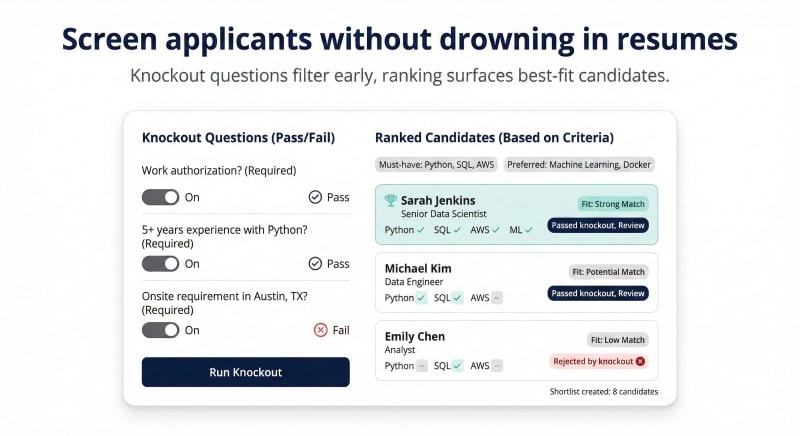
Screening tools sit between “we got applicants” and “we know who to interview.” Done right, they reduce screening resumes time and help surface top candidates. Done wrong, they screen out good people because the tool is looking for keywords, not capability.
Assessment & Screening tools like TestGorilla provide cognitive tests, personality questionnaires, and coding challenges to filter candidates efficiently.
Look for screening that supports structured intake: knockout questions, role-specific criteria, and consistent triage. The best tools also reduce manual data entry by parsing resumes into candidate profiles and keeping data clean.
Avoid screening tools that act like a black box. If you cannot explain why a candidate was rejected, you introduce compliance risk and undermine trust with hiring managers.
Skills assessments: validating hard skills to identify best fit candidates
If your hiring process relies mainly on resumes and interviews, you are mostly measuring storytelling. Skills assessments add signal, especially for hard skills where performance matters more than presentation.
Assessment & Screening tools like TestGorilla provide cognitive tests, personality questionnaires, and coding challenges to filter candidates efficiently.
Look for assessments that match the job, respect candidate time, and produce interpretable results for hiring managers. The best skills assessments integrate into the ATS and support consistent decision making.
Avoid generic tests that do not reflect real work. Candidates notice, and it harms candidate experience. For hourly workers, keep assessments short and directly tied to the role.

Interview tools: interview questions, structured scorecards, candidate experience
Interviews often fail because they are inconsistent. Different interviewers ask different interview questions, score differently, and then argue in debrief. Interview tools fix that by bringing structure: question banks, scorecards, and standardized feedback.
Video interview platforms can also help with early screening, especially when scheduling is a bottleneck. Tools like Spark Hire are commonly used for one-way video screening in high-volume roles, but the key is to use them sparingly and explain the process clearly to candidates.
Avoid overusing one-way video interviews for senior roles where relationship building matters. The tool should support the recruiting process, not replace human judgment.

Recruitment analytics: actionable insights, funnel drop-off, recruitment costs
Recruitment Analytics tools identify bottlenecks and support data-driven hiring decisions.
Recruitment analytics should not be a vanity dashboard. It should tell you what to fix. That includes stage conversion rates, time in stage, candidate drop-off points, and time to hire by role, team, and hiring manager.
Look for analytics that connect effort to outcome: which sourcing channels produce best candidates, which steps create delays, and which recruiters or hiring managers need process support. Useful analytics create actionable insights, not endless reports.
Avoid analytics tools that require heavy manual tagging to be accurate. If data capture depends on perfect human behavior, it will degrade fast.

Automation and AI tools: automated follow ups and repetitive tasks (with guardrails)
AI tools can reduce administrative tasks across the recruitment process: drafting job descriptions, summarizing candidate profiles, writing outreach, and producing interview recap notes. Workflow automation can also trigger reminders, status updates, and automated follow ups.
The best use of AI powered features is as an assistant to recruiters, not a replacement for decision making. AI can help you move faster, but it cannot define what “right candidates” means for your company culture and performance needs.
Avoid tools that hide how decisions are made, especially in screening. If an AI feature influences who gets interviewed, you need transparency, auditability, and compliance controls.

What a “Good” Recruiting Tech Stack Looks Like
Most hiring problems are not caused by missing one magical tool. They come from gaps between tools: candidates fall through handoffs, data lives in the wrong place, and hiring managers disengage because the workflow feels like extra work.
A good recruiting tech stack is boring in the best way. It creates one consistent recruiting process, reduces manual data entry, and keeps recruiting teams and hiring managers aligned without constant chasing.

Minimum viable stack for a small TA team
If you have a lean TA team, the goal is not “more software.” It is fewer tools that do their job well and do not create tool sprawl.
A minimum viable stack usually includes:
- Applicant tracking system as the system of record for job openings, candidate profiles, and hiring process stages.
- Job posting distribution to push job ads to relevant job boards without duplicating work.
- Interview scheduling to remove calendar bottlenecks and reduce time to hire.
- One structured evaluation layer to improve decision making (scorecards, interview questions, or assessments depending on role type).
For many teams, CRM is optional at the start unless passive candidates are your primary pipeline. If most hires come inbound, focus first on tightening screening and scheduling. If your roles are hard to fill, you will likely need CRM earlier.
This is also where “best tools” marketing gets people into trouble. A small team does not need a complex recruiting tech stack. It needs tools that reduce repetitive tasks and keep the hiring process consistent.

Stack for scaling talent acquisition teams
As you scale, complexity increases in predictable ways: more requisitions, more stakeholders, more hiring managers, more inconsistency. That is where a more complete recruiting tech stack becomes valuable, especially for talent acquisition teams hiring across multiple functions.
A scaling stack typically adds:
- Candidate relationship management to build a talent pool and keep passive talent engaged
- Sourcing tools for prospect data and ai powered sourcing
- Skills assessments where hard skills matter and interviews alone are too noisy
- Recruitment analytics that can show bottlenecks by team, role, and region
- Workflow automation to standardize the recruiting process across recruiting teams
When teams scale, the cost of inconsistency multiplies. Two recruiters running two different recruitment processes creates chaos for hiring managers and damages candidate experience. Your stack should enforce consistency without turning recruiting into bureaucracy.
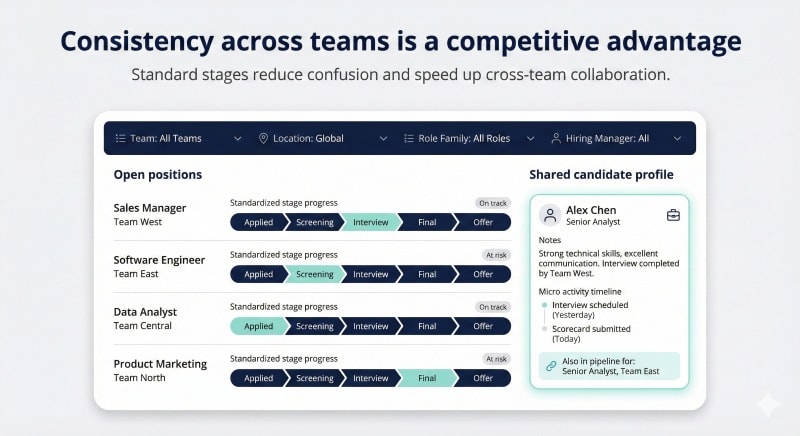
Where tools overlap (and how to avoid tool sprawl)
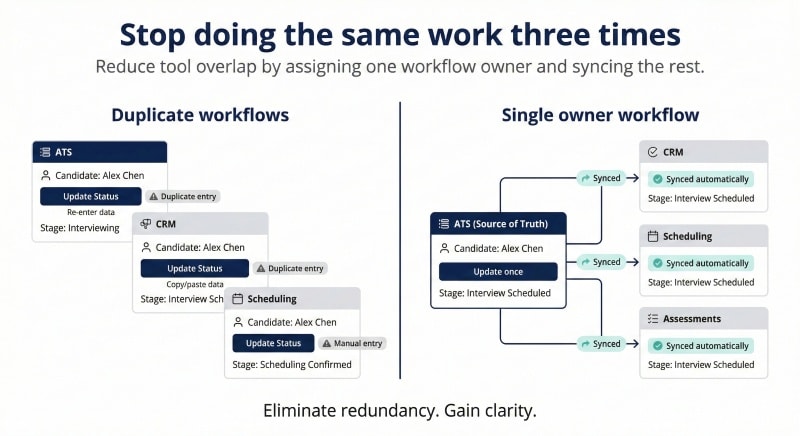
Overlap is where stacks become expensive and ineffective. The most common overlaps are:
- ATS vs CRM (both store candidate profiles)
- ATS vs scheduling tools (both can schedule interviews)
- ATS vs sourcing tools (both can track outreach)
- Analytics inside each tool vs a separate recruitment analytics layer
Overlap is not automatically bad. It becomes a problem when overlap creates duplicate workflows. If recruiters have to update two systems, it will not happen consistently. If hiring managers have to learn two interfaces, they will ignore one.
Use a simple rule: one system owns each critical workflow.
- The ATS should own pipeline stages and hiring process status.
- The CRM should own long-term engagement for passive candidates.
- The scheduling tool should own scheduling interviews.
- The assessment layer should own skills assessments and structured scoring.
- Analytics should pull from the system of record, not force extra manual tagging.
This is also where procurement questions should get blunt. If a vendor says “we do everything,” ask which part they do best, and which part they integrate with instead of replacing.
Common Mistakes When Buying Recruiting Software
Most “tool failures” are process failures with a subscription fee attached.
Optimizing for Volume Instead of Quality
- Job ads that flood the funnel create more screening resumes work, slower response times, and worse candidate experience. Track qualified candidates through the funnel, not raw applicants.
Buying Tools Hiring Managers Won’t Use
- If the workflow adds steps for hiring managers, adoption collapses. Prioritize tools that keep decision making inside one clean flow: clear candidate profiles, structured feedback, fast handoffs.
Over-Automating and Damaging Candidate Experience
- Automated follow ups and AI powered outreach help, until they feel spammy or impersonal. Use automation for speed and consistency, not to avoid human contact.
Ignoring Compliance Controls Until Legal Asks Questions
- If AI tools influence screening or ranking, you need transparency, audit trails, and consistent criteria. Black boxes create risk.
FAQ
What are the best recruiting tools?
The best recruiting tools are the ones that fix your bottleneck: ATS for process control, CRM for passive candidates, sourcing for hard to fill roles, scheduling to cut time to hire, and assessments to improve best fit candidates decisions.
What is the most common recruiting tool?
An applicant tracking system is the most common recruiting tool because it anchors the hiring process and manages job openings, job posting flow, and candidate profiles.
What is the best recruiting tech stack for hard to fill roles?
ATS + sourcing tool (prospect data) + CRM to keep passive talent engaged + fast interview scheduling + a role-relevant assessment layer to protect quality.
Do AI powered recruiting tools improve hiring or create risk?
Both. They reduce administrative tasks and repetitive tasks, but they can scale bias or poor criteria if you treat them as decision makers instead of assistants.
How do you measure whether recruiting efforts are working?
Track time to hire, stage conversion, qualified candidates reaching final rounds, offer acceptance, and drop-off points tied to candidate experience.
Conclusion
A “best recruiting tools” list is only useful if it leads to a coherent recruiting tech stack. Pick tools that remove friction in your hiring process, improve screening signal, and help hiring managers make consistent decisions.
If you want to see how OAD performs on your own roles and candidates, you can start with the free Top Performer Profile: 7 minutes, results in 24 hours, no credit card.