Workforce development is no longer just a public policy phrase, it is a strategic discipline that determines whether your organization can keep up with shifting markets and evolving skill demands. For companies with 50 or more employees, a structured approach to workforce development connects hiring, learning, and internal mobility to concrete business outcomes like growth, retention, and innovation. This article explores how to design workforce development strategies that build a skilled, adaptable workforce and turn talent into a lasting competitive advantage.
From Training Spend To Strategic Workforce Development
Most companies say they are “investing in people.” Fewer can explain exactly which capabilities they are building, why, and how that links to revenue, innovation, or resilience.
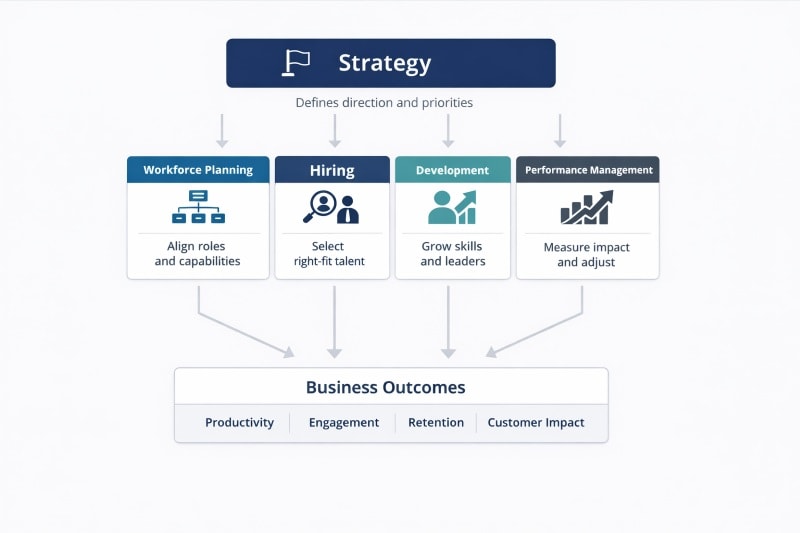
Workforce development is the intentional process of building the skills, behaviors, and capabilities your organization needs to execute its strategy. As a concept, workforce development serves as a foundational idea that shapes organizational strategy and collaborative efforts. It goes beyond sending people to courses. It connects hiring, learning, career development, and internal mobility into one coordinated system.
A structured workforce development strategy answers three questions and is guided by the mission to align organizational goals with broader societal impact:
- What work will matter most in the next three to five years?
- Which skills and behaviors are missing today?
- How do we build those capabilities in a predictable, repeatable way?
When this is clear, training is no longer a cost center. It becomes an operating system for growth, retention, and performance by helping connect people with opportunities and resources across the organization.
Gallup estimates that low employee engagement costs the global economy around 8.9 trillion dollars, or about 9 percent of global GDP. Workforce development, done properly, is one of the few levers that can move both engagement and performance at scale.
How Workforce Development Drives Growth In A Changing Labor Market
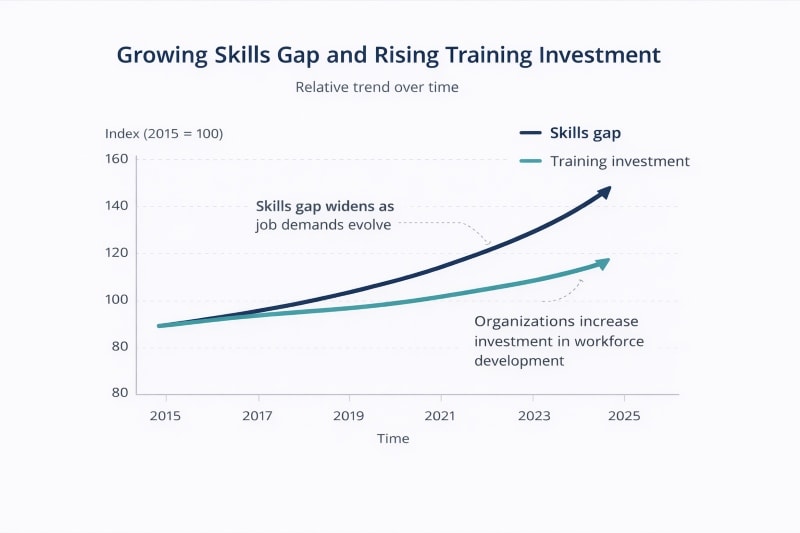
The labor market is shifting faster than traditional HR planning cycles. Demographics are tightening talent pools, remote and hybrid work expand competition for skilled workers, and AI is changing role requirements year by year.
According to the World Economic Forum, employers expect nearly 40 percent of key skills required on the job to change by 2030. Skill gaps are already cited by 63 percent of employers as the single biggest barrier to business transformation.
Relying only on external hiring is becoming less viable. Competition for experienced talent drives up wages and recruitment costs, while onboarding time slows execution.
A mature workforce development strategy:
- Reduces dependence on external hiring by building internal talent pipelines
- Shortens time to productivity through better onboarding and targeted learning
- Efficiently develops skills and training programs tailored to individual and market needs, ensuring organizations keep pace with labor market changes
- Raises engagement and retention by giving employees visible paths to career advancement
For organizations with 50 or more employees, this is not a “nice to have.” It is a structural requirement to support growth.
Core Components Of Effective Workforce Development Programs
Skills, Competencies, And In-Demand Roles
Effective workforce development starts with clarity on what “good” looks like.
Skills describe what people can do. Competencies combine skills with behaviors and judgment in context. High performance in a critical role requires both.
A practical starting point:
- Identify your most critical roles in the next three to five years
- Map the technical skills and behavioral competencies that distinguish strong performers
- Cross-check these with external labor market and industry data to ensure relevance
Workforce development programs are specifically designed to enhance the skills and competencies of employees, ensuring they are better equipped to meet evolving industry demands.
This avoids the common trap of designing development programs around generic leadership lists that do not match actual work.
Learning Pathways And Career Development
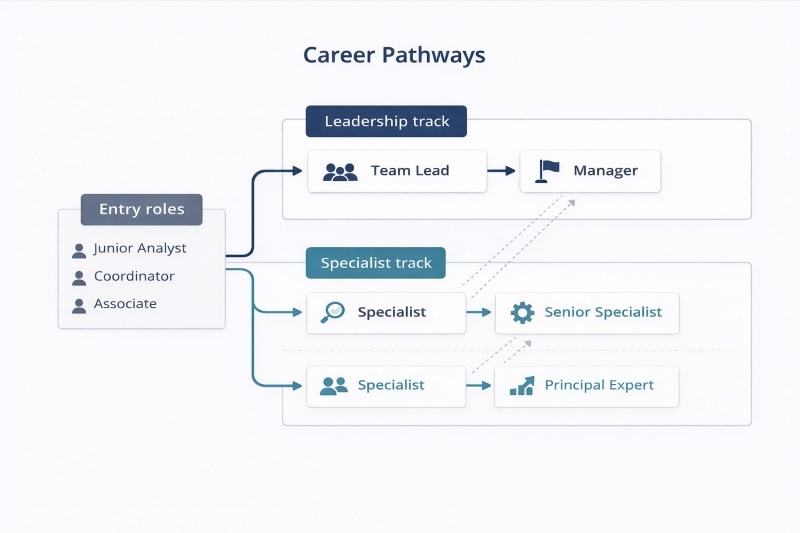
Workforce development is most powerful when employees see clear, structured pathways.
Examples:
- Early career pathways from entry level roles into specialist, professional, or supervisory positions
- Expert tracks for deep technical or domain specialists
- Leadership tracks for people leading teams, functions, or business units
Each pathway should specify the skills, behaviors, and experiences needed for progression. This transparency reduces guesswork, improves retention, and supports fairer advancement decisions.
Support Services That Remove Barriers To Performance
Support services are often treated as “extras.” In reality, they are part of workforce development.
Examples include:
- Coaching and mentoring that help employees apply new skills in real work
- Onboarding and buddy systems that shorten the time to productivity
- Practical supports such as flexible scheduling, language training, or accommodations for disabilities in certain sectors
These elements matter particularly for youth, career changers, and underrepresented groups. By providing these supports, workforce development programs can increase the likelihood that individuals are hired into roles where they can succeed and grow into productive, long-term employees.
Sector-Based And Place-Based Workforce Development: What Employers Need To Know
Demand-Side Strategies: Start With Business And Industry Needs
Sector-based workforce development starts from employer demand. Industry leaders identify critical roles, forecast hiring needs, and define the skills and standards required.
For employers, benefits include:
- Better aligned training pipelines that produce job-ready candidates
- Shared cost of training across multiple companies in a sector
- Stronger influence over the design of programs that feed your talent pool
This model is especially relevant where specific technical or regulatory skills matter, such as manufacturing, logistics, or regulated services.
Supply-Side Strategies: Developing Job Seekers And Local Talent
Place-based strategies focus on communities and job seekers. They aim to provide pathways out of unemployment or low-wage work and often integrate wraparound support such as childcare, transportation, or housing assistance provided through partners.
For employers, these programs are a source of motivated candidates who might otherwise be excluded from traditional recruitment channels. The key is to maintain clear performance standards and close communication with program operators so that candidates arrive with realistic expectations and relevant skills.
Why The Best Workforce Development Programs Combine Both
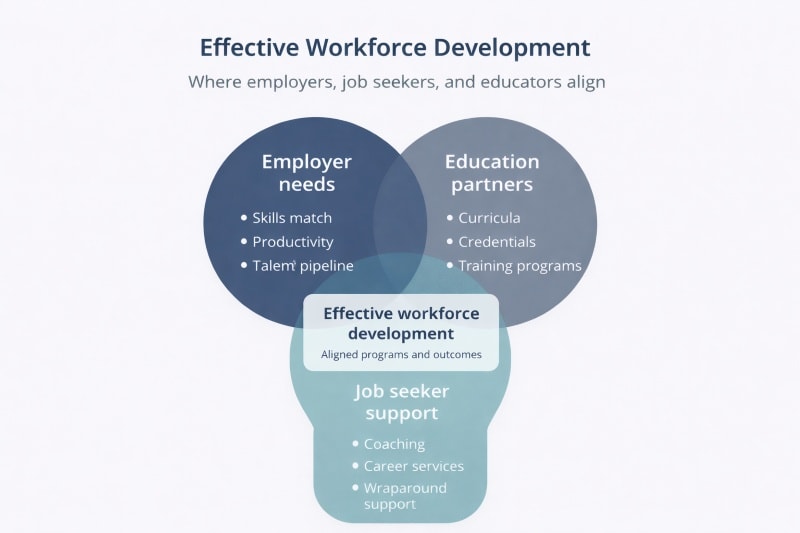
The most effective workforce development systems connect sector-based and place-based approaches.
This often looks like:
- Employers defining role requirements and standards
- Education providers and workforce agencies designing programs that meet those standards
- Support organizations helping participants overcome structural barriers to participation and retention
The result is a talent pipeline that is both high performing and more inclusive.
Barriers To Effective Workforce Development
Workforce development programs rise or fall on one critical factor: whether they can break through the barriers that limit their impact. Access isn’t just an issue — it’s the foundation that determines success. Job seekers in underserved areas face a stark reality: quality training programs that teach in-demand skills remain out of reach. This access gap doesn’t just hold individuals back — it chokes the talent pipeline that feeds economic growth.
The labor market moves fast, and workforce programs that can’t keep pace get left behind. Industry requirements shift constantly, creating a dangerous mismatch between what programs teach and what businesses actually need. This disconnect doesn’t slow growth — it stops it cold, making local economies less competitive and driving companies to seek skilled talent elsewhere.
Support services aren’t optional extras — they’re the infrastructure that makes participation possible. Career counseling, transportation, childcare — without these foundations, even the best training programs fail. Limited funding creates a cascading effect: essential services disappear, barriers multiply, and job seekers can’t capitalize on opportunities right in front of them.
The strongest programs mean nothing without direct pathways to employment. This isn’t about networking — it’s about engineering systematic connections between businesses, education providers, and support organizations. When these partnerships don’t exist, even perfectly trained workers fall into the gap between preparation and opportunity.
Global competition changes everything. Companies don’t compete locally anymore — they compete everywhere, demanding workforce agility that traditional programs can’t deliver. The solution isn’t more programs — it’s smarter design. Workforce development succeeds when it focuses on relevant skills, robust support infrastructure, and partnerships that create direct employment pathways. Organizations that engineer these connections don’t just fill jobs — they build competitive advantage and drive sustainable economic growth.
Conditions For Workforce Development Success
Workforce development programs either transform communities or fade into irrelevance — success hinges on strategic foundations that drive measurable impact. Strong partnerships between employers, employees, and businesses form the backbone of programs that deliver. When these stakeholders align their efforts, training transforms from generic offerings into precision-built solutions that address real market demands and power genuine skill development.
Access to high-quality education and training opportunities becomes the engine that propels career transformation. Job seekers must tap into skill-building pathways that connect directly to emerging opportunities and future-focused roles. This means creating dynamic learning ecosystems — from intensive classroom experiences to immersive hands-on training — that fuel both immediate career advancement and long-term professional growth.
Comprehensive support services separate programs that merely exist from those that genuinely transform lives. Career counseling, strategic job placement assistance, and practical support for transportation or childcare remove the barriers that prevent participation and success. These critical supports ensure that talent from every background can engage fully and unlock their potential within the program framework.
Industry leaders hold the keys to workforce development that stays relevant and results-driven. Their active involvement ensures training remains sharp, current, and directly tied to business realities and economic trends. Local economic landscapes demand tailored approaches, with programs engineered to capture the unique opportunities and address the specific challenges each region presents.
Successful workforce development thrives through proven approaches like apprenticeship programs, strategic on-the-job training, and targeted vocational instruction. These methods allow workers to build real experience, earn valuable qualifications, and accelerate their career trajectories through practical, hands-on engagement.
Ultimately, workforce development success flows from sustained collaboration and shared commitment across all stakeholders — employers, employees, businesses, education providers, and government agencies. When these forces unite, they create skilled workforces that drive economic growth, unlock opportunity, and strengthen communities across industries and regions. The result isn’t just better training — it’s economic transformation that benefits everyone involved.
Designing Workforce Development Programs Inside Your Organization
Start With A Data-Driven Workforce And Skills Assessment
An internal workforce assessment connects strategy with people.
At minimum, this should include:
- Current role inventory and headcount by team
- Performance and retention patterns in critical roles
- Skills and behavioral strengths and gaps for key populations
Scientifically validated behavioral and personality assessments add another layer. They clarify how people prefer to work, where they are likely to thrive, and where risk is highest if they are placed in the wrong role.
McKinsey research shows that most executives already experience skill gaps, yet fewer than half feel confident about how to address them. A structured, data-led workforce assessment is the first step toward turning that uncertainty into a concrete plan.
Build Learning Journeys, Not One-Off Training Events
Program design should follow the flow of the employee lifecycle:
- Pre-hire: realistic previews of roles, basic skill checks, and fit assessment
- Onboarding: structured, time-bound learning that connects strategy, culture, and daily tasks
- Early career: foundational skills in communication, problem solving, and collaboration
- Leadership: role-specific development for supervisors, managers, and senior leaders
Blend formal learning with on-the-job projects, coaching, and peer learning. Shorter, targeted interventions that connect directly to real work usually outperform long, generic courses.
Align Workforce Development With Talent And Business Strategy
Workforce development only works when it is aligned with actual business priorities.
That means:
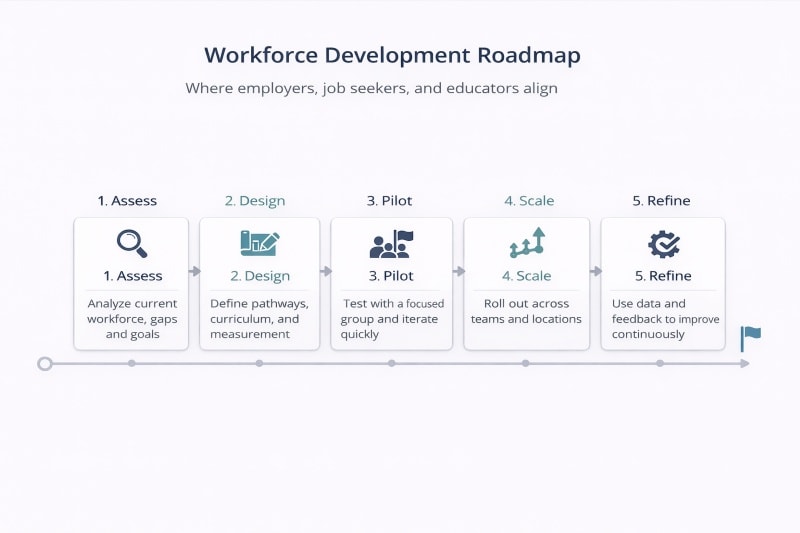
- Linking development initiatives to specific strategic moves such as new product launches, market entries, or digital transformations
- Aligning workforce development with succession planning and critical role coverage
- Clarifying governance between HR, L&D, and business leaders
When executives see workforce development as a core strategy lever rather than a cost item, investment decisions and participation rates both improve.
Partnering With External Stakeholders For Workforce Development
Education Providers, Apprenticeships, And Training Partners
Not every capability needs to be built in-house. Universities, colleges, and vocational institutions can be strong partners if expectations are clear.
Effective collaboration often includes:
- Co-designing curricula that reflect current industry tools and practices
- Offering apprenticeships or cooperative programs that rotate learners through your teams
- Aligning assessment standards with what “job ready” means for your organization
This allows you to influence the quality of graduates and reduces onboarding time.
Public Programs, Industry Bodies, And Local Ecosystems
Public workforce systems and sector bodies are underused resources for many mid-sized employers.
You can:
- Access local labor market data to understand supply, demand, and wage trends
- Participate in sector councils that shape training priorities
- Tap into existing programs for youth, veterans, or displaced workers instead of building dedicated pipelines from scratch
The goal is not to outsource your entire workforce strategy. It is to integrate your organization into a broader ecosystem that shares risk, cost, and learning.
Engaging Employers And Managers: The Non Negotiable Success Factor
Turning Managers Into Talent Developers, Not Just “People Owners”
Every workforce development initiative ultimately lives or dies with managers.
Gallup data shows that managers account for a large share of the variance in team engagement. If managers do not coach, feedback, and support development, even well designed programs stall.
Core expectations for managers should include:
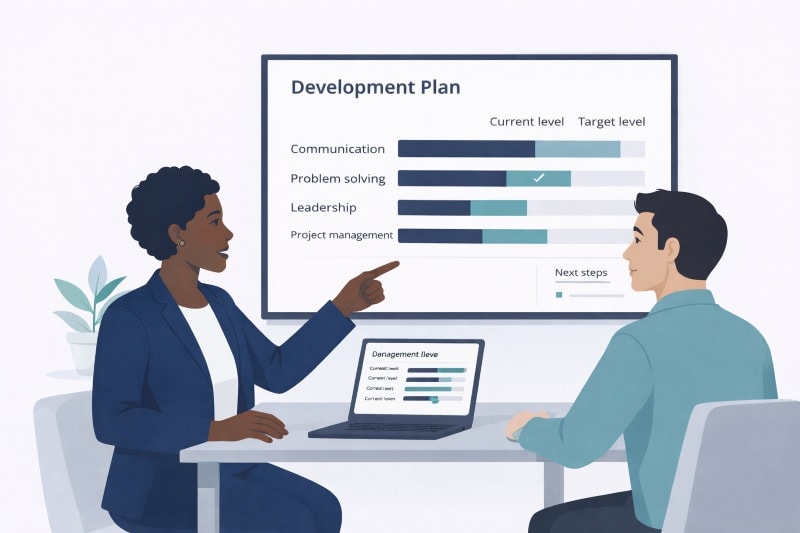
- Regular development conversations that go beyond performance ratings
- Coaching on applying new skills in real work
- Identifying stretch assignments that expand capability without overwhelming people
These responsibilities need to be backed by training, time, and recognition in performance management.
Embedding Workforce Development In Culture And Daily Work
Culture determines whether learning is a sanctioned activity or something employees must squeeze in around “real work.”
Signals that support workforce development include:
- Leaders actively participating in learning, not just sponsoring programs
- Protecting time for development and experimentation in team schedules
- Treating well designed failures as learning, not career risk
Without these cultural supports, even generous training budgets produce limited impact.
Measuring The Impact Of Workforce Development
Core KPIs Every HR Leader Should Track
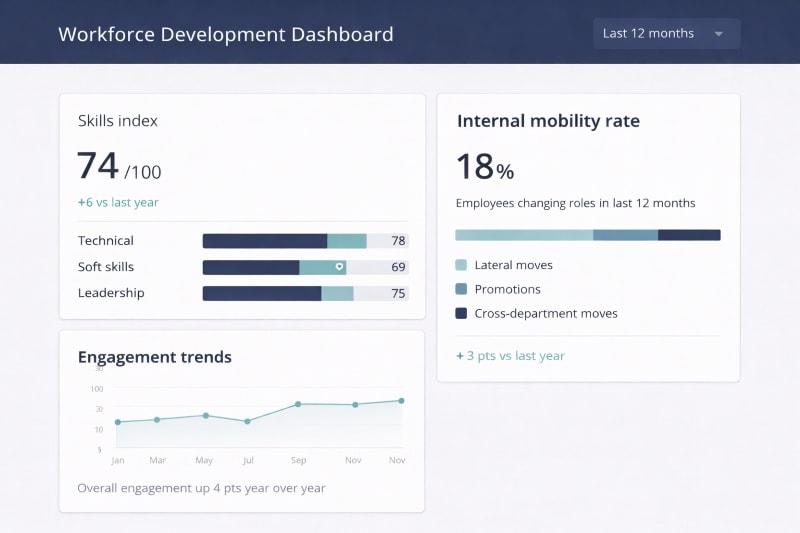
Measurement should balance talent and business outcomes. Useful metrics include:
- Time to productivity for new hires in key roles
- Retention and internal mobility rates for program participants
- Promotion rates by pathway and demographic group
- Business outcomes such as productivity, quality, customer satisfaction, or safety in teams that participate in workforce programs
These indicators should be tracked over time, not just in annual snapshots.
Leading Indicators, Not Just Lagging Outcomes
Lagging indicators such as turnover or revenue impact are important but slow. Leading indicators provide earlier feedback.
Examples:
- Participation and completion rates for learning journeys
- Skill assessment results before and after development interventions
- Manager quality scores, especially around coaching and feedback
- Engagement scores within units that are piloting new workforce programs
Linking these dashboards to executive reviews keeps workforce development on the agenda rather than in the background.
Common Pitfalls That Undermine Workforce Development Programs
Activity Without Strategy
Many organizations fall into the trap of measuring inputs rather than outcomes. For example:
- Counting training hours without knowing whether capability improved
- Launching new programs each year without retiring ineffective ones
- Offering the same development menu to all employees regardless of role or potential
A clear line of sight from strategic goals to specific workforce outcomes is the antidote.
Ignoring Behavior And Fit
Technical skills matter, but they are not enough. Misalignment in work style, pace, or decision making can derail performance and team dynamics even when skills are present.
Without good behavioral data, organizations risk:
- Promoting people into leadership roles they are not suited for
- Placing detail focused people in ambiguous, fast changing environments, or the reverse
- Misreading performance issues that are really fit issues
This is where behavioral assessments add precision that CVs and interviews alone cannot provide.
Fragmented Ownership And Poor Collaboration
Workforce development often spans HR, L&D, DEI, and multiple business units. Without clear ownership, programs fragment. Partnerships with external organizations can also suffer if missions and incentives are misaligned.
To avoid this:
- Assign clear executive ownership
- Define roles and decision rights across internal stakeholders and partners
- Establish simple governance and feedback loops so programs can adapt rather than ossify
Where Behavioral Science And OAD Fit Into Workforce Development
Using Assessments To Inform Hiring, Development, And Placement
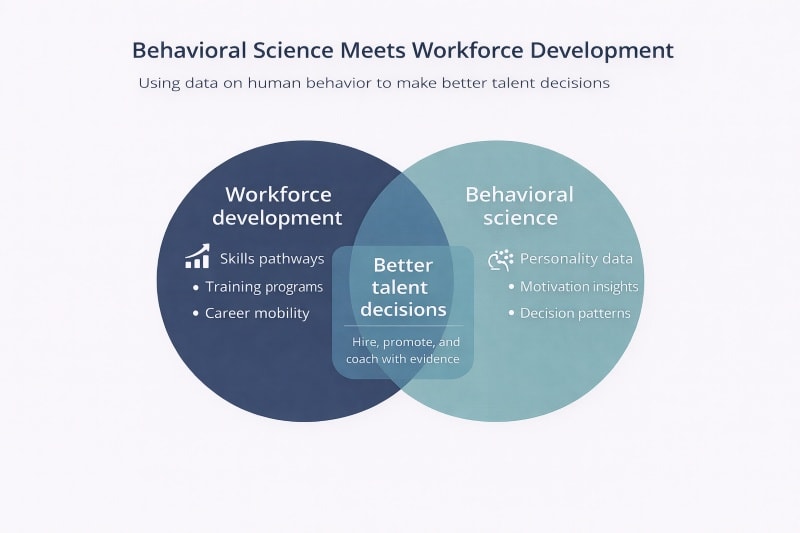
Workforce development works best when it is informed by data on how people actually behave at work.
OAD’s scientifically validated assessments help organizations understand:
- Natural work styles and motivational drivers
- Likely strengths and risk areas in specific roles
- How individuals will interact within teams and under pressure
This insight supports better hiring decisions and more targeted development plans.
Design teams with data, not gut feel.
Most org-design decisions come down to role fit, leadership style, and team dynamics. OAD reads those signals from a 7-minute behavioral survey, so you can reconfigure roles and teams with evidence instead of guesswork.
Designing More Targeted, Cost-Effective Workforce Development Programs
Behavioral data makes it possible to segment your workforce intelligently. Instead of sending everyone through the same generic programs, you can:
- Prioritize development for roles and individuals with highest leverage
- Match people to learning that addresses their specific behavioral patterns
- Reduce wasted training spend on interventions that do not fit how people actually work
McKinsey and others have shown that organizations investing in structured reskilling and upskilling are more likely to report successful transformations. Behavioral insight improves the precision of those investments.
Practical Use Cases For Mid-Sized And Larger Companies
Typical applications for organizations with 50 or more employees include:
- Building front line leadership pipelines that can scale with growth
- Stabilizing high turnover roles by aligning selection and development with behavioral fit
- Supporting rapid expansion or restructuring by aligning people, roles, and teams to new strategies
In each case, OAD gives leaders a clearer map of their workforce so workforce development decisions are less about intuition and more about evidence.
The Future Of Workforce Development
From Jobs To Skills And Capabilities
Organizations are gradually shifting from rigid job structures to more flexible, skills based models. Instead of asking “Who fits this job?” the question becomes “Which capabilities do we need for this work and where do we already have them?”
This has implications for:
- Job architecture and grading
- Pay structures and career progression
- Internal talent marketplaces that match work with skills in near real time
Workforce development is the mechanism that keeps this system supplied with the capabilities it needs.
AI, Automation, And Continuous Reskilling
AI and automation will continue to reshape task requirements rather than simply remove jobs. The Future of Jobs data suggests that skills disruption is significant but manageable if organizations invest in continuous learning and reskilling.
Technical skills are only one part of the picture. Demand is also rising for social, emotional, and advanced cognitive skills that are harder to automate.
Workforce development strategies need to anticipate this blend instead of chasing last year’s technical buzzwords.
Building A Workforce Development Strategy That Survives The Next Decade
Sustainable workforce development strategies share a few traits:
- They are anchored in clear business outcomes
- They are informed by data on skills, behavior, and performance
- They combine internal programs with external partnerships
- They treat managers as central to development, not an afterthought
These principles hold regardless of sector or geography.
Conclusion: Turning Workforce Development Into A Competitive Advantage
Workforce development is no longer a side project for HR. It is a core capability for any organization that wants to execute strategy, adapt to change, and retain good people in a difficult labor market.
The organizations that will win are those that:
- Know which capabilities matter most
- Invest in building them systematically
- Use data, not guesswork, to align people with roles and development pathways
If you want to see how behavioral data can sharpen your workforce development strategy, you can start with the free Top Performer Profile and explore how our assessments support better hiring, development, and talent deployment decisions across your organization.