High turnover of staff is more than an HR headache; it is a strategic risk that affects performance, culture, and long term growth. In this article, we break down what employee turnover is, how to calculate and interpret your turnover rate, and which factors most often drive people to leave. You will also learn practical, data driven strategies HR leaders can use to reduce unnecessary turnover and build a more stable, engaged workforce.
Why the Turnover of Staff Is a Strategic Risk
Employee turnover is not just an HR metric. The turnover of staff affects customer experience, institutional knowledge, innovation, and ultimately profitability. When too many employees leave in a short period, leaders see it in missed deadlines, increased errors, and an overworked core of remaining employees who are close to burnout. This situation significantly increases the risk of employee burnout, a major consequence of high turnover that can further impact workforce well-being if not addressed through proactive strategies.
High employee turnover is often a symptom of deeper issues. It can signal misaligned expectations in the hiring process, weak people management, poor career development, or a company culture that does not support a healthy work life balance. Even when the job market is tight, employees leave if staying feels too costly to their health, growth, or values.
At the same time, not all turnover of staff is harmful. Some level of employee turnover is normal and can even be healthy. The goal for HR leaders is not to drive turnover to zero, but to understand what drives it, measure it properly, and take intentional steps to improve employee retention where it matters most.
What Is Employee Turnover, Really
Employee turnover refers to the rate at which employees leave an organization within a specific period and need to be replaced. The terms turnover of staff, employee turnover, and staff turnover are usually used interchangeably in HR reporting.
A key distinction is between voluntary and involuntary turnover:
- Voluntary turnover happens when employees leave by choice, for example to take a new job, return to school, or because they are dissatisfied with their current role or company.
- Involuntary turnover happens when the organization ends the employment relationship, for example due to poor performance, restructuring, or redundancy.
Employee turnover measures are key metrics for understanding workforce health, as they help organizations assess the stability of their teams and the effectiveness of retention strategies.
Both types matter for understanding the health of your workforce. High voluntary turnover often points to issues with employee satisfaction, engagement, or career development. High involuntary turnover can signal weak hiring processes, unclear job expectations, or inconsistent performance management.
What counts as healthy turnover will differ by industry. For example, professional services firms often accept lower turnover as they depend heavily on institutional knowledge and long client relationships. Food services and some government jobs may naturally see higher annual turnover rates, often due to seasonal work, entry level positions, or rigid pay structures. The important step is to understand your context and define what a realistic and sustainable employee turnover rate looks like for your business. To do this effectively, it is essential to measure turnover regularly so you can track trends, identify patterns, and inform HR decisions.
How To Calculate Turnover of Staff
Many organizations talk about high turnover, but fewer calculate employee turnover rate consistently. Accurately calculating turnover is essential for assessing attrition within specific teams or departments and ensuring leadership has a clear understanding of workforce trends. Without a shared formula, it is easy to misinterpret trends or mislead leadership.
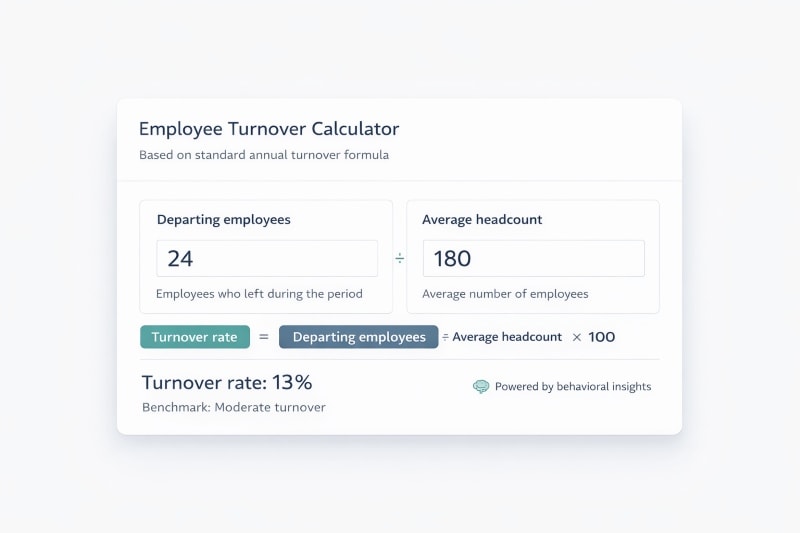
A common employee turnover formula is:
Learn more about Organization Analysis & Design (OAD).
Employee turnover rate = (Number of employees who departed during a specific period) ÷ [(Headcount at the beginning of the period + headcount at the end of the period) ÷ 2] × 100
This uses the average number of employees in the period, rather than a single snapshot, which creates a more accurate measure of turnover.
To calculate employee turnover rate:
- Choose the specific period you want to measure, such as a month, quarter, or year.
- Count the number of departing employees during that period. You can choose to include only voluntary turnover, only involuntary turnover, or all departures.
- Add the headcount at the beginning of the period to the headcount at the end of the period and divide by two to get the average number of employees.
- Divide the number of departing employees by the average number of employees and multiply by 100.
You can repeat this calculation for the total workforce, for specific departments, for new hires in their first year, or for critical roles. Over time, these numbers help HR professionals identify trends, hotspots, and the impact of new retention strategies.
What Is a Healthy Turnover Rate
There is no single healthy turnover rate that applies to every organization. Industry average benchmarks can provide a starting point, but context is critical. A 15 percent annual turnover rate may be problematic for a small professional services firm, but entirely normal for a large retail or food services employer. Comparing your turnover of staff to the employee retention rate in your industry helps assess organizational stability and employee satisfaction, and can reveal whether your retention strategies are effective.
Extremely low turnover of staff is not automatically good news. It can signal stagnation, lack of fresh perspectives, or employees who stay because they feel stuck rather than engaged. On the other side, high turnover creates visible cost and disruption, but it can also serve a purpose when it is driven by intentional performance management and better hiring decisions.
To define a healthy turnover rate for your organization, consider:
- Your industry and typical market benchmarks
- The nature of your roles and how quickly skills become outdated
- The importance of long term relationships and institutional knowledge
- The average tenure you need to recoup hiring and training costs
Healthy turnover is ultimately the rate at which you can maintain a productive workforce, protect institutional knowledge, and still allow for growth, mobility, and new talent.
Causes of High Turnover of Staff
High turnover of staff rarely comes down to a single factor. It is usually the result of several unresolved issues that accumulate over time.
Common causes of employee turnover include:
Poor management and unclear expectationsEmployees often leave managers, not companies. Poor management, inconsistent feedback, and unclear job expectations create frustration and confusion. When employees do not know what success looks like, poor performance and voluntary turnover are both more likely.
Compensation and benefits that are not competitiveIf salaries and benefits lag behind the market, especially in high demand roles, employees leave when a better offer appears. This is particularly visible in professional services and technical roles, where competitive salaries and benefits are expected basics.
Lack of career development and advancementA lack of career development opportunities is a key factor in employee retention. Employees who see no career growth or development opportunities start looking elsewhere. A lack of internal mobility, training, and stretch assignments directly weakens employee retention.
Weak company culture and negative work environmentToxic teams, unclear values, or a culture that tolerates poor behavior drive engaged employees away. A culture that does not support a healthy work life balance quickly leads to burnout and disengagement. A positive work environment and support for work-life balance contribute to higher job satisfaction, which helps retain employees.
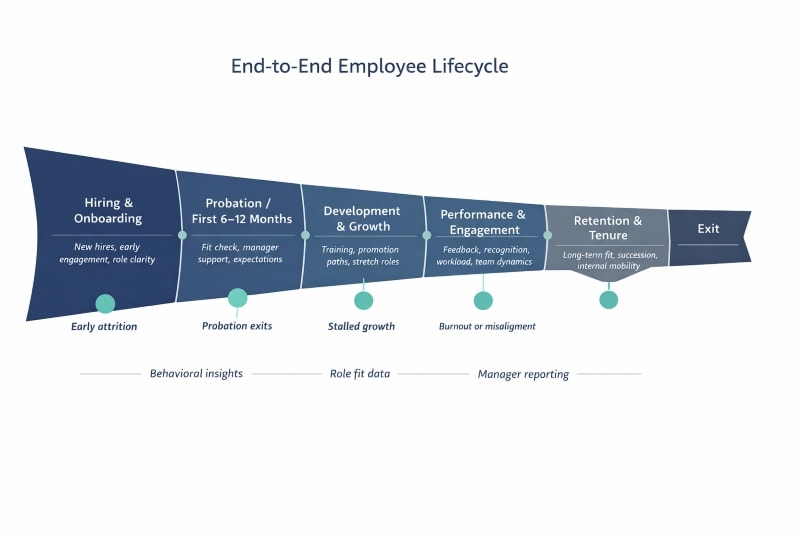
Hiring and onboarding misstepsIf the hiring process oversells the role or fails to screen for fit, new employees arrive with the wrong expectations. Weak onboarding processes then compound the problem, leaving new hires uncertain and disconnected. Early turnover among new employees is a common result.
Understanding which of these causes plays the biggest role in your organization is the starting point for effective retention strategies.

Consequences of High Employee Turnover
High employee turnover is expensive, and not only because of hiring costs.
Direct costs include:
- Recruitment spend for job advertising and agency fees
- Time spent by HR professionals and hiring managers in the hiring process
- Onboarding and training costs for new hires
Indirect costs often have a larger impact:
- Lost productivity while roles are vacant or covered by temporary staff
- Lower employee morale among remaining employees who absorb extra work
- Increased errors, missed opportunities, and slower decision making
Over time, frequent employee departures can erode institutional knowledge, weaken client relationships, and undermine the reputation of the company as an employer. Teams expend energy on constant replacement instead of innovation and improvement. Losing employees frequently can disrupt operations and increase costs, making it harder for organizations to maintain momentum and achieve their goals.
For HR leaders and executives, the real cost is not just the turnover of staff itself, but the lost potential of a stable, engaged, and productive workforce.
The True Cost of Employee Turnover
Employee turnover isn’t just another line item — it’s the silent force that can make or break organizational success. The true cost extends far beyond what appears on financial statements. Direct expenses hit immediately: advertising vacant roles, agency partnerships, interview investments, and comprehensive onboarding initiatives. But the hidden impact cuts deeper — productivity vanishes as positions remain unfilled, team morale fractures under increased pressure, and institutional knowledge walks out the door with each departure.
Research reveals a stark reality: replacing talent costs between 16% and 213% of annual compensation, escalating dramatically for specialized roles and leadership positions. Factor in ramp-up time for new hires to reach peak performance, and these numbers become transformational business challenges. High turnover doesn’t just disrupt workflow — it derails projects, compromises customer relationships, and creates cascading operational failures that ripple through entire organizations.
The numbers tell one story, but the human cost reveals another. Frequent departures don’t just affect spreadsheets — they erode the foundation of workplace culture itself. Remaining team members face mounting stress, accelerated burnout, and declining engagement, fueling an endless cycle of departure and replacement. Forward-thinking organizations understand this dynamic and engineer retention through strategic employee recognition, targeted career development, and meaningful growth pathways. This isn’t just about reducing costs — it’s about building resilient, engaged teams that drive sustainable success. When companies achieve this alignment, they don’t just save money. They create environments where talent thrives, productivity soars, and long-term business success becomes inevitable.
Diagnosing Your Turnover Problem With Data
Many organizations treat turnover as a headline number. To reduce employee turnover in a meaningful way, you need to move beyond a single annual turnover rate and work with more detailed turnover data.
Start by separating:
- Voluntary and involuntary turnover
- Turnover within the first 12 months vs later tenure
- Turnover in critical roles vs support roles
Next, segment your turnover of staff by:
- Department or business unit
- Location or site
- Manager
- Role family or job level
Patterns tend to reveal themselves quickly. Perhaps voluntary turnover spikes under specific managers, or first year turnover is high in a particular job family. These patterns point to different root causes and require different responses.
AI and HR analytics tools can help by spotting combinations of factors that predict employee departures, such as low employee engagement scores, low promotion rates, or certain manager behaviors. Collecting feedback through employee surveys to track employee happiness can also help identify areas for improvement and guide targeted actions to boost retention. However, tools are only useful if HR leaders are ready to act on what the data shows.

Industry Comparison: How Does Your Turnover Stack Up?
Employee turnover rates tell one story — but industry benchmarks reveal the truth behind the numbers. Understanding where you stand isn’t just helpful data; it’s the foundation of effective retention strategy. Turnover varies dramatically across sectors, and for good reason. Hospitality and retail face the reality of higher annual rates — part-time roles, seasonal demands, and entry-level positions create natural movement. Finance, government, and professional services operate differently. These sectors demand specialized skills and offer stable career trajectories, naturally driving lower turnover rates.
Benchmarking against similar organizations transforms raw data into actionable insight. When your turnover significantly exceeds industry averages, the numbers speak clearly — something’s broken. Employee satisfaction, work life balance, or growth opportunities aren’t meeting expectations. But here’s the flip side: rates below industry norms might seem ideal, yet they can mask stagnation. Low turnover without advancement signals a different kind of problem.
Smart HR professionals don’t just collect this data — they weaponize it. These insights become the blueprint for targeted retention strategies. Enhanced recognition programs. Competitive salary adjustments. Strategic career development investments. The key lies in digging deeper: analyze turnover by department, role, and tenure. Measure employee satisfaction continuously. Track progress relentlessly. This granular approach pinpoints exactly where intervention matters most.
Industry benchmarks don’t just inform decisions — they empower transformation. When you understand your competitive position, you can engineer solutions that reduce turnover, strengthen work life balance, and build genuinely productive workforces. Organizations that master targeted retention don’t just keep people. They create environments where talent chooses to stay, grow, and contribute to something bigger than individual roles.
Core Strategies To Reduce Turnover of Staff
Once you understand the causes and patterns, you can implement targeted strategies to reduce turnover. The ultimate goal is to minimize turnover by adopting effective retention practices such as competitive compensation, positive work culture, and ongoing development opportunities.
Strengthen the basicsReview pay structures and benefits against the market. If your salaries and benefits are significantly below industry average, retention strategies will struggle to compensate. Competitive salaries are the baseline for retaining employees in most markets.
Improve job design and expectationsClarify responsibilities, performance standards, and decision rights. Realistic job previews during hiring and well written job descriptions reduce the risk of surprises that lead to early exits.
Invest in employee engagement and employee experienceRegular check ins, listening sessions, and pulse surveys help HR professionals understand what employees need. Acting on this feedback is critical for improving employee satisfaction and engagement. It’s also essential to prioritize employee recognition, as recognition programs are a key driver of morale and retention.
Support a healthier work life balanceReview workloads, meeting culture, and availability expectations. Flexible work policies, thoughtful scheduling, and respect for non working time are practical levers for reducing burnout.
Reducing employee turnover is not a single initiative. It is a sustained effort to improve how people experience work in your organization.
Career Development, Growth, and Retention
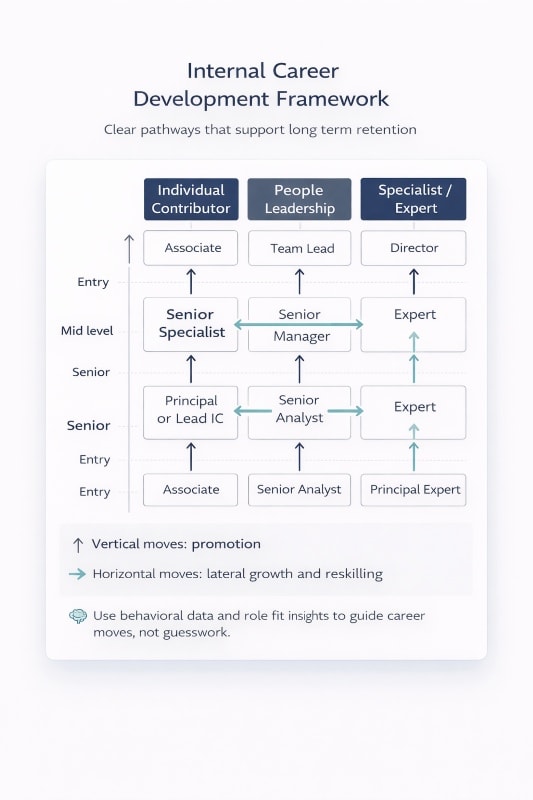
Career development is one of the strongest predictors of employee retention. When employees see clear career paths and growth and development opportunities, they are less likely to leave, even if competing offers exist.
Effective career development strategies include:
- Clear internal career paths and role frameworks
- Mentorship and coaching programs
- Access to learning resources, courses, and certifications
- Stretch assignments and project work that build skills
Managers play a central role. They need to discuss career growth regularly, not only during annual reviews. Employees who understand what skills they need for the next step and see support to get there are more likely to stay and contribute.
Organizations that treat career development as an ongoing conversation, not a formality, typically see higher employee retention rates and stronger internal pipelines for critical roles.
Employee Recognition and Everyday Motivation
Employee recognition is one of the most cost effective ways to improve employee morale, engagement, and retention. Employees want to know that their efforts and results matter.
Recognition can be:
- Public or private
- Monetary or non monetary
- Formal programs or informal appreciation
What matters most is that recognition is specific, timely, and linked to behaviors and outcomes that support the company’s values and goals. Recognizing employees for collaboration, problem solving, or exceptional service reinforces what the organization wants more of.
When recognition is missing, engaged employees often feel taken for granted. Over time, this can push them to become disengaged or to explore other opportunities. Prioritizing employee recognition can be a simple but powerful part of your retention strategies.
Hiring and Onboarding That Reduce Employee Turnover
Retention does not start after the first performance review. It begins during the hiring process.
High quality hiring and onboarding reduce employee turnover by:
- Setting realistic expectations about the role, workload, and company culture
- Screening for both skills and behavioral fit
- Providing new employees with the resources and relationships they need to succeed
A robust onboarding program typically includes structured training, introductions to key stakeholders, clear early goals, and regular check ins during the first months. New hires who feel lost or unsupported are more likely to leave within the first year, which is often the most expensive time to lose them.
Clear job expectations and strong onboarding processes are critical to build a foundation for long term retention.

Company Culture, Work Environment, and Retention
Company culture shapes the daily experience of employees. It influences how people communicate, make decisions, handle conflict, and balance work and life.
Elements of a culture that retain employees include:
- Psychological safety and open communication
- Consistent and fair management practices
- Respect for personal boundaries and non working time
- Inclusive decision making where voices are heard
The way culture is expressed can differ across sectors. In professional services, long hours may be common, but sustainable firms pair this with meaningful autonomy and career advancement opportunities. In food services, scheduling practices and supervisor behavior have a strong effect on turnover. In government jobs, rigid structures can be balanced with clarity, stability, and purpose.
A more positive work environment is rarely the result of a slogan. It requires practical habits and systems that consistently support how people work together.
Using Talent Assessments To Improve Employee Retention
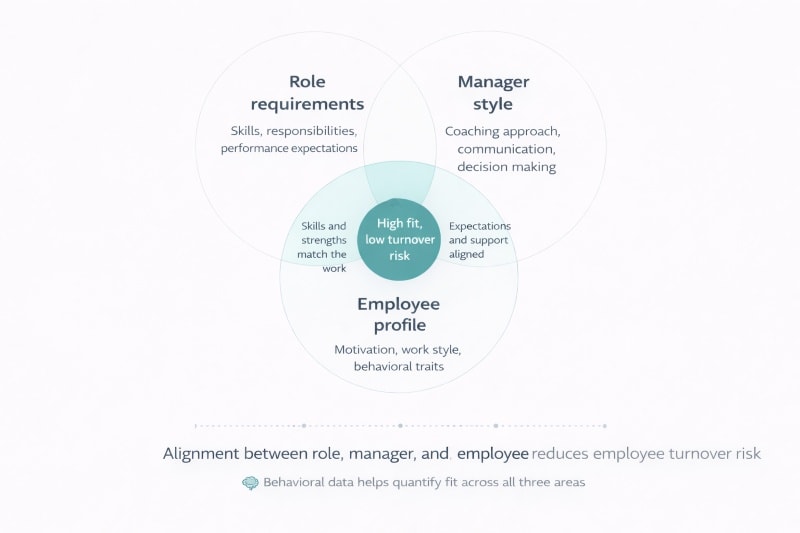
A major driver of turnover of staff is misalignment between the person, the role, and the manager. Even highly skilled people will struggle and eventually leave if the behavioral demands of their job do not match how they naturally work.
Scientifically validated talent assessments help organizations:
- Clarify the behavioral requirements of a role
- Understand the natural work style and motivators of candidates and employees
- Predict where friction, poor performance, or disengagement are likely
OAD is a personality and talent assessment that gives HR leaders and managers clear, practical insights into how people prefer to work, make decisions, and communicate. When you use this type of data during hiring and internal mobility decisions, you reduce the chance of placing someone in a role where they are likely to struggle and leave.
Design teams with data, not gut feel.
Most org-design decisions come down to role fit, leadership style, and team dynamics. OAD reads those signals from a 7-minute behavioral survey, so you can reconfigure roles and teams with evidence instead of guesswork.
For example, a team with high turnover in a particular role may discover, through OAD data, that successful incumbents share certain behavioral patterns that differ from those of frequent leavers. Adjusting the hiring profile and development approach accordingly can improve both performance and retention.
Building a Practical Retention Framework
To move from reactive fixes to a more systemic approach, HR leaders need a practical retention framework that combines metrics with action.
Key turnover measures include:
- Overall employee turnover rate and staff turnover by segment
- Voluntary and involuntary turnover percentages
- Retention rate for critical roles and high performers
- Average tenure by role, department, and manager
Leading indicators include employee engagement scores, burnout signals, internal mobility rates, and promotion patterns. Lagging indicators include employee departures and cost of turnover.
Responsibility for retention should be shared. HR can provide data, tools, and guidance. Managers own the day to day employee experience and performance management. Senior leadership sets priorities and allocates resources to address root causes.
A simple retention framework, reviewed regularly, helps everyone stay focused on the same goal: a healthy, productive workforce that is not constantly disrupted by unnecessary turnover.
Action Plan for HR Leaders and Executives
Reducing the turnover of staff is complex, but action can start quickly.
In the next 30 days, HR leaders can:
- Clarify how turnover is measured and standardize the employee turnover formula
- Segment turnover data to identify the biggest hotspots
- Start structured interviews or surveys with departing employees to deepen understanding
Over the next 90 days, organizations can:
- Address obvious pay or benefits gaps in critical roles
- Strengthen onboarding processes where first year turnover is high
- Train managers in basic coaching, feedback, and recognition practices
Over 12 months, companies can:
- Build out clear career development frameworks and internal mobility paths
- Integrate talent assessments, such as OAD, into hiring and promotion decisions
- Review workload and work design to reduce burnout and support a more positive work environment
Executives should expect regular reporting on both turnover data and the impact of specific retention strategies. Connecting these results to cost savings and performance outcomes keeps turnover reduction on the leadership agenda.
Design teams with data, not gut feel.
Most org-design decisions come down to role fit, leadership style, and team dynamics. OAD reads those signals from a 7-minute behavioral survey, so you can reconfigure roles and teams with evidence instead of guesswork.
Conclusion: From High Turnover to Intentional Retention
The turnover of staff is more than a number in an HR report. It reflects how employees experience their work, their managers, and their future with the organization. High employee turnover damages morale, productivity, and reputation. Healthy turnover, managed intentionally, supports learning, renewal, and long term performance.
Reducing employee turnover means understanding its causes, measuring it correctly, and implementing practical retention strategies across compensation, culture, management, and career development. It also means making better decisions at the hiring stage, so that employees are set up to succeed from day one.
Tools like OAD give HR professionals and leaders a clearer view of person role fit and manager team dynamics. When you combine this kind of behavioral insight with solid HR fundamentals, you get a more stable, engaged, and productive workforce.
If you want to see where your own turnover risks may be hiding, you can start with the free Top Performer Profile and explore how data driven insights support better hiring and higher employee retention.