HR leaders talk about being “data driven”, yet many critical people decisions are still based on gut feel and internal politics. This article walks through five concrete data driven decision making examples that show how to use HR and business data to improve hiring quality, reduce turnover, and plan your workforce more strategically. Use it as a practical reference when you want to move beyond dashboards and translate analytics into everyday HR decisions.
Data Driven Decision Making Examples: Why HR Needs It Now
Most HR leaders say they want to be “data driven”, yet many important people decisions are still made by gut feeling and internal politics. Overcoming reliance on intuition is a significant challenge for many HR teams. That sometimes works when teams are small and change is slow. It fails once you pass 50 employees and complexity increases.
Data driven decision making gives HR a way to back up recommendations with evidence. Instead of debating whose anecdote is more convincing, you start from relevant data, clear key performance indicators, and a repeatable decision making process. Aligning HR decisions with broader business objectives ensures that data-driven actions support the company’s overall goals.
Used well, data analytics in HR improves hiring quality, reduces turnover, and exposes performance issues before they become costly. The five examples in this article show how to move from theory to practice.
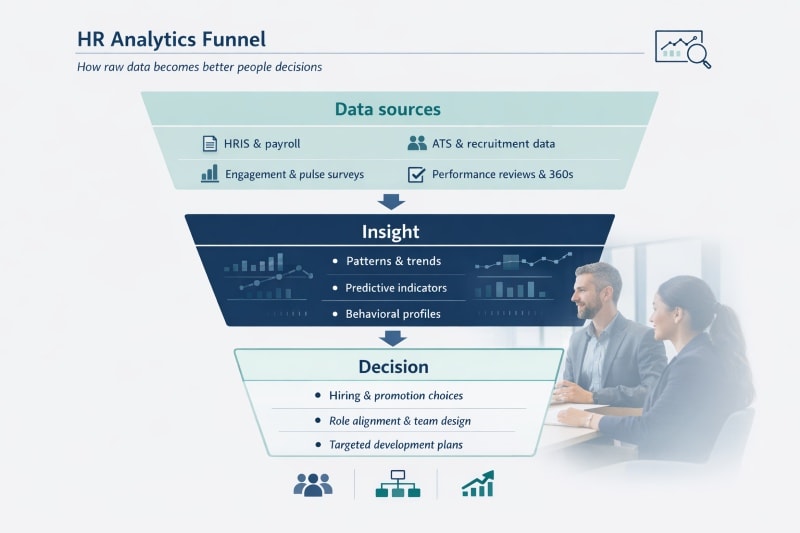
What Is Data Driven Decision Making in HR?
Data driven decision making uses data analysis to inform business decisions instead of relying primarily on intuition or habit. For HR, that means using data from your HRIS, ATS, performance systems, and employee feedback tools to guide hiring, promotion, pay, and workforce planning decisions. Integrating data-driven decision making into HR business processes leads to more efficient and effective outcomes.
Typical HR data sources
Typical HR data sources include historical data on hiring and turnover, performance and productivity metrics, engagement and pulse surveys, customer surveys, and customer satisfaction where roles are customer facing. The goal is not to replace human judgment, but to ground that judgment in facts rather than assumptions.
The Key Steps In A Data Driven Decision Making Process
A repeatable process matters more than sophisticated tools. Even basic spreadsheets and simple dashboards can support high quality decisions if the process is disciplined and consistent. Statistical analysis is a key component of extracting actionable insights from HR data, helping to identify patterns and trends that inform better decision-making.
Step 1: Define the business question and success metrics
Instead of saying “We need more data”, define questions such as “How can we reduce early turnover in sales by 20 percent within 12 months”. That instantly narrows the necessary data and clarifies which key performance indicators matter. Techniques from market research can help HR teams frame effective questions and identify the most relevant metrics for analysis.
Step 2: Gather, clean, and analyze the necessary data
Identify data sources that relate to your question, such as HR data, financial data, and sometimes customer data. Check data quality before analysis. Analyzing data at this stage helps uncover trends and patterns that inform decision making. Once data is trustworthy, use descriptive statistics, simple trend lines, or predictive analytics to identify patterns, then turn those insights into specific actions and monitor results. Interpreting data accurately is essential to ensure that the resulting actions are based on sound evidence.
Data Driven Culture: Embedding Analytics in Everyday HR
Building a data-driven culture in HR isn’t just an option — it’s the foundation upon which modern human resources either thrives or becomes obsolete. Organizations that embrace this transformation discover something powerful: when data flows through every decision, strategic initiatives ignite naturally, and operational efficiency doesn’t just improve. It soars.
True data literacy across HR teams operates like oxygen in the bloodstream — essential, life-giving, transformative. When every team member can interpret and wield data effectively, critical thinking becomes instinct rather than effort. Decision quality doesn’t just get better. It becomes sharper, faster, more precise. This isn’t accidental collaboration between data professionals and HR stakeholders — it’s engineered partnership that turns analysis into actionable business intelligence.
Organizations that embed analytics into their daily HR heartbeat unlock something extraordinary: they don’t just reduce costs and improve satisfaction. They evolve. They respond to change with agility that competitors can’t match. By consistently mining insights and acting on data-driven intelligence, HR transforms from support function to strategic powerhouse — driving meaningful change that ripples through every corner of the organization. Because when HR masters the science of people through data, they don’t just make better decisions. They reshape the future of work itself.
Example 1: Improving Hiring Quality With Structured Data
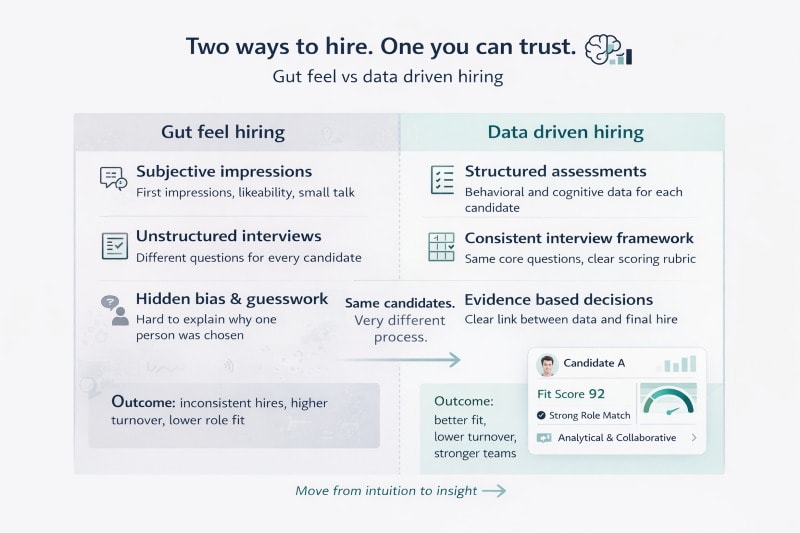
Many organizations experience the same frustration. A candidate looks strong on paper, interviews go smoothly, and then performance in role never matches expectations. Over time this erodes trust in both HR and the hiring process. A business analyst can help design and implement data-driven hiring processes to ensure better alignment between candidate selection and organizational needs.
Data driven approach
A data driven approach starts by defining what “success” actually looks like in a given role, for example 12 month retention, quota attainment, or customer satisfaction scores. Business analytics tools can be used to visualize and analyze hiring data, making it easier to identify which candidate attributes predict long-term success. You then connect those outcomes back to information available during hiring, such as interview scores, work samples, and assessment results, and analyze which signals reliably predict future performance.
OAD adds a layer of behavioral and cognitive data to this picture. Hiring managers see how a candidate’s natural work style aligns with the behavioral demands of the role and the existing team. The combination of job requirements, performance data, and OAD profiles makes hiring decisions more consistent and less dependent on individual bias.
Example 2: Reducing Voluntary Turnover With Predictive Signals
Turnover is one of the most visible and expensive people problems, especially in critical or customer facing roles. Analyzing customer behavior data can help HR understand the challenges faced by employees in these roles and develop targeted retention strategies. Many organizations still treat it as an unavoidable cost of doing business rather than something that can be predicted and influenced.
Data driven approach
A data driven approach starts by separating turnover into meaningful segments. You look at voluntary versus involuntary exits, tenure bands, critical roles, locations, and managers. Then you layer in additional data such as engagement scores, internal mobility, pay ranges, and themes from exit interviews to see where risk is concentrated.
OAD data strengthens this analysis by showing where people are misaligned with their roles or managers at a behavioral level. When you know which behavioral profiles tend to leave quickly in certain roles, you can refine hiring criteria, onboarding, and coaching strategies before turnover spikes. There are real-world examples of companies that have successfully reduced turnover by applying data-driven analysis to their HR processes.
Design teams with data, not gut feel.
Most org-design decisions come down to role fit, leadership style, and team dynamics. OAD reads those signals from a 7-minute behavioral survey, so you can reconfigure roles and teams with evidence instead of guesswork.
Example 3: Workforce Planning That Matches Strategy, Not Just Budget
Workforce planning often happens as a spreadsheet exercise shortly before the budgeting cycle. Hiring managers submit headcount requests, finance pushes back, and HR is caught in the middle without a clear view of long term capability needs. Effective workforce planning must be closely aligned with the organization’s business strategies to ensure the right talent is in place to achieve strategic goals.
Data driven approach
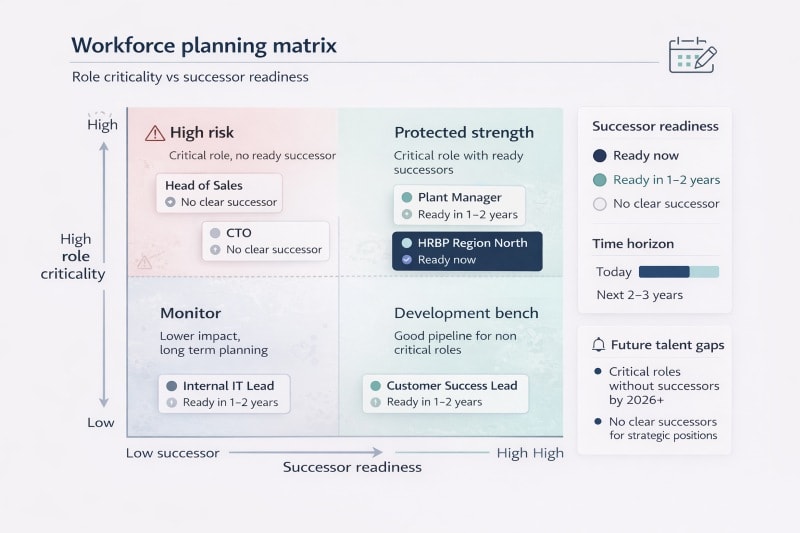
Data driven workforce planning starts earlier and goes deeper. You map the current workforce by role, skill, performance, and potential, then compare this to the organization’s strategic plan for the next 12 to 36 months. Historical hiring volumes, promotion rates, internal mobility, and time to fill critical roles all inform that view.
Scenario planning turns this information into clear options for leadership. You can show what happens to service levels, project delivery, or revenue growth if hiring for key roles is delayed, reduced, or accelerated. OAD contributes by clarifying where you already have leadership potential and where there are gaps, so workforce plans are based on real talent data rather than titles alone. Data-driven workforce planning can also reveal emerging business opportunities by highlighting skill gaps and potential areas for growth.
Example 4: Making Performance Management More Objective
Performance management is one of the areas where subjective judgment can quietly override data. Ratings drift, standards vary by manager, and high performers sometimes feel invisible when decisions are driven by opinion rather than evidence. Objective, data-driven performance management contributes to greater operational efficiency by ensuring that high performers are recognized and supported.
Data driven approach
A data driven performance process combines quantitative indicators with structured qualitative input. Sales numbers, project delivery metrics, quality measures, and customer satisfaction can all be tracked over time and reviewed in regular check ins, not only once per year. Trend data reveals who consistently delivers, who is improving, and where performance is unstable. By identifying and addressing performance issues early, organizations can minimize costs related to underperformance and turnover.
With OAD, you can go one step further by tailoring development plans to individual behavioral profiles. Two employees may have similar performance metrics yet benefit from very different coaching and communication styles. Behavioral data gives managers a practical guide for how to support each person.
Example 5: Focusing Learning And Development Where It Actually Moves Results
Training programs are easy to launch and hard to evaluate. Many organizations invest heavily in learning and development without a clear line of sight to business outcomes or any real sense of which programs work. By using data driven decision making examples, HR teams can implement strategies tailored to specific skill gaps identified through data analysis to maximize the impact of learning and development programs.
Data driven approach
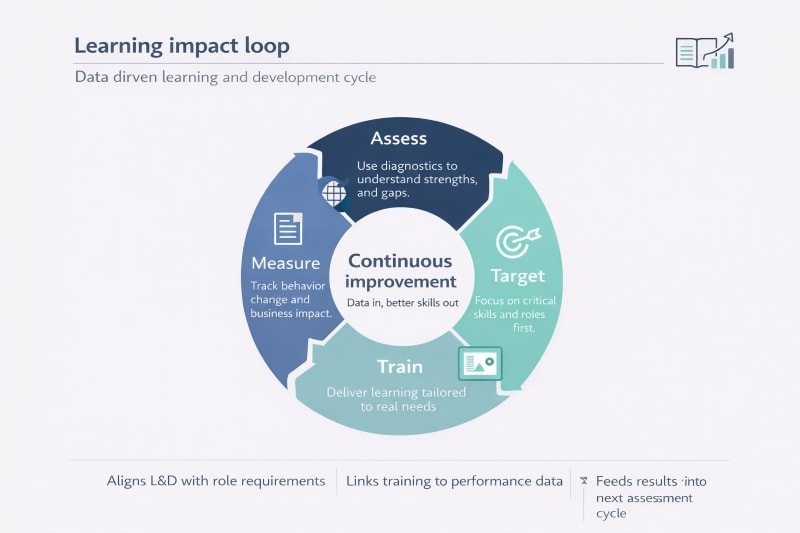
A data driven approach begins with a simple question: which capabilities, if improved, would have the largest impact on the company’s performance. You identify the roles and teams most closely linked to those outcomes, then examine existing data such as assessment results, performance ratings, error rates, or customer feedback to locate specific skill gaps.
When you run pilots, you treat learning and development as an experiment. You define success metrics up front, measure before and after, and compare groups who received the intervention with similar groups who did not. This mirrors how organizations conduct research to evaluate the effectiveness of new programs. OAD supports this process by clarifying how different behavioral profiles respond to particular learning formats, so each training investment is more likely to land.
Data Visualization: Turning Insights Into Action
Modern HR teams rise or fall on one factor: how well they transform raw data into strategic action. Complex datasets may overwhelm, but it’s data visualization that drives meaningful insights. True understanding isn’t accidental — it’s engineered through clear visual representations that reveal patterns, trends, and correlations hiding beneath the surface.
High-performing organizations operate with interactive dashboards that speak directly to stakeholders. They embrace real-time visualizations, welcome emerging data signals, and respond proactively without losing sight of data integrity. In these environments, insights flow freely, strategic decisions emerge naturally, and teams feel connected to something larger than spreadsheets and statistics. Maintaining rigorous data quality throughout collection processes isn’t just best practice — it’s the foundation that ensures every visualization accurately reflects organizational reality.
At the intersection of data and decision-making, visualization empowers HR leaders to bridge the gap between complexity and clarity. These tools transform findings into compelling narratives that drive engagement, spark meaningful conversations, and turn analytical insights into concrete actions. Because improving business performance isn’t just about better data systems — it’s about making that data accessible, understandable, and deeply relevant to strategic growth. And when HR teams achieve that alignment, they don’t just make better decisions. They communicate more effectively, act more decisively, and unlock the full potential of their organizational data.
Building The Foundations: Data Quality And Data Literacy
None of these examples work without trustworthy data. Data quality is a frequent hidden issue in HR systems. Duplicate records, inconsistent coding, and missing values can quietly distort analysis and reduce confidence in data driven decisions. Data scientists play a key role in maintaining data quality and supporting HR teams in developing data literacy.
Improving quality rarely requires new software. It requires clear ownership, agreed definitions, and simple rules for how data is entered and maintained. Regular audits to clean historical data make subsequent reporting and analytics faster and more reliable.
Data literacy is the other half of the foundation.
HR and business leaders need to understand what a metric does and does not say, how to read basic visualizations, and when a pattern is strong enough to inform action. This is not about turning everyone into a data scientist, but about ensuring that decision makers can interpret data without oversimplifying it.
Choosing The Right Tools For Data Driven HR
There is no shortage of HR dashboards and business intelligence tools. The challenge is choosing tools that match your maturity level and priorities rather than chasing every new feature.
For many organizations, the first step is consolidating data in one place and agreeing on a small set of core metrics. Simple reporting on hiring funnel conversion, quality of hire, time to fill, engagement scores, and turnover by segment often reveals more than complex machine learning models. Data-driven tools are also widely used in inventory management to optimize stock levels and reduce costs, showing how these approaches apply across different business functions.
As your data practices mature, you can explore more advanced analytics, such as predictive models for turnover or hiring success. At that stage, collaboration between HR leaders, data analysts, and finance becomes critical. Specialized tools like OAD sit alongside your core analytics stack and provide deeper insight into behavior, motivation, and role fit.
Stakeholder Engagement: Bringing the Organization Along
Data-driven HR decisions succeed or fail on one critical element: stakeholder engagement from day one. When people feel genuinely involved in the decision-making journey, something powerful happens — trust builds, resistance dissolves, and performance indicators transform from abstract numbers into shared victories. This isn’t wishful thinking. It’s the difference between data that sits in reports and insights that drive real change.
Clear communication becomes the bridge between complex analytics and human understanding. HR teams that master this art speak in plain language, weave relatable examples into their presentations, and never assume their audience shares their technical fluency. They invest in building data literacy — not through dry training sessions, but through hands-on experiences that help stakeholders see patterns, question assumptions, and connect decisions to outcomes. When people understand the “why” behind the data, they become partners in the analysis rather than passive recipients of conclusions.
Transparency isn’t just good practice — it’s the foundation of sustainable data culture. Organizations that open their data doors, share regular progress updates, and maintain clear accountability standards don’t just build trust. They create alignment that runs deeper than surface-level buy-in. This collaborative approach transforms decision-making from a top-down directive into a shared journey of discovery, embedding data-driven thinking into the very fabric of how teams operate and grow.
Common Pitfalls In Data Driven Decision Making
Being data driven is not the same as being data obsessed. Several common mistakes can quietly undermine the whole effort and push leaders back toward gut feel.
One pitfall is acting on incomplete or biased data, for example drawing broad conclusions about “what employees want” based only on survey results from one function or location. Another is confusing correlation with causation and assuming that because two trends move together, one must be causing the other. For instance, misinterpreting data can result in marketing campaigns that are based on faulty assumptions, leading to ineffective strategies that fail to achieve the desired outcomes.
A third risk is focusing so heavily on dashboards that you lose sight of the human context. People data always reflects real individuals with histories, ambitions, and constraints. It is often better to have a simple, well understood analysis that leaders trust than a complex model no one can explain.
Continuous Improvement: Evolving Your Data Driven HR Practice
Continuous improvement isn’t just a buzzword — it’s the lifeblood of any HR strategy worth its salt. In today’s volatile business landscape, HR teams either evolve or get left behind. This means relentlessly scrutinizing data quality, embracing cutting-edge analytics tools, and hunting down every opportunity to elevate operational efficiency and customer satisfaction. Excellence isn’t accidental — it’s engineered through disciplined refinement and strategic foresight.
Smart organizations don’t just collect data — they harness its power. Investing in data science, big data analytics, and predictive analytics transforms HR from a support function into a strategic powerhouse. Machine learning models become your crystal ball, revealing hidden workforce patterns and enabling organizations to anticipate challenges before they strike. This isn’t just technology adoption — it’s tactical advantage in human form.
The organizations that thrive don’t just embrace data — they make it flow through every decision. By committing to relentless improvement and staying hungry for innovation, HR teams unlock performance gains that ripple across the entire business. Regular process evolution, technological advancement, and a culture that breathes innovation ensures that data-driven decision making becomes more than a competitive edge — it becomes the foundation of unstoppable organizational success.
How To Get Started With Data Driven HR Decisions
You do not need a fully mature analytics function to benefit from data driven decision making. The most effective HR teams often start with one concrete use case and build from there rather than trying to transform every process at once.
Choose an area where the business already feels pain, such as hiring quality, turnover in a critical role, or inconsistent performance management. Define a clear question, identify the necessary data, and run a pilot that links insights to specific actions and measures outcomes.
Share results using straightforward visuals and language. When leaders see that data driven decisions lead to measurable improvements, support for further investment grows quickly. Over time, you can standardize the steps you used into a repeatable decision making process for other HR challenges.
Where OAD Fits In A Data Driven HR Strategy
OAD provides scientifically validated behavioral and cognitive assessments that help organizations hire, develop, and retain people with greater accuracy. In a data driven HR strategy, this information becomes an additional, high quality data source alongside your existing HR and business data.
By combining OAD profiles with performance, retention, and engagement metrics, you can see not only what top performers achieve, but how they naturally prefer to work, communicate, and make decisions. This helps refine hiring criteria, design roles that fit real people, and build teams with complementary strengths.
Clients use OAD to bring structure and evidence into decisions that were previously based on intuition alone, such as internal promotions, leadership succession, and team design. When behavioral data and business outcomes are analyzed together, patterns emerge that are hard to see through interviews and performance ratings alone.
Design teams with data, not gut feel.
Most org-design decisions come down to role fit, leadership style, and team dynamics. OAD reads those signals from a 7-minute behavioral survey, so you can reconfigure roles and teams with evidence instead of guesswork.
If you want to see how this works with your own data and roles, you can test OAD. Your team can explore sample reports, ask detailed questions, and see how OAD supports data driven decision making across hiring, development, and workforce planning.
Conclusion: Turning Examples Into Everyday Practice
The most successful organizations treat data driven decision making in HR as an ongoing discipline, not a one time initiative. They use data to clarify problems, design targeted interventions, and check whether those interventions actually work in the real world.
The five examples in this article are a practical starting point. Improve hiring quality, reduce turnover, plan your workforce more strategically, make performance management more objective, and focus learning investments where they matter most. Each area creates quick wins and builds confidence in a more analytical way of working.
Over time, the combination of better data, clearer processes, and structured tools like OAD helps HR move from reactive support function to strategic partner. People decisions become more transparent, more consistent, and more closely aligned with the company’s long term objectives.
Start with the free Top Performer Profile: 7 minutes, results in 24 hours, no credit card.