In a world where organizations are flooded with information, the real advantage lies in how effectively they use data to guide decisions. When leaders move from intuition-driven debates to evidence-based choices, they unlock the true advantages of data: clearer priorities, reduced risk, and more consistent performance. This article explores how a data driven approach transforms decision making, operational efficiency, and people decisions across the business.
Advantages of Data as a Strategic Advantage
Most organizations sit on vast amounts of data but still argue decisions in meeting rooms based on gut feeling, seniority, or politics. Reports exist, dashboards exist, yet decision makers—and business leaders who rely on data analytics to guide organizational choices—often cannot answer simple questions like what really drives performance or risk.
Data analysis changes that. When you analyze data systematically, you replace anecdotes with evidence and connect decisions to measurable outcomes such as revenue, productivity, quality, and turnover.
For companies with 50 or more employees, the advantages of data become even more important. As structures grow more complex, intuition alone is no longer enough to steer strategy, manage risk, or keep teams aligned.
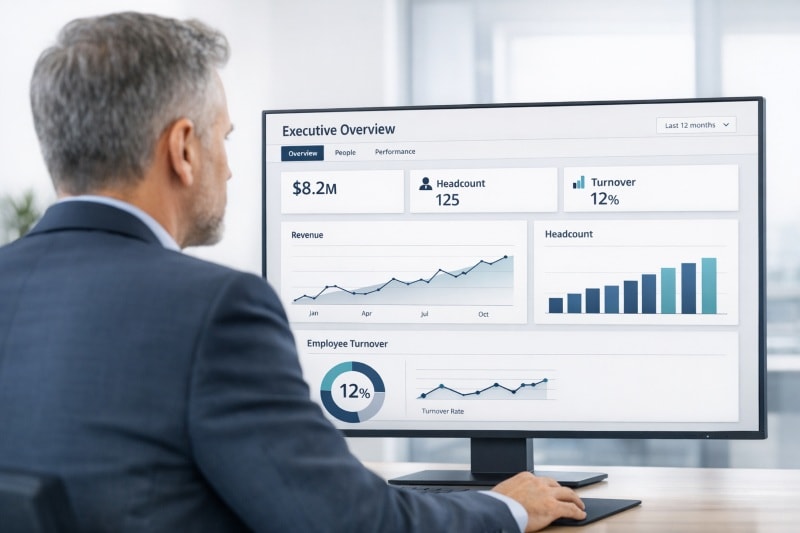
What Do We Mean By Data In Modern Organizations?
In a modern business, “data” is far more than financial results. It includes operational metrics, customer data, people data, market trends, and structured qualitative feedback from surveys or interviews.
Customer data covers buying habits, preferences, and behavior across digital and offline channels. Sales data records what was sold, to whom, at what price, and under which conditions.
People data includes performance indicators, engagement scores, assessment results, promotion history, and turnover rates. Operational data ranges from inventory levels and supply chain metrics to service response times and error rates.
The data collected from these sources forms the foundation for strategic planning and enables organizations to make more informed, effective decisions.
Most organizations already collect all of this. The real question is not whether data exists, but whether it is used in a deliberate, data driven way to improve business decisions and business operations.
From Data To Insights: The Role Of Data Analysis And Data Analytics
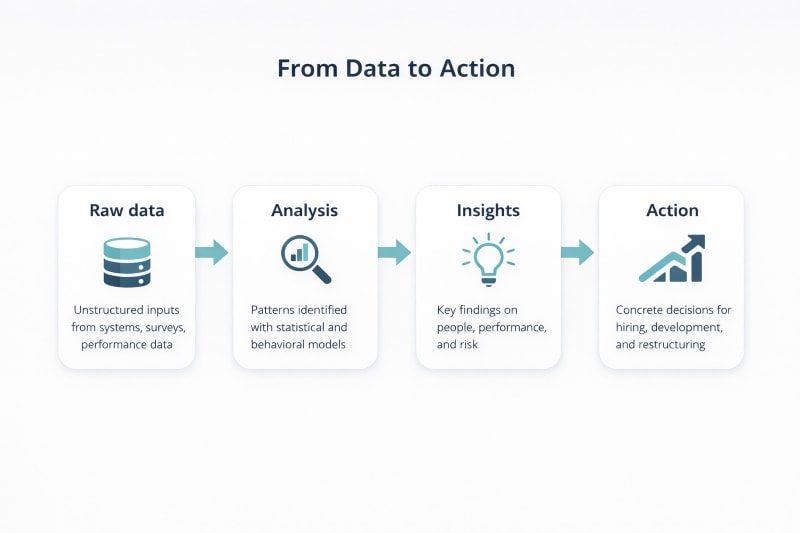
Data analysis is the discipline of examining data points to identify patterns, trends, and relationships. It is the foundation of data driven decision making because it turns raw data into meaningful insights.
Data analytics is the wider process that brings together tools, methods, and people. It covers data collection, cleaning, integrating different data sets, and presenting findings through dashboards, reports, or models. Organizations use data analytics to gain insights into customer behavior and trends, enabling more informed and strategic business decisions.
Not every organization needs a large team of data scientists. Many of the most important advantages of data come from consistent use of straightforward data analytics tools that make it easy to analyze historical data and monitor what is happening now.
The goal is not sophisticated models for their own sake. The goal is to extract actionable insights that support better decisions about strategy, operations, and people.
Types Of Data Analysis And Their Business Advantages
There are four commonly referenced types of data analysis. Each one answers a different question and offers specific benefits.
Descriptive analytics answers “What happened?” It summarizes historical data so you can see trends in revenue, headcount, turnover, customer satisfaction, or output quality.
Diagnostic analytics asks “Why did it happen?” It digs into relationships and patterns to identify root causes, correlations, or process gaps that explain performance.
Predictive analytics focuses on “What is likely to happen next?” It uses historical data and statistical models to forecast outcomes such as demand, customer churn, or default risk.
Prescriptive analytics goes further and answers “What should we do about it?” It uses data to recommend actions that are likely to achieve a desired outcome, such as changing pricing, reallocating resources, or redesigning workflows.
You do not need advanced models in all four areas to benefit. Even simple descriptive and diagnostic analytics can yield significant advantages when used consistently. There are many benefits to applying these types of data analysis in business contexts.
The Core Advantages Of Data For Better Decision-Making
Replacing Guesswork With Evidence Based Decisions
The most obvious advantage of data is the ability to base decisions on concrete evidence rather than intuition or internal politics.
When leaders see clear patterns in data sets, they can challenge long held assumptions about what works, which initiatives create value, and use data-driven insights to effectively allocate resources for maximum impact.
A data driven approach does not replace judgment. It gives decision makers a stronger foundation so their judgment is guided by facts instead of anecdotes.
Faster, More Confident Strategic Decisions
Data driven decision making also speeds up the decision making process. When you have reliable, timely data, you do not need to restart every debate from scratch.
Clear data points help leaders align more quickly on priorities, trade offs, and expected results. Discussions shift from “Who is right?” to “What does the data tell us and what do we want to test next?”
Over time, organizations that treat data as a strategic asset are better able to adjust their business strategy as conditions change.
Improved Risk Management And Fewer Costly Mistakes
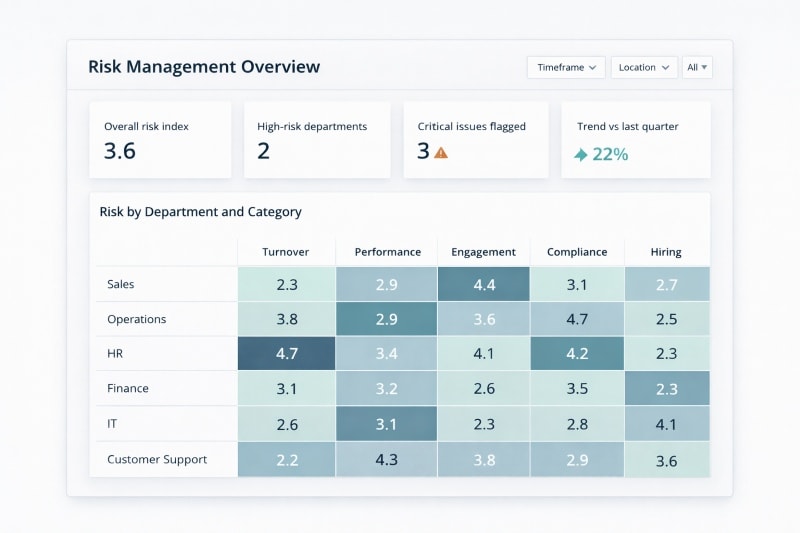
Another key advantage of data is improved risk management. By analyzing historical data, organizations can identify patterns that often precede problems.
For example, combining sales data with support data can highlight accounts at higher risk of churn. Operational data can reveal error patterns, safety incidents, or process bottlenecks that signal rising risk.
Data driven decisions do not eliminate uncertainty, but they make it easier to spot issues early and respond before they turn into expensive failures.
Using Data To Understand Customer Behavior And Market Trends
Customer Data, Preferences, And Buying Habits
Customers generate data at every touchpoint. Website visits, email interactions, quote requests, order history, support tickets, and survey responses are all examples of customer data that can be analyzed.
When you use this data to understand customer behavior, you can see which segments buy most often, which channels generate the best leads, and which customer preferences have the biggest impact on retention.
These insights help refine marketing strategies, sales messaging, and product design. Instead of guessing what customers want, you base decisions on observable behavior.
Market Trends And New Business Opportunities
Data also helps you track market trends. By combining internal data with external market data, industry benchmarks, and competitive intelligence, you can identify shifts in demand earlier.
This information is relevant far beyond the marketing team. It informs pricing, product roadmap decisions, and investment priorities across the organization.
Companies that use data as an early warning system for market trends are better positioned to identify new business opportunities before competitors react.
Big Data Analytics And Predictive Advantages
Turning Large Data Sets Into Predictive Power
In many industries, data volume has grown to the point where traditional tools are no longer enough. This is where big data analytics becomes relevant.
Big data analytics uses specialized platforms and methods to work with large, complex data sets. The goal, however, stays the same: extract meaningful insights that improve decision making.
One of the main advantages of big data analytics is the ability to build more robust predictive models. Forecasts of demand, churn, or operational risk become more reliable when models are trained on diverse, high quality data.
From Prediction To Action: Prescriptive Insights
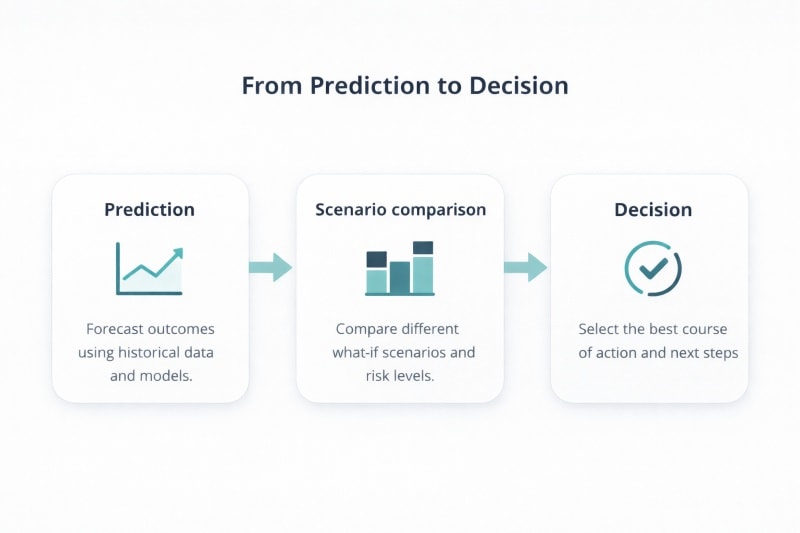
Prediction on its own does not create value. The real benefit appears when predictive analytics is paired with a prescriptive layer that suggests specific actions.
For example, a predictive model might flag customers with a high likelihood of churn. A prescriptive approach then recommends targeted outreach, revised terms, or additional support.
In other contexts, predictive analytics can identify locations at higher risk of supply disruption, while prescriptive rules suggest how to adjust inventory levels or supplier mix.
The pattern is similar across industries. Predictive analytics highlights likely outcomes. Prescriptive analytics helps decision makers choose the most effective response.
Operational Efficiency, Cost Savings, And Process Improvement
Identifying Bottlenecks And Gaps In Business Operations
Data is one of the most practical tools for improving operational efficiency. When you map processes and track key indicators, it becomes easier to identify bottlenecks, delays, and quality issues.
Metrics such as time to hire, time to resolve support tickets, production cycle time, or error rates can be monitored over time. Data highlights where performance consistently falls below expectation.
Instead of guessing which process changes might help, leaders can use data analytics to identify gaps within business operations and highlight opportunities to improve processes. This allows them to focus on the specific gaps that matter most and verify whether interventions actually improve results.
Resource Allocation, Inventory Levels, And Cost Savings
Data driven insight is just as important for resource allocation and cost savings. By analyzing trends in demand, capacity, and inventory levels, organizations can avoid both over investing and under investing.
In supply chain management, for instance, data can guide decisions about stock levels, reorder points, and supplier performance. In knowledge work, workload data can show where teams are overloaded or underutilized.
The advantage of data is very concrete in this area. It supports better resource allocation, less waste, and more predictable cost control.
Advantages Of Data In HR, Talent, And Workforce Decisions
Better Hiring Decisions Through Data Driven Assessment
People decisions are some of the highest impact decisions an organization makes, yet they are often the least data driven.
Traditional hiring relies heavily on resumes, unstructured interviews, and personal impressions. This increases the risk of placing the wrong person in a role, which leads to lower performance and higher turnover.
When organizations use structured data in hiring, such as validated behavioral assessments and job related performance indicators, they can make more consistent, evidence based decisions.
This is where tools like the OAD Survey provide a clear advantage. By measuring traits that relate to how people work, communicate, and lead, OAD gives hiring managers a more complete picture than interviews alone.
Design teams with data, not gut feel.
Most org-design decisions come down to role fit, leadership style, and team dynamics. OAD reads those signals from a 7-minute behavioral survey, so you can reconfigure roles and teams with evidence instead of guesswork.
Employee Engagement, Retention, And Training Programs
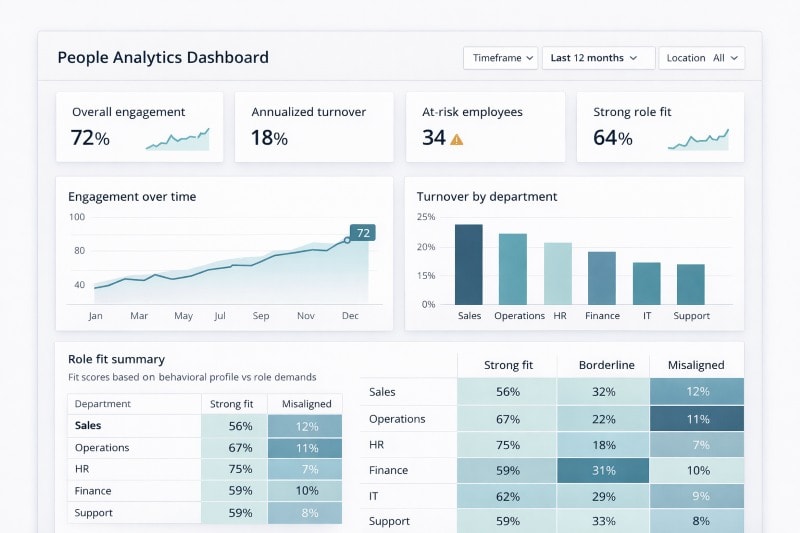
The advantages of data do not stop at hiring. People analytics helps leaders understand engagement levels, retention risks, and development needs across teams.
Combining survey data, performance metrics, and behavioral data makes it easier to see which conditions support high performance and where friction points appear.
These insights improve training programs, internal mobility strategies, and leadership development. Instead of launching generic initiatives, HR can target interventions based on actual patterns in the workforce. Just as healthcare professionals use patient data to develop personalized treatment plans, HR teams can leverage data to create tailored development plans for employees, addressing individual strengths and growth areas.
Data-Driven Business Strategy: Aligning Data With Organizational Goals
Successful businesses rise or fall on one foundation: how well they harness their data. Strategy may capture boardroom attention, but it’s data-driven insights that deliver sustainable growth. True strategic advantage isn’t accidental — it’s engineered through systematic analysis, pattern recognition, and evidence-based decisions.
High-performing organizations operate with concrete understanding of their landscape. They analyze customer behavior, track market shifts, and measure operational performance — extracting meaningful patterns from sales data, preferences, and historical trends. These insights flow directly into strategic decisions, revealing shifts that help businesses refine approaches and stay ahead of evolving markets. Leaders use this intelligence to minimize risks, maximize opportunities, and transform raw information into measurable competitive advantage.
Data-driven strategy isn’t just smart business — it’s essential survival in today’s marketplace. Organizations that align analytical insights with strategic goals don’t simply make better decisions. They respond faster, adapt stronger, and unlock opportunities others miss entirely. When companies achieve that alignment between data and strategy, they don’t just perform better. They build resilience, drive innovation, and position themselves to thrive in an increasingly complex business environment.
Driving Business Growth Through Data-Backed Innovation
Innovation doesn’t happen by accident — it’s engineered through data. Organizations that embrace data-driven decision making don’t just survive the competition; they redefine it entirely. When leaders analyze the patterns hidden within customer behaviors, operational metrics, and market signals, they discover pathways to growth that competitors never see coming.
Predictive analytics transforms uncertainty into opportunity. Companies forecast trends with precision, allocate resources with confidence, and master supply chains that adapt in real-time. Big data analytics doesn’t just reveal customer preferences — it unveils the blueprint for targeted campaigns that resonate, experiences that delight, and satisfaction that builds loyalty. The results speak for themselves: streamlined processes slash costs, enhanced experiences drive retention, and strategic marketing efforts multiply revenue.
Advanced analytics and big data aren’t just tools — they’re the foundation upon which competitive advantage is built. Evidence replaces guesswork. Risk transforms into calculated opportunity. Efficiency emerges from complexity. Organizations that harness data for actionable insights don’t just make better decisions; they unlock growth potential that aligns perfectly with business objectives. In today’s landscape, data mastery isn’t optional — it’s the difference between thriving and merely surviving.
Building A Data Driven Culture Across The Organization
Empowering Decision Makers With Data Literacy
Technology alone does not create a data driven organization. People need the skills and confidence to interpret data and ask the right questions.
Basic data literacy training helps leaders understand concepts such as variance, trends, confidence intervals, and sample size. It reduces the risk of common mistakes, such as reading too much into small data sets or confusing correlation with causation.
When decision makers know how to work with data, they are more likely to use it in everyday decisions instead of treating analytics as something that only specialists handle.
Governance, Ethics, And Fair Use Of Data
A serious data driven approach must also include governance and ethics. Customers and employees expect their data to be collected, stored, and used responsibly.
Organizations need clear policies on data access, privacy, and retention, as well as regular checks for bias in algorithms and decision rules.
Strong data governance protects both the organization and the people whose data it uses. It also builds trust, which is essential for any long term data strategy.
How To Start Leveraging The Advantages Of Data In Your Company
For organizations that feel overwhelmed by data, the most effective starting point is usually modest.
Begin by identifying a small number of high value decisions, such as pricing, workforce planning, or customer retention, where better data would clearly improve outcomes. Then determine which data is already available that could inform those decisions.
From there, you can introduce simple analytics, such as focused dashboards or recurring reports, and train decision makers to interpret them. Early wins help build momentum before you invest in more advanced data analytics tools or big data infrastructure.
Where Generic Data Stops And Behavioral Insights From OAD Begin
Most of the examples above relate to what happens in your markets, processes, and financials. For many organizations, the missing piece is a clear view of how people are likely to behave at work.
Generic HR data tells you what has happened. Behavioral data from tools like the OAD Survey helps explain why it happened and what may happen next.
By combining operational and financial data with OAD behavioral insights, you can see which profiles succeed in specific roles, how different personalities interact on teams, and where potential gaps exist.
This is especially powerful in hiring, succession planning, and leadership development, where a single poor decision can have long term consequences.
Design teams with data, not gut feel.
Most org-design decisions come down to role fit, leadership style, and team dynamics. OAD reads those signals from a 7-minute behavioral survey, so you can reconfigure roles and teams with evidence instead of guesswork.
Try OAD: Turn Your People Data Into Better Decisions
If you want to see how a structured, science based view of behavior can strengthen your data driven decisions, you can start with the free Top Performer Profile.
With a short survey and a clear description of role requirements, OAD translates abstract people data into concrete guidance for selection, coaching, and team design.
This brings the advantages of data directly into some of the most important decisions your organization makes.
Conclusion: Data Advantage As A Long Term Capability
Data is not a one time initiative or a single software purchase. It is a long term capability that supports better decision making, higher efficiency, and more resilient organizations.
When you move from raw data to a coherent, data driven approach, you gain clearer visibility into what truly drives performance, risk, and growth.
The organizations that benefit most are those that treat data, including behavioral data from tools like OAD, as a core asset that shapes how they think, decide, and lead every day.