Recruiting apps promise faster hiring, cleaner workflows, and better use of data, especially for HR teams managing multiple roles and high-volume pipelines. But when everything from job listings to interview scheduling is automated, it’s easy for the candidate experience to become cold and impersonal. This article shows how to use recruiting apps to streamline your hiring process while still protecting the human judgment and relationships that actually make great hires stay.
Recruiting apps promise to make hiring faster, easier, and more data-driven. For HR leaders and hiring managers dealing with high-volume hiring or complex recruitment processes, that promise is tempting. But there is a real risk: as you automate more of the recruitment process, the candidate experience can quickly feel cold and transactional, and your team may start relying on tools instead of judgment.
Think about the last time three hiring managers emailed you three different versions of the same candidate scorecard. A recruiting app solves that chaos in five minutes.
Used well, recruiting apps help you stay organized, save time, and identify better-fit talent. Used poorly, they just automate bad habits. The difference is not in the app store. It is in how you design your process and where you insist on keeping the human touch.
Teams think these tools identify better-fit talent; more often they just hide biased decisions under a layer of clean UI unless you define fit first.
At OAD, we see this mistake constantly: teams buy software hoping it will cure inconsistency, but all it does is speed up the inconsistencies.
Introduction to Recruiting Apps
Recruiting apps are software tools that centralize key steps of the hiring process: creating job listings, sourcing potential candidates, managing applications, scheduling interviews, and tracking candidate data. For busy HR teams, they act as a control center for the recruitment process.
Many recruiting apps function as or integrate with an applicant tracking system (ATS), which helps centralize candidate data and streamline the recruitment process.
Instead of hunting down who promised what to which candidate, everything lives in one timeline that any manager can scan in ten seconds.
Modern recruiting apps go beyond simple applicant tracking. The best recruiting apps integrate interview scheduling, skills assessments, background checks, and reporting features in one platform. They help recruiters and hiring managers stay organized across multiple roles, teams, and locations, without losing track of candidate information.
Without a real system, the same candidate gets interviewed twice by two departments who never realize they’re duplicating work.
Used as part of a well-designed recruitment process, these tools allow your team to focus on conversations and decisions, not on manual tasks, spreadsheets, and email chains.
What Are Recruiting Apps in Modern Hiring?
A Central Hub for the Recruitment Process
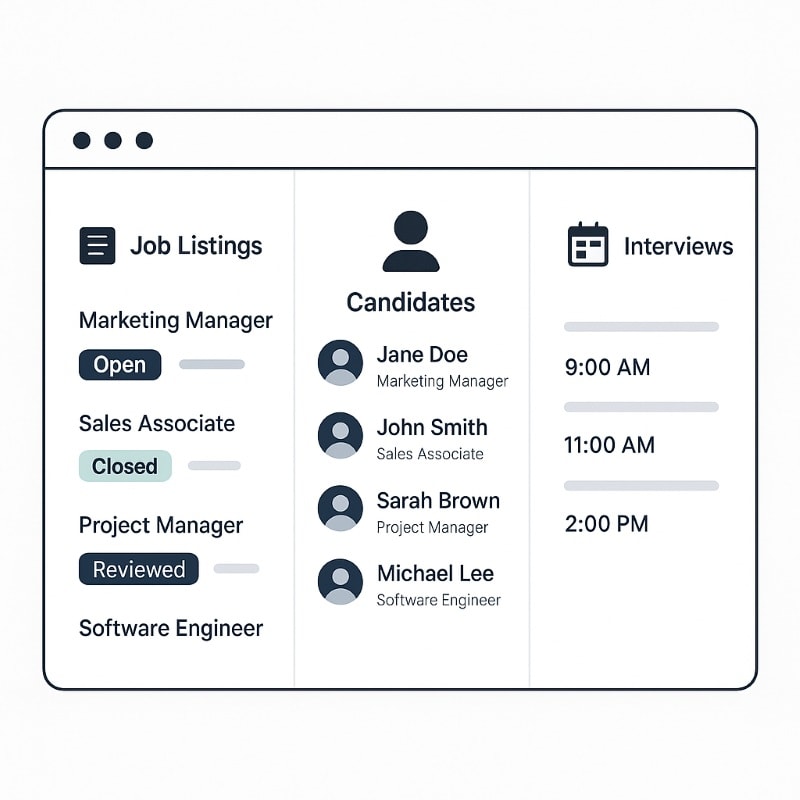
Recruiting apps and hiring apps sit at the center of today’s recruitment process. They are used to:
- Publish and promote job listings
- Source candidates from a vast pool of job seekers
- Manage applications and candidate profiles
- Coordinate interviews across the hiring team
- Track progress from first contact to offer
Instead of scattered emails and shared drives, recruiting apps give your team a single source of truth for candidates, interviews, tasks, and notes. For high-volume hiring, that centralization is not a luxury. It is survival.
In high-volume hiring, centralization isn’t a perk. It’s the only way to keep your recruiters from quietly building their own spreadsheets.
Jeff Bezos once said that ‘your margin is my opportunity.’ In hiring, your chaos is your competitor’s opportunity.
To truly serve as a central hub, recruiting apps must offer integrations with other HR tools and systems, ensuring seamless data flow and efficient workflows.
From “Nice-to-Have Tool” to Critical Infrastructure
For many organizations, recruiting apps have moved from an optional add-on to critical infrastructure. When you are hiring across multiple departments and locations, manual tracking is no longer viable. Your ability to source candidates, manage interviews, and move applicants through the hiring process is heavily shaped by the tools you choose.
As recruiting apps become critical infrastructure, data security becomes a top priority for organizations handling sensitive candidate information.
The danger is assuming that the app itself will fix an unclear recruiting process. A recruiting app can help you execute your recruiting efforts. It cannot tell you what “good” looks like, which skills and personality traits matter most, or how to build the best team for your specific context.
Buying a recruiting app to fix a broken process is like buying a treadmill to fix a bad diet. It makes you feel proactive while nothing actually changes. For smarter hiring strategies that address the root of leadership and cultural fit, consider solutions for founders and CEOs at OAD.
McKinsey found that broken processes, not tech limitations, are the root cause of hiring delays in most organizations. Our data at OAD supports the same pattern: bad judgment at the top of the funnel can’t be ‘fixed’ by an app.r
Benefits of Recruiting Technology
Efficiency and Time Savings
The most visible benefit of recruiting technology is efficiency. Interview requests pile up behind a single director who approves everything at 11 PM. Recruiting apps automate repetitive tasks such as:
- Posting jobs to multiple platforms
- Scheduling interviews and sending automated reminders
- Updating applicants on their status
- Sharing candidate information with the hiring team
This automation helps recruiters save time, reduce manual errors, and stay organized across many open roles. In high-volume hiring, this is often the difference between keeping up and falling behind.
Automation matters when your recruiter is juggling 47 open reqs and still gets chased by a VP asking why their candidate hasn’t received a calendar invite.
Additionally, collaboration tools within recruiting apps help teams work together more effectively, especially when managing multiple roles and stakeholders.
Better Communication and Transparency
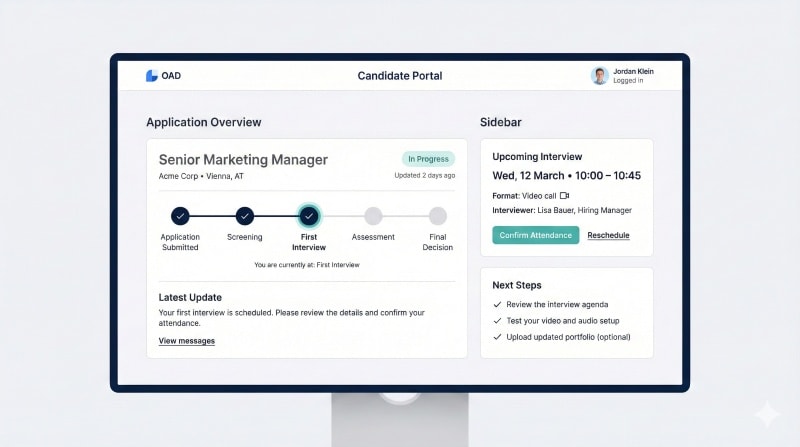
Recruiting apps also improve communication between recruiters, hiring managers, and candidates. When interview scheduling, status updates, and feedback all live in one platform, it is easier to maintain a transparent recruitment process.
Candidates benefit from clear timelines, consistent updates, and fewer “black hole” applications. Your team benefits from having a shared view of where each applicant stands in the process. Templates for emails and messages help ensure consistent, timely communication with candidates throughout the recruitment process.
Data to Inform Recruiting Goals and Decisions
Finally, recruiting technology generates data. Over time, you can track:
- Where the most qualified talent comes from
- How long each stage of the hiring process takes
- Which roles stall and why
- How changes to job listings affect applicant quality
These insights help HR leaders refine recruiting goals, improve processes, and make better decisions about where to invest effort and budget.
According to SHRM, organizations that track stage-level funnel data reduce time-to-fill by up to 30 percent.
Consider Google’s early hiring experiments, where they discovered structured data beat gut-feel hiring by a wide margin. The same principle applies here.
It’s also essential to prioritize privacy when collecting and analyzing candidate data in recruiting apps, ensuring responsible and ethical use of sensitive information.
Features of Effective Recruiting Apps
Core Features: Job Listings, Sourcing, and Application Management
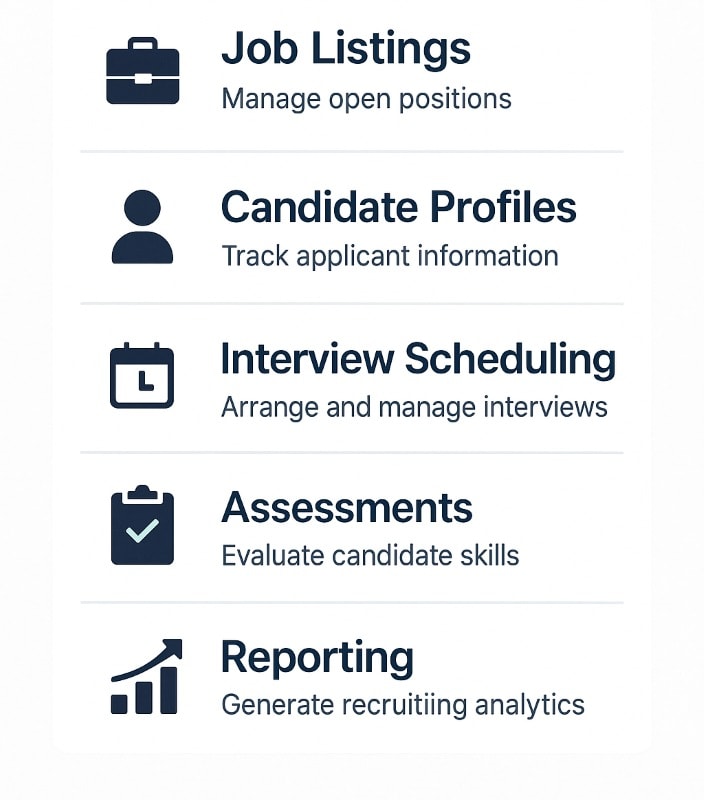
Effective recruiting apps usually cover three core areas:
- Job listings and promotion
Publishing and promoting jobs across platforms like LinkedIn, Indeed, Glassdoor, and ZipRecruiter, often with options to boost visibility and gain exposure to a larger pool of potential candidates. - Candidate sourcing and search
Tools to source candidates, search by skills and experience, and build pipelines of potential hires, including passive job seekers. - Application and candidate profile management
Centralized candidate profiles, with resumes, notes, interview history, and candidate data stored in one place so the team can track progress and manage applications consistently. Resume parsing features can automatically extract key information from resumes, making it easier to build candidate profiles.
Interview Scheduling and Automated Reminders
Interview scheduling is one of the biggest time sinks in recruitment. Tools that automate interview scheduling, such as Calendly or built-in scheduling features, can dramatically reduce back-and-forth emails. Many recruiting apps also handle time zone coordination, ensuring interviews are scheduled accurately across different locations. Automated reminders reduce no-shows and help both candidates and interviewers stay on track.
We’ve watched hiring teams lose candidates simply because two directors couldn’t align their calendars for a week.
For HR teams managing multiple interviews across different time zones and stakeholders, this is often where recruiting apps deliver immediate, visible impact.
Skills Assessments, Coding Challenges, and Background Checks
Elite athletes aren’t selected on raw skill alone. Coaches look for adaptability under pressure. Hiring should do the same. Many of the best hiring apps also offer ways to evaluate candidate fit:
- Skills assessments for role-specific abilities
- Coding challenges for technical roles and developers
- Personality traits assessments to understand working styles
- Background checks to verify employment history or qualifications
Structured interview workflows help ensure consistency and fairness in the evaluation process.
These features help you identify qualified talent and filter out mismatches early in the process. The key is to treat them as decision support, not as final verdicts.
Stanford’s research on structured assessments shows they outperform unstructured interviews by a significant margin. Our OAD profile data aligns: structure improves fairness and prediction.
Design teams with data, not gut feel.
Most org-design decisions come down to role fit, leadership style, and team dynamics. OAD reads those signals from a 7-minute behavioral survey, so you can reconfigure roles and teams with evidence instead of guesswork.
Reporting Features, Integrations, and User Experience
The most effective recruiting apps provide:
- Clear reporting features to track progress against recruiting goals
- Integrations with your applicant tracking system (ATS) and HRIS
- A user friendly interface that your team will actually use
- Mobile access so recruiters and hiring managers can work on the go
Without these elements, even powerful tools will struggle to gain adoption inside the organization.
Top Recruiting Apps for Hiring Managers
Sourcing and Relationship Tools
Platforms like LinkedIn Recruiter help recruiters search a vast pool of candidates, refine by skills and experience, and connect directly with potential hires. These tools are particularly powerful for roles where qualified talent is not actively applying.
Job boards and aggregators such as Indeed, Glassdoor, and ZipRecruiter focus on job listings, resume search, and exposure. They are often the starting point for many applicants and function as high-volume entry points into your recruitment funnel.
For college coaches and student athletes, NCSA is a leading recruiting app that streamlines the process of connecting talent with collegiate sports programs.
Screening and Interview Tools
Tools like Spark Hire, HireVue, and similar platforms support one way video interviews and structured screening. They allow candidates to record answers to standardized questions, so hiring teams can review responses asynchronously and compare applicants more consistently.
For technical roles, platforms such as HackerRank offer coding challenges and structured skills assessments. They help identify developers with the right mix of skills before you invest in multiple live interviews.
Scheduling and Coordination Tools
Many recruiting apps include built-in scheduling. However, standalone tools such as Calendly or integrated scheduling features inside ATS platforms can automate scheduling interviews, send automated reminders, and simplify time zone coordination.
The common thread: the best recruiting apps are those that genuinely remove friction from the process your team is already running, rather than forcing everyone to work around the app.
Job Listings and Exposure
Reaching a Vast Pool of Potential Candidates
Job listings remain the primary way organizations connect with candidates. Recruiting apps help you:
- Publish jobs across multiple platforms in a few clicks
Aggregators collect job listings from various platforms, increasing reach and exposure. - Promote specific roles to gain exposure in competitive markets
- Reach both active job seekers and passive candidates
For some audiences, such as early-career hires or workers changing jobs frequently, job listings are still the dominant entry point into your recruitment funnel.
College Recruiting and the Student Athlete Ecosystem
In parallel, there is a specific category of recruiting apps focused on the college recruiting process. These platforms help college coaches discover student athletes, often starting in high school, track their recruiting journey, and connect with families.
SportsRecruits is another leading platform in this space, providing student athletes and coaches with tools to streamline the college recruiting process.
Apps in this space help athletes and coaches:
- Create profiles that highlight achievements and skills
- Share video footage and performance data
- Track communication and interest from different colleges
The mechanics are similar: a platform, candidate information, and tools to manage connections. The lesson for corporate recruiting is that long-term relationship-building and clear visibility into the journey can be just as powerful as one-off transactions, especially for high-potential talent.
Candidate Experience and Satisfaction
Why Candidate Experience Still Matters in a Highly Automated Process
Candidate experience is not just a branding concern. In behavioral economics, uncertainty is one of the fastest paths to disengagement. A candidate lost in process limbo is already halfway gone. how For many roles, especially in tight labor markets, it can be the difference between securing a top candidate and losing them to a competitor.
Recruiting apps can significantly improve candidate experience when they:
- Offer a clear, user friendly interface for applications
- Provide transparent updates on the hiring process. Regular status updates help keep candidates engaged and informed.
- Automate basic communication without sounding robotic
Candidates want to know where they stand, what comes next, and how long the process will take. Your tools should make it easy to deliver that clarity.
One-Way Video Interviews, Assessments, and Human Perception
Features such as one way video interviews, skills assessments, and personality traits evaluations can help candidates showcase their abilities beyond a resume. They can also create anxiety or feel impersonal if not framed well.
We’ve had candidates tell us they recorded three takes at midnight because they feared a single awkward pause would eliminate them.
The experience will vary based on how your team uses these tools. If candidates feel like they are talking to a machine with no real human review, your brand may suffer. If you explain how the process works, how responses are reviewed, and what happens afterward, the same tools can feel fair and transparent.
Providing timely feedback after assessments or interviews can further improve the candidate experience, helping candidates feel valued and informed throughout the process.
How Recruiting Apps Support Each Stage of the Recruitment Process
Sourcing and Identifying Potential Candidates
Recruiting apps help teams source candidates by:
- Aggregating applicants from job listings across platforms
- Allowing recruiters to search by skills, experience, and location
- Highlighting potential candidates that match predefined criteria
Instead of manual search and spreadsheet tracking, recruiters can quickly identify top talent and focus on deeper evaluation.
Managing Applications and Tracking Progress
Once candidates enter the funnel, recruiting apps help you:
- Create structured candidate profiles
- Track each applicant’s stage in the process
- Assign tasks and interviews to different team members
This ability to track progress end-to-end is especially important when hiring for multiple roles at once or when several stakeholders participate in the process.
Scheduling Interviews and Coordinating the Team
Finally, recruiting apps simplify scheduling interviews by:
- Offering candidates available time slots
- Coordinating calendars across the hiring team
- Sending automated reminders to reduce no-shows
When combined with clear internal communication, this reduces administrative work and allows the team to focus on the quality of each interview.
How Should HR Teams Evaluate the Best Recruiting Apps?
Start with Your Process, Not the App
As Jeff Bezos likes to say, ‘Good intentions don’t work. Mechanisms do.’ In hiring, the mechanism is the process, not the price tag or the feature list.
The right app depends on your recruitment process and recruiting goals. Before investing, clarify:
- Where your process is currently breaking
- What your team struggles to track or manage
- Which parts of the process should be automated, and which must stay human
An app that is perfect for high-volume hiring in retail may not fit a specialized organization hiring a small number of highly technical roles.
Look for Usability, Adoption, and Data Visibility
Deloitte’s Human Capital Trends reports repeatedly show adoption is the make-or-break factor in HR tech ROI.
When evaluating platforms, prioritize:
- A user friendly interface that hiring managers will accept
- The ability to access and search candidate data easily
- Clear reporting features that help you see what works and what does not
If your team does not adopt the app fully, you will end up with partial data and frustrated employees.
Integrations, Security, and Additional Features
Check how well the app integrates with your existing HR systems, as well as its approach to:
- Data security and privacy
- Background checks and compliance
- Additional features like templates, automation rules, or collaboration tools
The goal is not to buy the app with the longest feature list, but to pick the one that fits your organization’s structure and risks.
How to Use Recruiting Apps Without Losing the Human Touch
Keep Humans in Control of the Most Important Decisions
Recruiting apps should handle tasks; people should handle decisions. If the app is deciding for you, you don’t have a hiring process. You have a slot-filling machine. That means:
- Recruiters and hiring managers own final hiring recommendations
- Assessments and coding challenges are inputs, not verdicts
- Data informs decisions but does not replace judgment
This mindset prevents over-reliance on automation and protects against one-dimensional hiring.
Design a Candidate Experience That Feels Personal, Not Programmed
It’s not the automation that feels cold. It’s the silence. Candidates forgive bots; they don’t forgive disappearing humans.
Use automation to keep candidates informed, not to avoid human contact. For key stages in the process, such as final interviews or rejections after multiple rounds, a human message carries more weight than a generic template.
We’ve watched companies automate every touchpoint, then wonder why top candidates ghost them. You can’t outsource warmth.
You can still use the app to stay organized, schedule calls, and document outcomes, while ensuring the candidate experience reflects your culture and values.
Train Recruiters and Hiring Managers to Interpret Data
If your team is not trained to interpret candidate data, they will either ignore it or misread it. Provide guidance on:
- How to use assessment results as conversation starters
- How to balance interview impressions with structured scores
- When to question or override automated recommendations
Recruiting apps are most powerful when your team knows how to combine insights from tools with their own expertise.
Where Recruiting Apps End – and Where OAD Begins
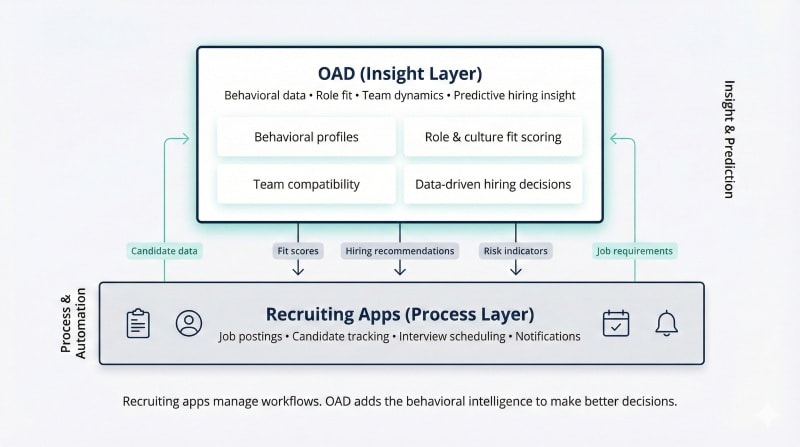
Recruiting apps excel at logistics: job postings, sourcing, scheduling, tracking. They help you manage candidates and keep the hiring process moving.
What they do not provide is a deep understanding of how people are likely to behave once they become employees. That is where OAD comes in.
That’s the blind spot we built OAD to solve. Tools track applicants; our data explains people.by
OAD’s scientifically validated assessments help you understand:
- Core personality traits relevant to specific roles
- How candidates are likely to respond to pressure and change
- Which combinations of employees will form the best team for a given context
By combining recruiting apps with OAD’s behavioral insights, organizations can move beyond “filling jobs” and toward building teams that perform, stay, and grow.
Warren Buffett has always said he invests in people first. The same logic applies here: process gets you applicants, insight gets you performers.
Measuring Success and ROI of Recruiting Apps
Modern recruiting succeeds or fails on one critical foundation: how precisely you measure what matters. Tracking the performance and return on investment of your recruiting technology isn’t merely advisable — it’s the cornerstone of any organization determined to transform hiring from guesswork into strategic advantage. The most sophisticated recruiting platforms, like LinkedIn Recruiter and Spark Hire, arrive armed with comprehensive analytics capabilities that illuminate progress across every stage of your talent acquisition journey.
Performance indicators such as time-to-hire, cost-per-hire, and candidate experience form the bedrock for evaluating recruitment excellence. These metrics don’t just measure — they reveal the true rhythm of your hiring engine. Automated reminders flow seamlessly into streamlined interview scheduling, cutting precious days from your timeline while elevating the candidate experience through consistent communication and meaningful engagement. Every touchpoint becomes an opportunity to demonstrate organizational excellence.
Through this data-driven lens, recruiting teams unlock the power to identify process bottlenecks, discover which opportunities magnetize exceptional talent, and pinpoint the precise moments where qualified candidates drift away. This analytical approach transforms recruitment from reactive filling of positions into proactive cultivation of talent pipelines — ensuring your organization doesn’t simply hire bodies, but attracts, engages, and secures the extraordinary individuals who drive sustainable success. When measurement meets purpose, hiring becomes more than process. It becomes competitive advantage.
Common Challenges and Solutions in Recruiting App Adoption
Even the most sophisticated recruiting platforms encounter resistance when transformation meets reality. Change aversion, technical friction, and integration complexities represent the inevitable tensions that emerge when innovation challenges established processes. The opportunity lies not in avoiding these forces — but in mastering them through strategic intention.
Sustainable adoption emerges through deep investment in human capability and ongoing partnership with your talent acquisition teams. When recruiters and hiring managers develop mastery over advanced capabilities — one way video interviews, comprehensive skills assessments, and structured interview architectures — they don’t simply adapt to new processes, they become architects of transformation. This becomes particularly vital when evaluating qualified talent for technical roles, where precision in assessment drives competitive advantage.
Strategic platform selection transcends the pursuit of novelty — it demands rigorous alignment between technological capability and recruitment imperatives. Each feature must serve your specific talent acquisition objectives and complement the nuanced requirements of your hiring ecosystem. Platforms like HireVue and VidCruiter represent this principle in action, delivering advanced video interviewing and assessment technologies that compress time-to-hire while enhancing talent identification precision.
True integration success flows from early attention to data coherence across your human capital infrastructure. Your recruiting platform must communicate seamlessly with existing HR systems, eliminating fragmented candidate intelligence and redundant workflows that undermine efficiency and insight generation.
When organizations approach these implementation challenges with strategic discipline, they don’t simply deploy new tools — they engineer competitive advantage. Empowered recruiters leverage sophisticated capabilities to accelerate recruitment velocity and precision, ultimately transforming how talent acquisition drives organizational growth and market position.
The Future of Recruiting and Hiring with Apps
Organizations succeed or fail on one critical factor: how effectively they attract and secure top talent. Technology may capture headlines, but it’s intelligent recruitment that drives sustainable competitive advantage. True talent acquisition isn’t accidental—it’s engineered through artificial intelligence, machine learning, and data analytics embedded within next-generation recruiting platforms. These technologies transform recruitment by eliminating repetitive tasks like candidate sourcing, screening, and interview scheduling, liberating recruiters to focus on what matters most: building meaningful relationships and making strategic hiring decisions that shape organizational futures.
Platforms like LinkedIn Recruiter and Indeed don’t just connect—they revolutionize how talent discovers opportunity. These central hubs provide access to vast candidate pools while evolving into sophisticated matching engines that align talent with organizational needs. When these tools reach their full potential, they deliver measurable recruiting gains that help organizations build not just teams, but competitive advantages.
For college coaches and student athletes, transformation runs even deeper. Apps like NCSA and SportsRecruits aren’t simply platforms—they’re performance accelerators that give athletes direct access to showcase capabilities while connecting them instantly with coaches who matter. These central hubs manage entire recruiting journeys from high school through college commitment, ensuring both athletes and coaches can track progress, communicate meaningfully, and make decisions backed by real data rather than guesswork.
Organizations that embrace this evolution—adopting innovative recruiting technology and leveraging data to inform every decision—don’t just hire better. They attract faster, engage deeper, and secure the talent that drives breakthrough performance. Whether building corporate teams or recruiting tomorrow’s athletic champions, the right technology doesn’t just connect you with candidates. It unlocks your organization’s full recruiting potential and transforms everyday hiring into measurable competitive advantage.
Conclusion: Turning Recruiting Apps into a Real Advantage
Recruiting apps are now essential infrastructure for most organizations. They help HR teams and hiring managers publish job listings, source candidates, schedule interviews, and track the recruitment process more efficiently.
The real advantage comes when you:
- Use recruiting technology to automate low-value tasks
- Protect the candidate experience and keep communication human
- Train your team to interpret data instead of blindly trusting it
- Combine app-generated candidate data with science-backed insight into behavior and role fit
If you want your recruiting apps to do more than just move applicants through a pipeline, connect them with tools that explain who your candidates really are and how they will perform in your environment.
To see how OAD can complement your existing recruiting apps and help you hire with more confidence, you can start with the free Top Performer Profile and explore how behavioral data fits into your current hiring stack.