Employee motivation is not a soft, feel-good concept; it’s a measurable performance variable. Organizations with highly engaged and motivated teams see double-digit gains in productivity and profitability compared to their peers, according to large-scale benchmarks. For example, longitudinal studies from institutes like Gallup consistently show that highly engaged teams drive significantly higher profitability. At OAD, we see the same pattern, but we can trace it down to specific motivational drivers and role fit instead of treating ‘engagement’ as a black box. When you understand what truly drives your employees to initiate, sustain, and direct their work, you can design roles, leadership practices, and a work environment that reliably support higher performance and healthier retention.
Employee motivation is one of the few levers that cuts across every HR metric executives care about: performance, quality of work, customer experience, and retention. When motivation drops, you see it in missed deadlines, lower-quality output, and rising turnover long before it appears in formal reports.
Motivated employees bring discretionary effort: they solve problems proactively, support co-workers, and stay engaged even when conditions are challenging. This “above-and-beyond” energy is what separates average organizations from those that consistently outperform their competitors. You see discretionary effort in small, measurable ways: a service team that recovers a near-lost client without escalation, or a plant crew that fixes a recurring quality issue before it shows up in defect reports.
In one manufacturing client, a shift supervisor noticed a pattern of micro-defects and quietly redesigned the handover checklist. Scrap rates dropped before the issue ever hit a KPI dashboard, and senior leadership only heard about it when margins improved.
What Is Employee Motivation? (An Organizational Psychology View)
In organizational psychology, work motivation describes the internal and external forces that initiate, direct, and sustain work-related behavior. According to Pinder (1998), work motivation is shaped by internal and external energetic forces that influence an employee’s effort, behavior, and persistence in a work setting.
It explains why some employees consistently take ownership, follow through in a timely fashion, and look for better ways to produce quality work, while others do the minimum or mentally check out.
Motivation is not a fixed personality trait. It is shaped by the fit between the person and their role, the work environment, leadership behavior, and the broader organizational culture. When these elements line up, employees feel energized, valued, and more willing to invest discretionary effort.
How Work Motivation Differs from Employee Engagement
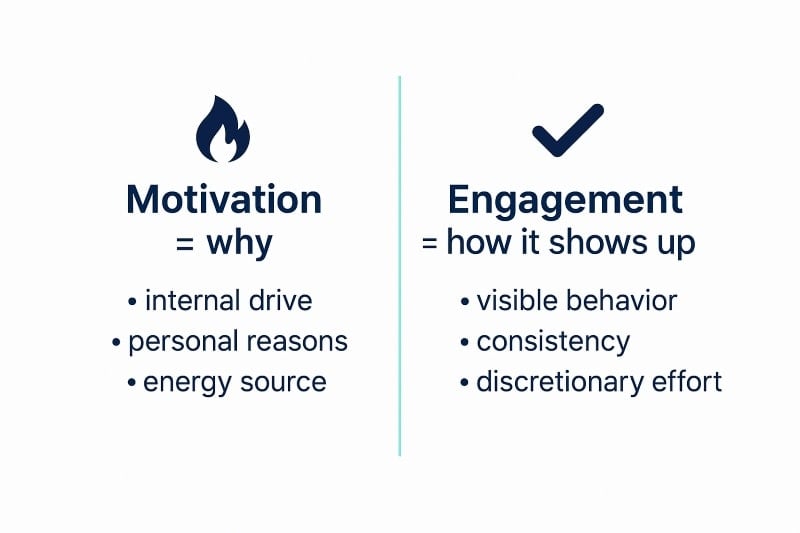
Employee engagement describes how consistently people show up with energy, focus, and participation in their roles. Work motivation is the underlying “why” that drives those behaviors: the motives, needs, and expectations that make employees feel it is worth contributing in the first place. Intrinsic motivation plays a key role in driving engagement by fostering active participation and commitment among employees.
You can see acceptable engagement scores while motivation is already eroding. In practice, we often see teams that look ‘green’ on dashboards but are quietly updating their résumés. For example, many employees will keep attending meetings and hitting targets for a while even if they no longer feel a strong sense of purpose, fair treatment, or growth. If you only look at surface engagement, you risk missing early warning signs of declining motivation and future turnover.
We’ve worked with teams whose engagement scores sat comfortably in the ‘green’ zone while half the senior contributors were already in late-stage interview processes elsewhere. On paper, they were engaged; in reality, they were planning their exit.
Intrinsic vs Extrinsic Motivation at Work
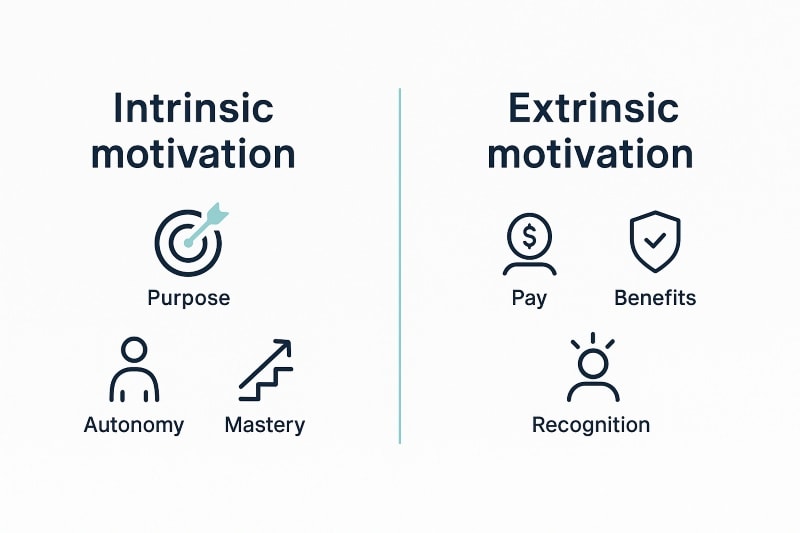
Employee motivation in the real world rarely comes from a single source. Most people are driven by a mix of internal motives (such as purpose or growth) and external rewards (such as pay or recognition). The challenge for leaders is to design roles, systems, and conversations that activate both, without relying on short-term incentives that fade quickly. A balanced approach to intrinsic and extrinsic factors is essential to drive employee motivation and create a positive workplace culture.
Understanding the difference between intrinsic and extrinsic motivation helps you match your management approach to what people actually need. It also prevents a common mistake: using bonuses or perks to compensate for poor job design, unclear expectations, or a culture that quietly drains energy.
Intrinsic Drivers: Meaning, Autonomy, and Mastery
Intrinsic motivation comes from the work itself. Employees feel motivated when they can use their strengths, see the impact of their work, and make progress on problems that matter. They experience a sense of purpose and ownership, which naturally supports higher engagement and better task performance.
A strong source of intrinsic motivation is autonomy. When employees have a say in how they organize their work, choose methods, or solve problems, they are more likely to invest discretionary effort. Micromanagement, on the other hand, signals a lack of trust and often reduces motivation, even when pay and benefits are competitive.
Think of the manager who insists on approving every client email before it goes out. After a few weeks, even strong contributors stop thinking creatively and just wait for instructions.
Another intrinsic driver is mastery: the opportunity to build skills and grow professionally. Professional development opportunities, stretch assignments, and constructive feedback all tell employees that the organization is willing to invest in their long-term success. When that signal is missing, motivation erodes, and highly capable people start looking elsewhere. Leadership practices that support mastery and growth are essential for fostering employee success and sustaining long-term motivation.
Extrinsic Drivers: Pay, Benefits, and Recognition
Extrinsic motivation is fueled by external rewards and consequences. Compensation, bonuses, benefits, job security, and recognition all play a role. Other benefits, such as additional perks or wellness programs, can also serve as motivating factors for employees. Employees do not expect their job to meet every psychological need, but they do expect fair treatment, competitive pay, and acknowledgment when they deliver quality work.
Rewards are most effective when they are transparent, consistent, and clearly linked to performance. Confusing criteria, delayed recognition, or perceived favoritism quickly undermine their impact. Over time, employees focus less on doing their best work and more on trying to interpret “what really counts” in the organization.
In OAD debriefs, we regularly hear employees say, ‘I don’t know what actually gets rewarded here.’ That sentence is an early sign that motivation is shifting from contribution to political navigation.
The key is balance. Relying heavily on extrinsic motivators can create a transactional mindset in which employees do only what is measured or rewarded. Combining fair, predictable rewards with meaningful work, autonomy, and growth creates a healthier, more sustainable foundation for motivation.
Core Factors That Influence Employee Motivation
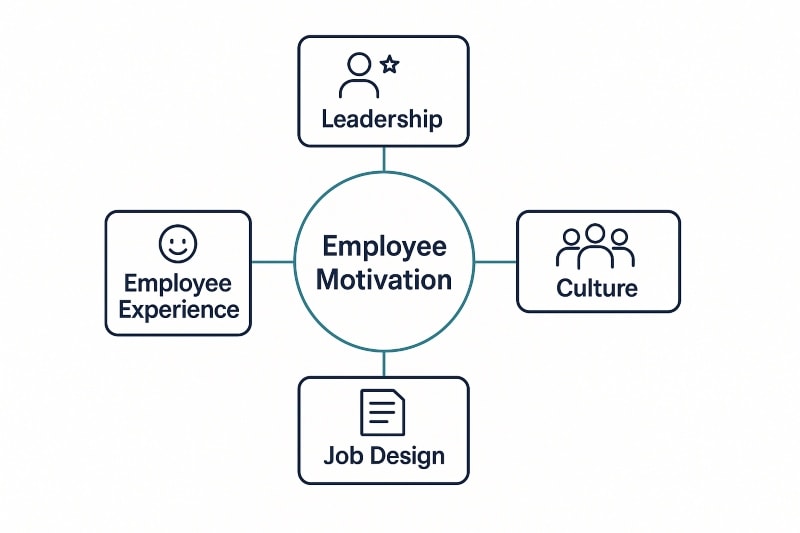
Motivation rarely fails in isolation. It typically breaks down at the intersection of leadership behavior, culture, job design, and day-to-day employee experience. When any of these elements is misaligned, employees may still “do their jobs,” but the energy, creativity, and ownership behind their work begin to slip.
Understanding these factors is essential if you want to do more than react to survey scores. It allows leaders to diagnose where motivation is being supported, where it is being blocked, and what needs to change at a structural level rather than relying on one-off initiatives.
Leadership Behavior and Psychological Safety
The direct manager is often the strongest single influence on employee motivation. Consistent communication, clear expectations, and follow-through on commitments tell employees they can rely on their leader. Unclear priorities, shifting demands, or broken promises have the opposite effect and quickly erode trust. Such leadership behaviors can also negatively impact employee morale, leading to disengagement and reduced motivation. Decades of engagement research point to the same pattern: the immediate manager explains a large share of variance in how motivated employees feel and whether they stay.
Gallup’s long-running research famously shows that managers account for a large share of the variance in engagement. Our experience at OAD confirms this, but we go a level deeper by mapping which leadership behaviors align with specific motivational profiles, not just ‘good manager / bad manager’ labels.
Psychological safety is a core part of this equation. When employees feel they can raise concerns, admit mistakes, or challenge assumptions without fear of punishment or embarrassment, they are more likely to share ideas and take responsible risks. Amy Edmondson’s work on psychological safety shows how strongly this climate predicts team learning and performance. At OAD, we often see that teams with ‘high safety’ scores also have leaders whose style matches the team’s underlying motivational profile, not just a generic ‘open door policy.’ In environments where people are criticized, ignored, or sidelined for speaking up, motivation shifts from doing great work to self-protection.
Organizational Culture, Fairness, and Values in Action
Culture is the lived experience of “how things work here,” not what is written on posters. Employees watch who gets promoted, how decisions are made, and whether stated values hold up when targets are missed. Leadership plays a crucial role in establishing and reinforcing the organization’s cultural values, which are essential for employee motivation and engagement. Culture shows up in small decisions: who is promoted after a failed project, who is shielded when a major client is lost, whose workload quietly doubles when targets are missed. Motivation suffers when there is a gap between official messages and everyday behavior.
Leaders like Jeff Bezos have repeatedly emphasized that what you reward and promote becomes your real culture. When a visibly abrasive high performer is promoted after losing a major client, employees infer that numbers matter more than the values on the wall.
Perceptions of fairness play a major role. When workloads, recognition, or advancement opportunities are seen as arbitrary or biased, employees disengage or redirect their energy elsewhere. A transparent approach to decision-making, coupled with clear criteria for rewards and progression, helps sustain motivation even in challenging periods.
Job Design, Workload, and Role Clarity
The structure of the job itself can either fuel or drain motivation. Roles that are clearly defined, aligned with a person’s strengths, and connected to meaningful outcomes are more likely to generate sustained effort. Such alignment helps keep employees motivated and engaged in their work. When employees understand how their work contributes to the organization’s success, they can prioritize tasks more effectively and see purpose in day-to-day activities.
By contrast, poorly designed roles with conflicting responsibilities or constant interruptions make it difficult to maintain focus. If employees are regularly pulled into urgent issues without clarity on what truly matters, they may feel they are always busy but rarely effective. Over time, this leads to frustration, lower job satisfaction, and declining performance.
Common examples include ‘player-coach’ roles where the same person is expected to lead strategically and handle constant frontline escalations. In OAD assessments, those individuals often show high drive but report chronic frustration and fatigue.
The Role of Employee Experience and Well-Being
Employee motivation is closely tied to the broader employee experience: the sum of everyday interactions, processes, and expectations that shape how people feel at work. Even highly motivated individuals will struggle to sustain their effort in an environment that consistently creates friction, overload, or ambiguity. By contrast, a supportive and well-structured work environment has a positive impact on employee motivation and well-being, fostering greater engagement and satisfaction.
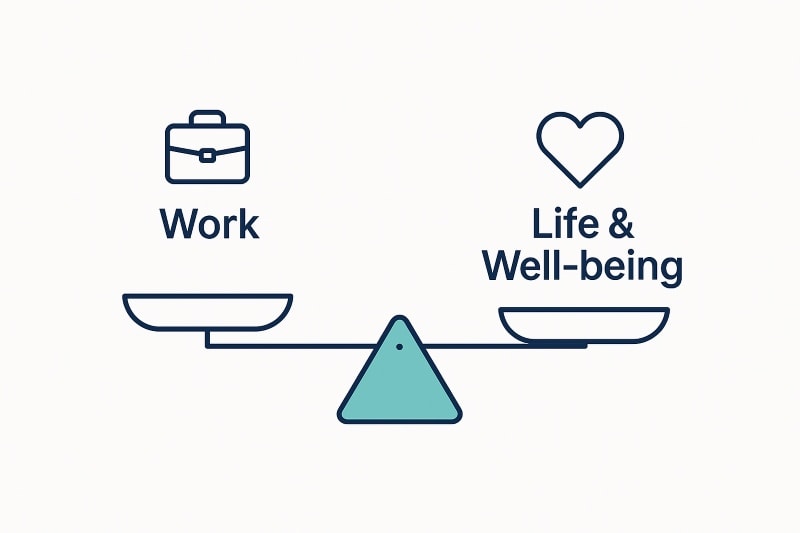
Well-being is a critical component of this. When employees have a healthy work-life balance, reasonable workloads, and access to support when they need it, they are better able to stay engaged and resilient. When these conditions are missing, motivation often fades quietly before performance issues become visible.
Work-Life Balance, Flexibility, and Support Systems
A good work-life balance does not mean the absence of pressure or deadlines. It means that demands are sustainable and predictable enough for employees to manage their energy and personal responsibilities without chronic stress. Elite athletes don’t train at maximum intensity every day; they cycle stress and recovery. Sustainable motivation at work follows the same pattern: periods of pressure, followed by predictable chances to recover. Flexible work arrangements, clear boundaries on availability, and realistic expectations around response times all contribute to a more sustainable rhythm of work.
Support systems also matter. Access to mental health resources, credible employee assistance programs, and managers who recognize signs of burnout signal that the organization takes well-being seriously. Employees who feel supported are more likely to remain committed through difficult periods and less likely to seek opportunities elsewhere. Strong support systems and a healthy work-life balance are key drivers of employee satisfaction and motivation, helping to foster an engaging and productive workplace environment.
How to Diagnose Motivation in Your Organization
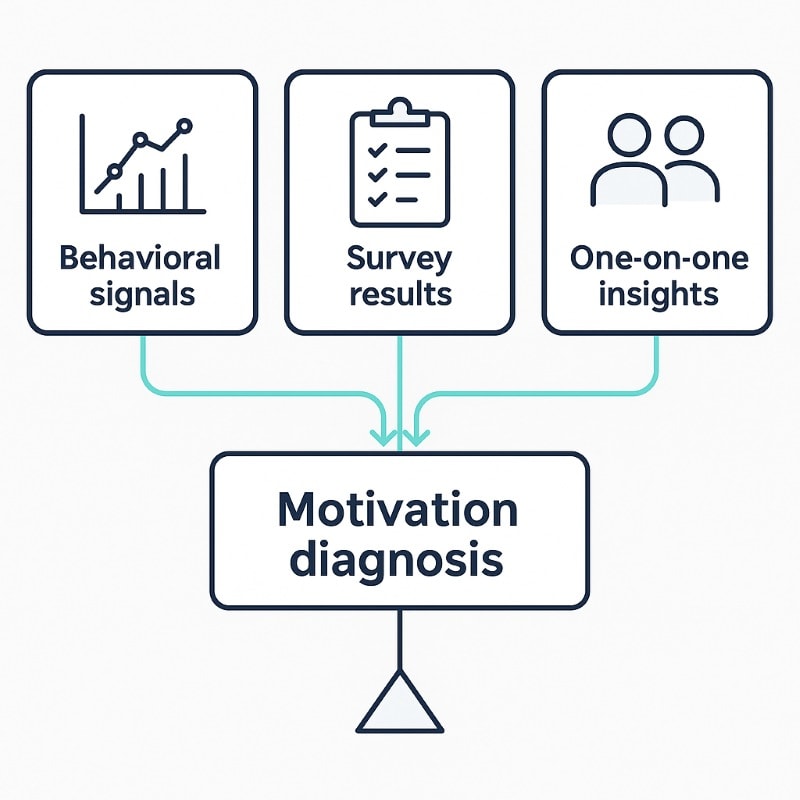
Diagnosing employee motivation starts with paying attention to what people actually do, not just what they say in surveys. Before looking at formal data, many leaders can already sense shifts in energy: teams that used to volunteer ideas go quiet, response times slow down, and more work is pushed “upward” instead of being owned at the right level.
A systematic approach turns these impressions into usable information. Organizations should measure employee motivation using both qualitative and quantitative methods to identify areas for improvement. By watching for behavioral signals, listening intentionally, and combining qualitative input with quantitative data, you can identify where motivation is strong, where it is fragile, and where specific teams may need targeted support rather than generic engagement campaigns.
For example, you might see similar engagement scores across two teams, but OAD data reveals that one group is highly driven by autonomy while the other prefers structure. The same policy on remote work or decision rights will land very differently in each case.
In practice, that means the same ‘freedom to work from anywhere’ policy will energize one team and quietly destabilize the other. Without that motivational map, leaders only see the average score and miss the conflicting needs underneath.
Design teams with data, not gut feel.
Most org-design decisions come down to role fit, leadership style, and team dynamics. OAD reads those signals from a 7-minute behavioral survey, so you can reconfigure roles and teams with evidence instead of guesswork.
Behavioral and Performance Signals to Watch
Motivation shows up in patterns of behavior. Early signs of declining motivation include increased rework, more missed or delayed deadlines, reduced participation in meetings, and lower initiative in solving problems. These changes can directly affect employee performance and overall work quality. Employees may still meet minimum expectations, but the curiosity and discretionary effort that used to distinguish their work begin to fade.
Pay attention to how employees talk about their work. References to “just getting through the week,” frequent complaints about unclear priorities, or a growing sense that “nothing changes here” often signal deeper issues with workload, role clarity, or trust in leadership. These are not isolated comments; they become part of the informal culture that shapes how teams feel about the organization over time.
Differences between teams are also instructive. If one unit consistently delivers high-quality work, collaborates well, and retains people while another with similar conditions struggles, the issue is rarely “employee attitude.” It is more likely tied to differences in leadership style, expectations, psychological safety, or perceived fairness.
Surveys, Feedback, and One-on-Ones as Motivation Sensors
Employee surveys and pulse checks provide a structured way to measure engagement and motivation across the organization. Understanding employee engagement and motivation through regular feedback and recognition is critical for fostering a motivated and committed workforce. Questions that explore satisfaction with role clarity, growth opportunities, recognition, leadership, and work-life balance help you see which motivational factors are working and which are not. Trends over time are often more useful than a single score.
However, surveys are only as useful as the conversations they enable. When leaders share results transparently, acknowledge concerns, and involve teams in shaping the response, surveys can strengthen trust and motivation. When results disappear into a black box or lead to cosmetic actions only, employees learn that providing feedback has little impact, which weakens motivation further.
Regular one-on-one meetings are an equally important “sensor.” These conversations allow managers to understand what motivates individual employees, where they feel blocked, and what kind of support or development would make the most difference. When managers listen actively and follow up on commitments, one-on-ones become a practical tool for protecting and rebuilding motivation at the team level.
Using Assessments to Understand What Motivates Employees
While observation and surveys reveal how motivated employees appear, they do not always explain why different people respond so differently to the same conditions. This is where tools from organizational psychology, such as validated behavioral and personality assessments, offer additional clarity.
Good assessments provide a structured way to understand how employees prefer to work, what energizes or drains them, and where they are likely to thrive or struggle. Validated behavioral and personality assessments, like OAD, translate complex psychological patterns into practical guidance for hiring and development, especially in organizations with 50+ employees where intuition no longer scales. When used responsibly and ethically, they help leaders move beyond generic assumptions about “what employees want” and instead tailor roles, communication, and development to real motivational patterns. This approach helps organizations cultivate engaged employees who are motivated, work productively, and contribute positively to productivity and overall organizational success.
Organizational Psychology Tools and Data
Modern assessment tools can surface patterns that are difficult to detect through conversation alone. For example, they can highlight who is naturally driven by autonomy and rapid decision-making versus who prefers stability, detailed structure, and time to process information. Both profiles can be highly motivated, but they require different role designs and leadership approaches.
A leader with a high-speed, ‘move fast’ style in the mold of Elon Musk might unintentionally demotivate employees who are wired for stability and detailed structure, even if those employees are exceptionally capable.
This kind of data becomes especially valuable in larger organizations, where leaders cannot rely solely on intuition or informal knowledge of each team member. By combining assessment insights with employee feedback and performance data, HR and business leaders can design environments that support motivation at scale rather than treating it as an individual issue to be “fixed” person by person.
How OAD Maps Motivation and Role Fit
OAD’s scientifically validated assessments are designed to reveal these underlying drivers in a practical, business-focused way. Instead of attaching broad labels to people, OAD maps how individuals are likely to approach tasks, respond to pressure, make decisions, and interact with co-workers and managers. These patterns influence what feels motivating, what feels draining, and which roles are likely to support sustained performance.
For example, OAD data can show whether a role that demands constant context-switching, rapid collaboration, and visible decision-making will energize or exhaust a particular employee. Leaders can use these insights to align people with roles, teams, and managers where their natural tendencies support success rather than working against them.
When organizations use OAD as part of their hiring, onboarding, and development processes, motivation stops being a guessing game. HR and leaders can see where there is strong role fit, where expectations need adjustment, and where targeted coaching or job redesign could make the biggest difference for both motivation and performance.

Evidence-Based Strategies to Improve Employee Motivation
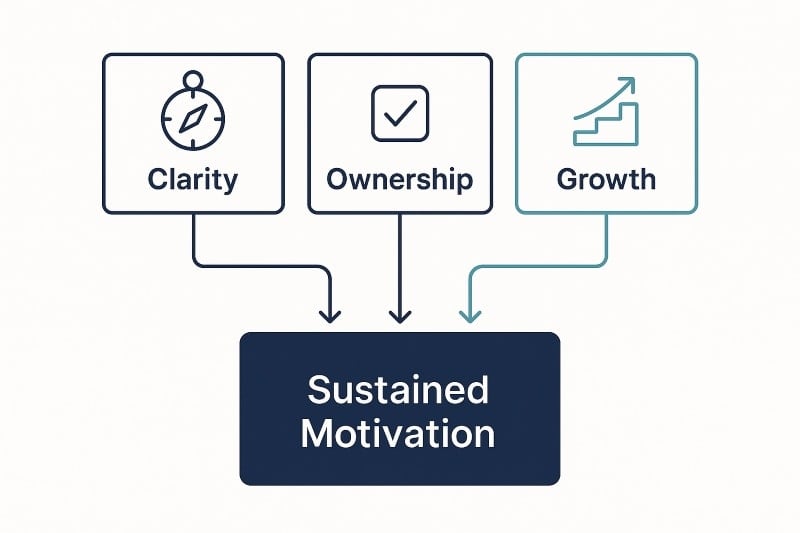
Translating insight into action starts with getting the basics right: clear expectations, real ownership, and visible growth. Most organizations do not need more motivational campaigns; they need consistent management habits that make it easier for employees to do meaningful work in a sustainable way.
We’ve seen companies spend heavily on annual ‘culture weeks’ while managers still cancel one-on-ones for months at a time. When those basic management habits shift, motivation improves even if the campaigns disappear.
When leaders align goals, autonomy, and recognition, they create conditions where both intrinsic and extrinsic motivators reinforce each other. These evidence-based strategies not only boost motivation but also improve employee engagement by aligning work with the organization’s larger purpose. The result is not a short-lived spike in enthusiasm, but a more stable pattern of engagement and performance.
Clarify Goals, Expectations, and Priorities
Employees cannot stay motivated if they are unsure what success looks like. Nothing erodes motivation faster than conflicting definitions of success: a sales rep told to ‘grow new accounts’ but measured mainly on short-term margin, or a manager rewarded for cost-cutting while being asked to ‘invest in people. Clear goals, aligned with the company’s strategy, give people a target for their effort and a way to judge progress. Aligning individual and team objectives with company goals ensures everyone is working toward the organization’s strategic priorities. Ambiguity, conflicting priorities, and frequent shifts in direction drain energy and create frustration.
Effective leaders translate organizational objectives into concrete expectations at team and individual level. They explain how specific tasks support business outcomes and adjust priorities when conditions change, instead of asking employees to do “everything” at once. This reduces noise, improves task performance, and gives employees a stronger sense of contribution.
Empower Employees and Build Ownership
Motivation increases when employees feel they have real influence over their work. Empowerment is not just delegating tasks; it is giving people decision rights, access to information, and the freedom to experiment within clear boundaries.
Practical moves include involving employees in problem-solving, asking for input before final decisions are made, and encouraging them to propose improvements to processes they use daily. When employees see their ideas implemented, they are more likely to take initiative again and less likely to default to passive compliance.
Strengthen Recognition and Growth Opportunities
Recognition is most effective when it is specific, timely, and linked to meaningful outcomes. Generic praise has limited impact; employees want to know what they did well and how it contributed to the team or organization’s success. This helps them repeat the behavior and reinforces a performance-focused culture.
Growth opportunities are equally important. Structured professional development, clear career paths, and access to learning resources show employees that the organization is invested in their future. When growth is visible and attainable, employees are more willing to stay, develop new skills, and stretch themselves in service of the company’s goals.
Building a Positive Work Environment That Sustains Motivation
A motivating work environment is built in small, repeated interactions, not in single events. Policies, tools, and programs matter, but employees experience the organization through daily conversations, meetings, and decisions that either support or undermine their ability to do good work. Building engagement through a strong organizational culture helps connect employees’ work to the company’s mission and values.
Leaders who pay attention to these details create conditions where motivation can survive the inevitable pressure of deadlines, market shifts, and organizational change.
Daily Management Habits That Build Engagement and Motivation
Certain management behaviors have a disproportionate impact on motivation: holding regular one-on-ones, giving actionable feedback, removing obstacles, and recognizing progress. When these habits are consistent, employees feel seen, supported, and able to focus on producing quality work instead of navigating unnecessary barriers. For example, a 15-minute Monday check-in where a manager clears roadblocks and confirms priorities often does more for motivation than an entire town hall.
Team-level practices also matter. Clear norms around communication, responsiveness, and collaboration help reduce friction between co-workers. When team members trust each other, share information freely, and feel safe asking for help, motivation becomes a shared resource rather than an individual struggle.

The Impact of Employee Motivation on Business Outcomes
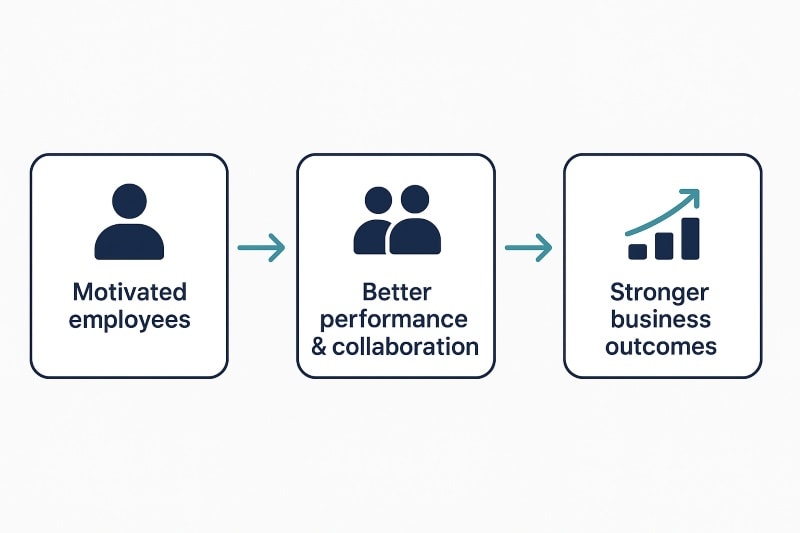
Employee motivation doesn’t just influence business outcomes — it transforms them entirely. Organizations rise or fall based on how deeply their workforce connects to purpose, growth, and recognition. When motivation flows freely through an organization, productivity surges, efficiency sharpens, and customer satisfaction reaches new heights. This isn’t coincidence. It’s the natural result of engaged employees who invest completely in organizational success, creating ripple effects that elevate everything from team morale to breakthrough innovation.
Motivated employees form the foundation upon which thriving organizations build their future. When people feel genuinely valued and secure, they don’t just meet expectations — they shatter them. Intrinsic motivators operate like internal engines: purpose drives direction, autonomy fuels ownership, and mastery opportunities spark continuous growth. These forces don’t require external pressure to sustain themselves. They create deeper organizational connections and push employees to deliver exceptional results, even when challenges intensify and circumstances demand resilience.
External rewards — competitive pay, comprehensive benefits, public recognition — ignite immediate action and drive short-term performance spikes. But sustainable motivation emerges when these extrinsic factors align with environments that prioritize security, development, and balance. Employees who access meaningful professional growth while feeling supported in their well-being don’t just stay engaged. They become organizational ambassadors, committed to long-term success and willing to invest their best efforts consistently.
Work-life balance has evolved from workplace perk to business necessity. Flexible arrangements, family support systems, and clear personal boundaries don’t just reduce stress — they amplify job satisfaction and sustain high performance over time. Organizations that invest strategically in these areas witness tangible returns: turnover drops, productivity climbs, and customer satisfaction strengthens. The equation is straightforward — support employee well-being, and business outcomes follow naturally.
Measuring motivation transforms good intentions into strategic advantage. Employee surveys, continuous feedback loops, and behavioral assessments reveal the precise factors that drive engagement and satisfaction. This data doesn’t just inform decisions — it empowers leaders to craft targeted interventions that actually work. More development opportunities, strategic recognition programs, and positive culture initiatives emerge from understanding, not guesswork.
Organizational psychology provides the roadmap for unlocking human potential at work. These insights don’t remain theoretical — they translate directly into role design, leadership practices, and work environments that empower teams and accelerate business success. Leadership becomes the multiplier effect. When leaders deliver clear feedback, empower decision-making, and model positive culture, they don’t just increase motivation. They create sustainable performance engines that drive organizational transformation and lasting competitive advantage.
Measuring Employee Motivation Over Time
Motivation is not static. It changes with leadership shifts, restructuring, market conditions, and personal circumstances. Treating it as a one-time project guarantees you will miss important inflection points where a timely intervention could have prevented disengagement or turnover.
Regular measurement does not mean constant surveying. It means combining a few well-chosen metrics with structured listening and acting on what you learn.
Key Metrics and Indicators
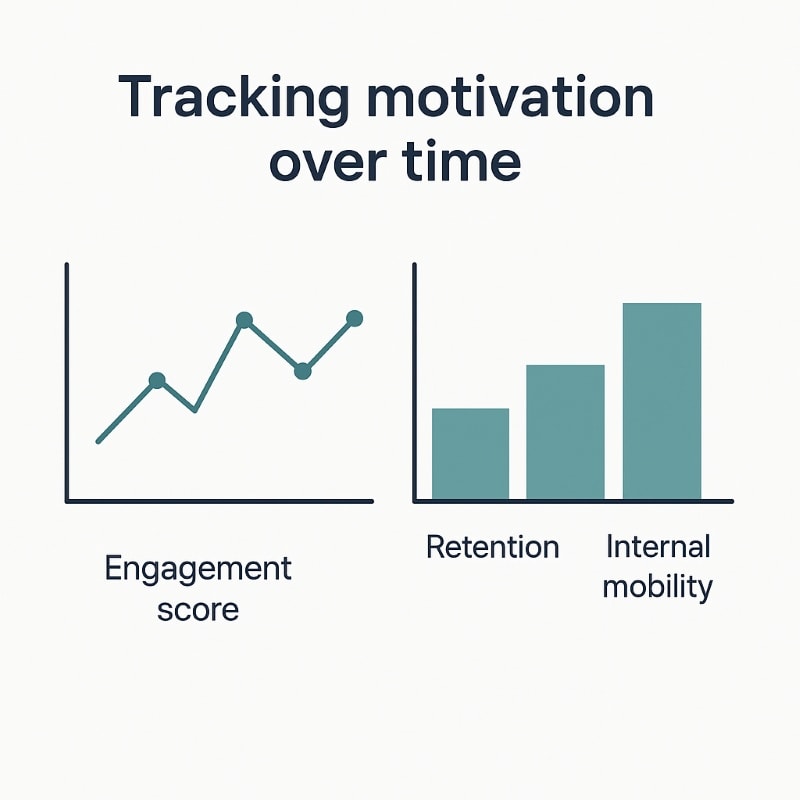
Common indicators include employee engagement scores, satisfaction with key aspects of the employee experience, retention and internal mobility rates, and quality and timeliness of output. None of these alone capture motivation, but together they reveal patterns worth investigating.
Segmenting results by team, role, and manager helps you see where motivation is strong and where it is at risk. Leaders like Warren Buffett are known for looking at the underlying drivers behind a single number. Treat motivation the same way: you don’t manage the overall score; you manage the patterns inside it. High performance with rising turnover, for example, may signal teams pushing hard without sufficient support or sustainable workload. Stable performance with declining engagement scores may indicate early-stage disengagement that has not yet reached output.
Turning Insights Into Action
The most important step is closing the loop. Communicating what you have learned, sharing the organization’s response, and involving employees in shaping solutions all strengthen trust. When people see their input reflected in concrete changes, they are more likely to engage honestly in future feedback efforts.
From there, tracking a small number of leading indicators over time allows you to see whether initiatives are improving motivation or simply shifting problems elsewhere. This approach supports continuous adjustment instead of cyclical “motivation drives” that fade once attention moves on.
Common Mistakes and How to Avoid Them
Many organizations invest in employee motivation but see limited results because their efforts are misdirected. The most common error is treating motivation as something to be “fixed” with perks and campaigns instead of addressing the underlying conditions that shape everyday work. Addressing the root causes of motivation is essential for supporting the organization’s success and long-term performance.
Another frequent mistake is pushing responsibility for motivation entirely onto HR while leadership behaviors, structure, and incentives remain unchanged. Employees quickly notice the gap between messaging and reality, and motivation erodes further.
Over-Relying on Perks and Quick Fixes
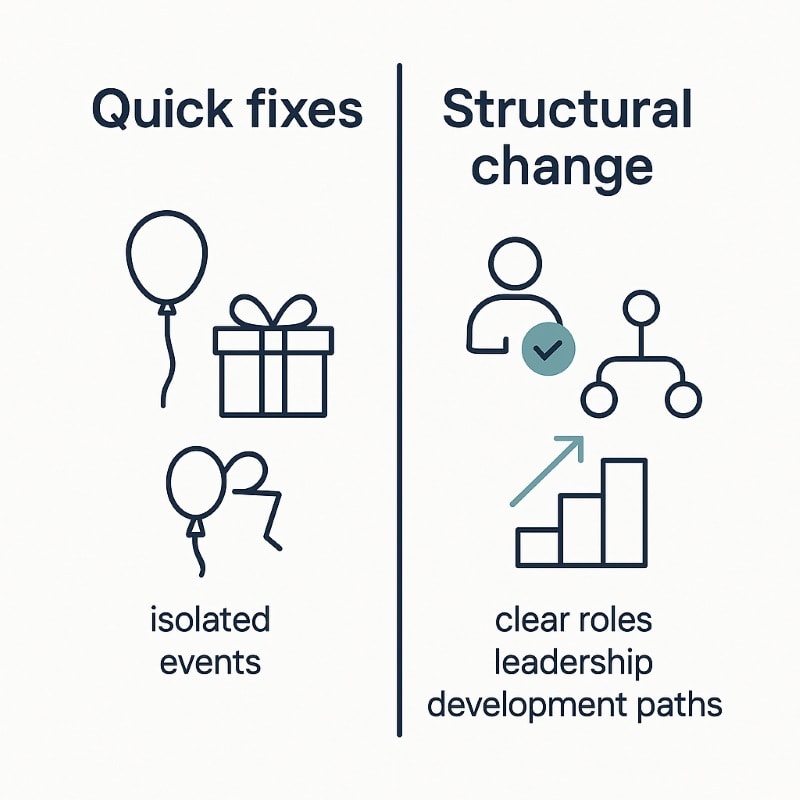
Perks such as social events, snacks, or one-off recognition programs can be appreciated, but they do not compensate for unclear roles, unrealistic workloads, or inconsistent leadership. A team that hasn’t had a realistic headcount in two years will not be ‘re-engaged’ by pizza or a mindfulness app. When core issues remain unresolved, these initiatives may even be perceived as attempts to distract from deeper problems.
Avoid this trap by addressing foundational elements first: role clarity, fair treatment, growth opportunities, and credible leadership communication. Perks should reinforce a healthy environment, not substitute for it.
Treating Motivation as a One-Time HR Project
Motivation is a product of organizational dynamics, not a quarterly campaign. If surveys, workshops, or new tools are launched without follow-through, employees learn that change is temporary and driven by trends rather than a real commitment to improvement.
To avoid this, anchor motivation initiatives in business strategy and leadership routines. Ensure senior leaders model the behaviors expected of managers and hold themselves accountable for the motivational climate in their areas of responsibility. Integrating motivation into ongoing business strategy is key to driving the company’s success and profitability.
Conclusion: A Practical Starting Point for Boosting Employee Motivation
Improving employee motivation does not require guessing what people want or chasing every new trend. It requires a clear understanding of what drives behavior at work, thoughtful alignment of roles and culture, and consistent leadership habits that support both performance and well-being.
Improving motivation is less about inspirational campaigns and more about design and data: designing roles and leadership routines that make good work possible, and using tools like OAD to see which levers matter for which people.
A practical starting point is simple: diagnose where motivation currently stands, clarify goals and expectations, strengthen daily management routines, and use data to refine your approach over time. Tools like OAD give you an additional layer of insight into what energizes different employees and how well they fit the roles and teams they are in.
When you are ready to move from intuition to evidence, you can start with the top perfromer profile and see how scientifically grounded insights into motivation, behavior, and role fit help you build teams that are motivated, aligned, and equipped to deliver sustained performance.