Work motivation is not a “nice-to-have” HR topic; it is one of the strongest predictors of how consistently people perform, collaborate, and stay with your organization. When employees are genuinely motivated, they bring discretionary effort, creative problem solving, and resilience that no policy or process can substitute. Treating work motivation as a strategic priority, not an afterthought, is the starting point for building a high-performing, future-ready workforce.
What Is Work Motivation?
Defining work motivation in organizational psychology
Work motivation describes the psychological processes that initiate, direct, and sustain work-related behavior. In organizational psychology, it explains why employees choose to invest energy in some tasks and not others, why they persist when work is difficult, and why some teams consistently achieve success while others stall. It links internal drivers like values and goals with external factors such as role design, leadership, and the broader workplace environment.
Picture two analysts: one checks reports because they have to; the other double-checks assumptions because they care about getting it right. Same task, totally different motivation.
At OAD, we often see two engineers with identical skills produce wildly different results simply because one feels connected to the outcome and the other doesn’t. Visualizing high-performance standards and exemplifying success helps employees understand the characteristics of excellence within the organization, aligning their efforts with the company’s goals.
Work motivation vs. employee engagement: what’s the difference?
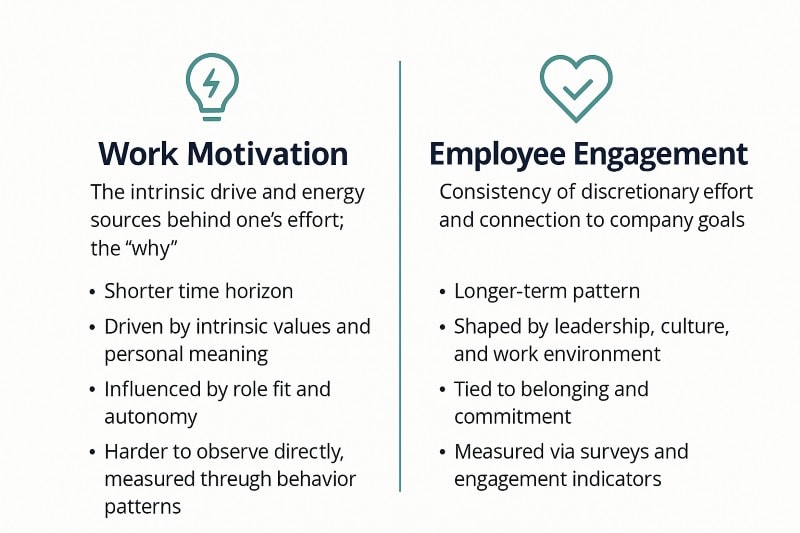
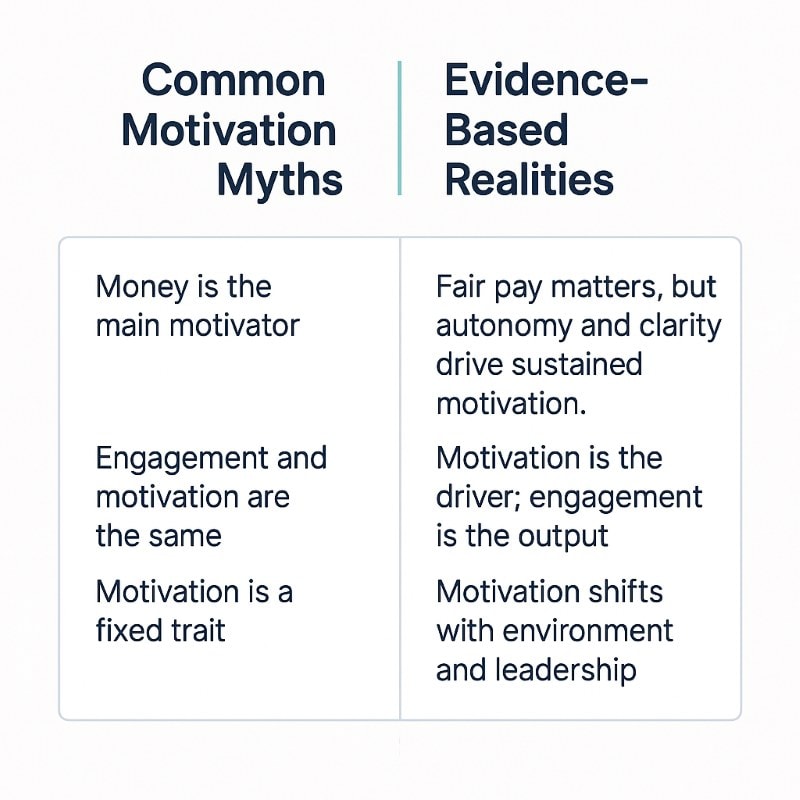
Employee engagement describes how consistently employees bring effort, focus, and participation to their roles. Work motivation explains the “why” behind that behavior: the underlying reasons employees feel motivated to contribute in the first place. Engagement can look high for a time even when true motivation is fragile, for example when people work hard out of fear of negative consequences rather than a deeper connection to the company’s mission. If you only track engagement scores without understanding motivation, you risk optimizing for visible activity instead of sustainable performance.
We see teams that hit numbers for three quarters straight, then collapse because fear, not commitment, was the real engine.
A team can look “engaged” during a product launch simply because everyone is afraid to miss a deadline, not because they believe in the mission.
Think of the engineer who gets ownership of a small feature versus the engineer buried under Jira tickets they didn’t choose. The first ships faster. The second counts days.
How work motivation influences performance, retention, and well-being
Motivation at work has a direct impact on performance: highly motivated employees initiate work-related behavior proactively, solve problems creatively, and follow through on goals without constant supervision. Over time, strong work motivation is linked to higher quality, fewer mistakes, and more consistent goal attainment across the team. Low or unstable motivation, by contrast, often shows up as missed deadlines, minimal effort, or resistance to change long before it appears in formal performance reviews.
Harvard’s Teresa Amabile found that people do their most creative work on days when they feel steady progress. OAD’s data aligns with this: progress is one of the strongest drivers of day-to-day motivation.
Decades of research from organizational psychology shows that motivation predicts performance more reliably than experience or tenure. OAD data reinforces this: teams scoring high on motivation-based indicators consistently outperform their counterparts even in high-pressure cycles.
Work motivation also shapes retention and emotional well-being. Employees who feel a strong sense of purpose, psychological safety, and alignment with organizational goals are more likely to stay, recommend the company, and recover from setbacks. When employees feel motivated and aligned with organizational goals, it leads to positive outcomes for both individuals and the organization. When people do not feel motivated, they disengage mentally long before they leave physically, which quietly erodes team performance and company culture.
Leaders like Satya Nadella built entire cultural turnarounds on this principle, shifting from fear-based performance to growth-based motivation.
Key types of work motivation in the modern workplace
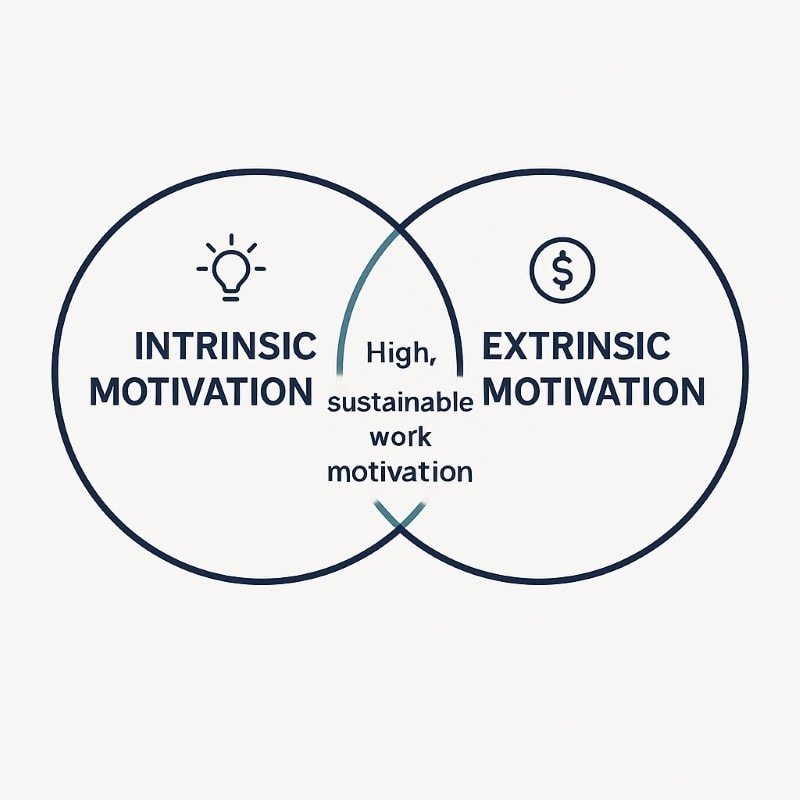
In today’s workplace, motivation is rarely driven by a single factor. Intrinsic motivation arises from the work itself: meaningful work, opportunities for personal growth, and a feeling of mastery or progress. Extrinsic motivation comes from external rewards and pressures, such as financial incentives, recognition, or fear of negative consequences. Social factors like team norms, leadership style, and the broader social context of the organization also play a crucial role in how motivated employees feel. In addition to these, other factors, such as organizational culture, team dynamics, and personality traits, also influence motivation in the workplace.
At OAD, profiles with high “ownership” scores naturally lean toward intrinsic drivers, while structured profiles often need clearer external signals.
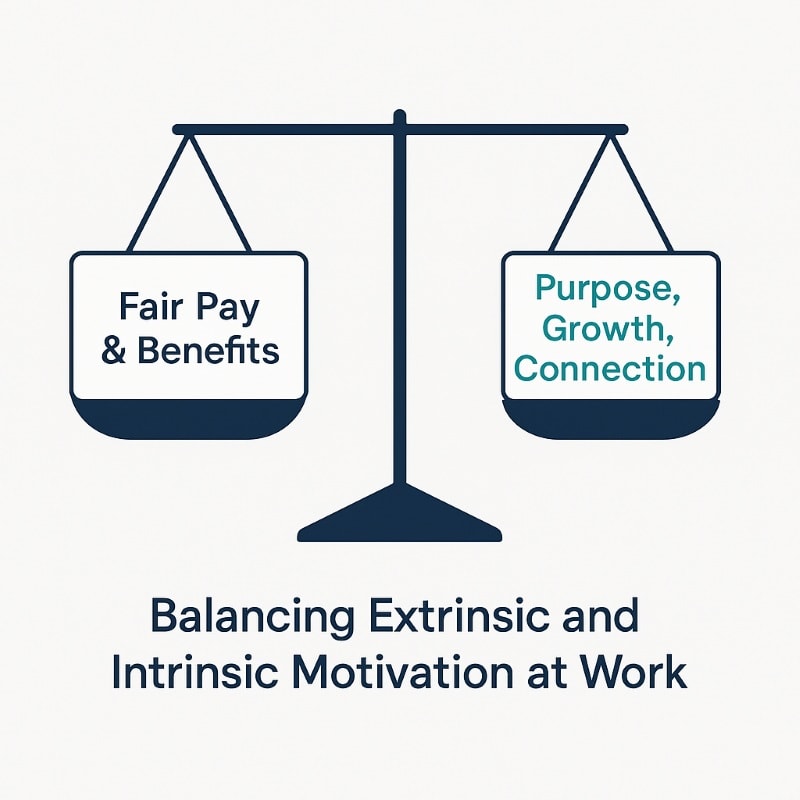
Effective leaders don’t choose between intrinsic and extrinsic motivation. They design a positive work environment where employees feel valued, see how their team’s contributions support the company’s goals, and receive fair extrinsic rewards. At the same time, they protect the intrinsic motivators that turn motivated employees into highly motivated, resilient teams.
Intrinsic and Extrinsic Motivation at Work
What is intrinsic motivation and why it matters for meaningful work
Intrinsic motivation describes doing work because the work itself is interesting, challenging, or personally meaningful. Employees feel a strong sense of ownership, curiosity, or satisfaction when they complete tasks, learn a new skill, or see the positive impact of their work. This type of motivation is closely tied to self-motivation and emotional well-being, because people feel that their daily efforts align with their values and long-term goals. Understanding and finding meaning in work is a vital factor for engagement and motivation.
When intrinsic motivation is high, employees initiate work-related behavior without needing constant reminders, incentives, or pressure. They are more willing to experiment, seek feedback, and develop creative solutions, because the work is not just a to-do list but a meaningful learning process. Over time, this leads to higher-quality work performance, stronger problem solving, and a deeper connection to the company’s mission.
What is extrinsic motivation and how external rewards shape behavior
Extrinsic motivation is driven by external factors such as financial incentives, bonuses, promotions, public recognition, or avoiding negative consequences. These external rewards and pressures can have a direct impact on short-term behavior. Employees may work longer hours, complete more tasks, or respond quickly to urgent requests when tangible rewards or clear consequences are on the line.
Used well, extrinsic motivators clarify priorities and signal what the organization values. Fair pay, competitive benefits, and recognition programs help employees feel that their contributions are seen and rewarded. However, when extrinsic motivation is the only focus, employees can become dependent on rewards, feel controlled, or experience pressure that undermines their emotional well-being. In such environments, motivation levels often swing with each new policy or incentive plan.
Daniel Pink’s research highlights this blind spot: rewards help with routine tasks but can narrow focus and undermine problem-solving in complex roles.
How intrinsic and extrinsic motivation interact in real workplaces
In real organizations, intrinsic and extrinsic motivation are constantly interacting. A well-designed role with meaningful work, clear goals, and growth opportunities can be supported by fair compensation and recognition, creating a strong, positive feedback loop. Effective leaders understand and tap into the highest human motivations to foster trust and commitment. Employees feel motivated internally and see that the organization backs this with external rewards, which reinforces trust and commitment.
Problems arise when extrinsic motivators override or conflict with intrinsic drivers. For example, aggressive bonus schemes that reward individual performance at the expense of collaboration can damage team trust and psychological safety. Similarly, constant short-term incentives for volume can push employees to prioritize speed over quality, eroding their sense of craftsmanship and pride in their work. When this happens, employees may start to do “just enough” to secure rewards rather than striving for high performance.
Sales teams chasing monthly bonuses often cannibalize long-term accounts just to hit the number.
When extrinsic motivators undermine intrinsic motivation
Motivation research has repeatedly shown that excessive control, narrow targets, and overused rewards can crowd out intrinsic motivation. When employees feel that every action is monitored, measured, and rewarded, they may stop asking, “What is the best way to do this?” and instead ask, “What will get me the bonus or keep me out of trouble?” The result is compliance rather than genuine commitment. Even Elon Musk, known for intensity, publicly stresses autonomy for engineers because it keeps intrinsic drive intact.
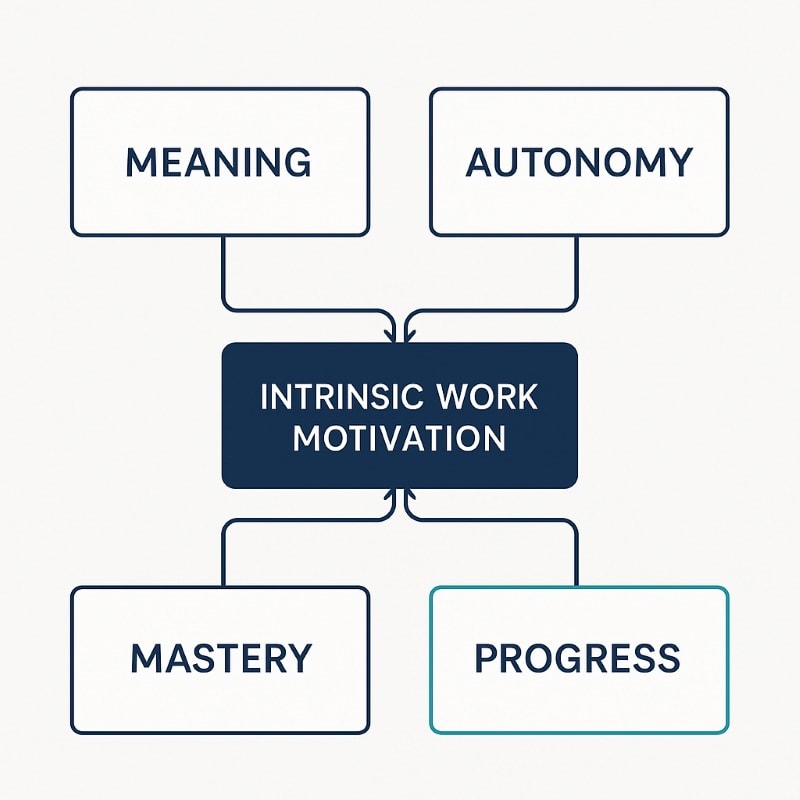
Leaders need to pay close attention to how performance systems, metrics, and reward structures shape day-to-day behavior. Extrinsic motivators should support, not replace, intrinsic motivators such as mastery, autonomy, purpose, and social connection. If employees once felt proud of their work but now feel pressured, transactional, or disconnected from the company’s goals, it is a sign that extrinsic motivators are doing more harm than good.
Core Motivation Theories HR Should Actually Use
Self-determination theory: autonomy, competence, and relatedness
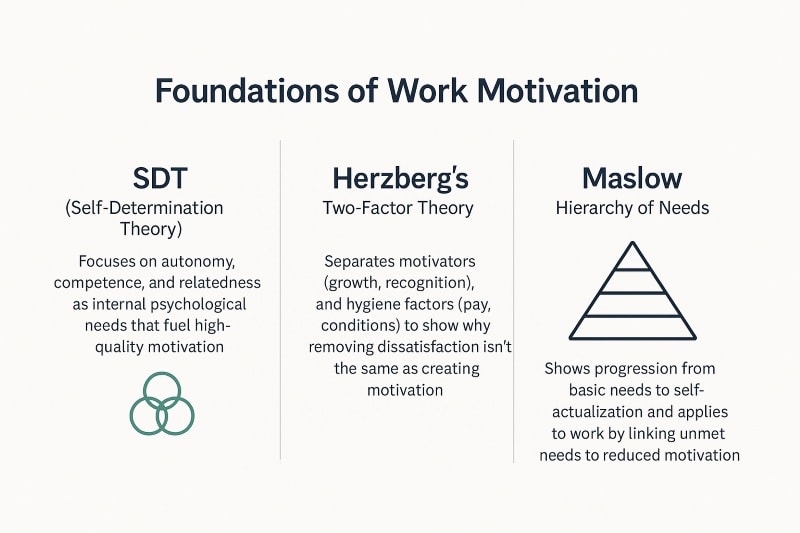
Self-determination theory (SDT) is one of the most practical frameworks for understanding motivation at work. It suggests that people feel motivated when three core psychological needs are met: autonomy (having control over how they do their work), competence (feeling capable and effective), and relatedness (feeling connected to others and the company’s mission). When these needs are supported, intrinsic motivation and self-motivation increase naturally. A developer given freedom to choose tools (autonomy), stretch tasks (competence), and a clear customer benefit (relatedness) will outperform one simply following a Jira queue.
In practice, this means employees are more likely to feel motivated when they can make real decisions about their tasks, see that their skills are growing, and feel that their contributions matter to the team and organization. When autonomy is replaced by micromanagement, or when employees never receive constructive feedback to build competence, motivation quietly declines. Supporting these needs consistently is far more effective than simply adding another bonus or perk.
Herzberg’s two-factor theory: motivators vs. hygiene factors
Herzberg’s two-factor theory distinguishes between “motivators” and “hygiene factors.” Motivators are elements that directly increase motivation, such as meaningful work, recognition, responsibility, and opportunities for advancement. Hygiene factors, like salary, policies, and working conditions, do not create motivation on their own, but when missing or unfair, they cause dissatisfaction and reduce motivation.
For HR and leaders, this distinction is crucial. Financial incentives, clear policies, and a safe work environment are non-negotiable hygiene factors. These hygiene factors are closely linked to employee satisfaction, which plays a key role in influencing workplace motivation and employee behavior. They prevent frustration and negative consequences but rarely create highly motivated employees on their own. To truly improve motivation levels, organizations also need to invest in motivators: designing roles with purpose, providing recognition that feels genuine, and giving employees room to grow and contribute at a higher level.
Maslow’s hierarchy of needs in a modern organizational context
Maslow’s hierarchy of needs is often simplified into a pyramid, but the core idea is straightforward: people are more likely to focus on higher-order needs, such as esteem and self-actualization, when more basic needs are reasonably met. In the workplace, this translates into a sequence: if employees do not feel physically safe, financially stable, or respected, they will struggle to fully engage with goals related to personal growth, innovation, or long-term contribution.
In modern organizations, this means that initiatives around “purpose” and “meaningful work” must be grounded in reality. Talking about self-actualization while employees experience constant role uncertainty, unclear expectations, or inconsistent leadership will ring hollow. Addressing basic needs like clarity, fairness, and psychological safety is not optional; it is the foundation that allows higher levels of work motivation to develop.
What motivation research tells us about high-performance workplaces
Across frameworks, a consistent pattern emerges in motivation research: environments that combine clarity, fairness, and psychological safety with opportunities for mastery and contribution tend to produce highly motivated teams. Employees in these environments understand the company’s goals, see how their work contributes, and feel trusted to use their judgment. They receive regular, constructive feedback that helps them learn rather than fear failure.
For HR leaders and executives, the implication is clear. Improving work motivation is less about finding a single “magic” reward and more about aligning systems, leadership behavior, and role design with how human motivation actually works. When performance management, reward structures, and day-to-day leadership all support intrinsic and extrinsic motivation in a balanced way, motivation becomes a measurable, manageable driver of organizational performance rather than a vague, “soft” topic. Regularly measuring motivation through surveys and performance metrics is essential to track progress and inform improvements.
Intrinsic Work Motivation: Building Deep, Sustainable Drive
Designing roles that feel meaningful and connected to the company’s mission
Intrinsic motivation grows when employees feel that their work matters. That starts with role design. If a role is a long list of disconnected tasks, employees struggle to see the point. When roles are framed around clear outcomes and their link to the company’s mission, employees can draw a direct line from their daily work to a meaningful impact.
For example, “process invoices” is a task. “Ensure our suppliers are paid accurately and on time so we can deliver reliably to customers” is a purpose. The work is the same, but the psychological experience is very different. Employees in purpose-framed roles are more likely to feel motivated, take ownership, and initiate work-related behavior without constant prompting.
Autonomy and trust: giving employees real control over how they work
Autonomy is one of the strongest drivers of work motivation. Employees who have a say in how they organize their work, which methods they use, and how they solve problems feel trusted and respected. This sense of control taps into self-motivation and increases their willingness to take initiative, experiment, and own results.
This does not mean a complete absence of structure. Clear goals, boundaries, and expectations remain essential. The shift is from “do exactly what I say” to “here is the outcome we need; use your professional judgment to get us there.” Micromanagement, overly rigid processes, and constant checking signal a lack of trust and quickly erode intrinsic motivation, even in otherwise positive work environments.
Mastery and personal growth: learning processes, new skills, and stretch goals
Highly motivated employees usually feel they are getting better at something that matters. Mastery is not about endless training courses; it is about a continuous learning process embedded in real work. Projects that stretch current skills, opportunities to learn new skills, and time to reflect on what worked and what did not all contribute to intrinsic motivation.
Leaders can support this by aligning development with both organizational goals and personal growth. This includes designing assignments that gradually increase in complexity, pairing less experienced employees with mentors, and making it normal to talk about learning, not just outcomes. When employees see progress in their capabilities, they feel a strong sense of forward motion, which reinforces motivation at work.
Feedback, recognition, and a strong sense of progress
Intrinsic motivation thrives when employees see evidence that their efforts matter. Specific, constructive feedback helps people understand how their work contributes to team goals and where they can improve. Recognizing the team’s contributions in a meaningful and frequent way is essential to sustaining motivation and engagement. Recognition that focuses on impact (“your analysis helped the team avoid a costly mistake”) rather than vague praise (“good job”) deepens the emotional connection to the work.
A strong sense of progress is also created through clear goals and visible milestones. When teams track meaningful indicators, celebrate progress, and review lessons learned, they create a positive feedback loop. Employees feel that their contributions are noticed and that their work is moving something forward, which sustains motivation even during demanding periods.
Supporting emotional well-being and self-motivation
Intrinsic motivation is hard to sustain in environments that constantly drain emotional energy. Chronic stress, unresolved conflict, and unclear expectations undermine the psychological resources people need to stay motivated. Supporting emotional well-being is not a “nice extra”; it is a precondition for self-motivation and high performance.
This includes practical steps: manageable workloads, realistic timelines, psychological safety to speak up about problems, and leaders who model healthy boundaries. When employees trust that the organization cares about their well-being and not just their output, they are far more likely to invest discretionary effort and remain motivated over the long term. Trust predicts discretionary effort more accurately than reward systems. Gallup found that employees who trust leadership are 4x more likely to stay engaged even during restructuring.
Extrinsic Motivation: Using Rewards Without Creating Dependency
Financial incentives, bonuses, and pay fairness as extrinsic motivators
Extrinsic motivation often starts with the most visible factor: pay. Financial incentives, bonuses, and performance-based rewards can have a clear, direct impact on work-related behavior. When employees believe compensation is fair and aligned with their contributions, they are more likely to feel respected and willing to put in extra effort. Conversely, perceived unfairness in pay or bonuses is one of the fastest ways to damage employee motivation and trust.
However, financial incentives work best when they are part of a broader system, not the only tool. Over-reliance on bonuses to drive work motivation can push employees to focus on short-term metrics at the expense of long-term quality, collaboration, or innovation. Pay needs to be competitive and transparent enough to remove it as a constant concern, so employees can focus their energy on meaningful work rather than on negotiating or second-guessing their value.
Tangible rewards, benefits, and hygiene factors that prevent dissatisfaction
Beyond salary, tangible rewards and benefits form part of the “hygiene factors” that Herzberg identified. Health insurance, flexible work options, safe working conditions, modern tools, and clear policies may not create highly motivated employees by themselves, but when they are missing or inconsistent, they quickly create dissatisfaction. In other words, these hygiene factors are essential to prevent motivation from eroding.
Thoughtful benefits also send a clear signal about the company’s culture and priorities. Support for professional development, mental health resources, and family-friendly policies communicate that the organization sees employees as long-term partners, not just resources. When the basic work environment is stable and supportive, employees are more open to engaging with intrinsic motivators like growth, mastery, and deeper connection to the company’s goals.
Managing negative consequences, fear, and punitive cultures
Not all extrinsic motivators are positive. Negative consequences such as public criticism, constant threat of punishment, or a culture of blame can shape behavior in the short term, but they do so at a high cost. Fear-based environments often produce compliance, not commitment. Employees become highly focused on avoiding mistakes rather than pursuing creative solutions or stretching beyond their comfort zone.
Over time, punitive cultures damage psychological safety, reduce trust in leadership, and push motivated employees to leave. The remaining workforce may appear disciplined on the surface, but work motivation is fragile and transactional. High-performance organizations set clear accountability and expectations, yet handle mistakes and underperformance in a way that supports learning and continuous improvement, not fear and withdrawal.
When external rewards are effective and when they backfire
External rewards are most effective when they reinforce behaviors that are already aligned with intrinsic motivation and organizational goals. For instance, recognizing a team for cross-functional collaboration can strengthen both social connection and a culture of shared ownership. Targeted bonuses for meaningful achievements can highlight what truly matters and create a positive feedback loop around high-value behaviors.
They backfire when they:
- Reward the wrong behaviors (for example, volume over quality).
- Create internal competition where collaboration is needed.
- Feel random, opaque, or politically driven.
- Are used as a substitute for fair base pay, clear roles, or good leadership.
The test is simple: do external rewards help employees feel more connected to their work and the organization’s mission, or do they make work feel more like a series of transactions? Leaders who regularly ask this question are better equipped to design extrinsic motivation systems that support, rather than erode, long-term work motivation.
The Work Environment: Where Motivation Lives or Dies
Psychological safety and employees’ trust in their leaders
Work motivation is fragile in environments where people feel they have to protect themselves. Psychological safety means employees can ask questions, admit mistakes, and challenge assumptions without fearing negative consequences. When this is present, people are more willing to contribute ideas, take intelligent risks, and own outcomes. When it is missing, they default to self-protection and do the minimum required to stay out of trouble.
Trust in leaders is a direct amplifier or drain on motivation. Employees watch closely: do leaders keep commitments, share information transparently, and handle setbacks fairly, or do they shift blame and change direction without explanation? Where trust is high, employees are more likely to stay engaged during difficult periods and believe that their effort will be met with support, not criticism.
Company culture and clear organizational goals as motivation drivers
Company culture is the day-to-day social context in which work motivation plays out. It is visible in what gets rewarded, how decisions are made, and how leaders behave when under pressure. Cultures that link daily work to clear organizational goals, communicate priorities consistently, and model the company’s stated values create a strong sense of direction for employees. A well-aligned culture and clear goals are essential for sustaining employee motivation across the organization. Think less “vision statement,” more “playbook.” Elite teams don’t guess the next move; neither should yours.
Without clarity on goals and priorities, even highly motivated employees burn energy on the wrong things. Motivation at work is not just about intensity, but about alignment. When employees understand how their team’s contributions support the company’s mission and long-term objectives, they can direct their motivation toward meaningful outcomes rather than guessing what matters most.
Social factors: team dynamics, social context, and peer influence
Humans are deeply influenced by the people around them. Team dynamics, informal norms, and peer expectations all have a significant impact on motivation levels. In teams where collaboration is expected, colleagues support each other, and success is shared, motivation tends to spread. In teams dominated by internal competition, siloed behavior, or unresolved conflict, motivation quickly becomes uneven and fragile.
Leaders need to pay attention not just to individual performance but to the social context in which work happens. A single consistently negative or undermining team member can erode motivation for an entire group. Conversely, a few highly motivated, constructive individuals who demonstrate ownership and optimism can lift the standard for everyone.
Workplace environment, workload, and emotional well-being
The physical and digital work environment also shapes motivation. Poor tools, constant interruptions, or unrealistic workloads reduce the mental bandwidth needed for high-quality work and self-motivation. Employees may still care, but they feel stuck in systems that make it difficult to do their best work. Over time, this leads to frustration, emotional exhaustion, and a quiet withdrawal of effort.
Balancing workload, clarifying priorities, and providing the right resources are basic, but often overlooked, drivers of work motivation. When employees see that the organization actively removes barriers and designs the environment for focus and effectiveness, they feel respected and supported, which reinforces their willingness to invest effort.
Creating a positive work environment where employees feel valued
A positive work environment is not about constant celebration or forced optimism. It is about day-to-day practices that signal respect: listening carefully, involving people in decisions that affect their work, recognizing contributions, and addressing issues rather than ignoring them. When employees feel valued as people and professionals, they are more likely to feel motivated and stay committed during both stable and challenging periods. A psychologically safe environment works more like a high-trust combat unit than a cheerful office. Reliability beats enthusiasm.

How to Measure Work Motivation Without Getting Lost in Vanity Metrics
What to measure: motivation levels, satisfaction, and work-related behavior
Work motivation is invisible unless you measure it deliberately. Useful measurement focuses on three areas: how motivated employees feel, how satisfied they are with key aspects of their work, and how this shows up in observable behavior. Motivation surveys, targeted questions about meaningful work, autonomy, and growth, and structured check-ins provide a baseline. They complement, rather than replace, traditional engagement scores. Measuring motivation regularly is essential for assessing employee motivation levels and informing leadership strategies, ensuring that interventions are data-driven and effective.
The goal is to understand not just whether employees like their jobs, but why they choose to give extra effort or hold back. Questions that probe intrinsic motivation (purpose, mastery, connection) and extrinsic factors (fairness, rewards, workload) reveal which levers are currently supporting or undermining motivation at work.
Surveys, pulse checks, and qualitative feedback that reveal real motivation
Annual engagement surveys give a snapshot, but motivation is dynamic. Shorter, focused pulse checks can detect shifts in motivation levels earlier, especially during change or high-pressure periods. Open-text questions and qualitative feedback from listening sessions or focus groups add context to quantitative scores and highlight specific barriers or enablers.
Leaders should treat these tools as starting points for dialogue, not as scorecards. When employees see that honest feedback leads to action, they are more likely to share accurate information about what helps or hurts their motivation. When feedback disappears into a black box, motivation to participate in future surveys drops quickly.
Behavioral indicators: initiative, creative solutions, and discretionary effort
Beyond self-reported data, motivation shows up in behavior. Employees who regularly propose improvements, volunteer for cross-functional projects, or help colleagues without being asked are signaling high work motivation. A decline in initiative, growing resistance to change, or an increase in “checking out” behaviors (silent meetings, defaults to minimal effort) often indicates that motivation is slipping.
Tracking these patterns at team level, alongside performance and retention data, helps identify where deeper investigation is needed. The point is not to label individuals, but to spot where the work environment or leadership context may be limiting motivation.
Linking motivation data to performance, turnover, and business outcomes
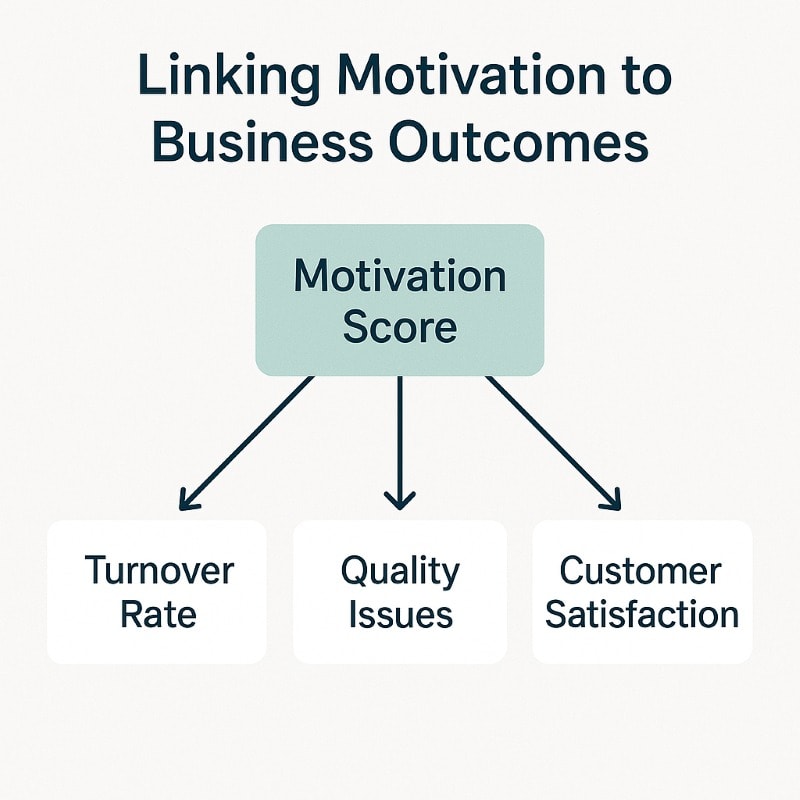
Work motivation becomes a strategic asset when it is linked to hard outcomes. Comparing motivation and satisfaction data with metrics like turnover, absenteeism, quality errors, and customer satisfaction can reveal clear relationships. Teams with consistently higher motivation scores often show better performance and lower unwanted turnover.
In one client’s manufacturing division, motivation dips predicted quality defects nearly six months before they appeared in performance metrics. Linking these insights gave leadership weeks of lead time instead of reacting after the damage was done.
By treating motivation metrics as part of the same dashboard as operational and financial indicators, executives and HR leaders avoid the trap of treating motivation as a “soft” side project. Instead, it becomes part of a continuous improvement system that connects human motivation, work design, and business results.
Practical Strategies to Improve Work Motivation at Scale
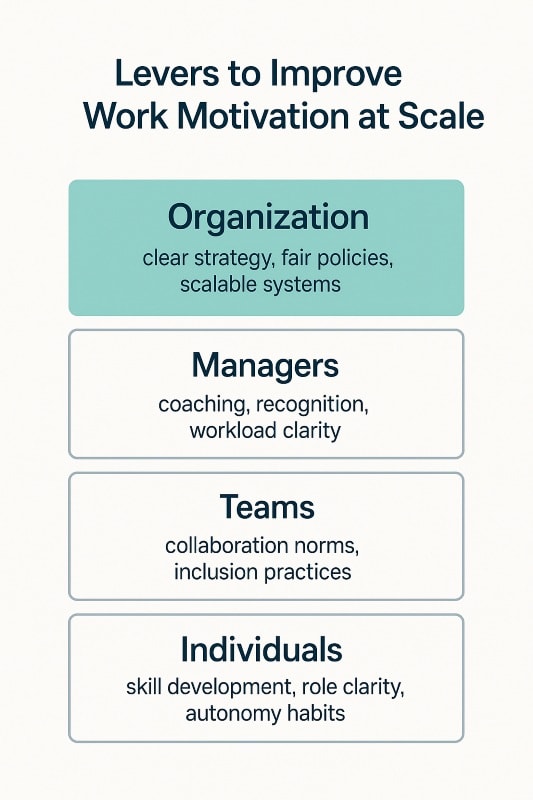
Organizational-level levers: strategy, company culture, and systems
At the organizational level, work motivation improves when strategy, culture, and systems are coherent. This means clearly articulating the company’s mission, translating it into concrete objectives, and aligning policies and processes accordingly. If the strategy emphasizes innovation but systems punish failure harshly, employees receive conflicting signals that suppress motivation.
Practical steps include clarifying values and behaviors, simplifying decision-making structures, and ensuring that performance management reinforces the behaviors the organization actually wants. When employees see that systems support, rather than contradict, the stated mission, their motivation to contribute meaningfully increases.
Manager-level behaviors: coaching, constructive feedback, and role clarity
Managers are the direct lens through which employees experience the organization. Their behavior has a direct impact on motivation levels. Managers who provide role clarity, set realistic expectations, and check in regularly on both progress and well-being create conditions where employees can focus on doing their best work instead of guessing what is expected.
Coaching and constructive feedback are equally important. Instead of only intervening when things go wrong, effective managers help employees set goals, seek feedback, and reflect on what they are learning. They recognize achievements in specific, credible ways and address performance issues early and fairly. Over time, this builds trust, self-motivation, and a sense of shared responsibility for results.
Team-level practices: norms, collaboration, and shared ownership
Teams with strong work motivation often have clear norms about how they operate. They agree on how decisions are made, how conflicts are handled, and how responsibilities are shared. Leaders can support this by facilitating explicit discussions about team expectations rather than assuming that everyone shares the same unwritten rules.
Collaboration practices also matter. Regular knowledge-sharing, peer feedback, and moments where teams reflect together on successes and failures create a sense of shared ownership. When people feel accountable not only to their manager but also to their peers, motivation to contribute and not let the team down increases.
Individual-level strategies: self-regulation, goal setting, and personal growth
Employees are not passive recipients of motivation. They can actively shape their own experience through self-regulation strategies. Setting clear personal goals, breaking complex work into manageable steps, and scheduling focused time for deep work help individuals maintain momentum. Seeking feedback intentionally, rather than waiting for annual reviews, accelerates learning.
Organizations can support this by providing tools and frameworks for personal goal setting, time management, and career planning. When employees feel empowered to influence their own trajectory, they are more likely to invest energy in building new skills and pursuing opportunities that align with both their interests and organizational goals.
Encouraging employees to seek feedback and own their development
One of the most powerful shifts in work motivation occurs when employees see their development as a shared responsibility, not something that “belongs” to HR or their manager. Leaders can encourage this by normalizing upward feedback, creating space for career conversations, and rewarding initiative in learning.
Simple practices such as asking, “What skill do you want to grow this quarter?” or “What kind of projects would stretch you in a good way?” signal that development is not an afterthought. Over time, this encourages individuals to seek feedback, propose growth opportunities, and take ownership of their learning process, which directly strengthens self-motivation.
Common Myths and Mistakes About Work Motivation
Myth 1: “Money is the main motivator”
Compensation must be fair, but beyond a certain threshold, simply adding more financial incentives does not reliably create higher work motivation. When pay is the only lever, employees often focus on maximizing rewards rather than doing what is best for the customer, team, or long-term health of the business. Intrinsic motivation, growth opportunities, and a strong sense of purpose become decisive factors once basic financial needs are met.
Myth 2: “Perks and fun events are enough to keep people motivated”
Perks, social events, and office comforts can make work more pleasant, but they cannot compensate for poor leadership, unclear roles, or a lack of meaningful work. Employees may appreciate these benefits while still feeling disconnected from the company’s mission or frustrated by daily obstacles. Sustainable work motivation depends much more on role design, psychological safety, and fair systems than on surface-level perks.
Myth 3: “High performers are always highly motivated”
High performance and high motivation are not the same thing. Some high performers are driven primarily by external pressure or fear of negative consequences. They may deliver results while feeling exhausted, disengaged, or ready to leave. Without understanding what truly drives these individuals, organizations risk burning out their most capable people and misreading early warning signs.
Myth 4: “Motivation is HR’s problem to solve”
HR can design frameworks, provide tools, and support leaders, but day-to-day work motivation is shaped most directly by managers, team dynamics, and organizational decisions. Treating motivation as a project owned only by HR isolates it from strategy and operations. When executives and line leaders take shared responsibility for creating a motivating work environment, initiatives have a far better chance of producing real, measurable change.
Building a Continuous Improvement Loop Around Work Motivation
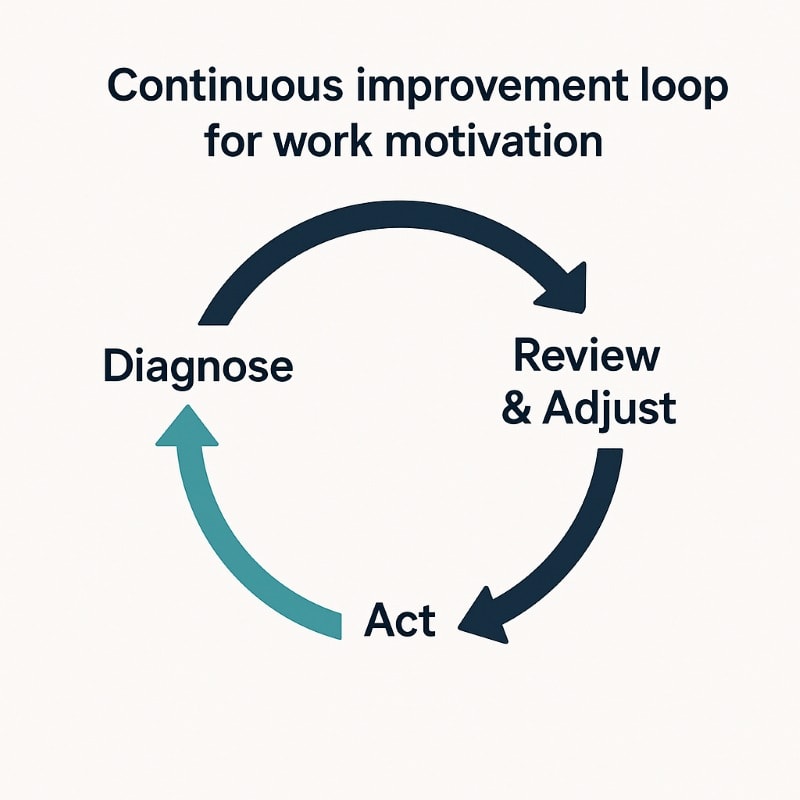
Diagnose: measure motivation and identify root causes
The first step in improving work motivation is to move from assumptions to data. This means combining surveys, interviews, and behavioral indicators to understand where motivation is strong and where it is fragile. Rather than jumping straight to solutions, leaders should ask: which teams are thriving, which are struggling, and what patterns connect them?
Diagnosing root causes requires looking beyond surface symptoms. Low motivation in one area might be driven by unclear goals, while in another it might stem from a lack of growth opportunities or poor team dynamics. Treating all motivation problems with the same generic intervention rarely works.
Further research is needed to deepen understanding of the social and cultural factors influencing work motivation.
Act: design targeted interventions instead of random initiatives
Once patterns are clear, organizations can design targeted actions. For example, teams suffering from low psychological safety might benefit from leadership training and structured forums for feedback, while teams facing role confusion may need redesigned job descriptions and clearer decision rights. The key is to focus on a few high-impact changes rather than launching a long list of disconnected initiatives.
Communicating the “why” behind these actions is critical. Employees are more likely to re-engage when they see that feedback has been taken seriously and translated into concrete steps, not just written into a report.
Review & adjust: learning from data and feedback
Work motivation is not a one-time project; it is an ongoing learning process. After interventions are implemented, organizations should revisit the same indicators they used in diagnosis: motivation scores, behavioral patterns, performance, and retention. Where improvements appear, leaders can double down. Where little changes, they can refine their approach based on new feedback.
Creating this continuous improvement loop turns work motivation into a manageable, evidence-based area of leadership, rather than a vague concept. It also signals to employees that their experience at work is not static, but something the organization is committed to improving over time.
How OAD Helps You Build Highly Motivated Teams
Using OAD data to understand individual and team motivation drivers
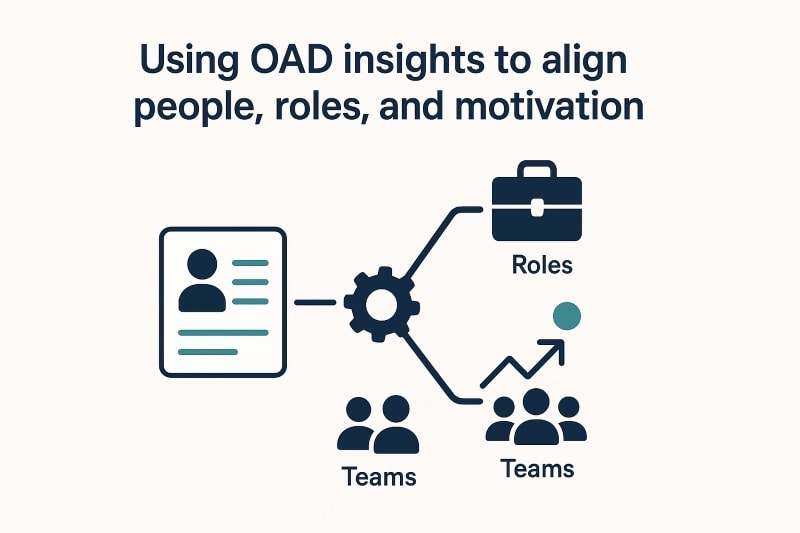
Generic motivation programs often fail because they treat all employees as if they are motivated by the same things. OAD provides scientifically grounded insight into individual work styles, needs, and behavioral tendencies, helping leaders understand what drives motivation for different people and teams. Instead of guessing, managers can see which roles, environments, and leadership styles are likely to support or undermine motivation.
Matching people to roles, managers, and environments that fit their profile
Work motivation increases dramatically when there is a strong fit between a person and their role. OAD helps organizations identify this fit more precisely. By understanding how an individual prefers to work, make decisions, and interact with others, leaders can place them in roles and teams where those preferences become strengths rather than sources of friction.
This also extends to manager-employee fit. Some employees thrive with a highly structured leader; others are more motivated when given broad objectives and room to experiment. OAD insights help leaders adapt their approach or adjust reporting lines to minimize unnecessary friction and maximize motivation.
Turning assessment insights into concrete action plans for leaders
Assessment data only creates value when it leads to action. OAD translates insights into practical guidance for managers: how to set goals, structure feedback, design development plans, and handle conflict in ways that support motivation instead of accidental demotivation. Teams can use OAD results to talk openly about how they work best and agree on norms that respect different styles.
Over time, this leads to clearer expectations, better communication, and more effective collaboration. Employees feel understood as individuals, not just job titles, which strengthens their emotional connection to the organization.
How Organizations Use OAD to Improve Motivation, Trust, and Performance
Organizations that integrate OAD into their talent processes use it far beyond hiring. They use it to support onboarding, leadership development, succession planning, and change management. Across these areas, the common thread is the same: understanding people more deeply so that roles, teams, and systems can be designed for higher motivation and better performance.
For HR leaders and executives who want to move from generic engagement campaigns to targeted, science-based action, OAD provides a practical foundation. Instead of relying on assumptions about what should motivate employees, they can work with concrete data about what actually does.
To see how this works with your own teams, you can test OAD in your organization with a free, live demo and explore how its data can support both motivation and performance.
Conclusion: Treating Work Motivation as a Strategic Advantage
Work motivation is not an abstract concept or a “soft” HR topic. It is the practical, measurable force that determines how consistently people bring energy, creativity, and resilience to their work. Organizations that understand and design for human motivation build stronger performance, lower unwanted turnover, and more resilient teams.
The most effective leaders focus on both intrinsic and extrinsic motivation, align roles with the company’s mission, and create a work environment where employees feel valued, trusted, and able to grow. They measure motivation thoughtfully, act on the insights, and treat improvement as a continuous process, not a one-time initiative.
With tools like OAD, you can move beyond generic assumptions and build strategies that reflect how your people actually work and what they genuinely need to stay motivated. The result is not just higher engagement scores, but a workplace where motivation becomes a lasting strategic advantage.