A single poor decision can cost companies millions — from a failed product launch to hiring the wrong executive. Leaders face complex choices every day, but too often, those choices are made on gut instinct rather than structure. Think of a CEO greenlighting a new product because it ‘felt right’—only to watch six months of development vanish when customers rejected it. Structured decision making (SDM) offers a science-backed framework that replaces guesswork with clarity, helping leaders navigate uncertainty, balance risk, and drive better business outcomes.
What Is Structured Decision Making?
Defining Structured Decision Making
Structured decision making (SDM) is a systematic approach to solving complex problems by breaking them into clear, logical steps. Unlike informal decision making — which often relies on intuition or speed — SDM emphasizes structure, transparency, and accountability. At OAD, we see this shortcut all the time in hiring: leaders rushing to fill a role, then regretting the lack of structure when turnover spikes. It’s about creating a repeatable framework that helps leaders evaluate options, weigh risks, and choose the path that leads to better outcomes.
Origins in Decision Sciences and Management
The concept of SDM was first developed in the decision sciences, especially in fields like natural resource management where leaders had to weigh competing priorities — economic, environmental, and social. Over time, the framework proved so effective that it expanded into other domains, from project planning to corporate leadership. Harvard Business Review has long noted that structured processes reduce bias in corporate strategy. At OAD, we apply that same rigor to people decisions, where bias is even more costly. Today, organizations use SDM not only for environmental policy but also to guide complex business and HR decisions where stakes are high and uncertainty is inevitable.
Structured vs. Ad-Hoc Decision Making
Ad-hoc decision making may feel faster, but it leaves organizations vulnerable to bias, blind spots, and costly mistakes. Structured decision making ensures leaders define their objectives, consider multiple alternatives, and evaluate evidence before acting. Jeff Bezos famously used a ‘regret minimization framework’ to guide key decisions—an idea rooted in the same logic as SDM. SDM brings focus to the most critical aspects of a decision, helping teams stay aligned and avoid distractions. The importance of considering all relevant aspects and using systematic methods in SDM cannot be overstated, as this comprehensive approach leads to more informed and transparent outcomes. It’s the difference between a poker table decision — fast, emotional, risky — and a chessboard strategy where every move is deliberate and connected to the endgame.
Why Leaders Need Structured Decision Making
High-Stakes Leadership Decisions
From mergers and acquisitions to executive hiring, leaders often face decisions that can shape the future of an entire organization. In these high-stakes moments, relying on instinct alone can lead to costly missteps. Structured decision making provides a framework to slow down the process just enough to ensure that choices are rooted in evidence, not impulse.
Accountability and Transparency in Decision Making
In today’s business environment, leaders are expected to justify not just what they decide, but how they decide. A CFO can no longer say, ‘We went with Plan A because it felt right.’ Boards now demand a clear trail of criteria and trade-offs. A structured process creates transparency by documenting objectives, alternatives, and evaluation criteria. This not only strengthens accountability but also builds trust with stakeholders, employees, and boards.
Linking SDM to Business Outcomes
Companies that adopt structured decision making don’t just avoid mistakes — they gain a competitive advantage. By clarifying objectives, identifying risks, and evaluating trade-offs, leaders can align decisions with long-term strategy. The result is stronger outcomes, from improved financial performance to a healthier organizational culture.

The Core Principles of Structured Decision Making
Clear Objectives and Evaluation Criteria
Strong decisions start with clarity. Leaders must define exactly what success looks like before weighing alternatives. Think of it like a coach defining the score that wins the game — without that clarity, teams play hard but may not even be chasing the same goal. In structured decision making, this means setting measurable objectives and evaluation criteria upfront. Without them, choices risk drifting toward personal bias or short-term fixes rather than long-term strategy.
Transparency and Communication
Transparency doesn’t mean drowning teams in endless reports — it means making your reasoning visible so managers understand not just the decision, but the trade-offs behind it. We remind clients that transparency doesn’t mean endless reports—it means showing the reasoning behind decisions so teams stay aligned Structured decision making requires leaders to document the reasoning behind each choice. This level of openness strengthens communication across teams, ensures alignment, and builds credibility with stakeholders who expect both accountability and clarity.
Involving the Right Stakeholders
Not every decision should be made in isolation. Involving the right stakeholders brings diverse perspectives, expertise, and potential blind spots into the process. When leaders actively include managers, experts, or cross-functional teams, they not only improve the quality of decisions but also secure greater buy-in for implementation.
Evidence and Critical Thinking in Practice
Structured decision making is rooted in evidence, not assumptions. Leaders are encouraged to rely on data, risk analysis, and proven frameworks while applying critical thinking to evaluate trade-offs. This principle ensures that choices are not just well-informed, but resilient in the face of uncertainty.

The SDM Framework in Practice
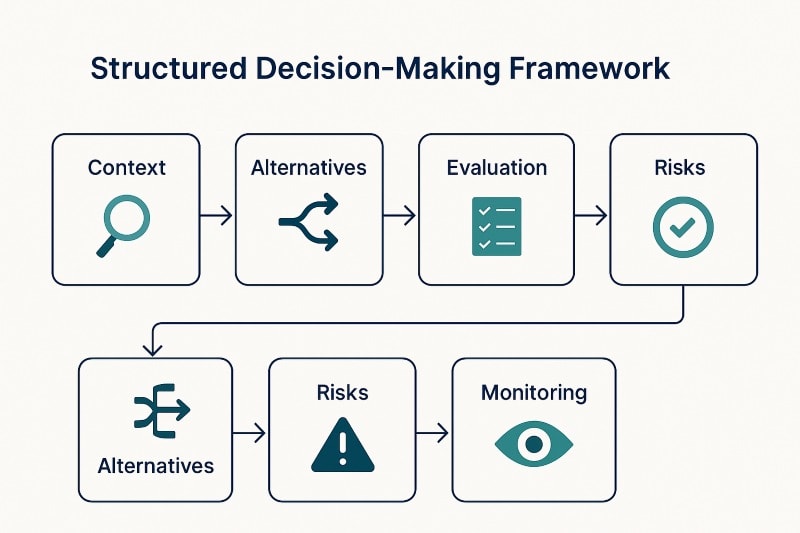
Structured decision making isn’t just a concept — it’s a repeatable framework leaders can apply across industries and challenges. The SDM framework relies on structured methods and decision support tools to facilitate systematic, transparent, and informed decision-making. While every decision context is unique, the following six steps form the backbone of the process.
Step 1: Define Context and Objectives
Every decision begins with understanding the problem and setting clear objectives. Leaders must establish scope, identify constraints, and agree on what success looks like. Without this clarity, organizations risk solving the wrong problem.
Step 2: Identify Alternatives
Strong decisions require choice. Leaders should generate a range of alternative actions rather than defaulting to a single option. By considering multiple pathways, they increase the chance of uncovering innovative solutions.
Step 3: Apply Evaluation Criteria
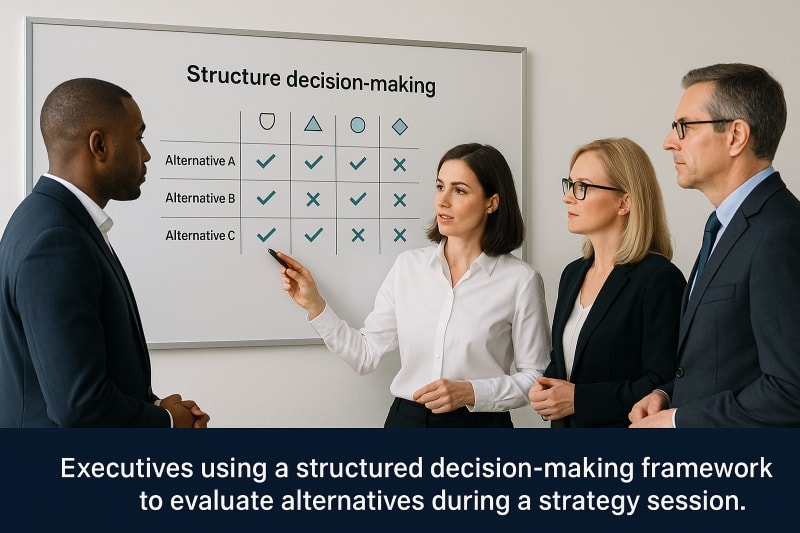
Each alternative must be judged against objective, agreed-upon criteria. Whether it’s cost, cultural impact, or long-term growth, clear criteria keep the process focused and prevent personal bias from overshadowing facts.
Step 4: Analyze Risks and Trade-Offs
No decision is without risk. Warren Buffett built Berkshire Hathaway on this principle—trading quick wins for investments that held long-term resilience. Leaders must evaluate uncertainties, consider trade-offs, and weigh short-term costs against long-term benefits. Economics plays a key role in this process, as economic analysis helps assess the costs, benefits, and overall value of different options when evaluating trade-offs. This step ensures that the decision is resilient even when conditions shift.
Step 5: Make and Implement Final Decisions
After rigorous analysis, leaders move forward with a final decision. Implementation should follow immediately with clear communication, accountability structures, and timelines to ensure alignment across the organization.
Step 6: Monitor Outcomes and Adapt
Structured decision making doesn’t end when the choice is made. Leaders must track outcomes, collect feedback, and adjust as necessary. This adaptive management approach allows organizations to learn from results and strengthen future decisions.
Overcoming Challenges in Structured Decision Making
Even the strongest frameworks can fail if leaders don’t anticipate common obstacles. Consider a leadership team that skips the evaluation step—six months later, they’re back at the table, repairing a decision that should never have been made. Structured decision making works best when leaders are aware of the pitfalls and actively address them. Incorporating diverse opinions is essential to overcoming challenges, as it ensures that multiple perspectives are considered and leads to more robust, well-rounded decisions.
Common Pitfalls Leaders Face
One of the biggest risks is skipping steps — jumping to a conclusion before alternatives are fully explored. Other pitfalls include overreliance on intuition, lack of clarity in objectives, and inconsistent use of evaluation criteria. These shortcuts weaken both accountability and outcomes.
Addressing Uncertainty and Risk
Every major decision comes with uncertainty. The challenge for leaders is not eliminating uncertainty but managing it. By openly acknowledging unknowns and applying risk analysis, leaders can build resilience into their choices instead of being blindsided later.
Securing Commitment and Buy-In
A decision made at the top can fall apart if the people responsible for executing it aren’t on board. Structured decision making requires leaders to secure commitment early in the process. Involving managers and stakeholders builds trust and ensures smoother implementation.
Ensuring Accountability and Responsibility
Without accountability, even the best decision can stall. Leaders should assign clear roles, responsibilities, and timelines as part of the structured process. This ensures not only execution but also a mechanism for learning when outcomes don’t align with expectations.

Benefits of Structured Decision Making for Leaders
When applied consistently, structured decision making transforms how leaders guide their organizations. The benefits extend beyond a single choice — they shape culture, accountability, and long-term results.
Leaders often face complex challenges rooted in the nature of environmental systems and resource management. SDM helps address these challenges by providing a framework to understand the natural environment, its processes, and the residual effects of decisions on ecosystems and resources.
Scientists play a crucial role in developing and applying SDM frameworks. They design models, implement monitoring systems, and train others in SDM skills, ensuring that adaptive management strategies are grounded in evidence and expertise.

Better Outcomes and Long-Term Impact
Structured decision making helps leaders avoid costly mistakes by grounding choices in evidence and analysis. Over time, this disciplined approach produces better outcomes, from financial growth to improved employee retention, because decisions are aligned with long-term strategy rather than short-term pressures.
Building Trust Through Transparency
Employees, boards, and stakeholders gain confidence when they can see how a decision was made. Structured processes make the reasoning visible, increasing transparency and strengthening trust. This trust becomes a competitive advantage in times of change or crisis.
Enhancing Adaptive Leadership in Uncertain Markets
Markets are shifting faster than ever, and leaders must adapt quickly. Structured decision making builds adaptability by encouraging leaders to monitor outcomes and adjust strategies as conditions change. Instead of rigid plans, leaders create living strategies that evolve with new data and insights.
OAD’s Perspective on Structured Decision Making
Bringing Science to Leadership Decisions
At OAD, we see firsthand how many leadership decisions still rely on instinct — especially in hiring and talent management. Structured decision making changes that by providing leaders with data and a clear framework. OAD’s scientifically validated assessments bring structure to some of the most high-impact decisions an organization can make: who to hire, promote, or place in key leadership roles.
Design teams with data, not gut feel.
Most org-design decisions come down to role fit, leadership style, and team dynamics. OAD reads those signals from a 7-minute behavioral survey, so you can reconfigure roles and teams with evidence instead of guesswork.
Aligning Talent with Strategy Through OAD Assessments
When leaders use OAD assessments, they don’t just evaluate candidates — they align people decisions with organizational objectives. This structured approach ensures that talent strategy is not only clear but also measurable, reducing the risk of costly mis-hires and improving long-term team performance. In practice, OAD turns the principles of structured decision making into a practical tool leaders can apply every day.

Conclusion
Why Structured Decision Making Matters More Than Ever
In a world where uncertainty is constant and stakes are high, leaders can’t afford to rely on guesswork. Structured decision making provides the clarity, transparency, and discipline needed to make smarter choices that drive sustainable success. Without structure, decisions become risks; with structure, they become competitive advantages.
Next Steps for Leaders
If you’re ready to move beyond instinct-driven decisions, the next step is to apply structure where it matters most: your people. Talent decisions shape culture, performance, and long-term growth. With OAD’s science-backed assessments, leaders gain a structured, repeatable process for building stronger teams and aligning talent with strategy.
Want to see how OAD helps leaders make smarter, structured decisions about talent? Start with the free Top Performer Profile: 7 minutes, results in 24 hours, no credit card.