Too many leadership articles start with the cliché: ‘Leadership isn’t about titles.’ Yet try telling that to the 200 people who must answer to a VP every day. Titles matter — but growth matters more. Think of the manager promoted for tenure alone, who stalls their team’s progress — versus the young leader who constantly adapts, learns, and inspires. In today’s business environment, the best leaders are those who continually develop new skills, expand their awareness, and adapt to change. Backed by science and decades of workplace research, this guide explores five essential areas every organization should invest in to strengthen leadership, plus one unexpected bonus that separates good leaders from great ones.
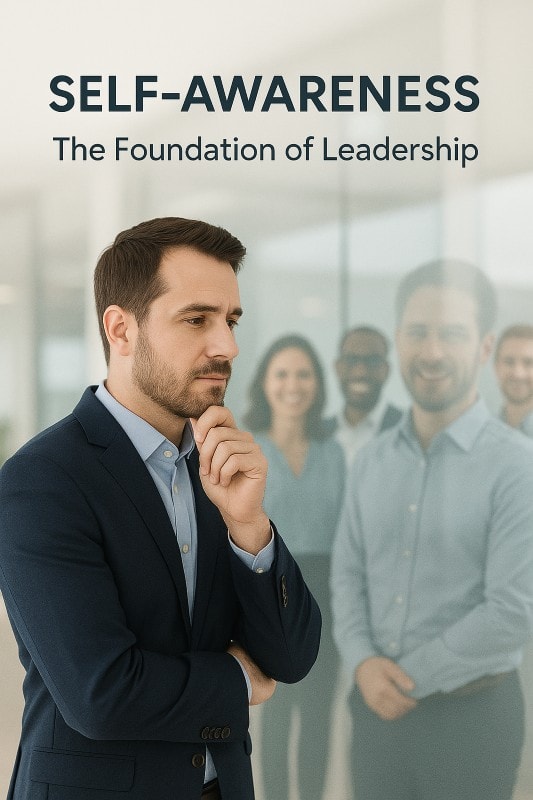
Self-Awareness: The Foundation of Leadership and Key Area for Development
Elite athletes obsess over film review, not because they enjoy watching mistakes, but because spotting blind spots is the only path to improvement. Leadership is no different.
The most effective leaders share one critical trait: they know themselves. Becoming a great leader is an ongoing process of personal growth and self-awareness, requiring continuous reflection and adaptation. Self-awareness is the foundation of leadership development because it influences every other area — from decision-making to communication. Leaders who understand their own strengths and weaknesses are better equipped to build trust, delegate effectively, and make balanced choices.
At OAD, we see this mistake all the time: leaders overestimating their delegation skills, only to discover through assessment that their team feels micromanaged.
A Korn Ferry study found that companies with highly self-aware leaders outperform those without by nearly 30%. Why? Because self-aware leaders recognize blind spots before they become costly mistakes. They also model humility and openness, encouraging team members to share honest feedback.
For HR leaders, cultivating self-awareness means going beyond performance reviews. It requires structured assessments, regular 360-degree feedback, and tools that reveal patterns of behavior leaders may not see in themselves. When leaders invest in understanding how they show up at work, they lay the groundwork for every other aspect of development.
Mindfulness and Self-Reflection in Leadership
Leadership today often moves at a relentless pace. Without pause, even the strongest leaders risk operating on autopilot — reacting instead of responding, managing tasks instead of inspiring people. This is where mindfulness and self-reflection become essential tools for leadership development.
Mindfulness keeps leaders grounded in the present moment. By paying attention to their own thoughts, emotions, and triggers, leaders develop greater self-awareness — the foundation for effective leadership. Instead of making impulsive decisions, mindful leaders are more likely to pause, assess, and act with intention.
Self-reflection builds on that awareness. Leaders who set aside time to review their actions, decisions, and interactions gain sharper insight into what’s working and where improvement is needed. This habit not only strengthens critical thinking but also accelerates growth by turning everyday experiences into learning opportunities.
When embedded into leadership development programs, mindfulness and reflection create more than just personal growth. They foster stronger emotional intelligence, better conflict management, and greater adaptability — qualities that ripple outward to teams and the wider organization. Leaders who master these practices aren’t just more focused; they’re more resilient, capable of guiding their teams through complexity with clarity and confidence.
Emotional Intelligence: Leading with Empathy
Behavioral economics shows emotions drive most decisions — including whether an employee stays or leaves. Leaders who dismiss EI often pay the hidden tax of turnover.
If self-awareness is the foundation of leadership, emotional intelligence (EI) is the glue that holds teams together. Leaders with high EI can recognize and manage their own emotions while understanding and influencing the emotions of others. In practice, that means they navigate conflict more effectively, inspire loyalty, and create workplaces where people want to contribute. Emotional intelligence is a defining trait of an effective leader.
Daniel Goleman popularized this idea decades ago — and OAD’s behavioral data continues to confirm it. Developing leadership qualities such as empathy, self-regulation, and social skills is essential for anyone seeking to grow as a leader. Leaders who rank high in EI consistently outperform peers with higher IQ but lower empathy. A leader who can regulate stress, show empathy, and connect on a human level is far more likely to retain top performers than one who simply directs tasks.
Consider the contrast: Elon Musk is known for bold decisions and rapid innovation, but his leadership style has also been criticized as polarizing. In contrast, Microsoft CEO Satya Nadella rebuilt the company’s culture around empathy and collaboration — driving growth while increasing employee engagement. Both approaches get results, but leaders with higher EI tend to create environments where teams thrive long term.
For organizations, EI development should be embedded into leadership programs. That means training leaders to listen actively, manage conflict constructively, and read between the lines of what their teams are really saying. When leaders develop emotional intelligence, they don’t just manage people — they inspire them.

Decision-Making and Critical Thinking
Every leader makes decisions — but not every leader makes them well. To make effective decisions, leaders must think strategically and reflect on the potential outcomes before acting. In today’s complex business environment, effective decision-making is less about having all the answers and more about asking the right questions. Imagine a leader who delays a product launch for months waiting for perfect data — versus one who rushes without testing. Both fail. The best leaders act quickly, but with structured thinking to avoid blind spots.
Critical thinking plays a vital role here. Without it, decision-making becomes reactive, vulnerable to bias, or swayed by the loudest voice in the room. Leaders who can step back, evaluate evidence, and consider multiple perspectives reduce risk and increase the likelihood of long-term success. Ultimately, critical thinking helps leaders set and achieve their goals more effectively.
Take Jeff Bezos, for example. Amazon’s principle of “disagree and commit” is a masterclass in leadership decision-making. It’s a principle we often reference in OAD workshops: encouraging debate reduces blind spots, but unity afterward builds unstoppable momentum. Leaders are encouraged to debate vigorously, but once a decision is made, the team aligns fully. This approach fosters both critical evaluation and organizational momentum — two qualities every leader needs.
For HR leaders, this means leadership development programs should include not just problem-solving exercises but also scenarios that challenge assumptions. Training leaders to recognize cognitive biases, evaluate alternatives, and make confident yet flexible choices prepares them to navigate real-world uncertainty.
Most companies rely on surface-level leadership training, but OAD’s psychology-driven assessment goes deeper — uncovering whether a leader naturally thrives in structured decision-making or struggles under ambiguity. For organizations with 50+ employees, that difference determines whether teams scale smoothly or stall under pressure.

Communication and Influence
A leader’s impact is measured not just by what they decide but by how they communicate it. Soft skills, such as empathy and active listening, are essential for effective communication and help leaders connect with their teams. Effective communication is more than passing along information — it’s about inspiring action, aligning teams, and building trust.
Gallup proves the point — and OAD assessments reveal why. Leaders who naturally score high in clarity and persuasion drive engagement metrics far beyond the average. The opposite is also true: According to Gallup, employees who feel poorly communicated with are 62% more likely to be actively disengaged.
Design teams with data, not gut feel.
Most org-design decisions come down to role fit, leadership style, and team dynamics. OAD reads those signals from a 7-minute behavioral survey, so you can reconfigure roles and teams with evidence instead of guesswork.
But great leaders go beyond clarity. They influence. They know how to tailor their message to different audiences, how to use storytelling to bring strategy to life, and how to listen as well as they speak. Whether in a boardroom presentation or a one-on-one conversation, influential communication creates alignment and momentum. Maintaining a professional approach in all communications is crucial for building trust and credibility.
For leadership development programs, this means teaching both the mechanics and the psychology of communication. Communication is a foundational aspect of developing leadership skills, as it enables leaders to motivate, guide, and support their teams effectively. Leaders need to master verbal and non-verbal cues, deliver feedback that motivates rather than discourages, and practice active listening. When communication is elevated to influence, leaders don’t just convey a vision — they move people to believe in it.

Managing Conflicts and Challenges
Conflict is an unavoidable part of organizational life. Even the most effective leaders encounter disagreements, competing priorities, and moments of tension. The difference between leaders who struggle and those who excel lies in how they approach these situations. Strong leaders see conflict not as a setback but as a chance to strengthen relationships and drive better outcomes.
The ability to manage conflict well depends on a blend of emotional intelligence, communication, and critical thinking. Leaders who can read the emotions behind a disagreement, listen actively, and articulate their own perspective clearly are far more likely to de-escalate tensions and guide teams toward constructive solutions.
This isn’t about avoiding difficult conversations — it’s about approaching them with skill and confidence. Leadership development programs can accelerate this growth by providing frameworks for conflict resolution, communication strategies, and problem-solving under pressure. When leaders are trained to manage challenges in this way, the benefits ripple outward: stronger trust within teams, healthier workplace cultures, and greater long-term resilience.
Ultimately, leaders who handle conflict effectively not only keep productivity on track — they also model the kind of calm, strategic thinking that inspires others, even in the most difficult moments.
Fostering a Positive Team Culture
High-performing teams don’t happen by chance. They are the result of leaders who intentionally shape the culture around them. From how people communicate to how achievements are recognized, leaders set the tone for the environment in which their teams operate.
A positive culture is built on trust, recognition, and belonging. When leaders prioritize open communication and take time to acknowledge contributions, employees feel valued and motivated. This not only improves morale but also drives measurable outcomes — research consistently shows that engaged employees are more productive, innovative, and loyal to their organizations.
The key lies in a leader’s interpersonal skills and emotional intelligence. Leaders who connect authentically with their teams can better address concerns, celebrate wins, and foster collaboration. They turn culture from a buzzword into a lived experience.
Leadership development programs reinforce this by equipping leaders with the skills to build and sustain positive team dynamics — from conflict resolution to team-building practices. When leaders actively cultivate culture, they don’t just create happier workplaces; they establish the conditions for continuous growth, innovation, and long-term success.
Continuous Learning and Development
Leadership is not a destination — it’s a practice. Continuous learning is a key part of professional development, helping leaders grow and adapt in their roles. The most successful leaders treat development as a lifelong journey, consistently seeking out new ideas, feedback, and challenges. In a workplace where change is constant, leaders who stop learning quickly fall behind.
Ironically, an obsession with learning can backfire. Discipline in learning must be developed intentionally, as leaders who chase every new book or framework risk overwhelming their teams. Continuous learning only works when it’s applied with discipline.
Continuous learning doesn’t just benefit the leader — it strengthens the entire organization. Leaders who embrace ongoing development set the tone for a growth-oriented culture. They model curiosity, openness, and adaptability, signaling to employees that learning is not optional but essential. By continually improving their skills, leaders help drive organizational success.
Just as Warren Buffett credits his success to ‘reading and thinking time,’ Nadella built Microsoft on a foundation of learning. Both prove growth isn’t luck — it’s a discipline. By shifting the company’s culture from a “know-it-all” mindset to a “learn-it-all” one, Nadella not only revitalized innovation but also increased engagement across all levels of the business. That change started at the top, with leadership committed to continuous development.
For HR teams, this means building structures that support leadership growth: mentoring, coaching, leadership development programs, and feedback loops that encourage leaders to evolve. Setting clear goals for leadership development ensures progress can be measured and success can be achieved. The message is simple — when leaders keep learning, organizations keep growing.

Resilience & Adaptability: Thriving in Uncertainty (Bonus)
If the past few years have taught us anything, it’s this: resilience is no longer optional. Leaders must be prepared to respond to changes in industry trends, technological advancements, and market shifts to stay competitive. From global disruptions to technological revolutions, leaders are facing challenges that can’t be solved with static playbooks. What separates good leaders from great ones is their ability to adapt — not just surviving change but turning it into opportunity.
Resilient leaders remain steady under pressure. They know how to absorb setbacks without losing momentum and can shift direction without losing focus. Adaptable leaders embrace uncertainty as a chance to innovate, guiding their teams with confidence through the unknown. Netflix founder Reed Hastings built adaptability into the company’s DNA with the principle of ‘freedom and responsibility’ — preparing teams to pivot before disruption strikes.
In our own work with clients, we’ve seen the same pattern — those who adapted hiring and leadership training quickly didn’t just survive disruption; they gained market share. Consider Airbnb during the COVID-19 pandemic. Practically overnight, their core business model collapsed. But instead of clinging to the old way of operating, leadership quickly pivoted, leaning into local experiences and longer-term stays. That adaptability didn’t just save the company — it strengthened its position for long-term growth. Resilience and adaptability are also closely related to other leadership skills such as effective communication, conflict management, and employee motivation.
Design teams with data, not gut feel.
Most org-design decisions come down to role fit, leadership style, and team dynamics. OAD reads those signals from a 7-minute behavioral survey, so you can reconfigure roles and teams with evidence instead of guesswork.
For HR leaders, resilience and adaptability should be embedded in leadership training. This includes scenario planning, stress management, and encouraging leaders to experiment with new approaches. Leaders who can stay grounded and flexible in uncertainty are the ones who future-proof organizations. Building resilience directly impacts the organization’s ability to achieve long-term success and foster a culture of growth.

Bringing It All Together
A leadership program that looks good on paper but doesn’t change behavior is like a gym membership no one uses — it exists, but it doesn’t build muscle. It’s the difference between a leader who freezes when the playbook fails — and one who sees uncertainty as a chance to rewrite the rules. From self-awareness to emotional intelligence, from critical decision-making to communication, continuous learning, and resilience, these six areas form the blueprint of effective leadership. Developing strong leadership skills is essential for driving both personal and organizational growth.
Leadership development is not a one-time event; it requires attention at multiple times throughout a leader’s career to ensure ongoing growth and adaptability. The most important takeaway? Leadership is learned, not born. Organizations that invest in developing these skills don’t just create better managers — they create cultures where employees thrive, innovation flourishes, and long-term success becomes inevitable. There are many real-world examples of organizations that have benefited from prioritizing leadership development and investing in their people.

Ready to identify and strengthen leadership potential in your organization? With OAD’s scientifically validated assessment, you can uncover strengths, spot gaps, and create leadership development plans that drive measurable results.